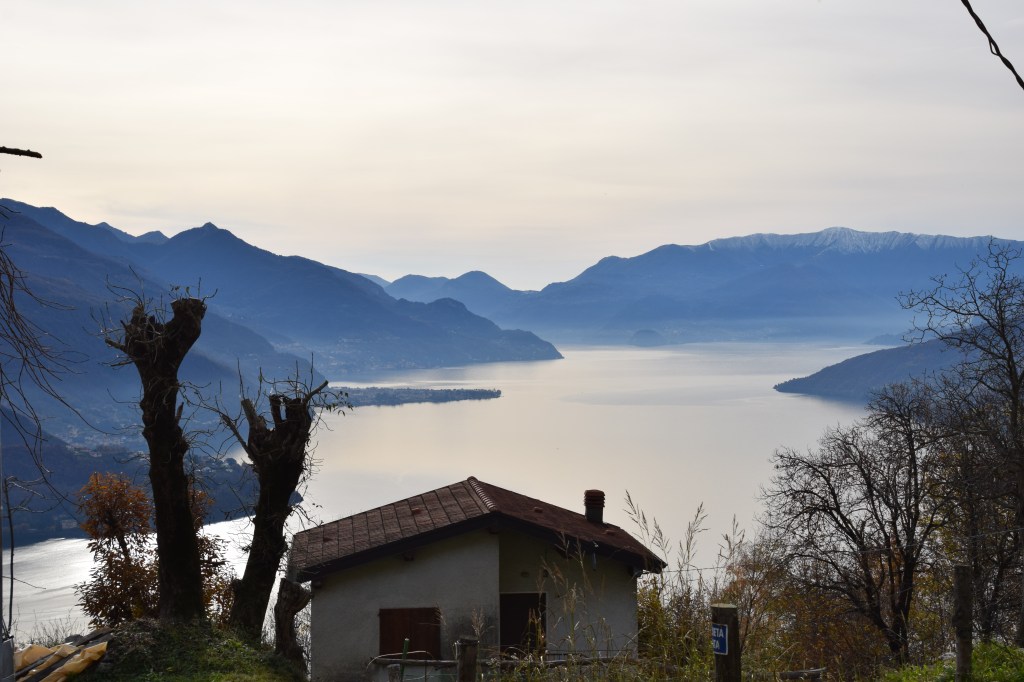
Naro is a tiny localitá of Peglio. Both villages are located above Lake Como in the area called the Alto Lario. The Alto Lario is the northern region of Lake Como that begins at Menaggio on the western side of the lake and Bellano on the eastern side of the Lake and ends at the top in the villages of Sorico and Colico, respectively. The region includes the mountainous areas and the connecting valleys. Naro is situated on the Sasso Pelo mountain between the valleys carved by the Livo Torrent and the Liro Torrent – both mid-altitude valleys above the lake.
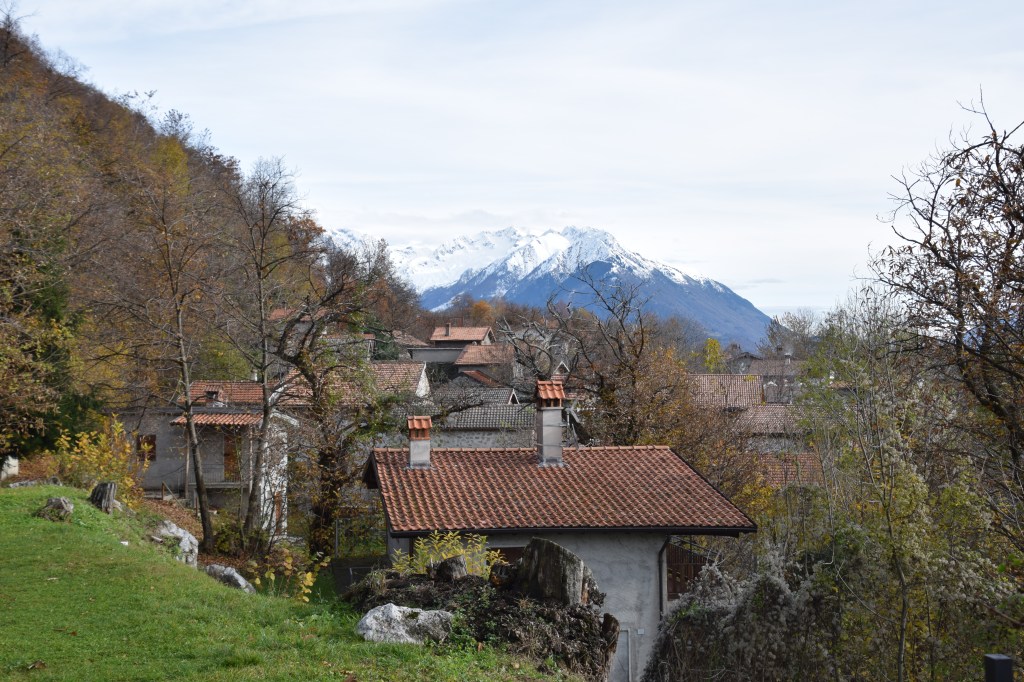
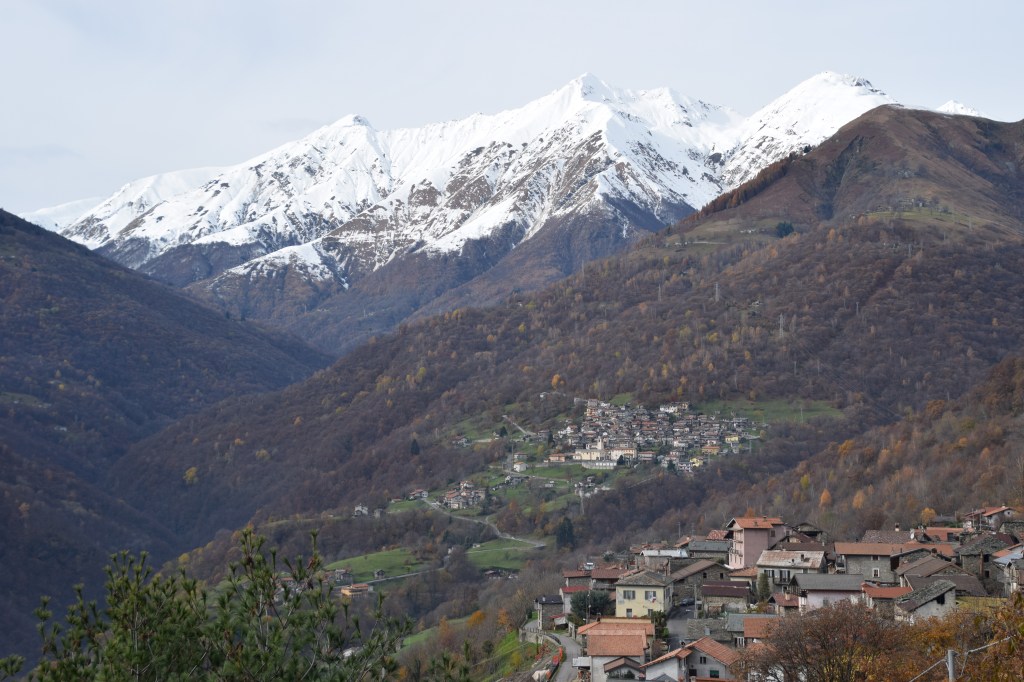
Peglio lies above the lakeside town of Gravedona ed Uniti at 650 meters. Naro is 20 meters above Peglio off the Strada Provinciale road that leads to Livo the elevation of which is a scant bit above both. Naro – like Peglio – has simply astonishing views of the entirety of Lake Como and is situated in such a way that no tree or power line impedes its vistas. Livo, being set back into the valley and woodlands, lacks any decent view of Lake Como.
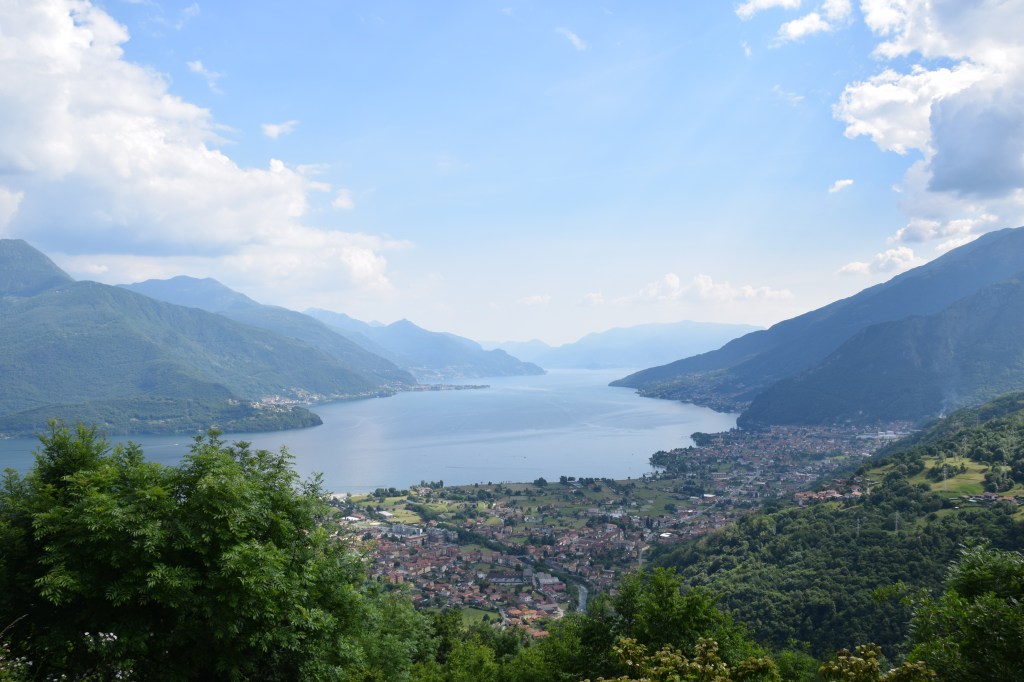
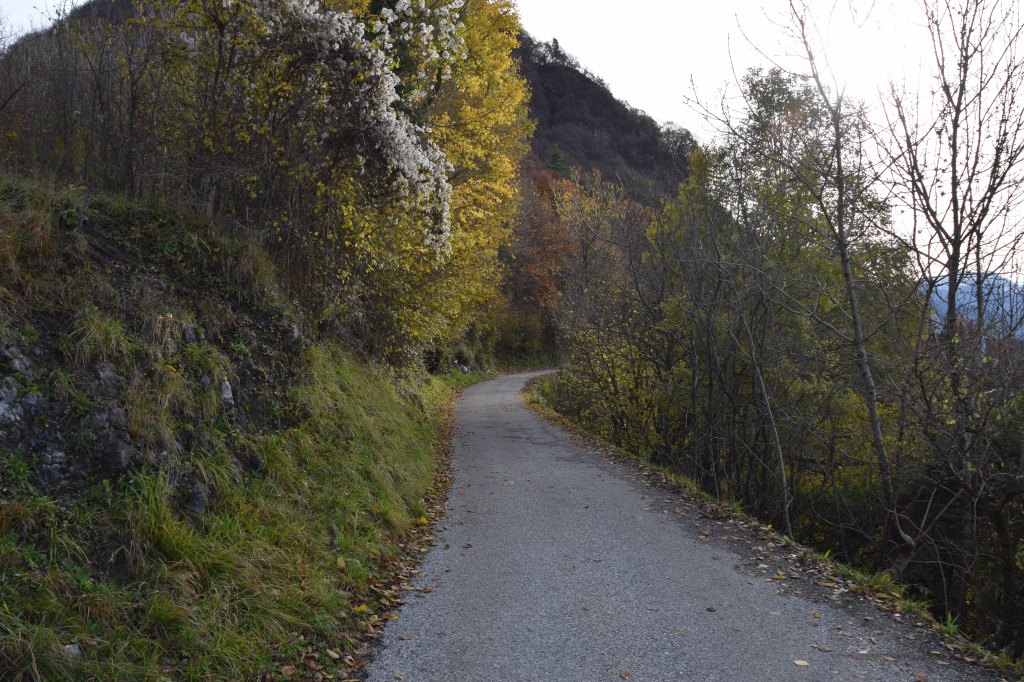
The two-kilometer, lateral road to Naro is easily traversed having asphalt and guardrails (most of the way), and a nice parking area just before the last 2/10’s kilometer of the road that is restricted to residents. According to a local, this was not always the case. When he bought his home in Naro some decades before, the road was very narrow, unpaved, full of big stones and holes, and lacking guardrails – perfect for a 4×4 or a long walk!
But he also made clear that it was Naro one reached on the old mulatierra and sentiero when one walked up into the Valle di Livo from Gravedona. And this, he claimed, was the reason for the very beautiful small church that is still laden with frescoes from the 16th-century.
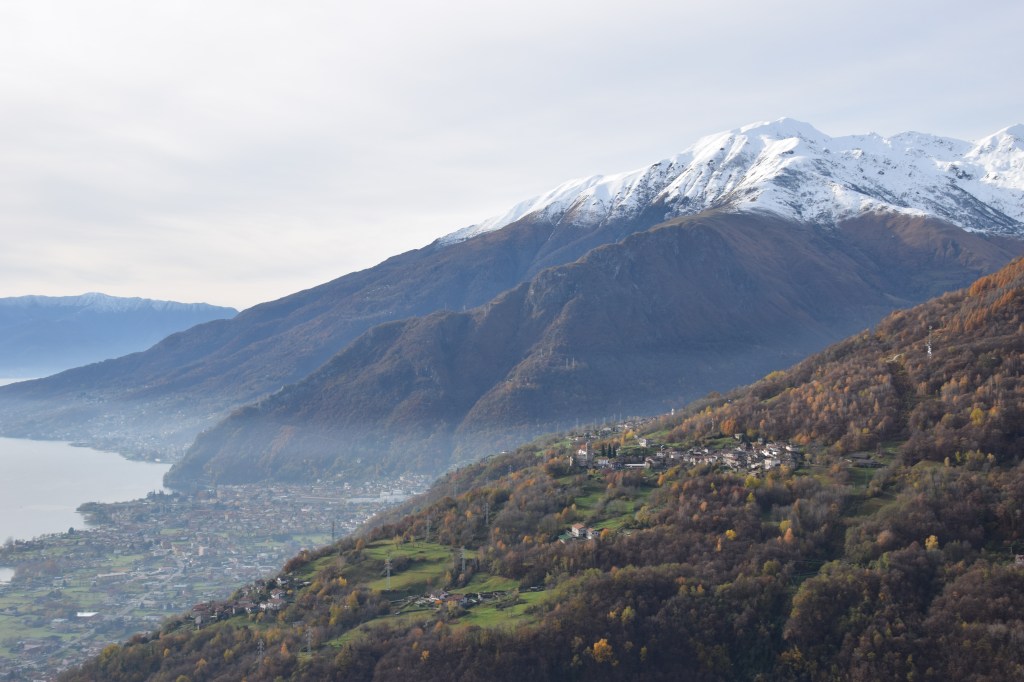
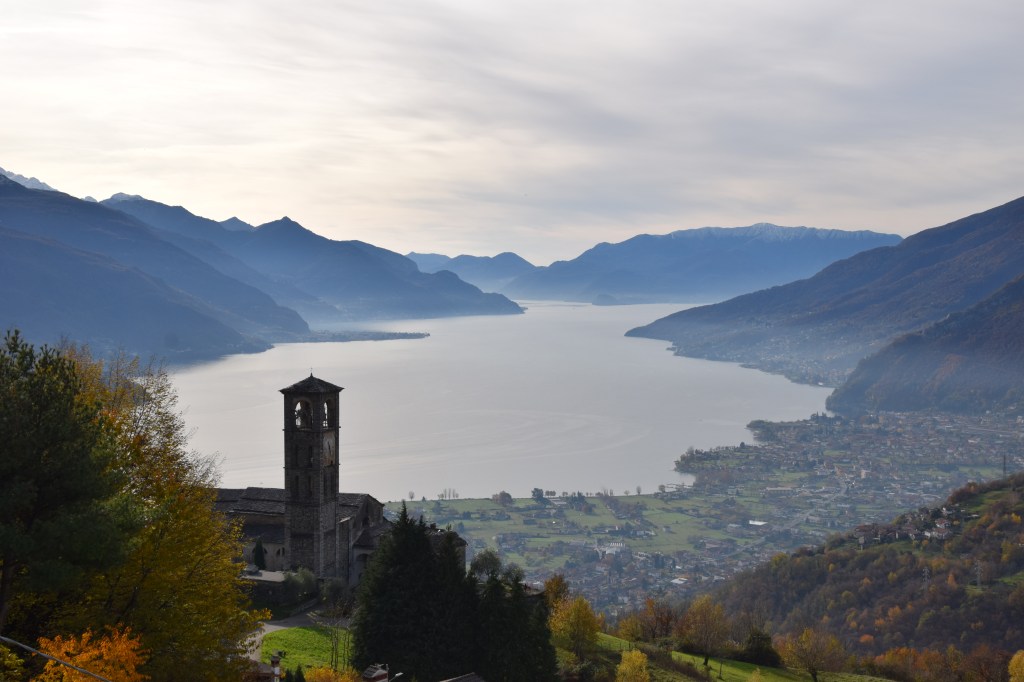
Inhabited for at least a century previous to its documented history as the area changed hands between nobles, and having a name that evolved from the 14th-century “Narri”, this tiny borgo is slowly transforming from ruined ancient stone houses to renovated weekend retreats made possible in no small measure by the quality of the 10 kilometers of road one must drive from the lake to reach it. Still, home prices at this elevation are subdued in part by distance, the many hairpin turns, and the reality that there are absolutely no conveniences up here save a couple of small trattoria’s and a tiny grocery store none of which is located in Naro.
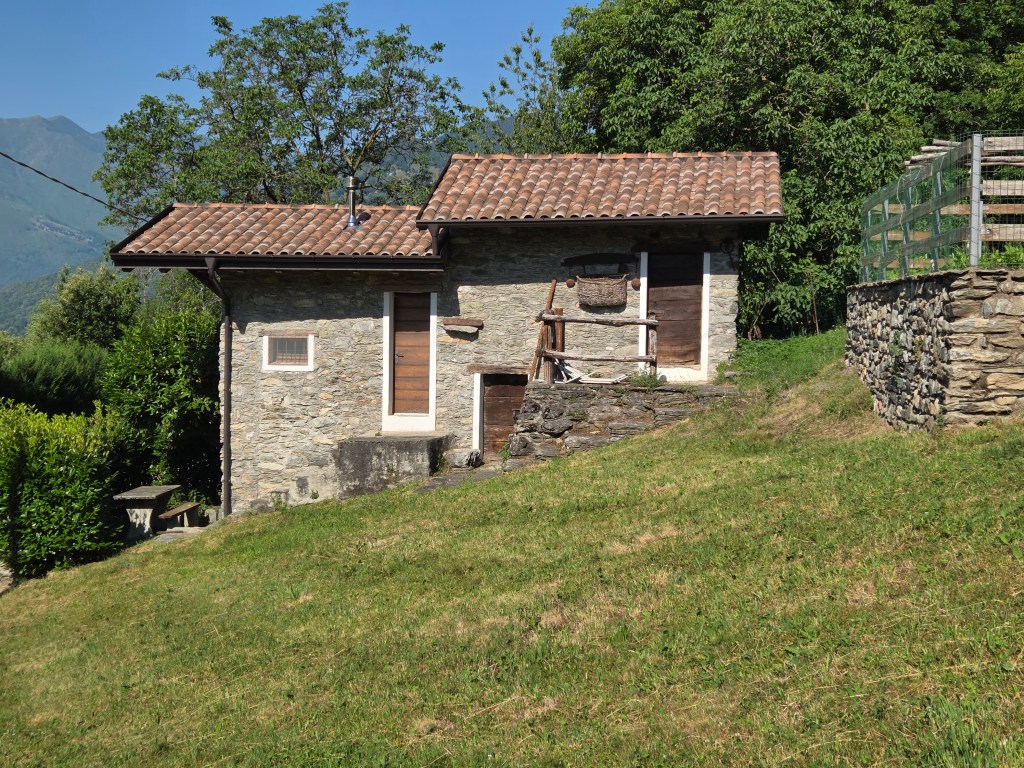
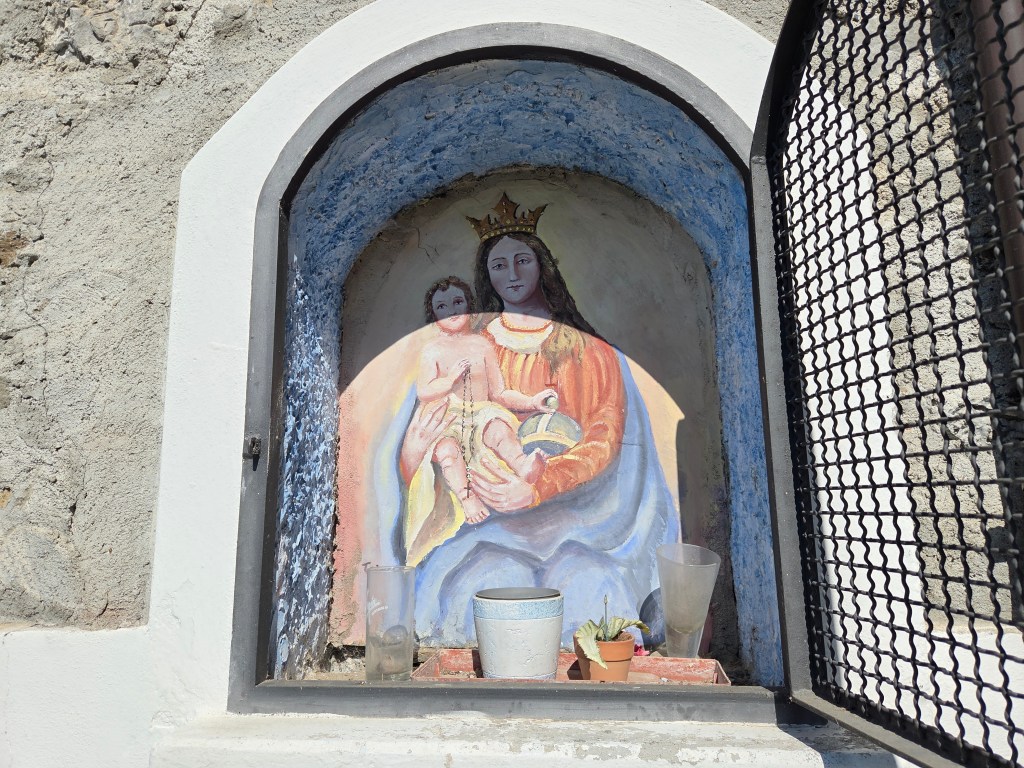
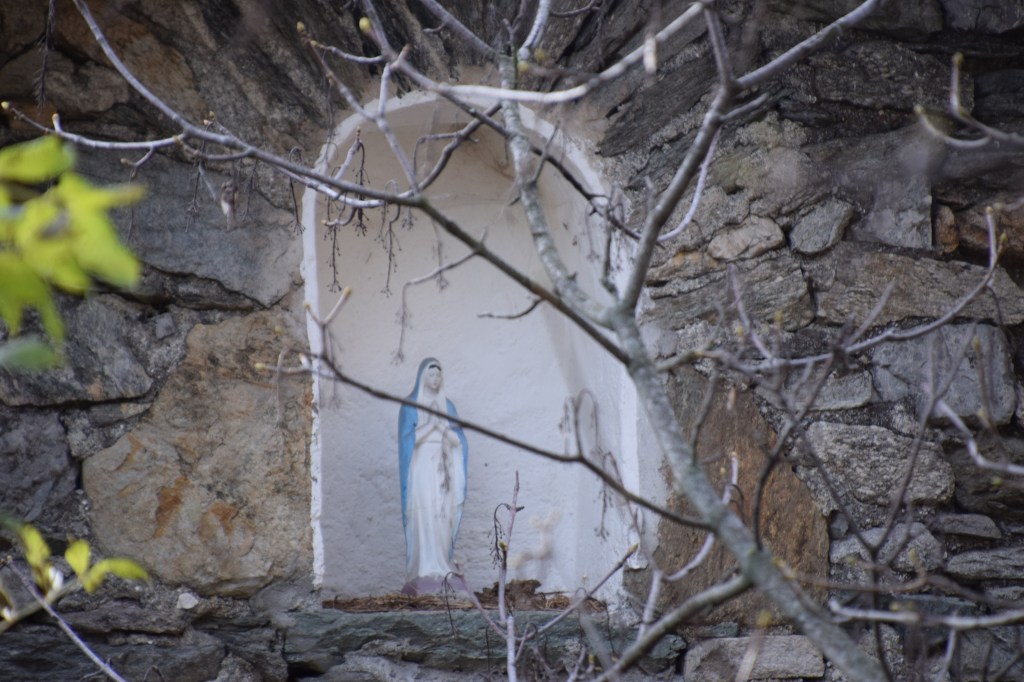
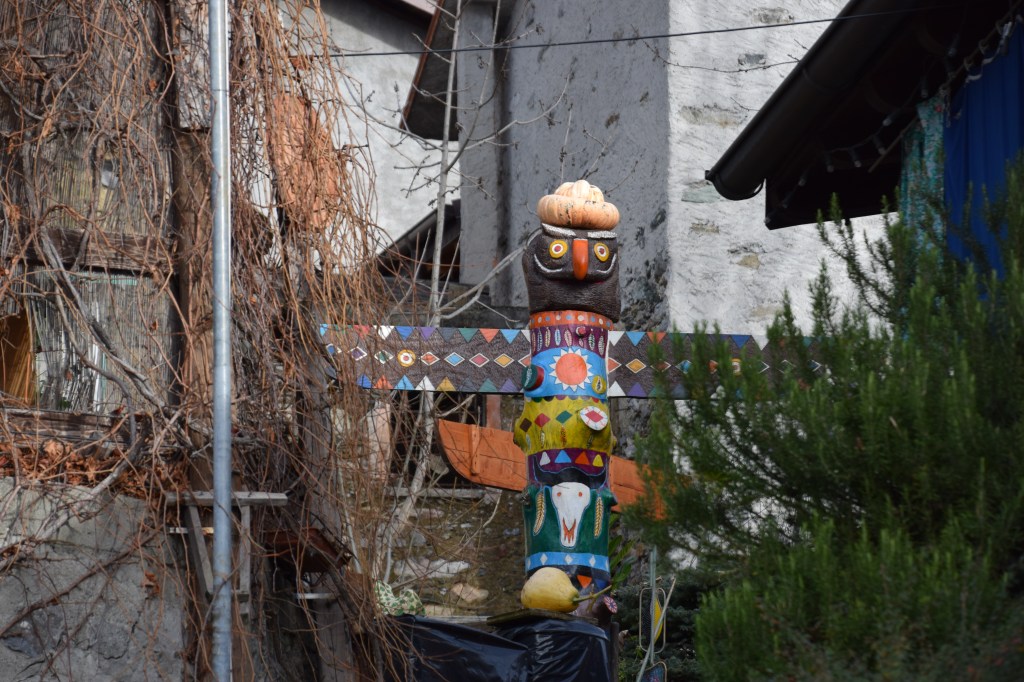
My search for Wall Madonna’s in the Alto Lario led me to Naro some years ago where I found only two – a modern fresco preserved on the exterior wall of a renovated home and a Madonna in a niche found in the clutter of the home of an eccentric local whose goose chased me off the road.
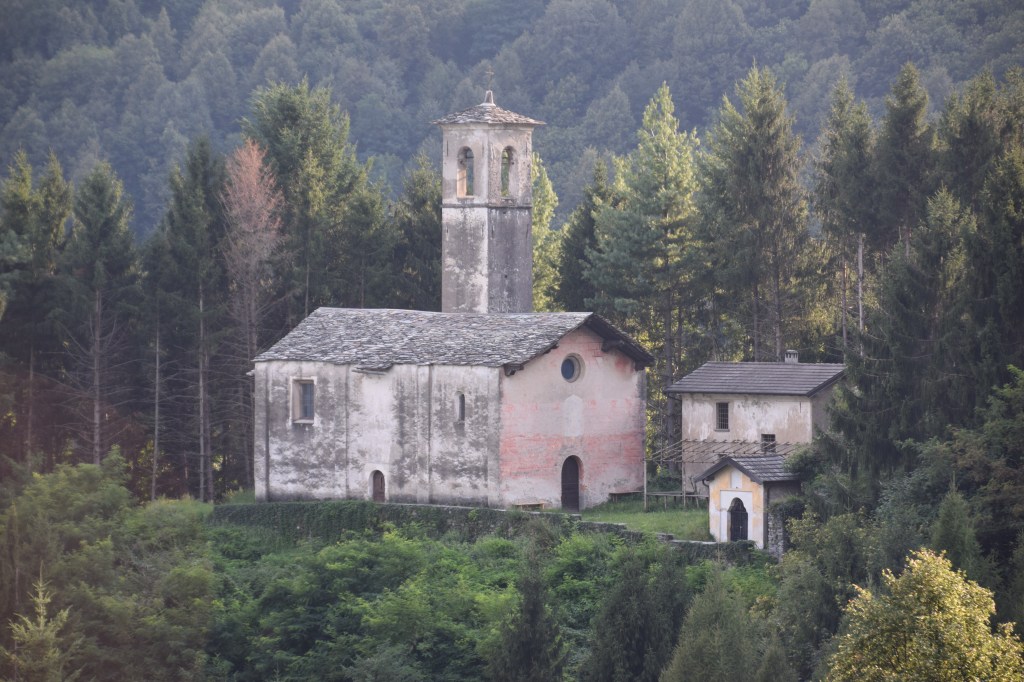
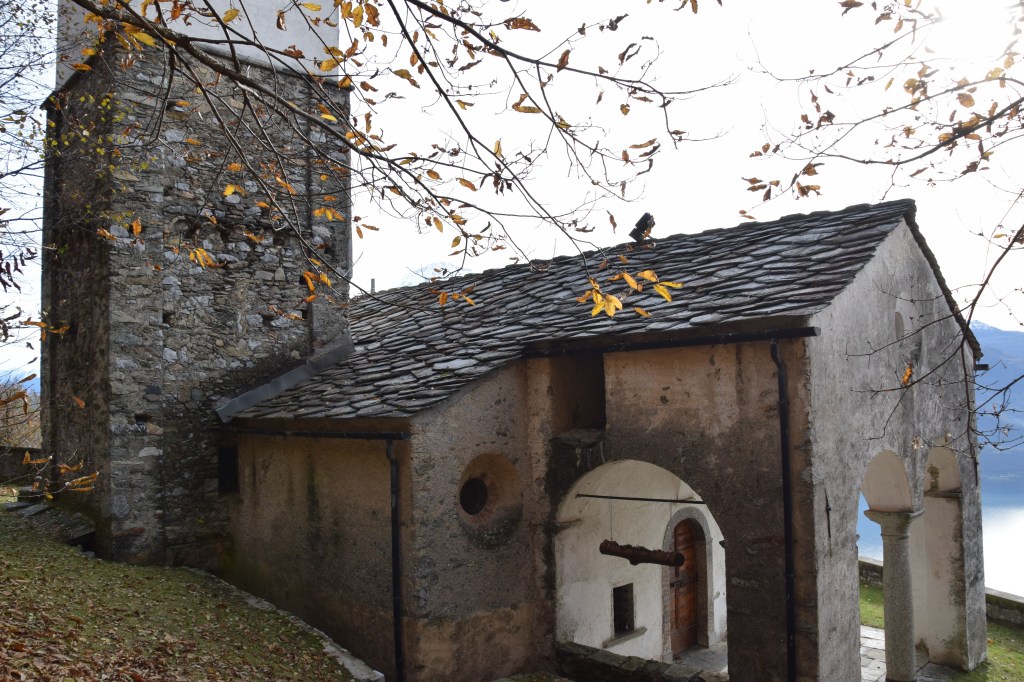
Of course in my quests for frescoes, I investigate the local churches. Especially in these small, mostly uninhabited and ancient towns one is apt to find at the very least a beautiful presbytery fresco from the renovations that occurred in thanks for the end of the 16th-century plagues that devastated this region. Naro’s parish church had to be ‘discovered’ as it cannot be seen from the center of the village or from the walk there. Hidden in the woods, a walk to the Chiesa di Santa Croce – the tiny parish church of Naro – requires one to either walk the old sentiero that begins outside the borgo and leads to the ancient entry doors of the church….
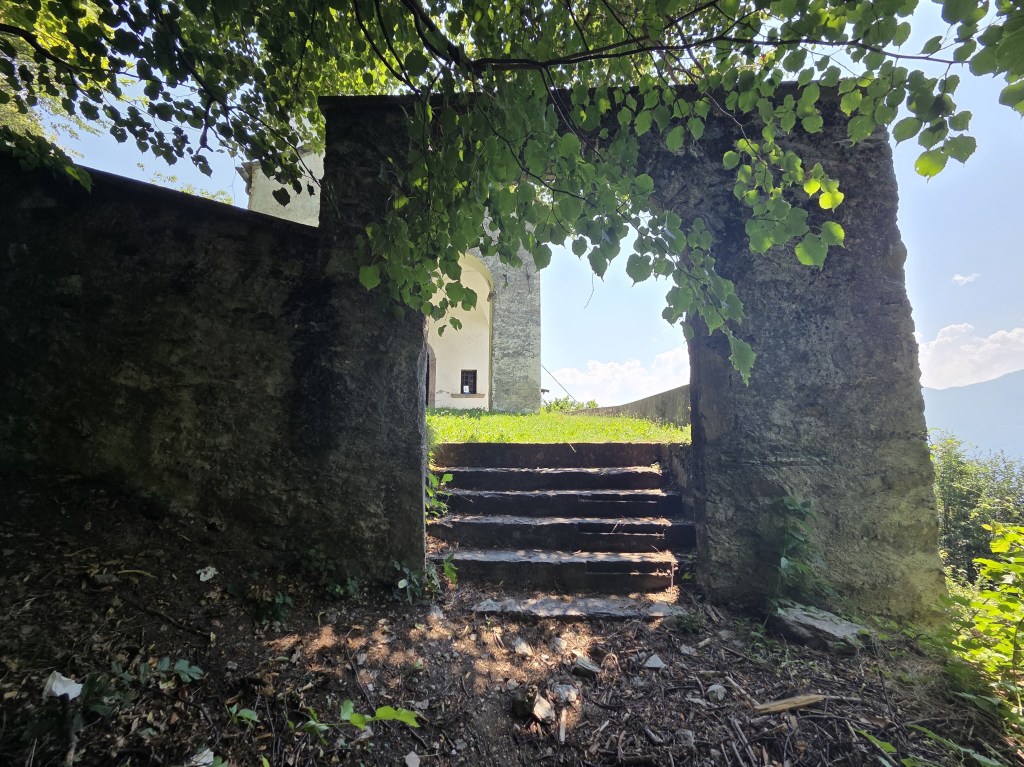
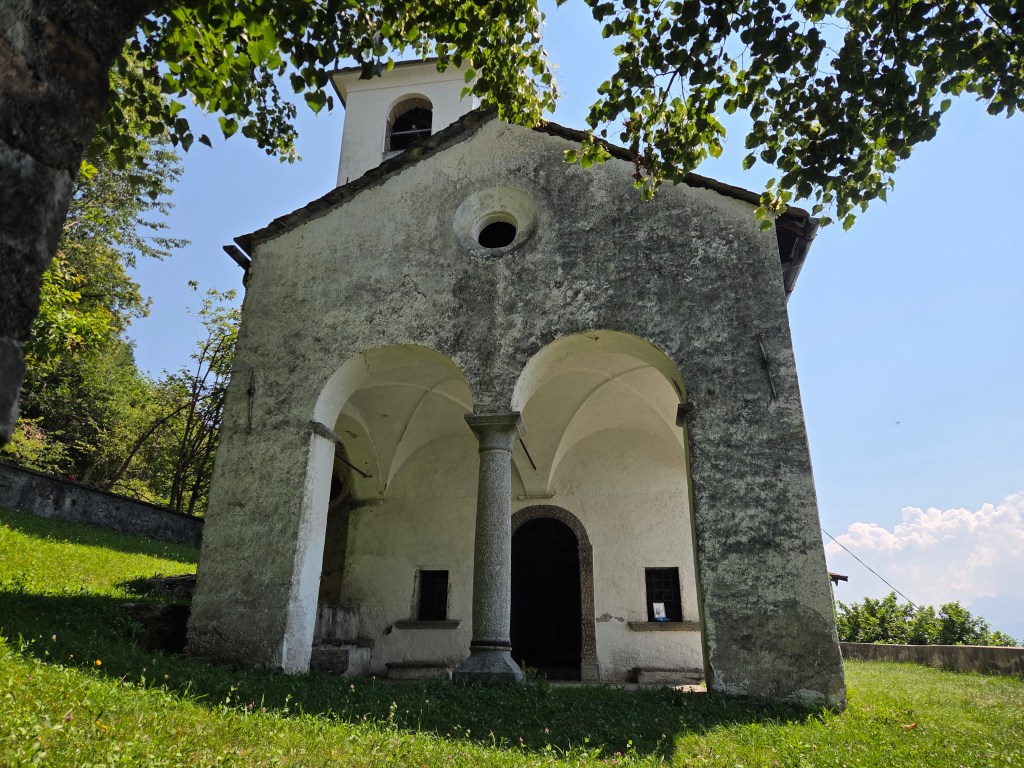
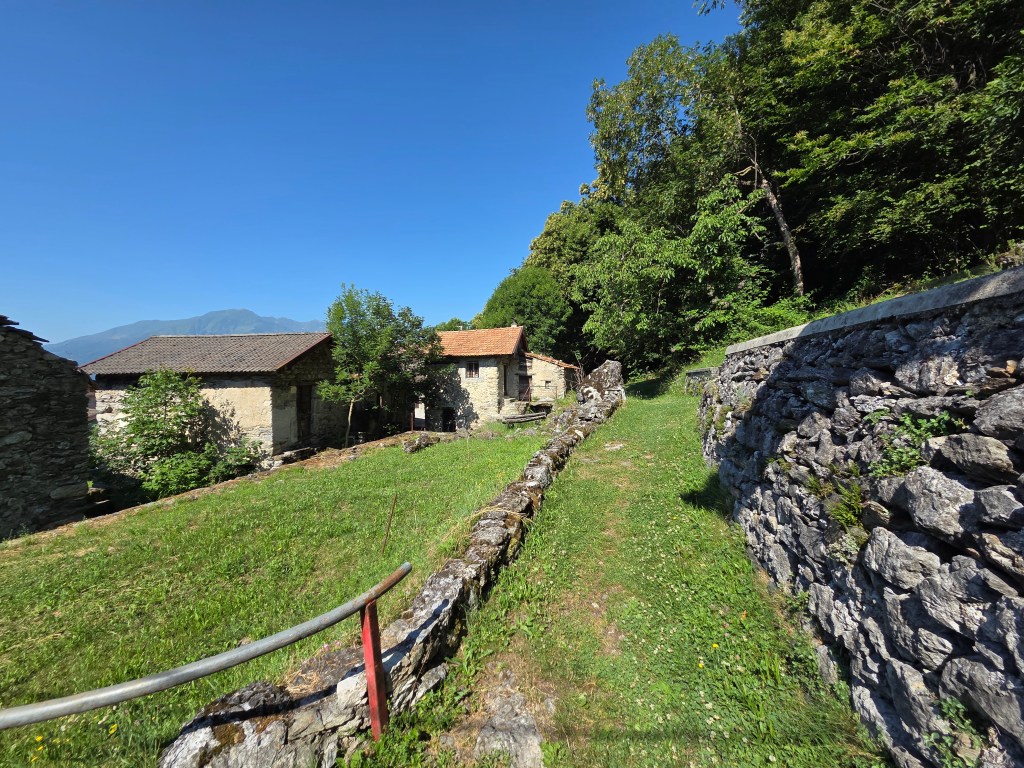
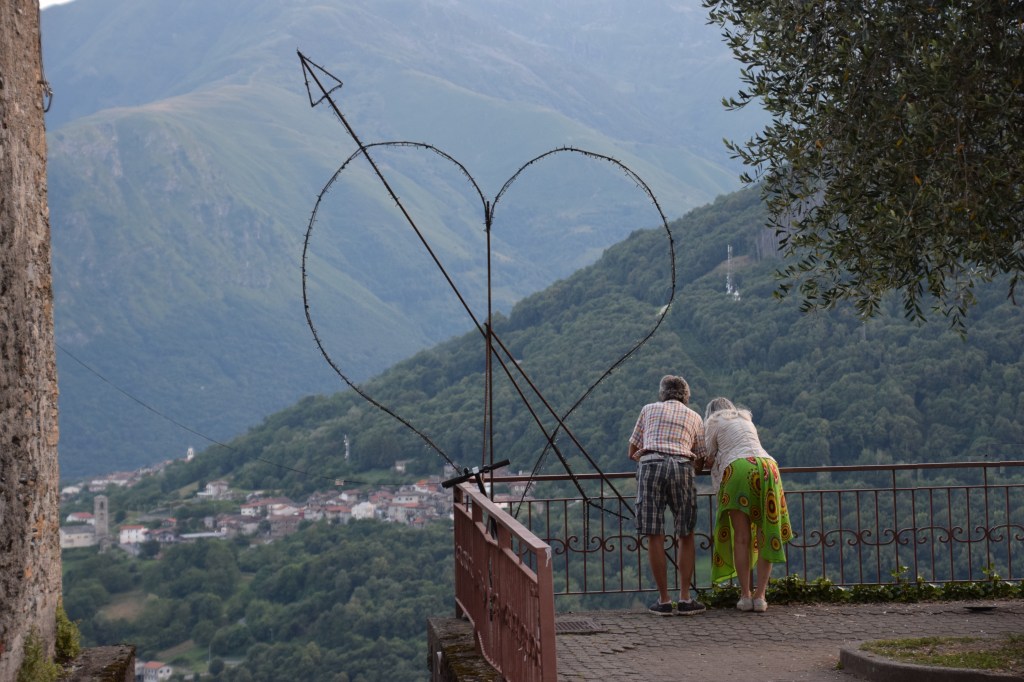
…… or to walk the grassy sentiero that brings one to the east end of the church where one can enter through a side door from the courtyard which faces Lake Como and offers a spectacular view.
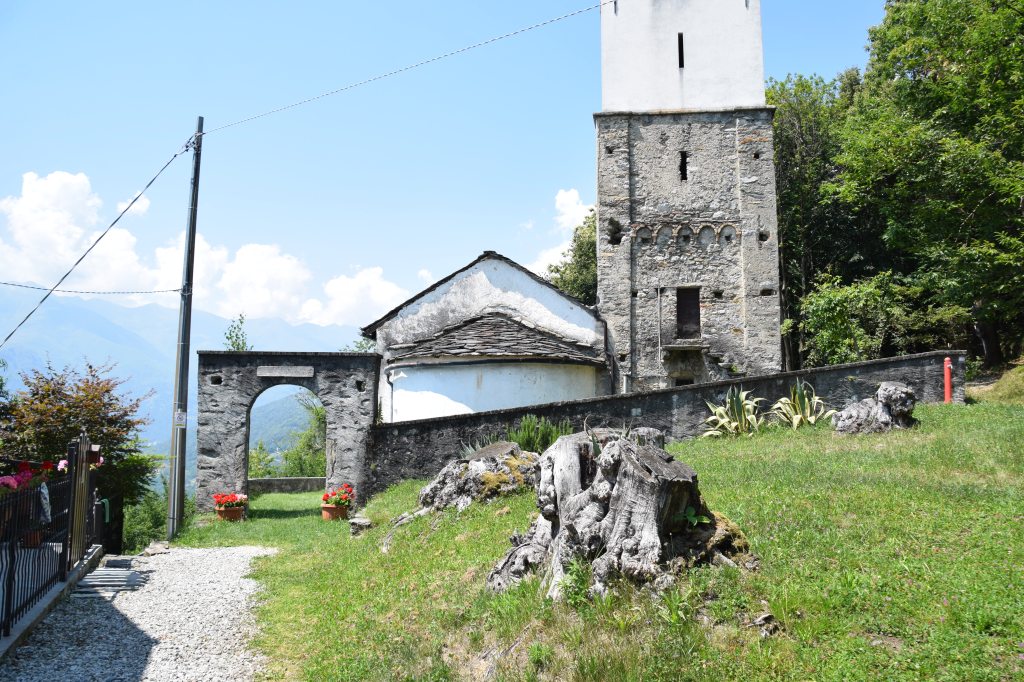
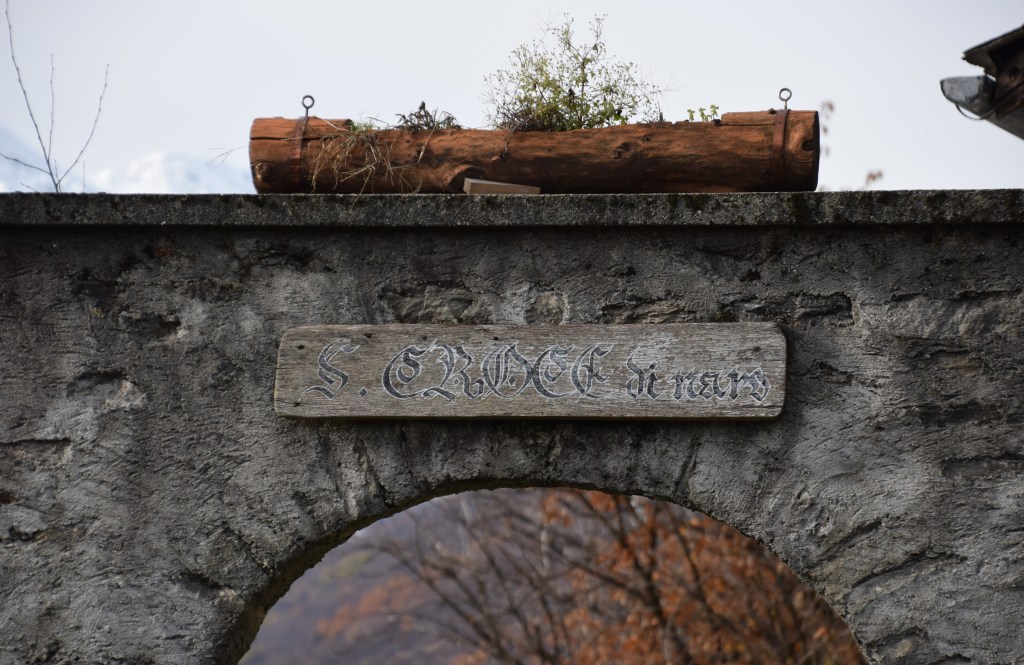
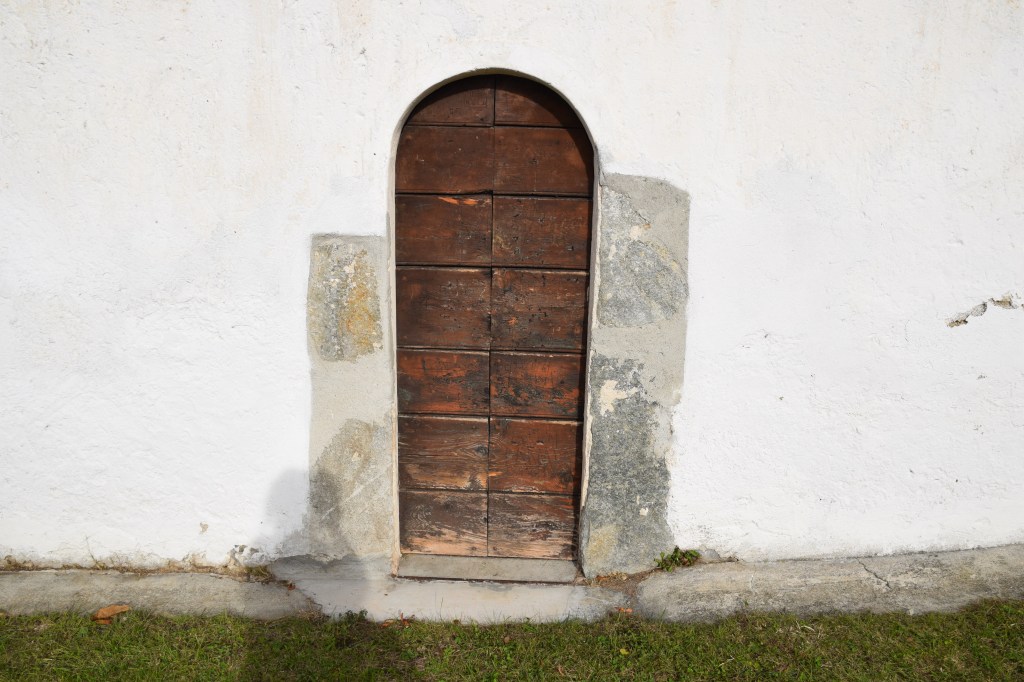
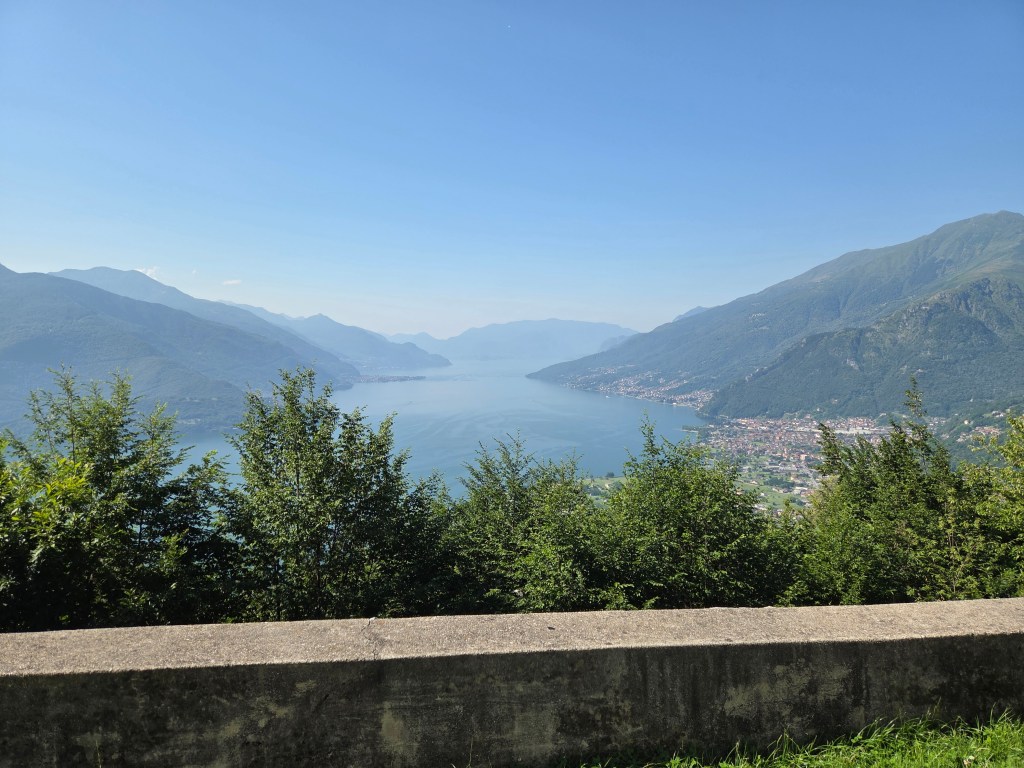
On my first visit to Naro the Chiesa di Santa Croce was closed. I was able to take some photos with my phone through the grates in the west end windows. The luscious frescoes were abundant – colorful – original – and impossible to photograph well!! Through inquiries I learned that the church was always closed. Because there was no dedicatory saint associated with it, I could not plan to visit the one day a year a closed church would be open to celebrate the birthday of its saint. I tried to hire a tourist guide to obtain access but no guide responded positively to my request. I have since learned that there is a celebration in the chiesa on May 1 – Primo Maggio which is Italy’s Labor Day (Festa del Lavoro).
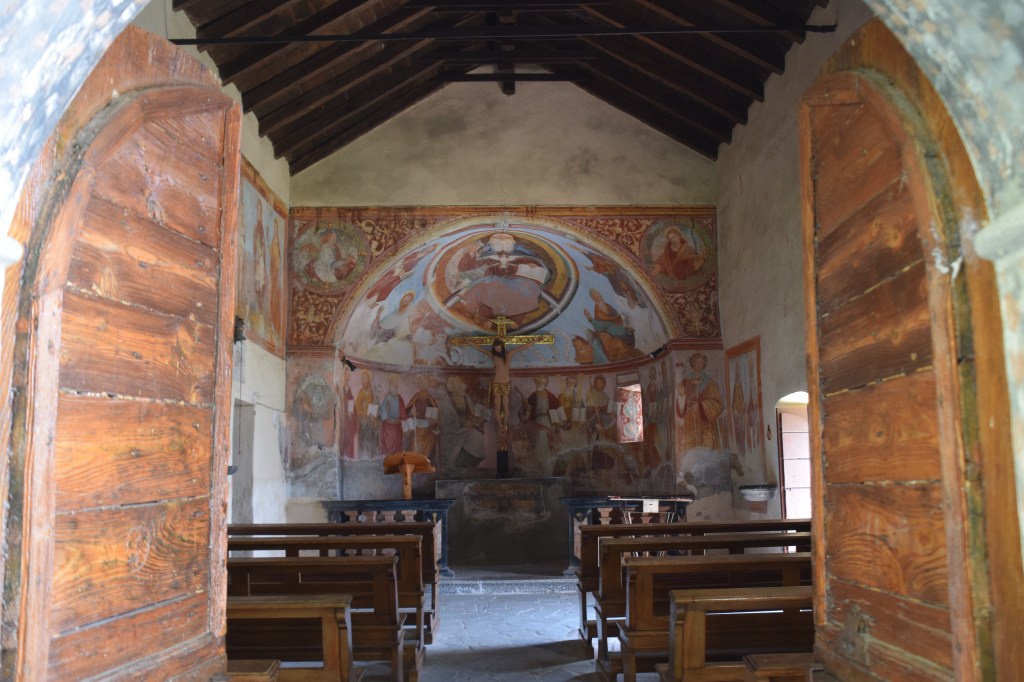
But fortune smiles on visitors this summer. The caretakers moved back to their home in Naro permanently and have chosen to open the church in the summer while they laze on their patio guarding this sacred space and its frescoes while welcoming all visitors. And because their home is just to the left of the east end entry to the walled church, Angelo and Carla – married 56 years this December – offer advice and directions to hikers who are traveling the sentieri that pass the chiesa, and warm conversation to any who wish to stop and chat.
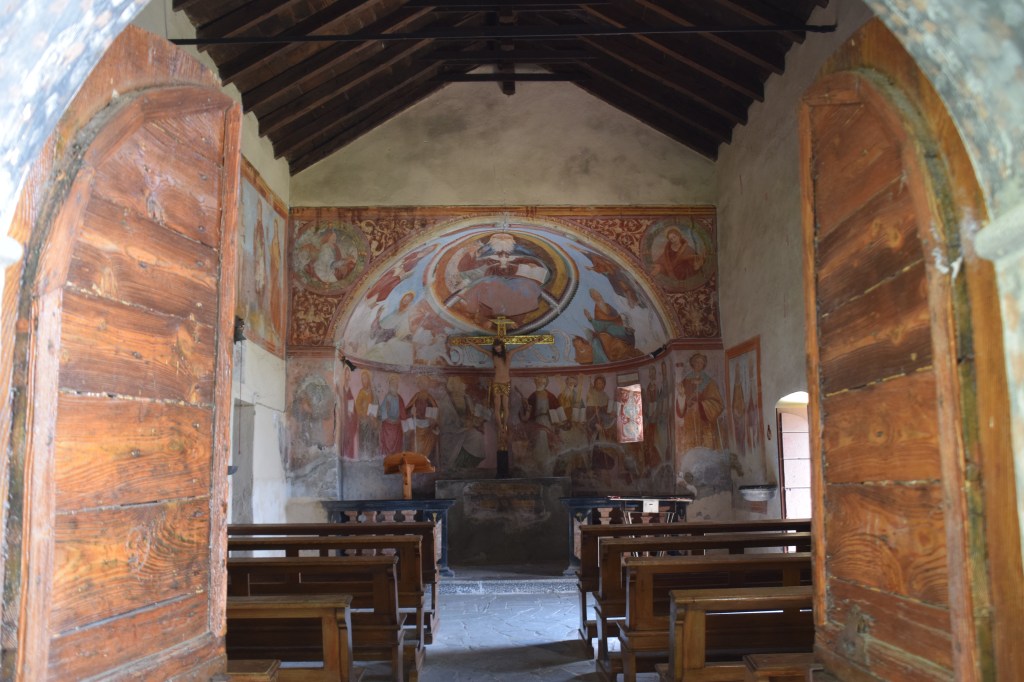
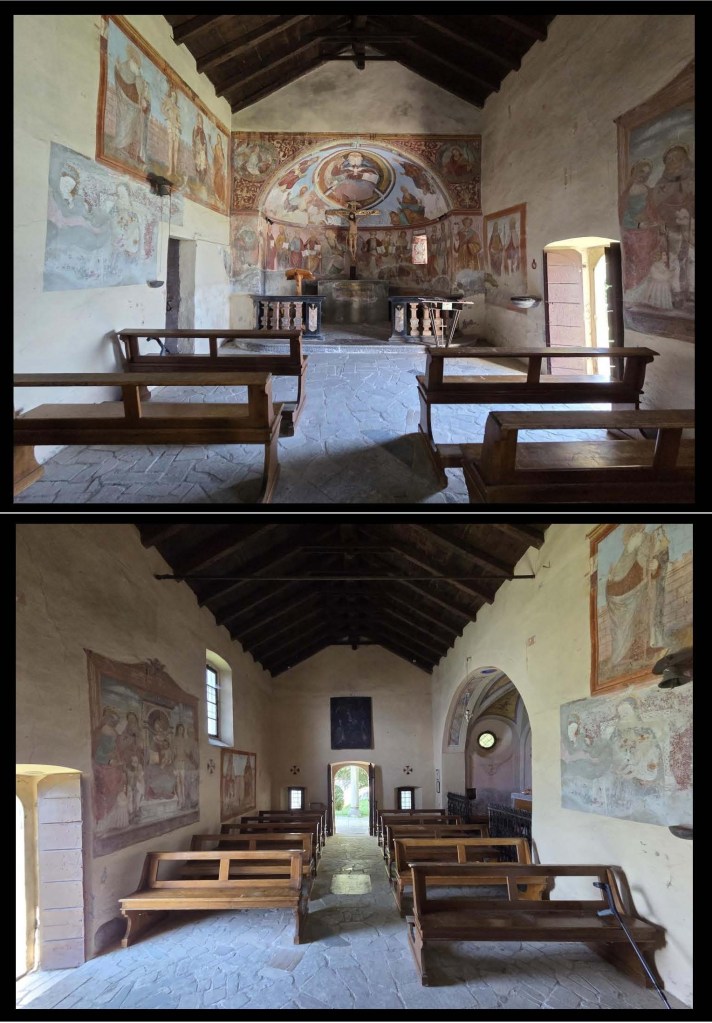
As one first encounters the bright interior the colors and imagery of which snatch your attention, one could theorize that the inner walls of the Church of Santa Croce were once fully frescoed and what artworks remain are those that have survived renovations & rededications, leaky roofs, and the erosion caused by age and aided by the damp, candlelight, curious & venerating hands, and accident.
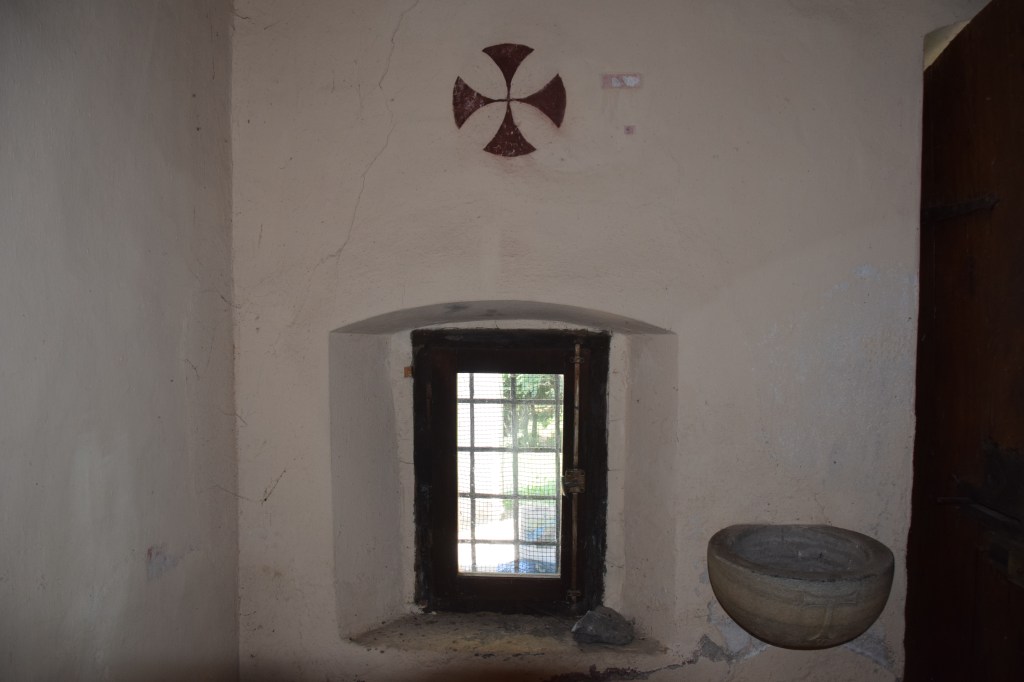
For example, on the north wall a small chapel now dedicated to Santa Rosalia was – in the past – dedicated to the cross as would be expected as all churches in some way make note of the ‘name’ of the place of worship by some interior imagery or space. The caretaker – Angelo – was insistent that the name of the church and its original dedication in the 12th or 13th-century and the red consecration crosses on the interior walls were the mark of the Knights Templar in Naro and thus reflect the legendary presence of these warrior monks in the Alto Lario. A church dedicated by the Templars would be memorable and the use of their red cross distinctive. The garments of the Templars were plain in keeping with their vow of poverty, while their white mantel reflected the symbolism of purity and their vow of chastity, and the red Templar cross symbolized obedience to Jesus and their willing martyrdom in the protection of pilgrims voyaging to the Holy Land and for their faith.
Indeed, although found mostly in oral histories and village legend, the Alto Lario area was frequented by the Templar Knights who were deeply and one might even say radically dedicated to the cross and who kept barracks and convents in northern Lombardy. The Chiesa di San Giacomo Vecchia in nearby Livo was transformed in the 12th-century from a refuge to a church on the word of a Templar. The nearby lungolago Romanesque Chiesa di Santa Maria Maddalena of Ossuccio-Tremezzina was once called the Lombard Rennes-le-Château for its association with the search for the Holy Grail and, thus, the Templars. The Castle of Vezio above Varenna, the village and castle of Correno Plinio, the Castle of Lierna, the remains of the Castelvedro in Dervio, the Castle of Rezzonico and all their associated churches were host to the Templars and their activities in the Lake Como area.
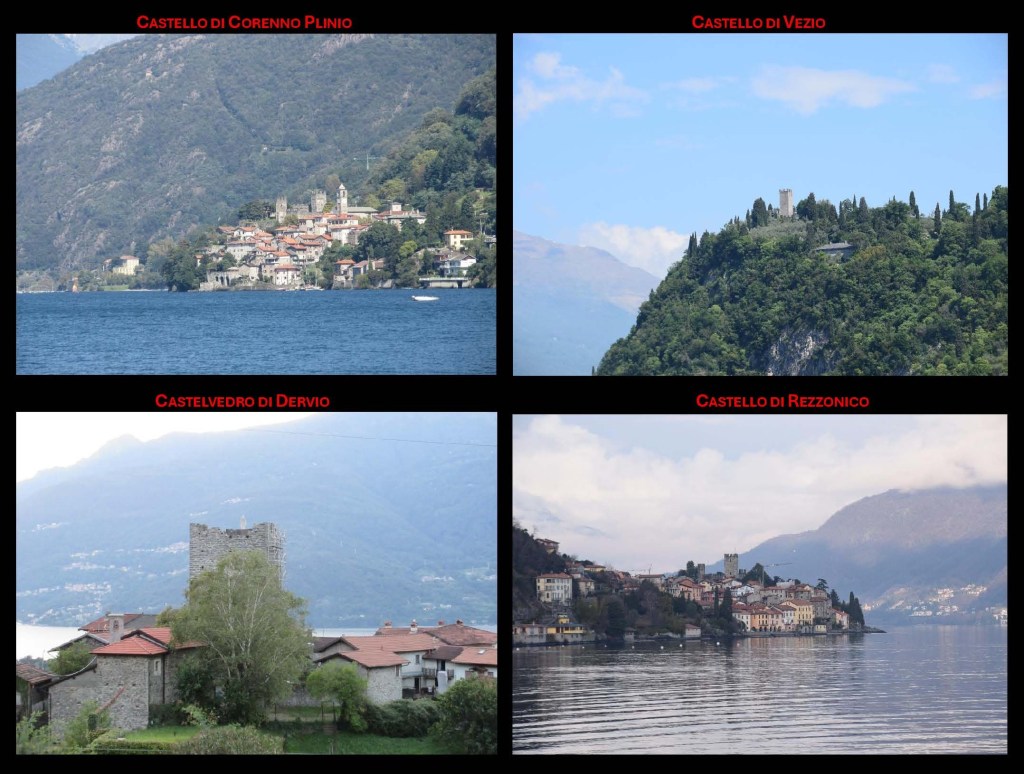
TOP LEFT: The Medieval Correno Plino and its 11th-century castle which is still privately owned;
TOP RIGHT: Above Varenna on the lake is the very ancient Castello di Vezio which is said to be haunted by the Lombard Queen Theodelinda (570-628) who spent years there;
BOTTOM LEFT: the 5th-century Castelvedro di Dervio with its distinctive statue pof the Virgin Mary on top;
BOTTOM RIGHT: The Castello di Rezzonico in its present state was built in the 14th-century.
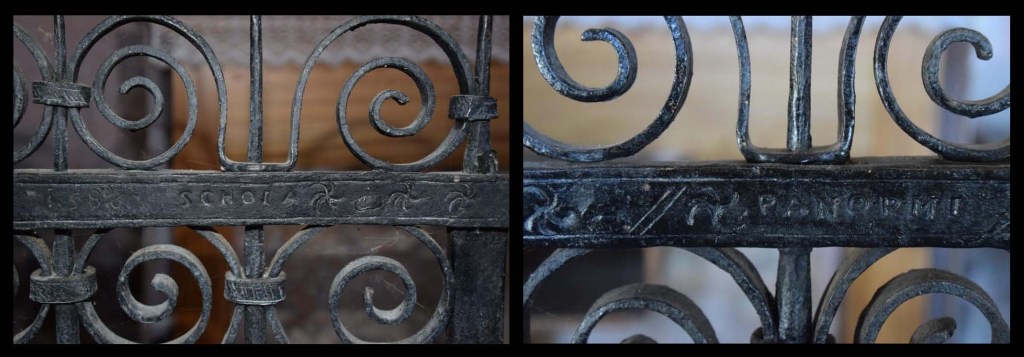
Recently, in terms of the age of the church, the original chapel that was dedicated to the cross (perhaps because of the patronage of the Knights Templar) was rededicated to the Sicilian saint Santa Rosalia by the returning emigrees who had left home to find work in Sicily as testified to by the inscription on the really beautiful handwrought iron gate of the chapel which reads “1586 SCUOLA PANORMI” and by the wealthy patron Bartolomeo Albonico who, one might theorize given the chosen dedicatory saint, earned his monies too from an emigration to that island. He is buried in the church.
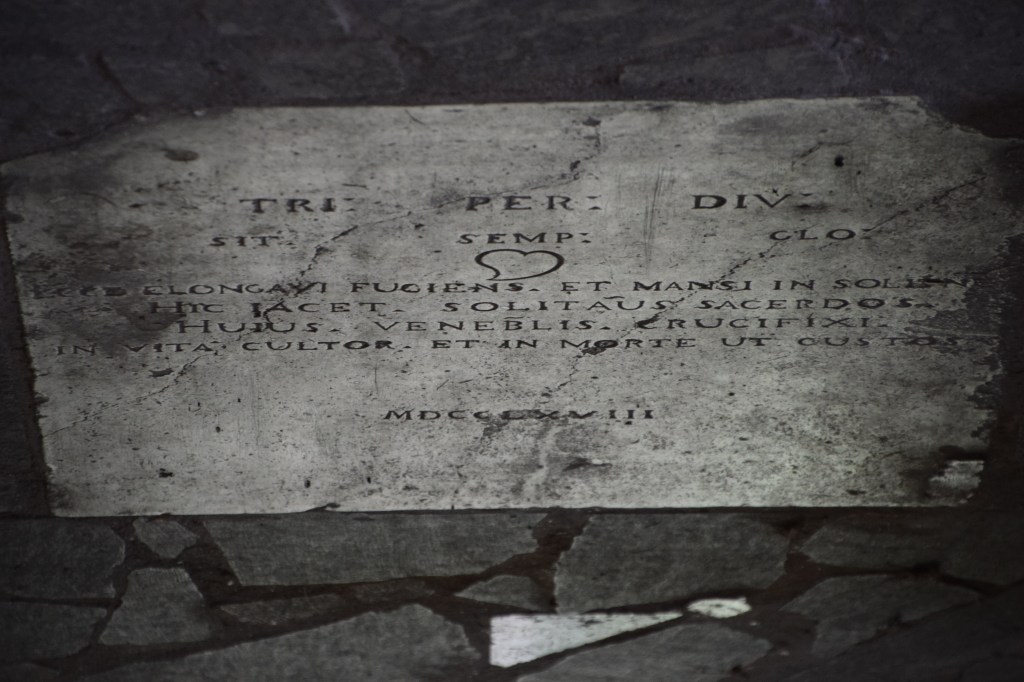
The tomb is dated 1768 which is 128 years after Albonico’s death. This would indicate that the heirs who rededicated the chiesetta to Santa Rosalia di Palermo installed his tomb at that time. Recall that the chapel was restored in 1888. Hence, it was established prior to that and it replaced the chapel of the original church which was dedicated to the cross. Moreover, an inspection of the current fresco shows that there is an older work parts of which remain underneath the 19th-century restoration and behind the altar, which is also newer. The tomb is elaborately inscribed with words about Christ the Redeemer from Christian theology. But the tomb is difficult to photograph because of the white marble (likely from nearby Musso) and the effect on the stone of the natural light. The full inscription on the tomb reads in Latin:
TRI – PER – DIV (TRINITAS PATER DIVINA)
SIT – SEMP -CLO (SIT SEMPER COLLECTA)

ECCO ELONGAVI FUOIENS ET MANSI IN SOLIS
HIC FACET SOLITARIUS SACERDOS
HUIUS VENEBLIS CRUCIFIXI
IN VITA CULTOR ET IN MORTE UT CUSTOS
MDCCLXVIII
This is my best attempt at a translation. The first line I know is correct:
MAY THE DIVINE HOLY TRINITY BE ALWAYS WITH US

I AM FAR AWAY AND I AM ALONE
THIS IS WHAT THE SOLITARY PRIEST DOES
THIS VINE WAS CRUCIFIED
IN LIFE A WORSHIPPER AND IN DEATH AS A GUARDIAN
1768
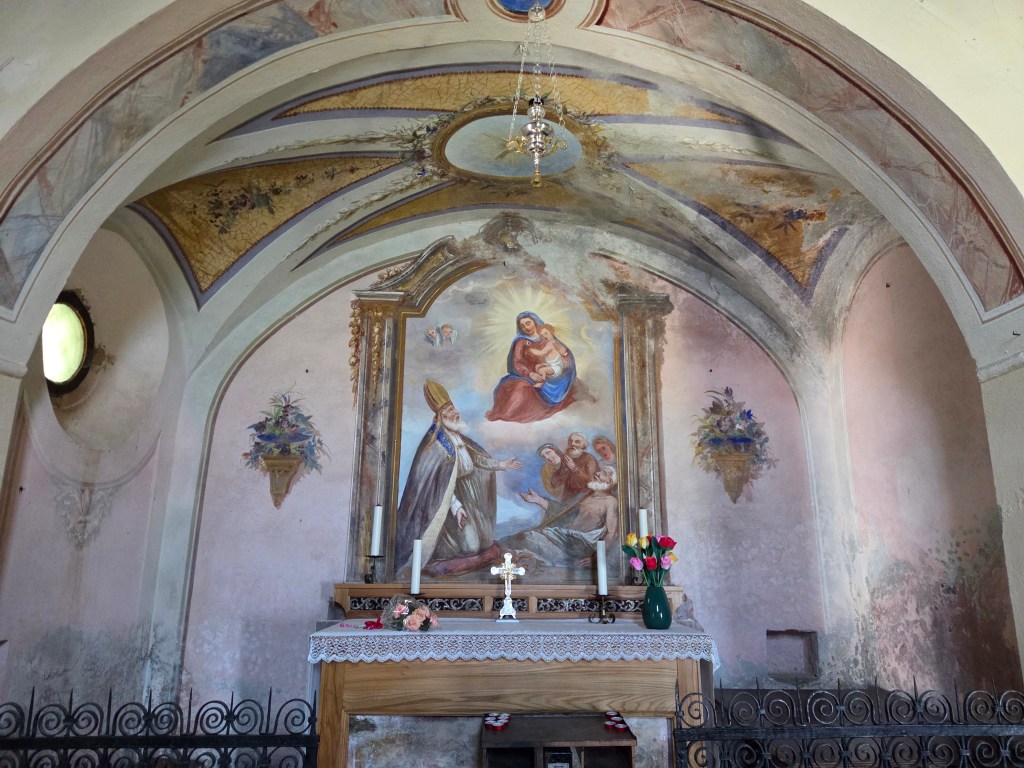
The original 16th-century frescoes of the north wall chiesetta are gone and now a central fresco of San Gottardo – a popular saint around north Lake Como – predominates. The bishop saint is seen interceding with the Virgin Mary on behalf of an ailing adherent. These current frescoes in this chapel date to a 19th-century restoration that was funded by the heirs of Bartolomeo Albonico (died 1640). One might wonder why in a chapel dedicated to Santa Rosalia one encounters no image of the saint in her chiesetta. Does the 1888 restoration update original frescoes or replace them? The resultant inscription does claim the chapel was ‘newly painted’ but this testimony is not informative enough to provide insight.
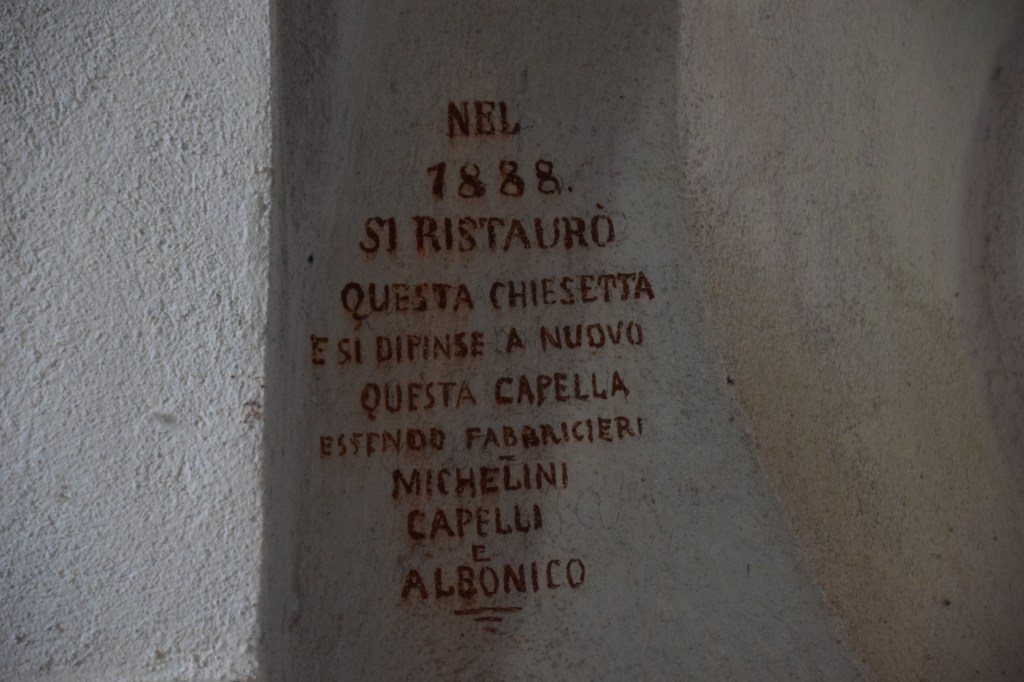
The inscription on the west wall of the chapel to the left of the round window attests to the restoration and patrons and it reads:
(Italian) NEL 1888 – SI RESTAURO – QUESTA CHIESETTA – E SI DIPINSE A NUOVO – QUESTA CAPPELLA – ESSENDO FABBRICIERI – MICHEL(L)INI, CAPELLI, E ALBONICO
(English) IN 1888 – THIS LITTLE CHURCH WAS RESTORED – AND THIS CHAPEL WAS NEWLY PAINTED – BY THE TRUSTEES – MICHEL(L)INi, CAPELLI, AND ALBONICO
To explain the word “FABBRICIERI”: The fabbricieri were members of an organization called a “fabbriceria”. They were trustees – laymen – in charge of all things necessary to maintain the integrity of a church structure and especially for the restoration of a church or chapel. The word is related to the word “fabrica” which refers to the ‘fabric’ of a building – the physical edifice. In this case the trustees included the heirs of Bartolomeo Albonico who was the 16th-century patron. At the very least by the inscription, we know that these men were in charge of the upkeep of the chapel if not the entire church.
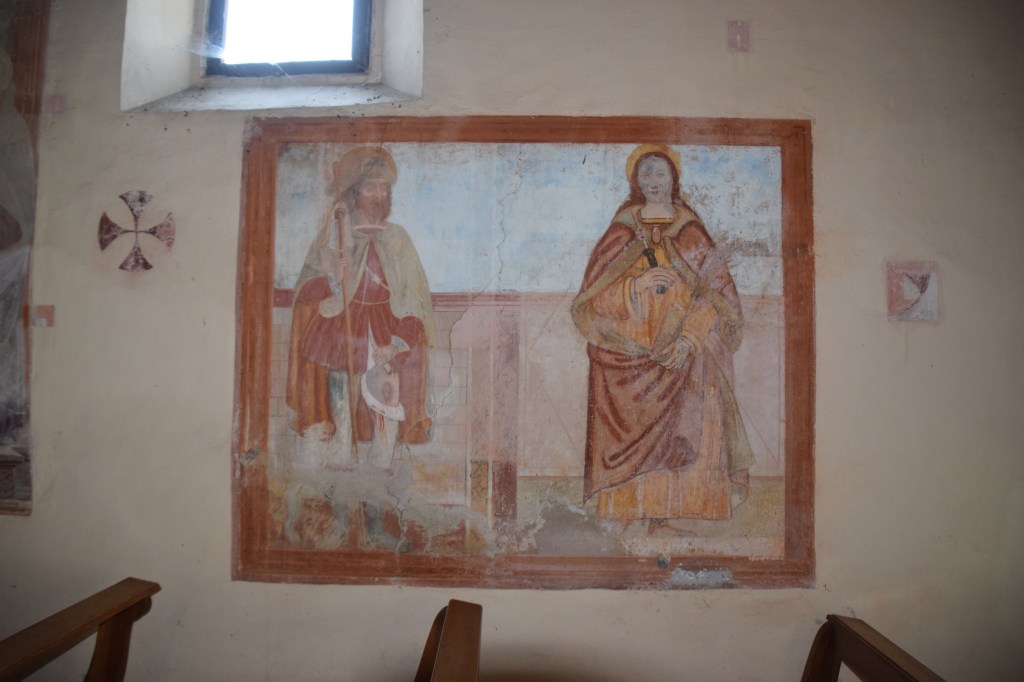
Other than the influence of the Templars passionately engraved in the collective memory of the villagers, the Chiesa di Santa Croce pays homage to the prosperity brought home from men’s emigration to Sicily in the elaborate frescoing of the little church and in the presence in imagery of two Sicilian saints – Rosalia from Palermo and Lucia from Siracusa. Santa Lucia is a presence in four frescoes. The dedication to Santa Rosalia claims the north wall chapel and she is frescoed on the left pilaster of the triumphal arch.
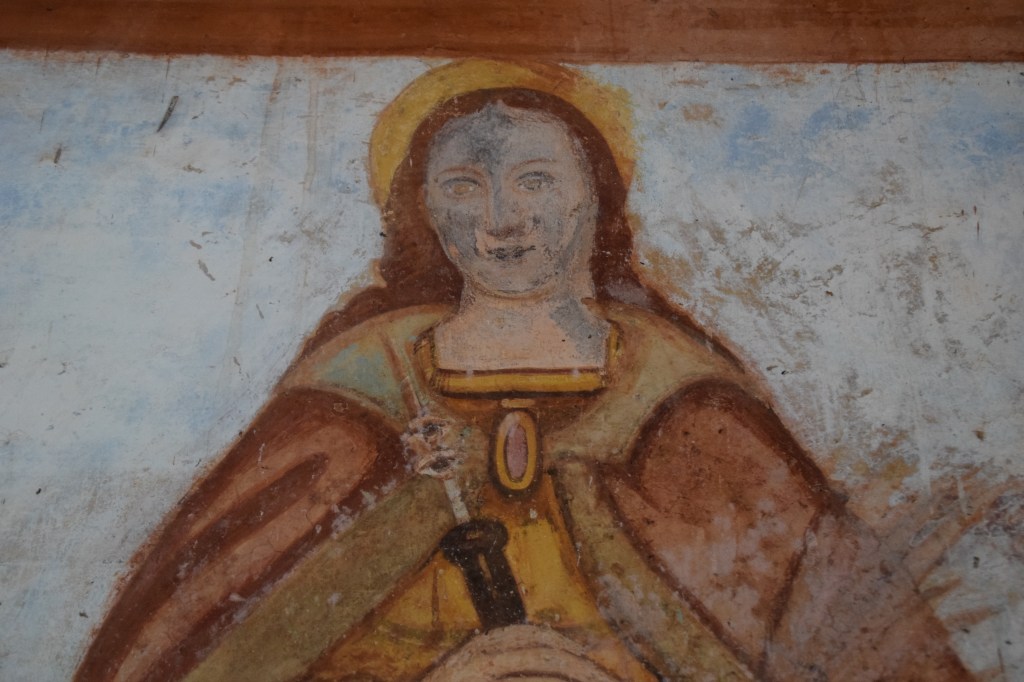
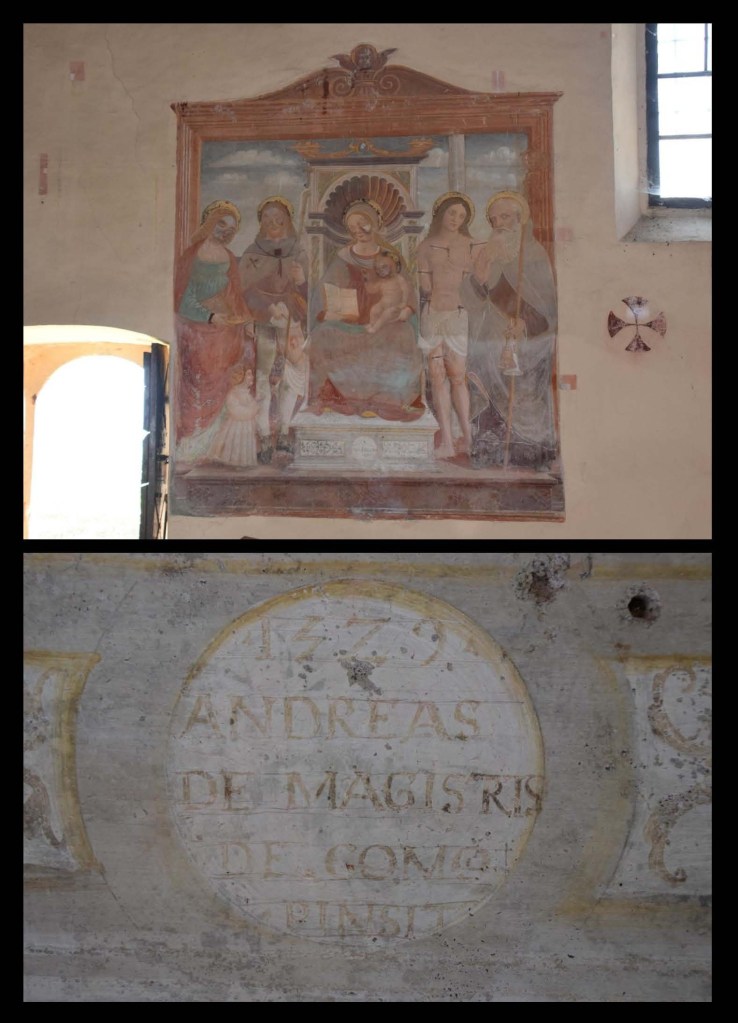
The most important fresco featuring Santa Lucia di Siracusa is on the south wall to the right of the side entry door and it was painted by (Giovanni) Andrea De Magistris (1460-1532) father of Sigismondo De Magistris – the primary author of the church’s frescoes. Because of the prominence of the saints associated with the plague, this fresco invokes intercession to those saints whose miracles cure illness, and offers veneration to the saint who received the prayers of the emigrees. Featured in this exceptional work are Santa Lucia, San Rocco, the Virgin Mary & Child, San Sebastiano, and Sant’Antonio Abate.
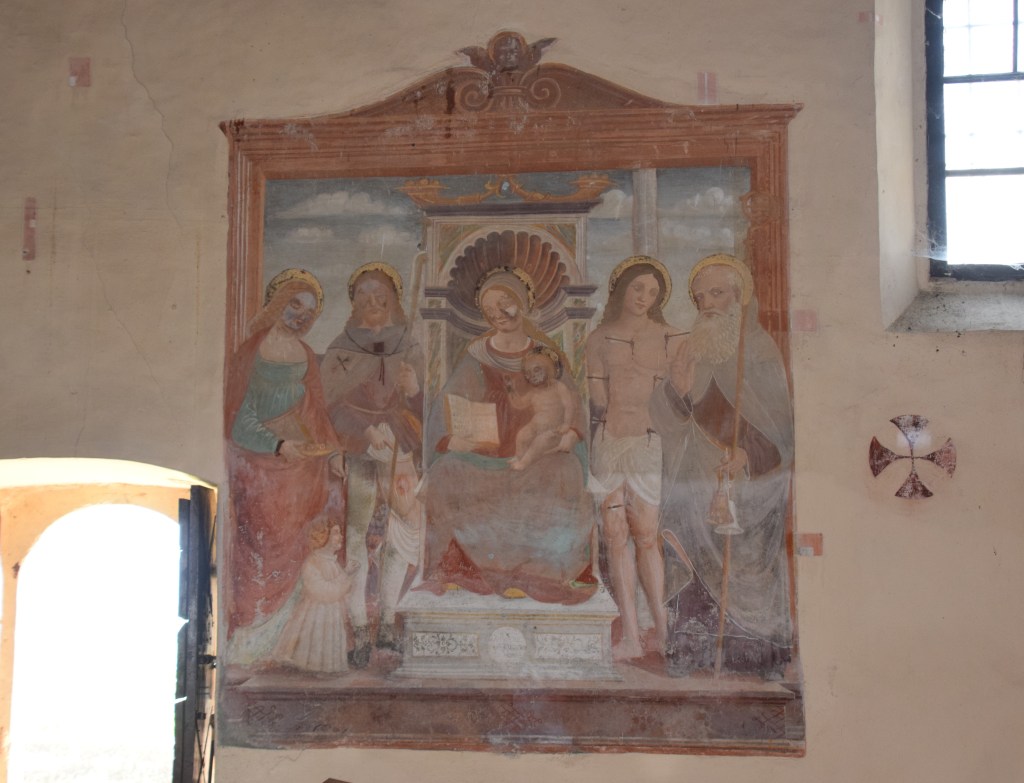
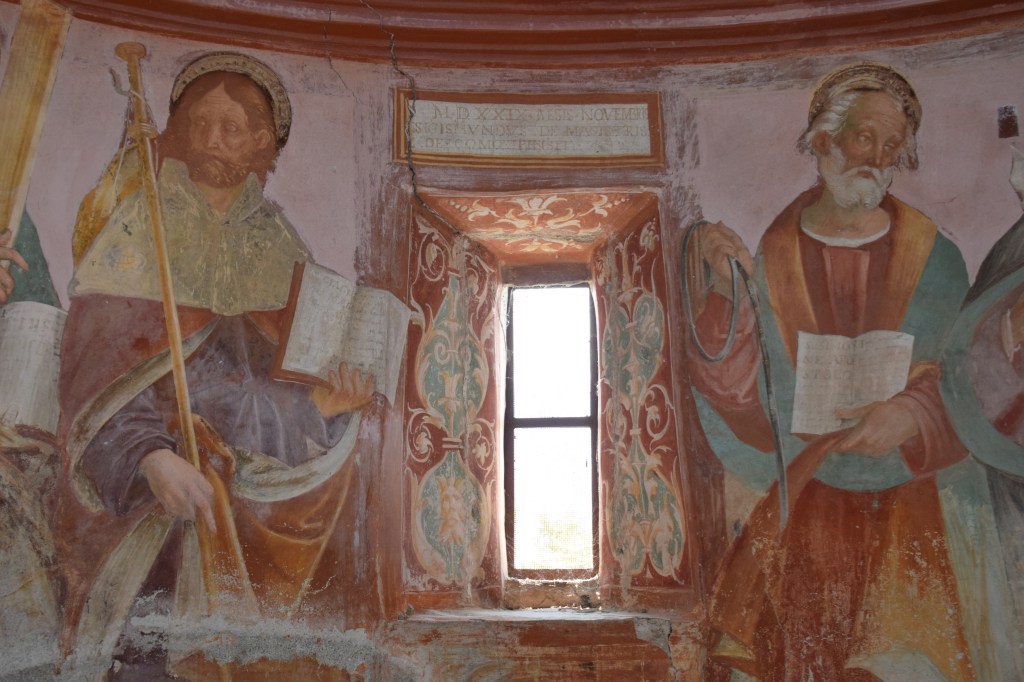
Much of the literature discussing the church and available online misidentifies Sigismondo De Magistris as the author of this fresco. However, both father and son signed their work in this church. Andrea De Magistris inscribed the front of Mary’s throne and Sigismondo De Magistris painted his signature above the presbytery window.
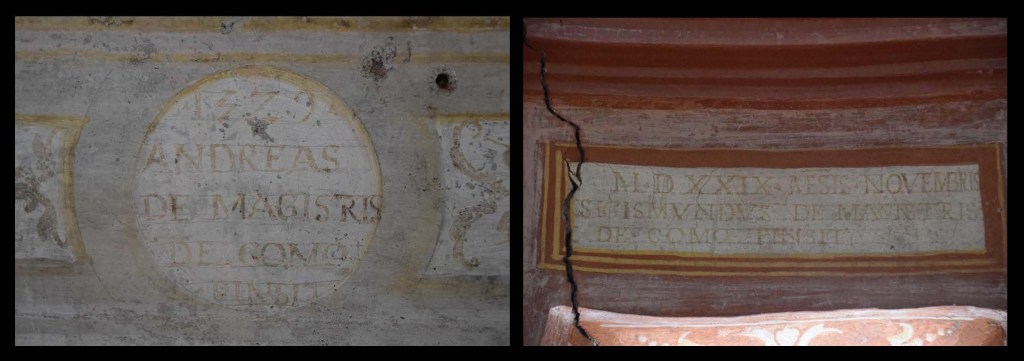
LEFT: Signature of Andrea De Magistris: Latin: 1529 – ANDREAS – DE MAGISTRIS – DE COMO – PINSIT; English: Andreas De Magistris of Como painted it in 1529;
RIGHT: Signature of Sigismondo De Magistris: Latin: MDXXIX MESIS NOVEMBRIS – SIGISMONDO DE MAGISTRIS – DE COMO PINSIT; English: In the month of November 1529 Sigismondo De Magistris painted it.
The father/son painting duo worked extensively in the Lake Como and Valtellina. Their work is found in numerous churches. For example, in the Valtellina, Andrea De Magistris painted the presbytery of the tiny early 14th-century Chiesa di San Domenico in Regoledo di Cosio, and Sigismondo De Magistris painted the south chapel apse in the Chiesa di San Giovanni di Bioggio in Mello – both in the Valtellina.
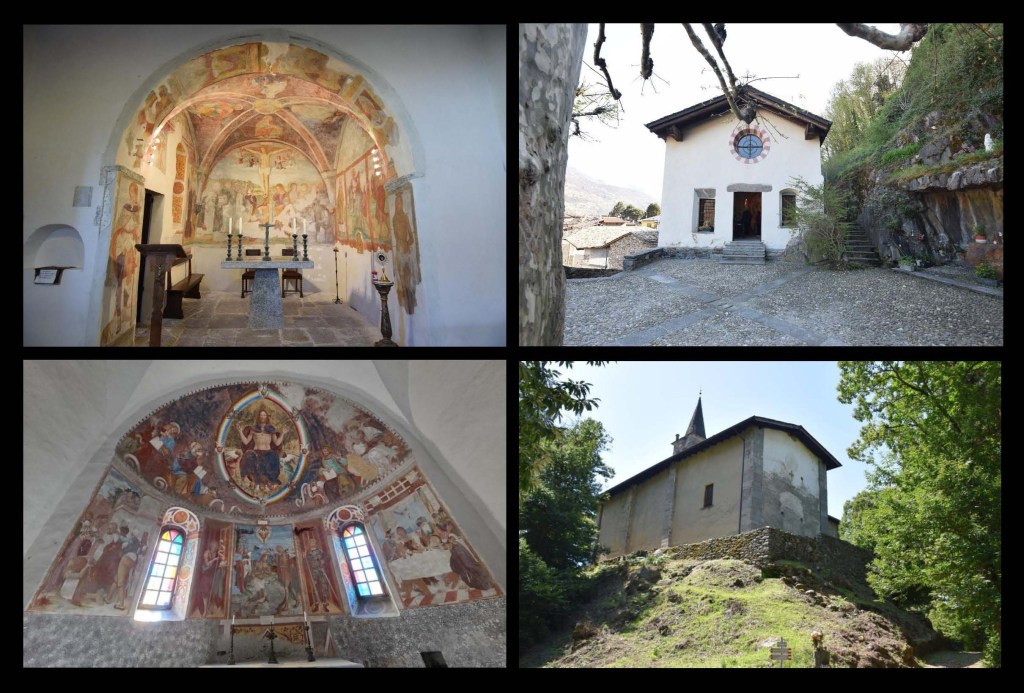
Top: REGOLEDO di Cosio Valtellino – Chiesa di San Domenico, 14th-century:
LEFT: Andrea De Magistris painted this elaborate presbytery fresco in 1514. The central image is a crucifixion and the side-wall saints include those associated with the plague and curing illness – Rocco & Sebastiano who predominate on the triumphal arch pilasters; Antonio Abate on the left wall; the protomartyr San Lorenzo; San Martino, & San Giovanni Battista on the right wall as well as a pope and a bishop. The pillars contain the images of San Rocco and San Giacomo Maggiore. The four evangelists are frescoed in the vault and the triumphal arch depicts the prophets or doctors of the church. RIGHT: A view of the tiny church located on a small hill on the old pedemontana -the ancient road that skirts the foot of the mountains at the very back of the village.
Bottom: MELLO – Chiesa di San Giovanni di Bioggio, 13th-century:
LEFT: Sigismondo De Magistris painted this fresco in 1522. The central image is of Christ the Redeemer in a flaming sacred mandorla surrounded by the four evangelists. Beneath are frescoed scenes from the life of Saint John the Baptist. RIGHT: A view of the church from the carriage road. The church is large and sits on a hill stone with stairs blocking a frontal view. Getting a good photo from the front is impossible. This church sits between Mello and Cercino at about 700 meters and is just below the localitá of Bioggio at 800 meters.
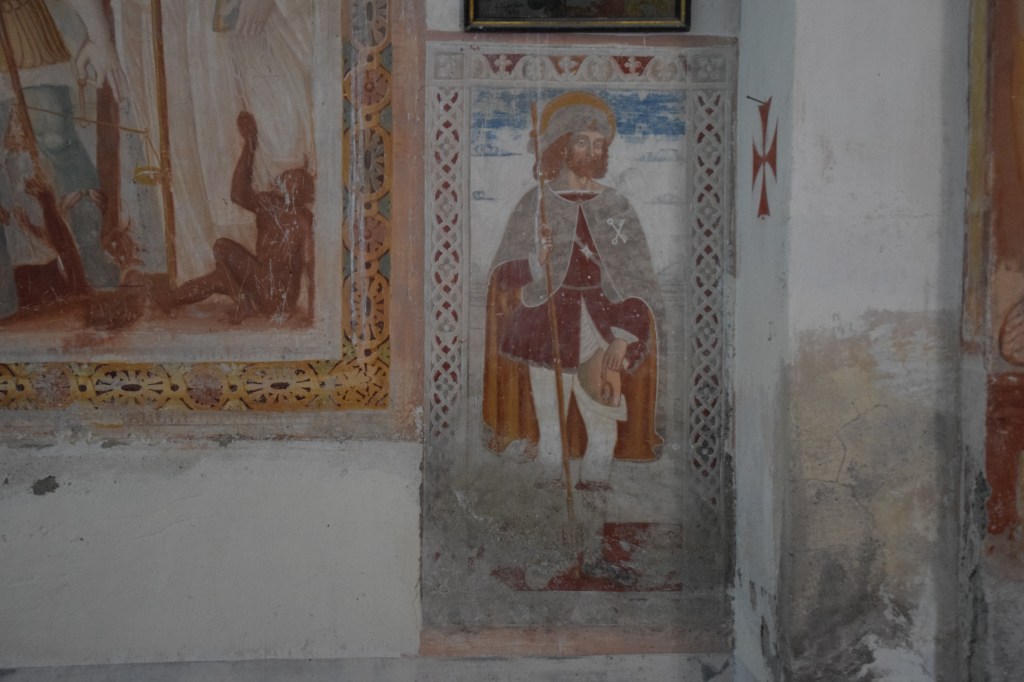
Santa Lucia is an integral figure in three other frescoes. The south wall of the church has three frescoes with her image and the north wall has one. To the left of the side entry door – which may have been a later addition to the church – is Santa Lucia and San Rocco. I hesitantly posit that this was painted by Andrea De Magistris although I have not found any literature that attributes it to him. Although it is not signed, the father and son clearly worked in collaboration in the church and the signed work was commissioned by a donor and is separate from that commissioned by the trustees for the church proper. That it may be part of the elaborate fresco cycle of the presbytery is possible and perhaps one might want to attribute the work to the son – Sigismondo. However, I think the style is more in keeping with the father – Andrea.
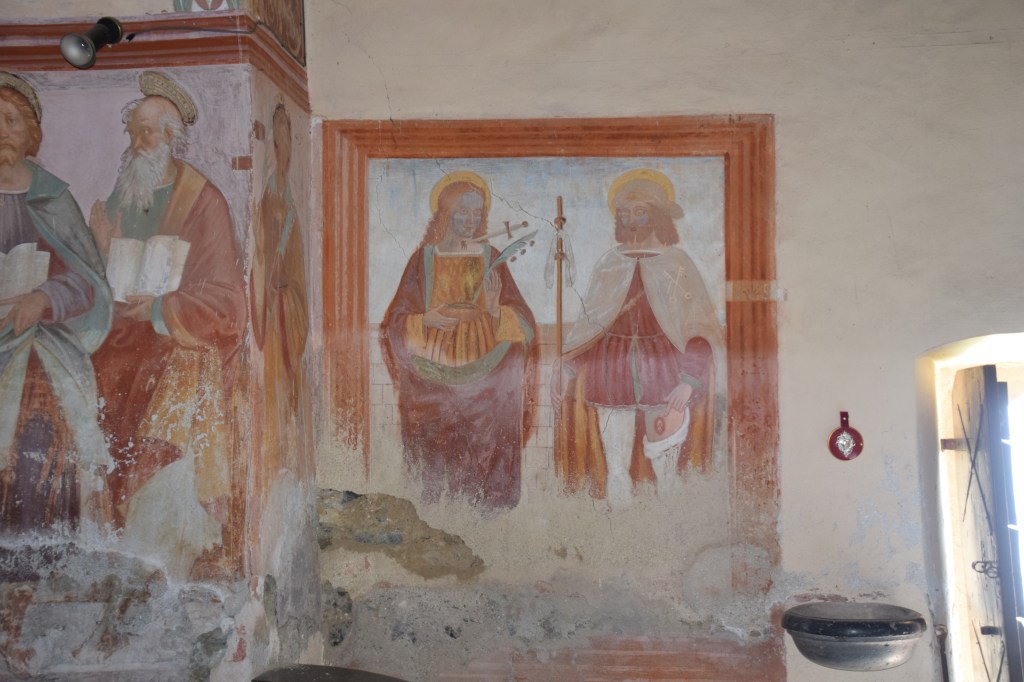
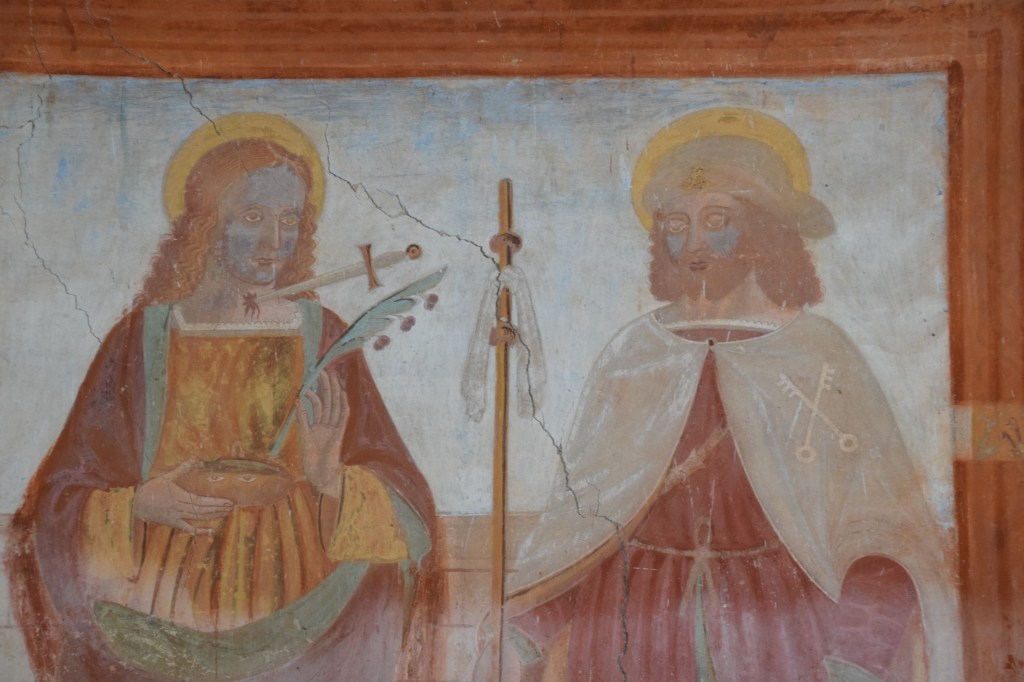
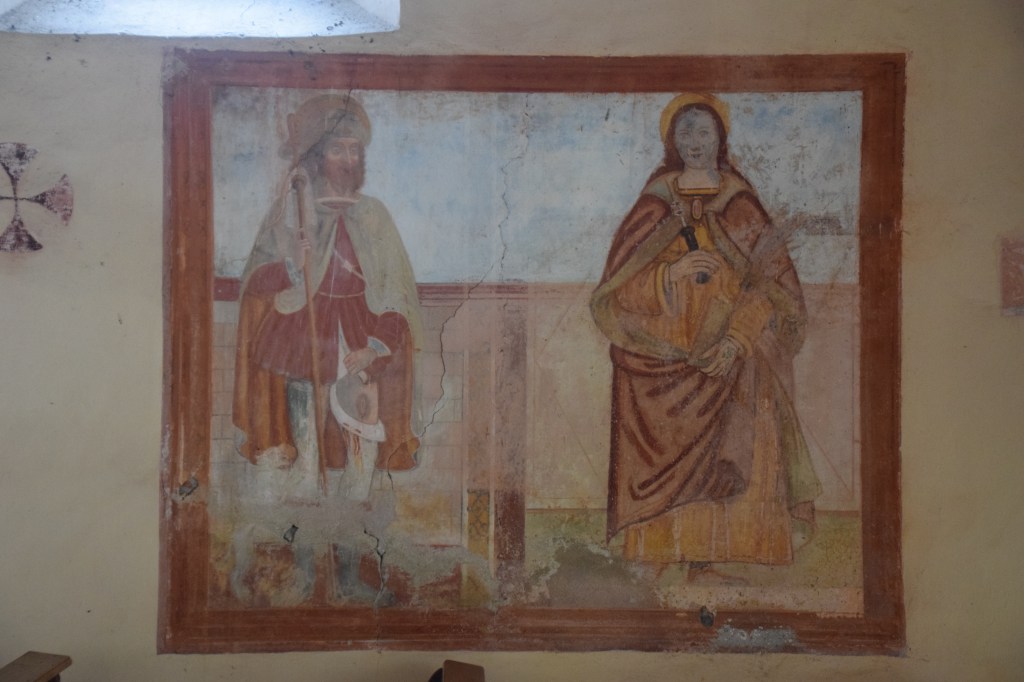
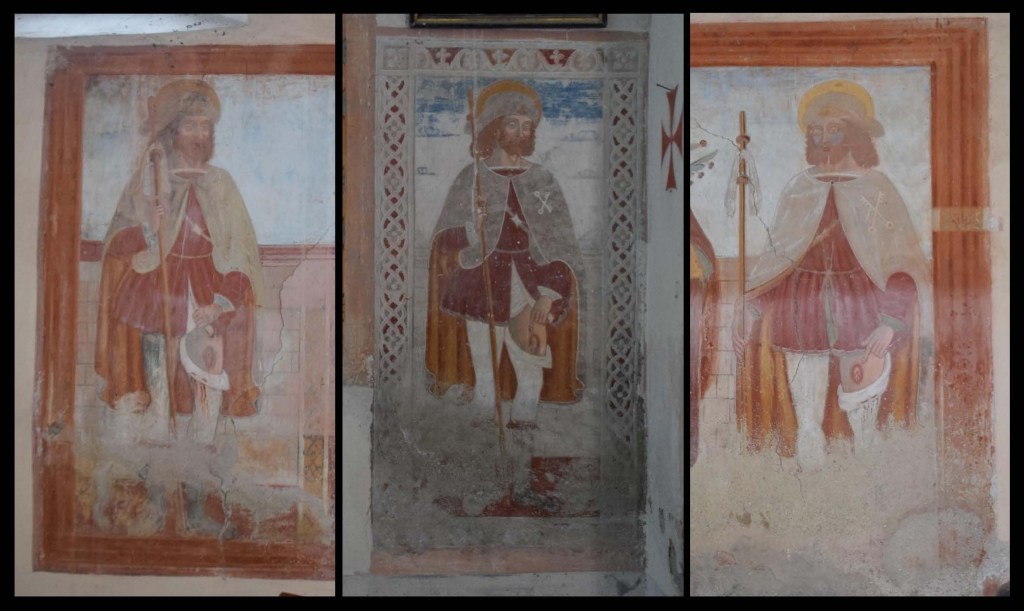
The third fresco on the south wall features – again – San Rocco and Santa Lucia. This work, I, once more, but hesitantly suggest is by Andrea De Magistris which would make him the author of the works on the south wall. They two flanking, dual-image frescoes are not as high quality as the presbytery frescoes or the signed fresco by Andrea De Magistris. But I add this disclaimer – the two frescoes that flank the signed south wall fresco are definitely by the same artist. The crafting of the figures of San Rocco is near identical. And there is a symmetry to the execution. The left-most fresco features a linear order with Santa Lucia on the left and San Rocco on the right where he is facing to the left. The right-most fresco features San Rocco on the left where he is facing to the right and Santa Lucia on the right. These two frescoes complement each other like opposing bookends.
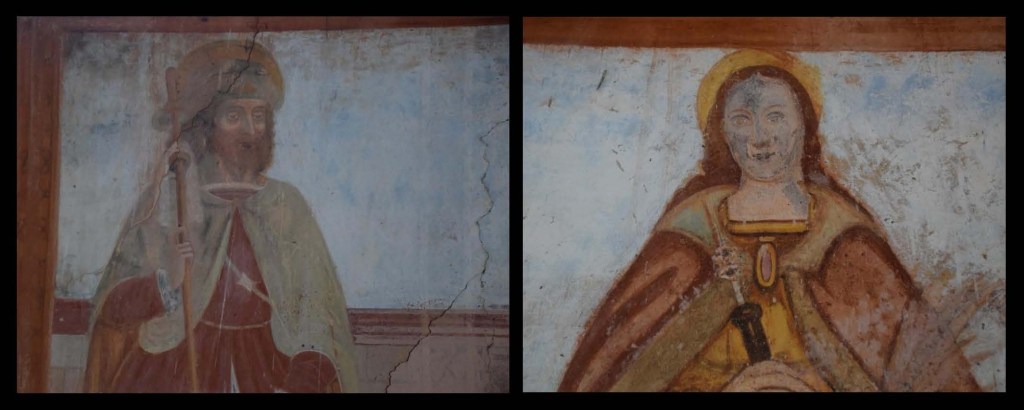
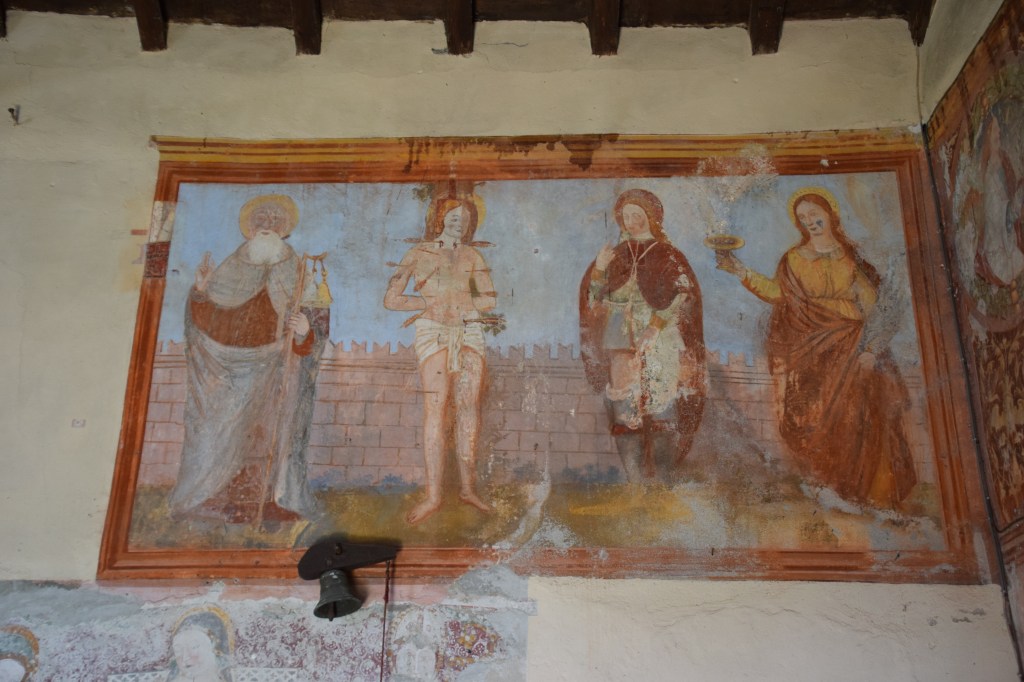
Finally, the fourth fresco that features Santa Lucia which is high on the north wall is clearly by an entirely different artist than the one who painted the south wall works. This is clearly a plague fresco as it contains three saints commonly invoked against the plague – Sant’Antonio Abate, San Sebastiano, and San Rocco, and Santa Lucia di Siracusa – the favored saint of the returning emigrees in this church. San Rocco is depicted without a beard in this work. I suggest that this is the work of Sigismondo De Magistris. The north wall fresco beneath the plague fresco is attributable to an earlier date – likely the late 15th-century – and to the artist Mencio Anesi da Bormio** who was active from 1491 to 1515.
With respect to my theory concerning the three unattributed plague frescos, I offer some work from the Chiesa di San Pietro in Costa – also a part of Gravedona ed Uniti. This tiny 15th-century church has a Romanesque presbytery cycle of frescoes commissioned by the local priest Vincenzo Curti, painted December 9, 1532 and attributed in some Alto Lario literature to Sigismond De Magistris (1490-1548).
Contained in the church are a number of frescoes one of which features a solitary San Rocco. I believe this depiction of the plague saint is essentially identical in style, color, and execution as the south wall San Rocco images of the Chiesa di Santa Croce. Using my theory, this makes Andrea De Magistris the author and offers evidence that the father/son duo commonly worked in the same church at the same time.
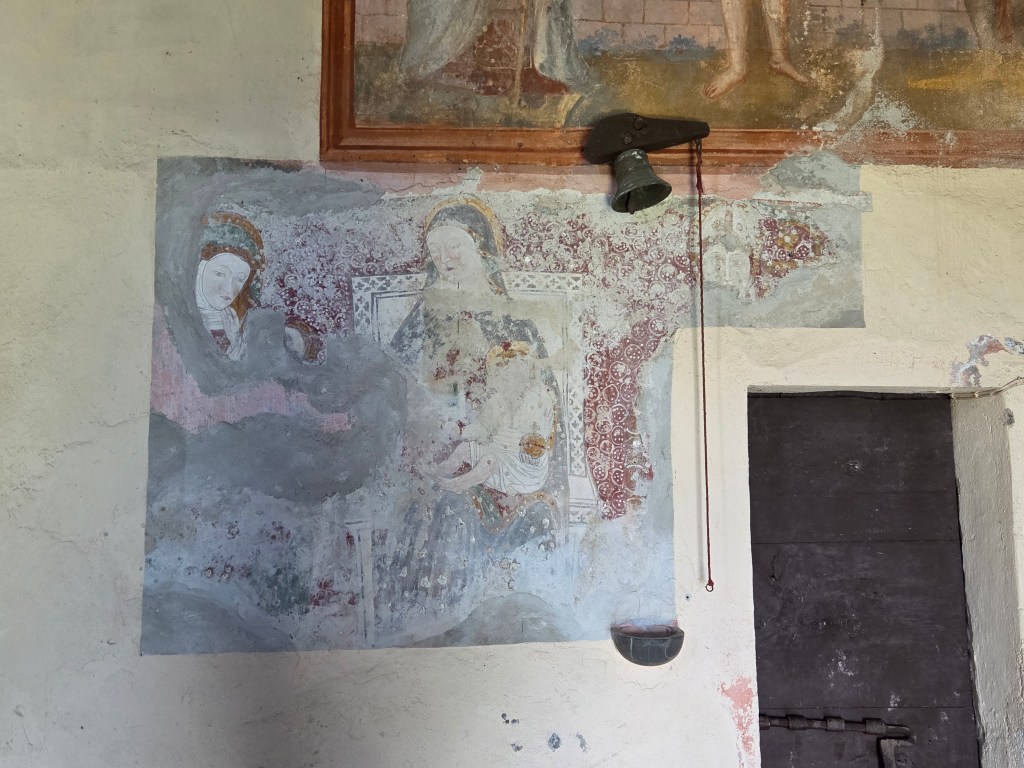
Featured below is the north wall fresco that I assert is the work of the artist Mencio Anesi da Bormio.** His painting is stylistically unique where facial features, garments, halos, and fresco ‘frames’ are similar throughout his work in the Valtellina and Lake Como areas. Additionally, a close look at the wall indicates that this fresco is some layers of gesso underneath the gesso of the upper wall, plague fresco with four saints, and the Anesi** work was painted over, as can be seen in the gesso layering and the ‘pock marks’ that mar it. Hammered or chiseled ‘pock marks’ were made in an older fresco so that the new gesso – on which the new fresco would be painted – would adhere to the wall.
Further, this Menico Anesi** work was ruined and the figure of the bishop almost wholly destroyed by the addition of the door to the sacristy, which is under the bell tower that was added centuries after the church was built – perhaps during the renovation of the early 1500’s. Older frescoes in ancient churches often reflect goals of trustees and donors that differ substantially from the intentions of those who commission the newer works painted over them. This late 1400’s veneration of the Madonna & Child by Mencio Anesi** is such a work as it is quite distinct in theme from all the other frescoes in the church.
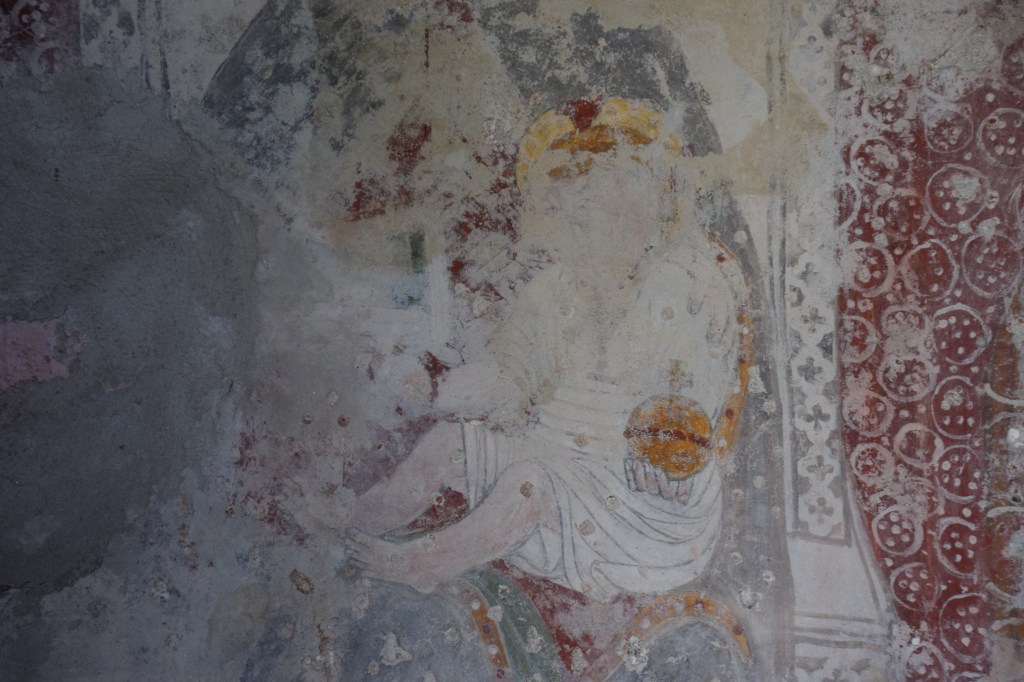
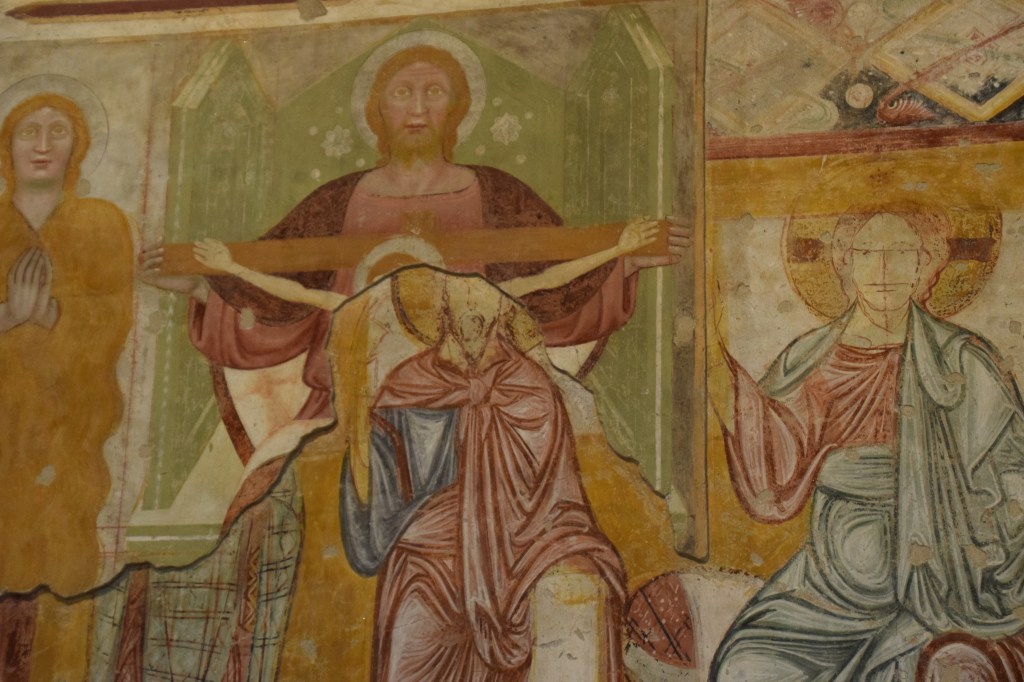
Centrally enthroned are the Madonna & Child with the baby Jesus holding a globus cruciger in his right hand. His left hand – eroded but still discernable – is gesturing with the symbol of the Holy Trinity. On Jesus’ wrist is a beaded, red coral bracelet. The Madonna holds a book in her right hand. To the left is Santa Anna – grandmother to Jesus – holding the infant Mary who is reaching for her mother’s cheek with her right hand. On the right is a the remains of the head of a Holy Bishop identifiable by his detailed miter and surrounding halo. The rest of his body was destroyed by the addition of the door to the bell tower. Given the fresco imagery, the time period, and the geographical zone – the Alto Lario, the bishop is likely San Gottardo. Further support for this hypothesis is the replacement of the chiesetta dedicated to the cross with a fresco of San Gottardo. With the exception of the presbytery imagery, which is necessarily focused on the requisite theology for sacred worship, the four remaining frescoes were indicative of seeking respite and rescue from the plague. This fresco champions the lineage of Jesus whereby the kinship of three generations of believers gives testimony to the faith. Such a fresco is called a “Sant’Anna Metterza.” The addition of the Holy Bishop adds a ‘modern’ statement of the continuity of generations united in the kinship of faith and belief.
The symbolism of Jesus’ coral bracelet is compelling. Sometimes coral was added to Jesus as a necklace or bracelet by artists working for returning emigrees from Sicily. It symbolized their time there and their affluence since coral – considered a gem – was expensive. However, the more common meaning was an amalgamation of ancient pagan beliefs with Christian theology. Coral was believed to have apotropaic powers and was used by Greek and Romans to ward off misfortune specifically the “evil eye” (malocchio). In line with this belief, coral was placed on children as a type of amulet to guard against and cure illness.
More current Christian belief uses red coral to both symbolize Jesus’ humanity and his future blood sacrifice and resurrection. Given the time period of this fresco – late 15th-century – the saints included in the work, the region – Lombardy – and the artist I suggest that the meaning is related to the older pagan beliefs where the coral acts as an apotropaic talisman juxtaposed with the symbols of Catholic belief – the hand gesture and the globus cruciger. Locals descended from the time and place of paganism commonly mix the old peasant ‘superstitions’ with the new religious ‘truths’.
This once very colorful and still very beautiful fresco shows the detailed handwork of the red background against which the saints are placed. Stenciling – a common and economical technique used to create elaborate backgrounds, fabrics, and frames for frescoes and paintings – was not used here. The background against which the figures are placed features a intricate vermillion pattern of circles with incised dots that exposed the white gesso underneath using it as a color. This was entirely painted by hand. A friend who is a designer described this pattern thus:
“A hand-painted, all-over decorative pattern composed of repeating circular rosettes in deep iron-oxide red and soft chalk white. Each medallion is individually rendered with a ring enclosing a stylized six- to eight-petal flower formed from small dots and teardrop shapes. The intentionally irregular spacing, varying proportions, and visible brushwork create a rhythmic, organic composition that celebrates the human hand rather than mechanical precision.” (Michael Tavano, WhatsApp communication, 20:28 CEST, 07/09/2026)
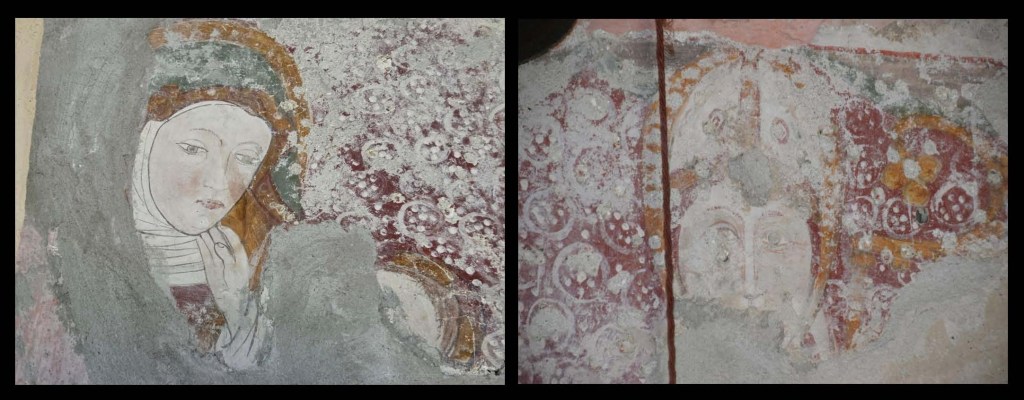
Although the saints here are less animated and ‘natural’ in their features, the talent of the artist and his eye for a balanced composition in terms of color and placement is clear. The move toward the emotive representation of sacred figures began in the mid to late 16th-century. When Mencio Anesi da Bormio** was painting the goal was not to make saints and gods ‘human’ – more relatable? – but to present Christian ideology in a repeatable and, thus, understandable way for the largely illiterate body of the faithful. Here is the work of Mencio Anesi da Bormio** found in the nearby Chiesa di San Giacomo Vecchia and a fresco found in Sondalo which features another elaborate hand-painted background.
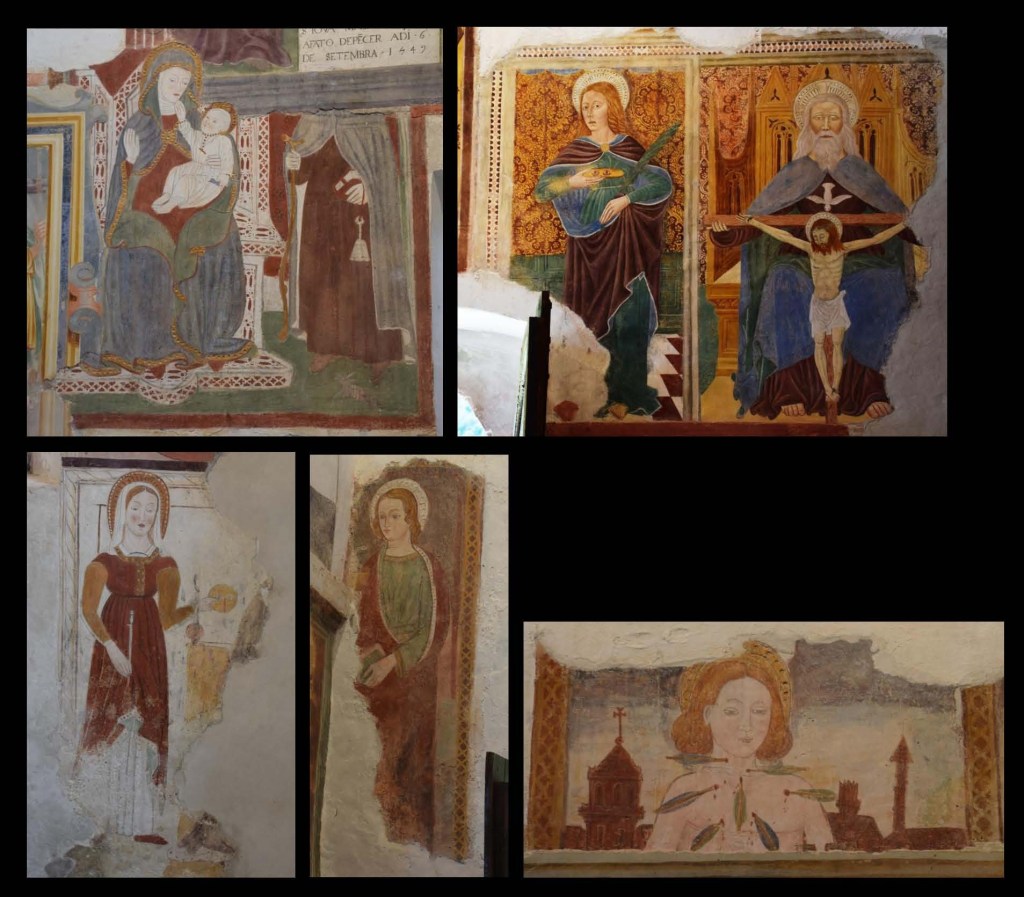
TOP LEFT: Enthroned Madonna & Child with Sant’Antonio Abate, Jesus wears a coral necklace;
TOP RIGHT: Santa Lucia di Siracusa next to a Trinity;
BOTTOM LEFT: Santa Lucia di Siracusa next to a mostly eroded Sant’Antonio Abate;
BOTTOM CENTER: San Giovanni Evangelista identifiable by the chalice with a dragon rising out of it;
BOTTOM RIGHT: San Sebastiano
Essentially, there are five frescoes in the Chiesa di Santa Croce that are not attributed: two on the south wall, two on the north wall, and the fresco in the chiesetta di Santa Rosalia. The two known painters who signed work are the father/son pair – Andrea and Sigismondo De Magistris. The 15th-century north wall fresco of Santa Anna, the Madonna & Child, and a Holy Bishop (likely San Gottardo) is undeniably attributable to Mencio Anesi da Bormio** who painted five frescoes in the same time period in the Chiesa di San Giacomo Vecchia three kilometers away in Livo.
The author of the late 19th-century fresco of San Gottardo is certainly a local artist. I suggest that Luigi Tagliaferri (1841–1927), also known as Luigi di Pagnona, painted this fresco. He was working in the churches of Lake Como in the late 19th-century and in Domaso in 1888 – the same year the chiestta was restored. I offer two works below juxtaposed with the San Gottardo from Santa Croce for comparison – a rendering of the protomartyr San Vincenzo from the triumphal arch in the Chiesa di San Vincenzo in Gera Lario and the triumphal arch and presbytery fresco from the Chiesa di San Biagio in Musso.
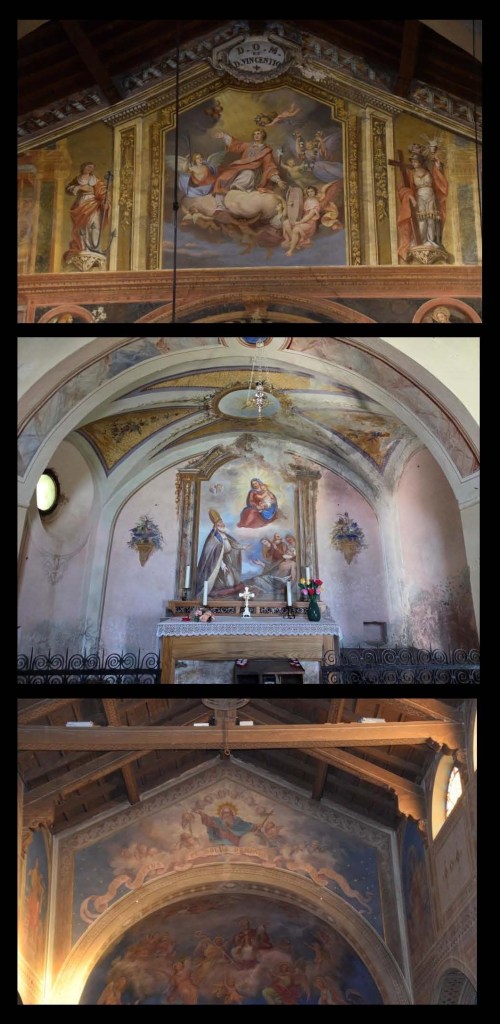
TOP: GERA LARIO! Chiesa di San Vincenzo, 11th-century – the triumphal arch featuring the protomartyr San Vincenzo painted 1869;
CENTER: NARO! Chiesa di Santa Croce,12th-century: Chiesetta of Santa Rosalia – San Gottardo intercedes with the Virgin Mary painted in 1888;
BOTTOM: MUSSO! Chiesa di San Biagio, 12th-century: Presbytery – San Biaggio ascended, and Triumphal arch – God the Eternal Father painted late 1800’s.
Thus, three unattributed frescoes remain which I believe were painted by Sigismondo and Andrea De Magistris. I think Andrea De Magistris painted all three 16th-century frescoes on the south wall. Informing that opinion is my firm position that the two frescoes, which each depict San Rocco and Santa Lucia and that flank the signed fresco by Andrea De Magistris, were crafted by the same artist. The four-saint plague fresco of the north wall with an unbearded San Rocco I suggest is the work of Sigismondo De Magistris. That the central fresco is more elaborate than the other two could be the result of a wealthy patron commissioning the work. There is a donor kneeling on the left of Mary’s throne. The other frescoes were almost certainly commissioned and paid for by the trustees of the church – the fabricieri – emigrees who returned affluent from Sicily bringing their new devotion to Santa Lucia di Siracusa and Santa Rosalia di Palermo with them.
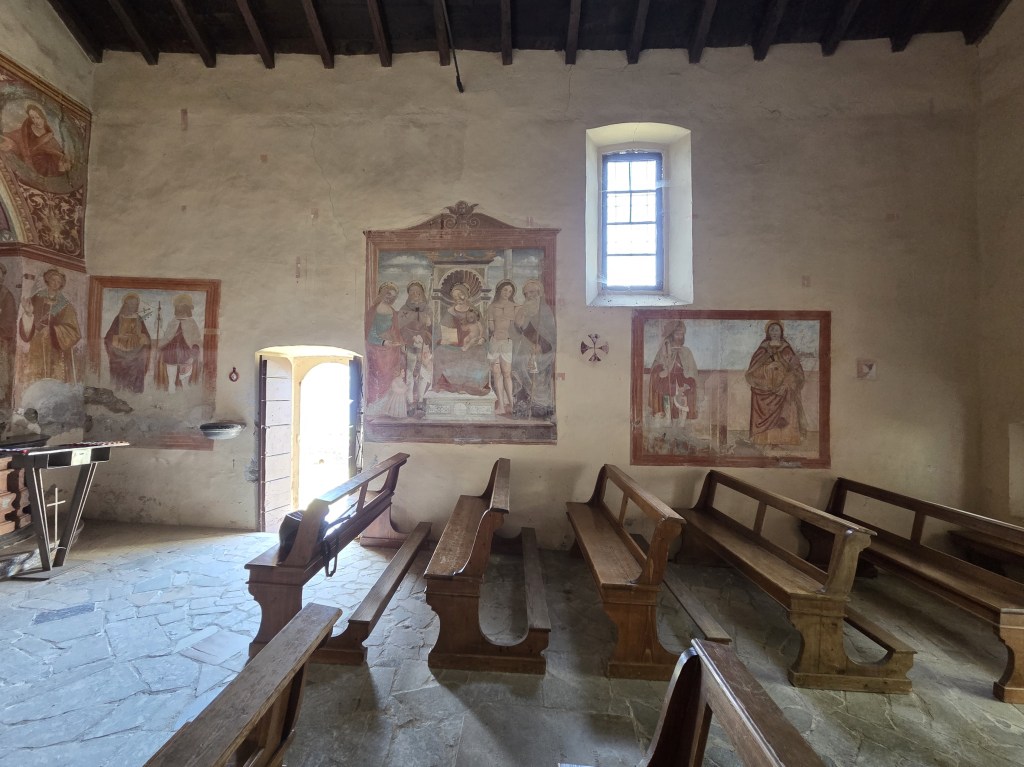
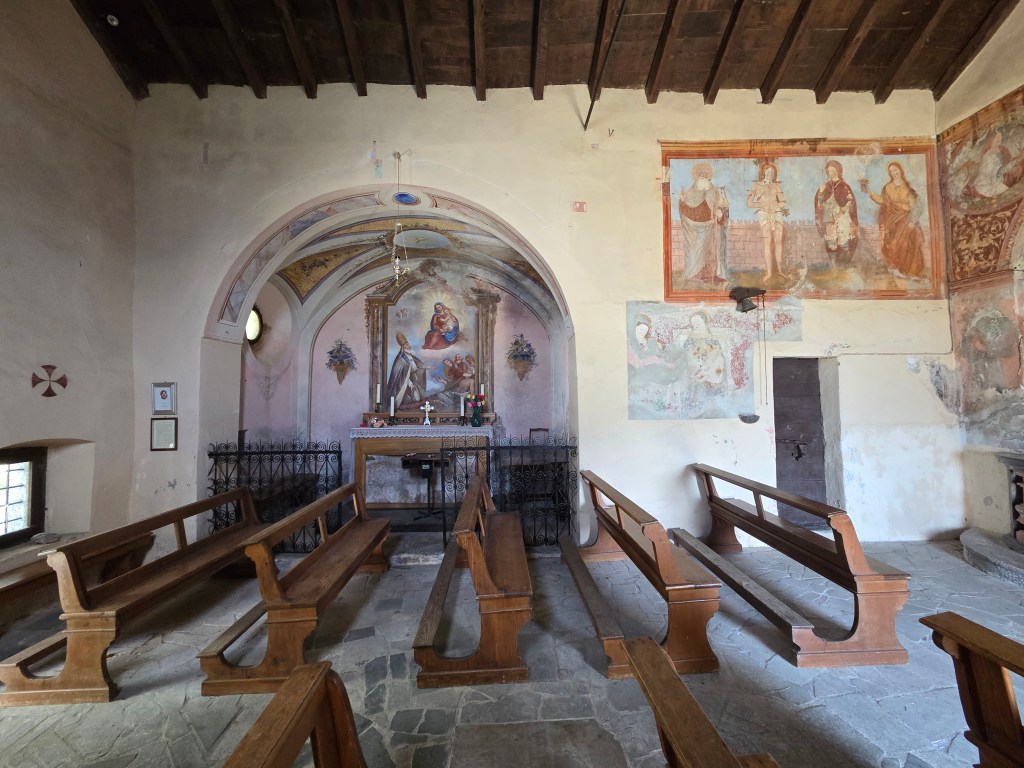
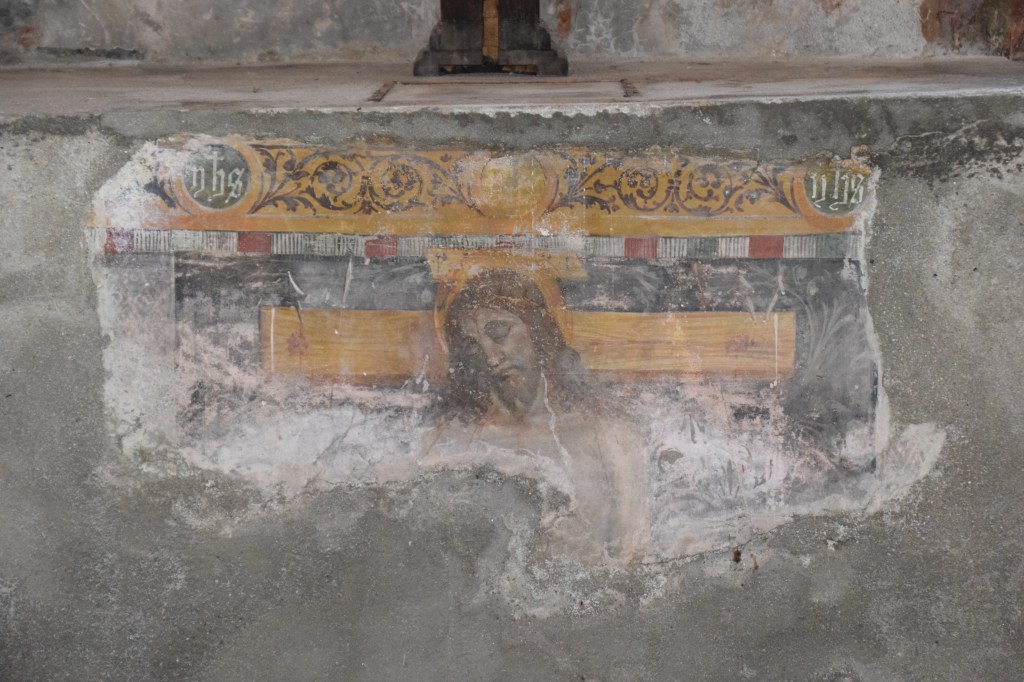
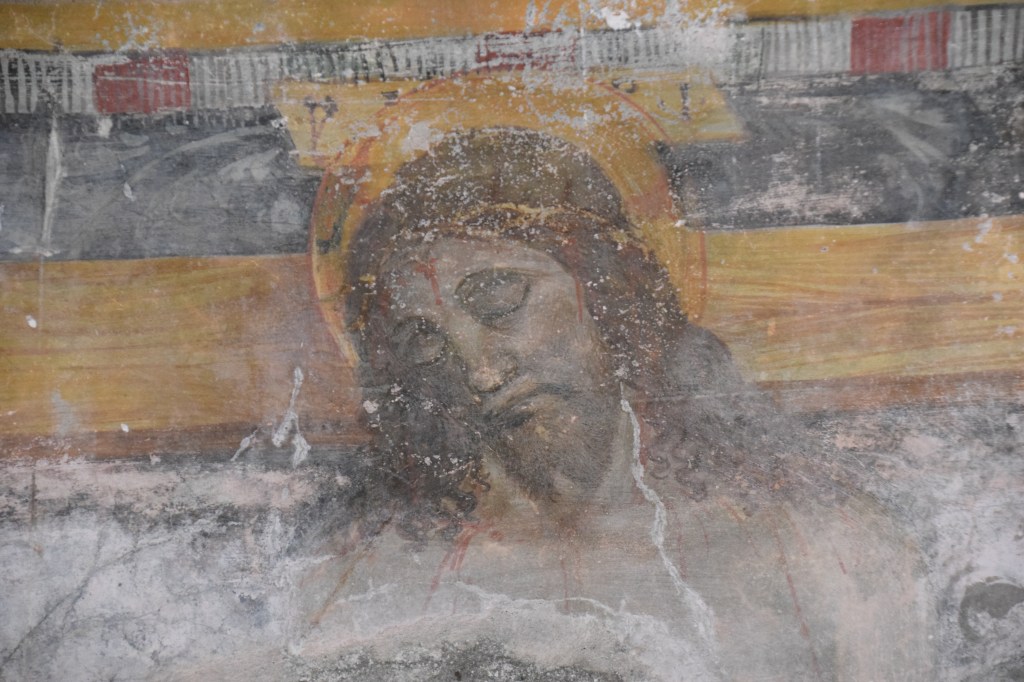
The triumphal arch and presbytery fresco, which includes the Man of Sorrows painted on the front of the altar, are spectacular in their original colors and are the work of Sigismondo De Magistris. His signature above the exquisitely decorated presbytery window splay leaves no doubt.
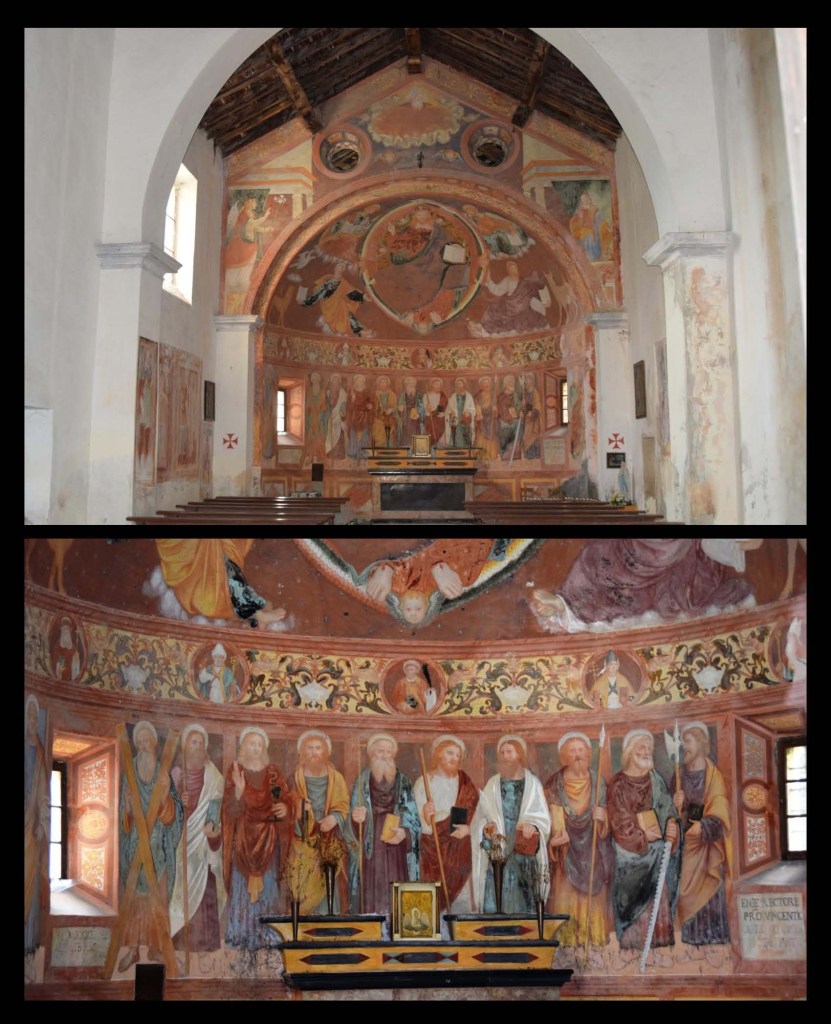
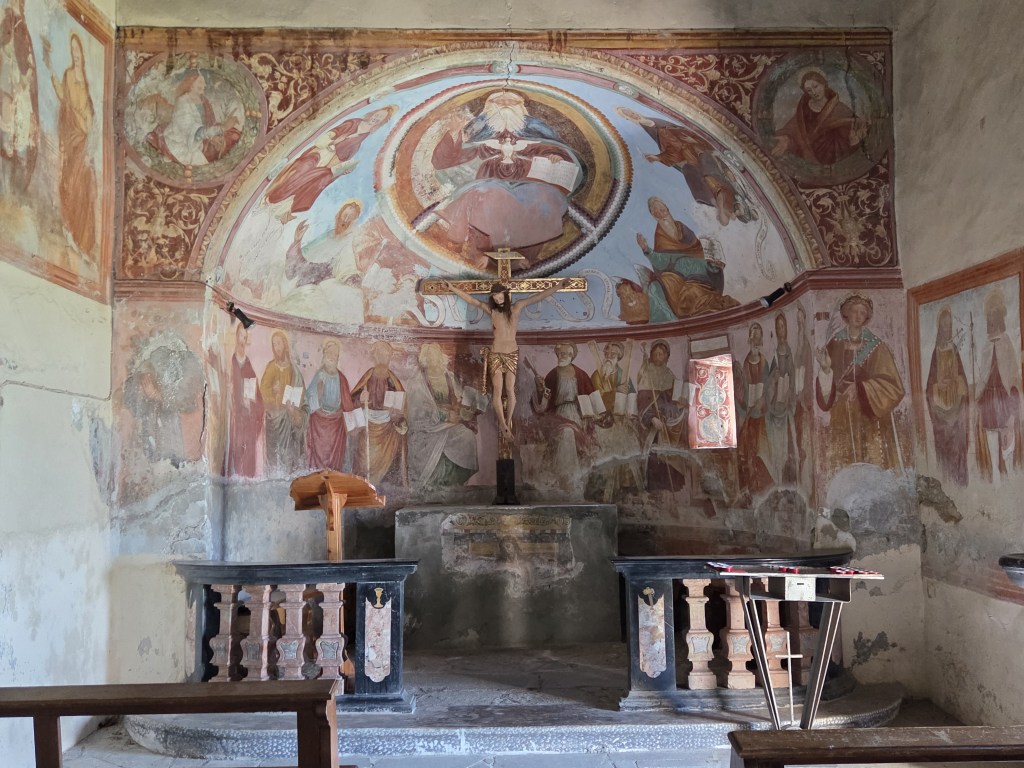
The imagery composition is theologically cohesive and reflective of the common themes found in the presbyteries of numerous Lake Como and Valtellina churches that have retained their Renaissance artworks. One often finds Christ the Redeemer or God the Eternal Father in a flaming sacred mandorla surrounded by the four Evangelists in the vault of a presbytery. In the surround behind the altar typically one finds the twelve apostles with Paul replacing the betrayer Judas. The triumphal arch corners usually have an Annunciation and the pilasters relevant saints – either protomartyrs or dedicatory saints for the specific church. The under-arch or conch will feature prophets from the Old Testament or doctors of the church. The Chiesa di Santa Croce reflects many of these motifs.
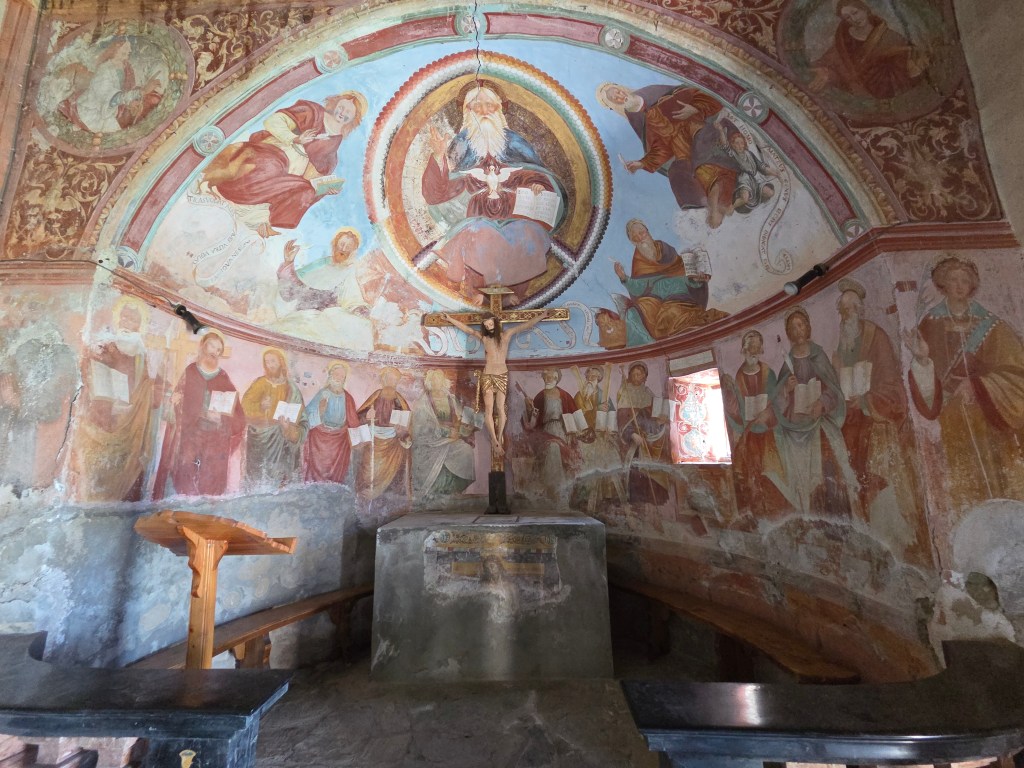
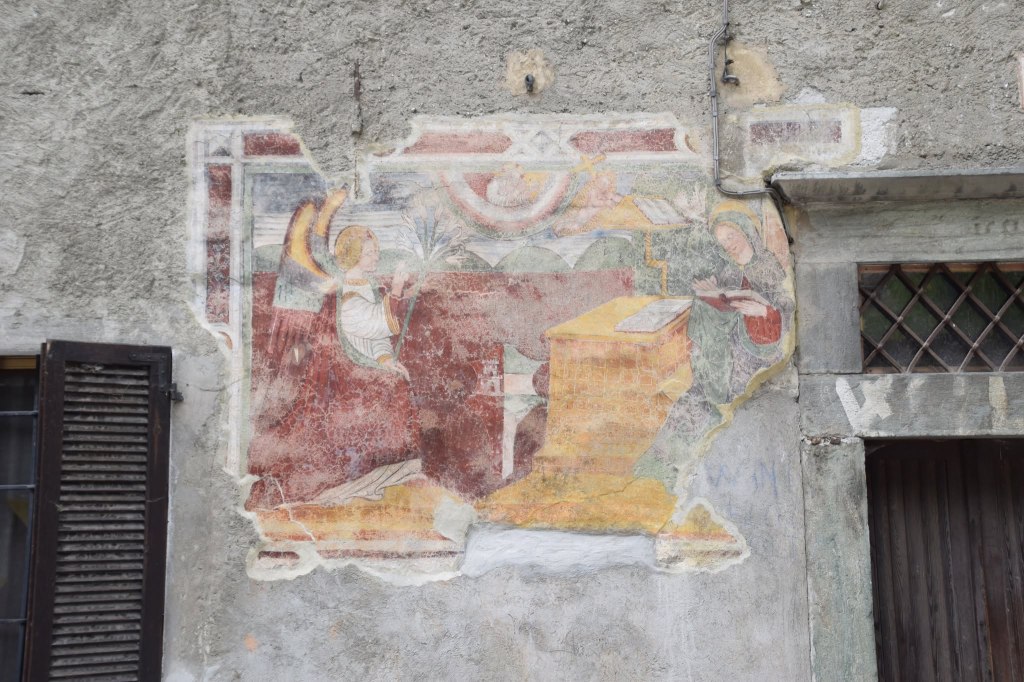
The triumphal arch is fully painted with an Annunciation. The elaborate decorative stenciling of the background of the Annunciation acts as a frame to the vault fresco of the enthroned Eternal Father. On the left is the Archangel Gabriel. He holds a white lily which symbolizes Mary’s purity in both body and soul. On the left is the young Virgin Mary with outstretched arms and open hands and a rather unhappy face. Her gesture and emotion present a very somber demeanor meant to symbolize the future sadness of the crucifixion. The emotive faces of the images reflect the changes beginning in Renaissance painting and a major difference between Sigismondo’s work and his father’s.
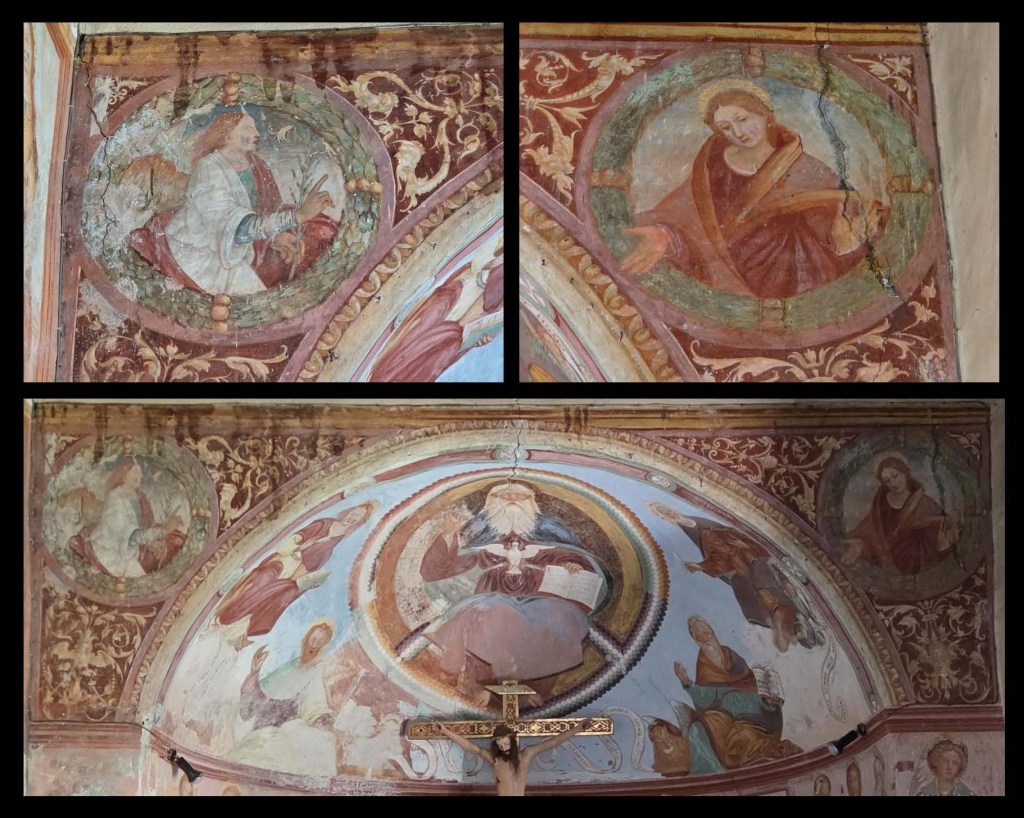
The conch or underside of the triumphal arch is simply decorative and does not depict biblical prophets or doctors of the church as is commonly the case. The motif features seven, white Templar crosses enclosed in green tondos. Between each cross the field is painted red as is the background of the tondos.
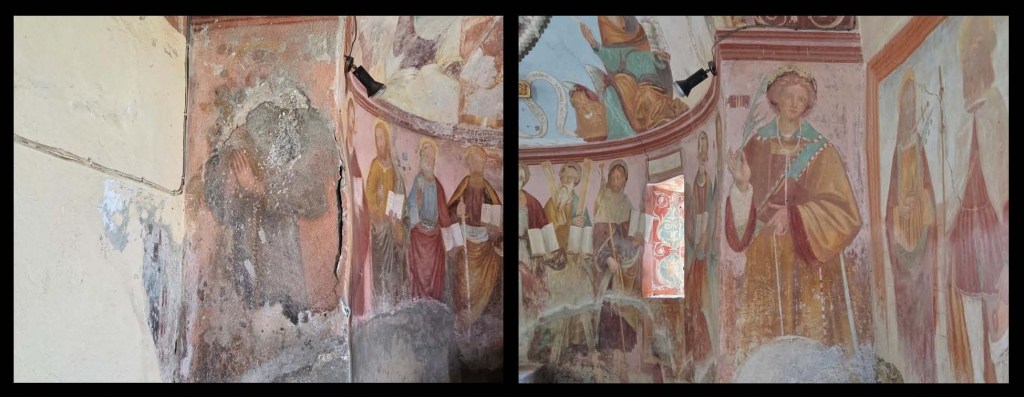
On the pilasters of the triumphal arch of the presbytery are frescoes by two different artists painting in two different time periods. On the right and painted in 1529 by Sigismondo De Magistris is the protomartyr San Vincenzo identifiable by his garments and the millstone associated with his death. San Vincenzo di Saragossa was tortured and killed and his body thrown in the sea tied to a millstone to prevent its recovery. But – according to his hagiography – he miraculously floated to the surface and was found by a woman who buried him with the respective rites.
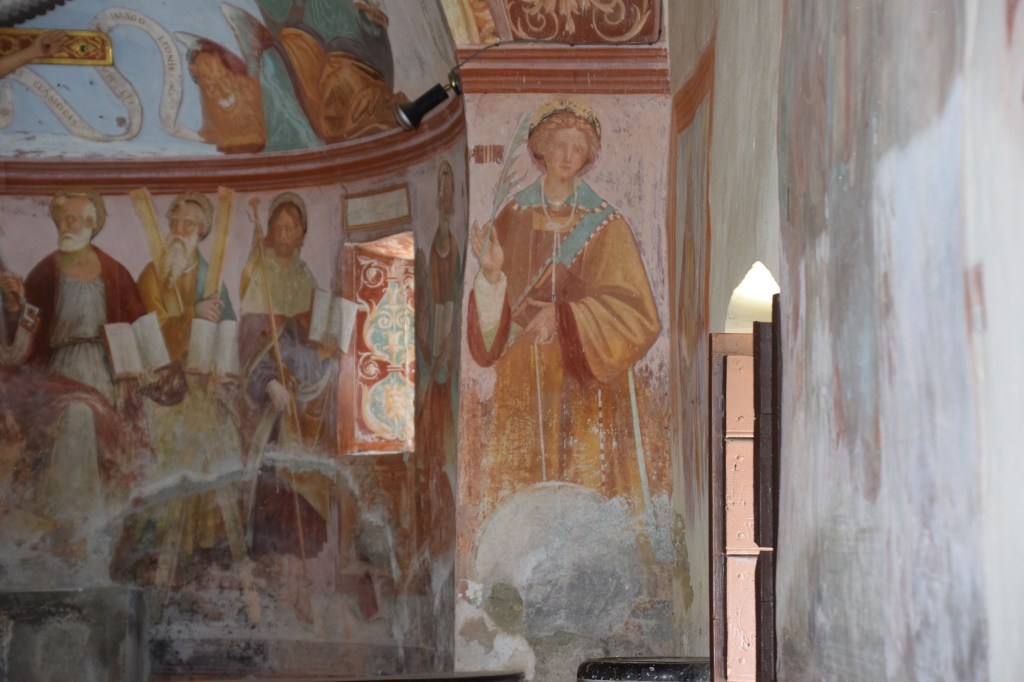
On the left pilaster is an eroded fresco of Santa Rosalia – the patron saint of Palermo, Sicily and a favorite saint of the men who emigrated from the Alto Lario – especially the Tre Pievi area of Dongo, Gravedona (Naro is included here), and Sorico – to Sicily for work bringing back prosperity and the saints they adopted from their journey. One can assume that based on the dedication of the nearby north wall chapel that the fresco of Santa Rosalia dates to the establishment of the patronage of Bartolomeo Albonico in this chiesa.
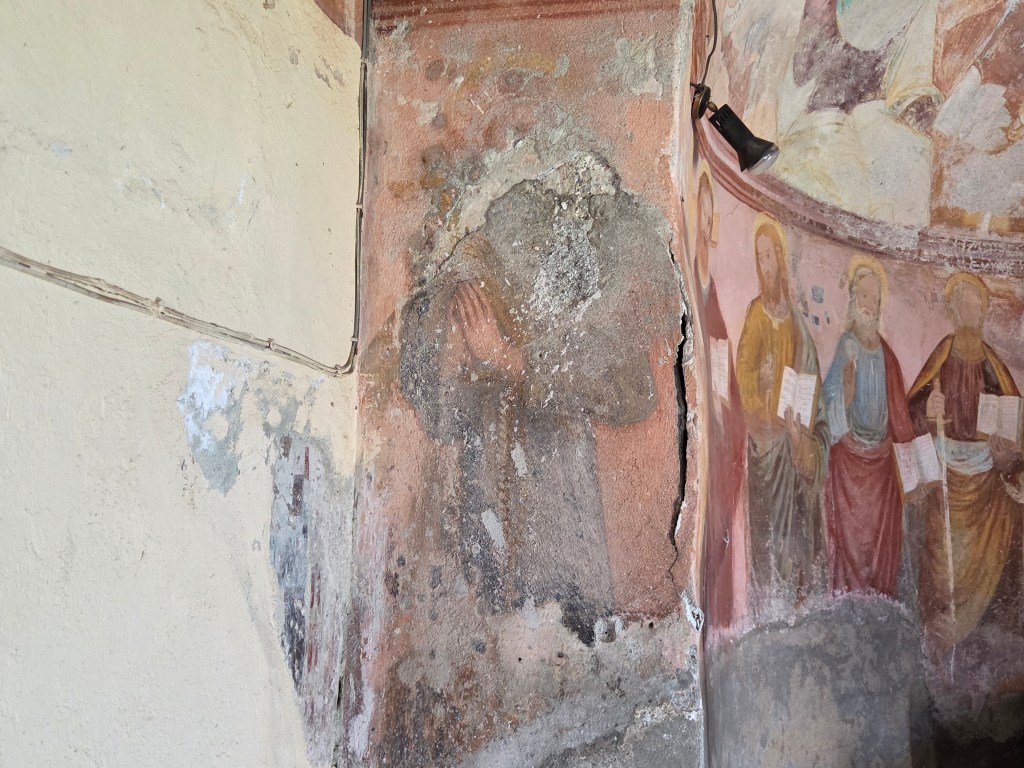
The artist responsible for the frescoes of the 16th-century north wall chapel is unknown as is the artist of the left pilaster of the triumphal arch. But one may posit that the image of Santa Rosalia, intentionally, was painted over an original image by the artist Sigismondo De Magistris in thanks for the success of the economic journey of the men who returned to their families affluent. These wealthy men formed brotherhoods and taxed themselves spending those monies on their villages by beautifying their churches and paying the best artists for their talents. It is not uncommon to find original frescoes overlaid with a new fresco often in a more ‘modern’ style and in keeping with the theme of a restoration of a church. An excellent visual cacophony of this phenomenon is found in the Basilica di San Zeno in Verona. It is certainly a difficult decision made by restorers of ancient churches as to which layer of frescoing should be preserved. The evidence is clear in the Chiesa di Santa Croce that the image of Santa Lucia likely dating to the late 16th-century was painted over an intact earlier fresco and this is seen in the example given below from the frescoes found in the Basilica di San Zeno Maggiore in Verona.
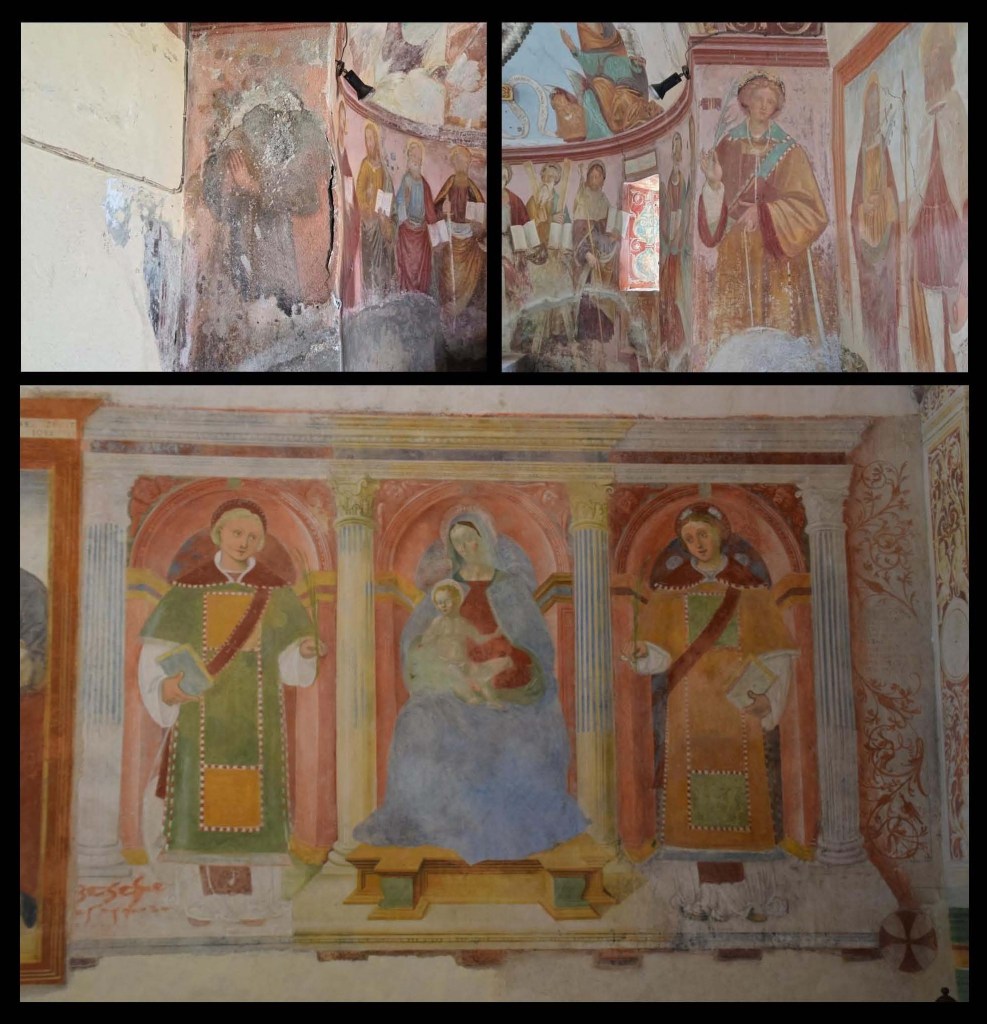
It is my opinion that the pilasters of the triumphal arch, which were originally painted by Sigismondo De Magistris in 1529, depicted two protomartyrs. San Vincenzo remains on the right pilaster and it is very likely that Santo Stefano was painted on the left pilaster. It is very common to find San Vincenzo and Santo Stefano depicted together in sacred art. They were Holy Deacons of the early Christian church and the first martyrs of their respective countries. And when depicted they generally flank a central figure – usually the Virgin Mary or Christ.
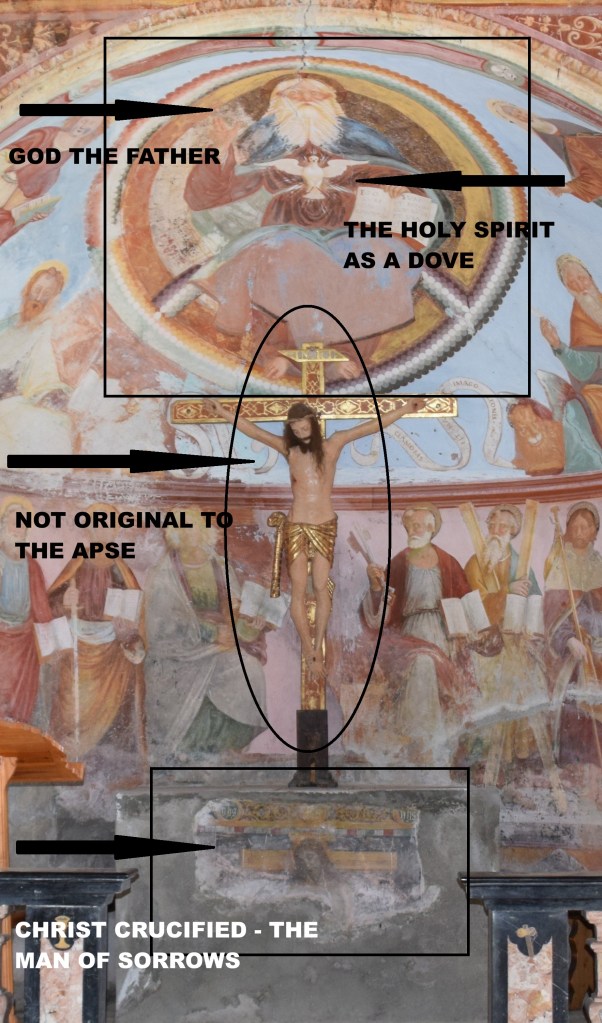
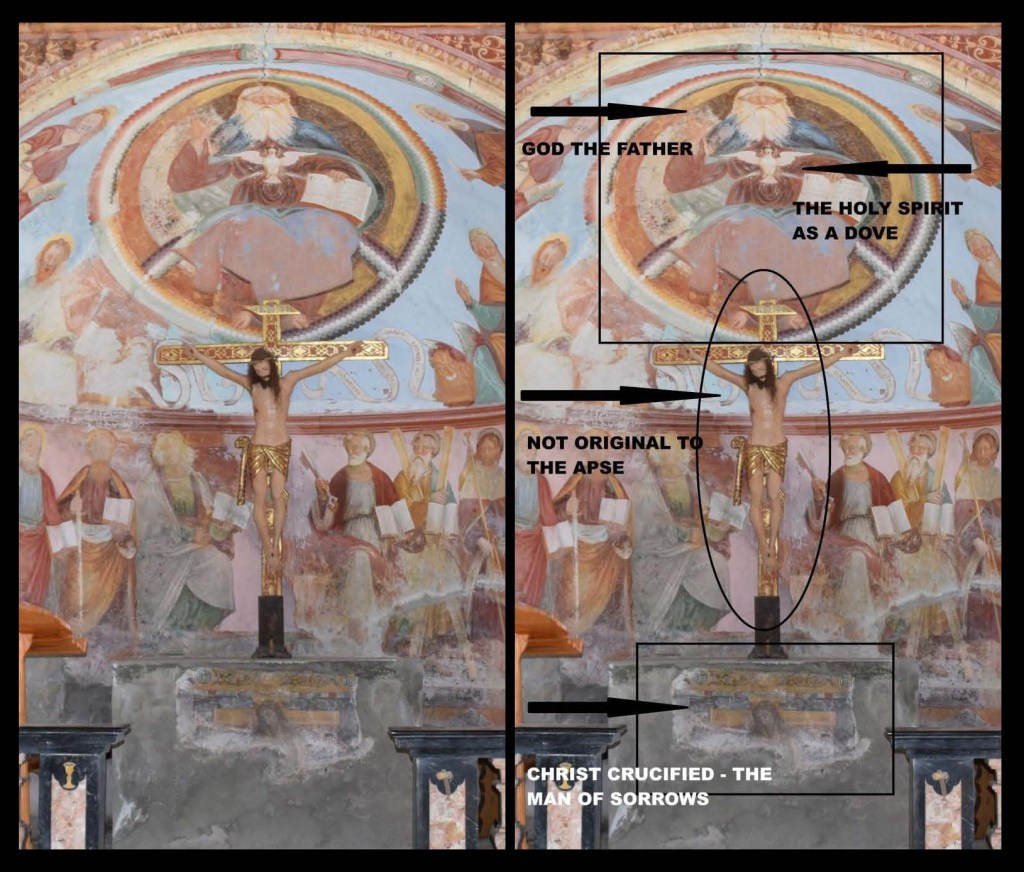
In the Chiesa di Santa Croce, they flank the presbytery fresco which depicts a type of Trinity with God the Father and the Holy Spirit represented by a dove in the apse and Christ as the Man of Sorrows frescoed on the front of the altar. Hence, it would be in keeping with the artistic preferences of the era for Sigismondo De Magistris to have painted these two saints on the opposing pilasters. Moreover, one would not see a protomartyr paired with Santa Rosalia.
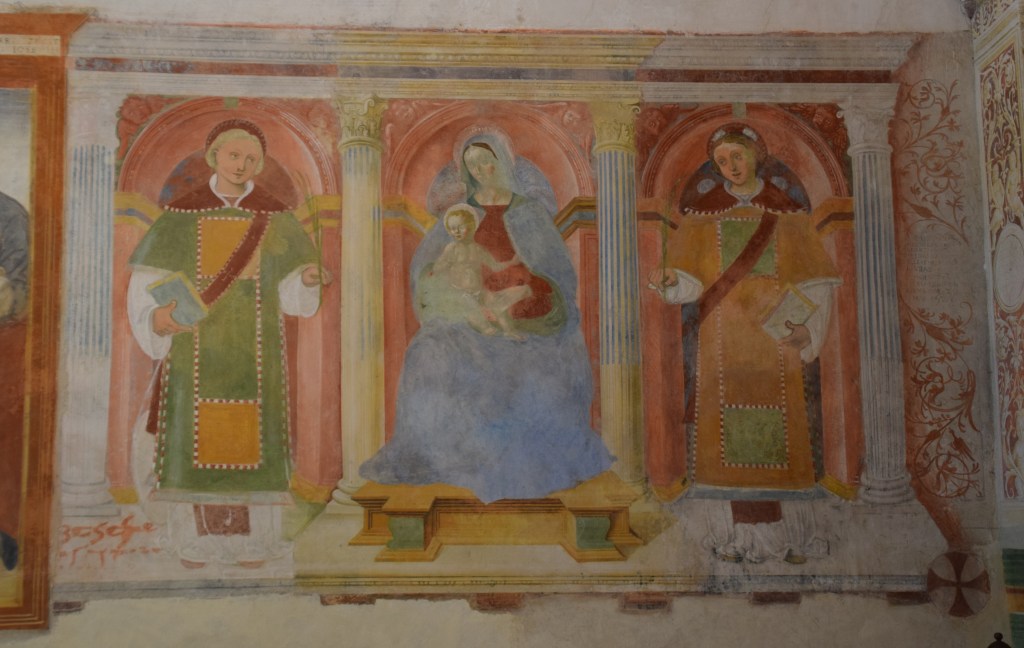
As additional evidence, I offer a presbytery fresco of both from the nearby Chiesa di San Giacomo Vecchia in Livo that was painted in 1526 by the same author – Sigismondo De Magistris. Here one sees both saints garbed in the dalmatics often associated with ancient deacons and, hence, these protomartyrs with San Vincenzo on the left and Santo Stefano on the right. As would be expected, they flank an enthroned Virgin & Child.
I make the point here that the literature available on the Chiesa di Santa Croce of Naro does not explain the original apse imagery as a Trinity. In the detailed photo below, I offer a depiction pointing out the components of the post-15th-century representation of the Trinity.
Prior to the mid 1500’s, the representation of the Christian triune godhead took a number of forms. For example, the monk Andrei Rublev (1360-1430) represented the Holy Trinity as three seated angels in the 15th-century. The Master of the Codex Rossiano (active ca. 1380–1400) in an illustrated Gradual installed a Trinity as three holy men seated on a throne of red Seraphim inside the letter B which begins the page for the Mass for Trinity Sunday: Benedicta sit sancta Trinitas (Blessed be the Holy Trinity). But the most notorious representation begun in medieval Europe and criticized at the Council of Trent then banned by papal bull were the depictions of the Trinity as three-faced or three-headed men. And because the banning required these images to be destroyed those that survive exist in museums and odd places where their placement allowed them to be passed over and/or forgotten. For a discussion of this representation, please see my blog “CASPANO – the frescoes of an ancient Paravicini family villa” at https://wallmadonna.com/2025/04/05/caspano/
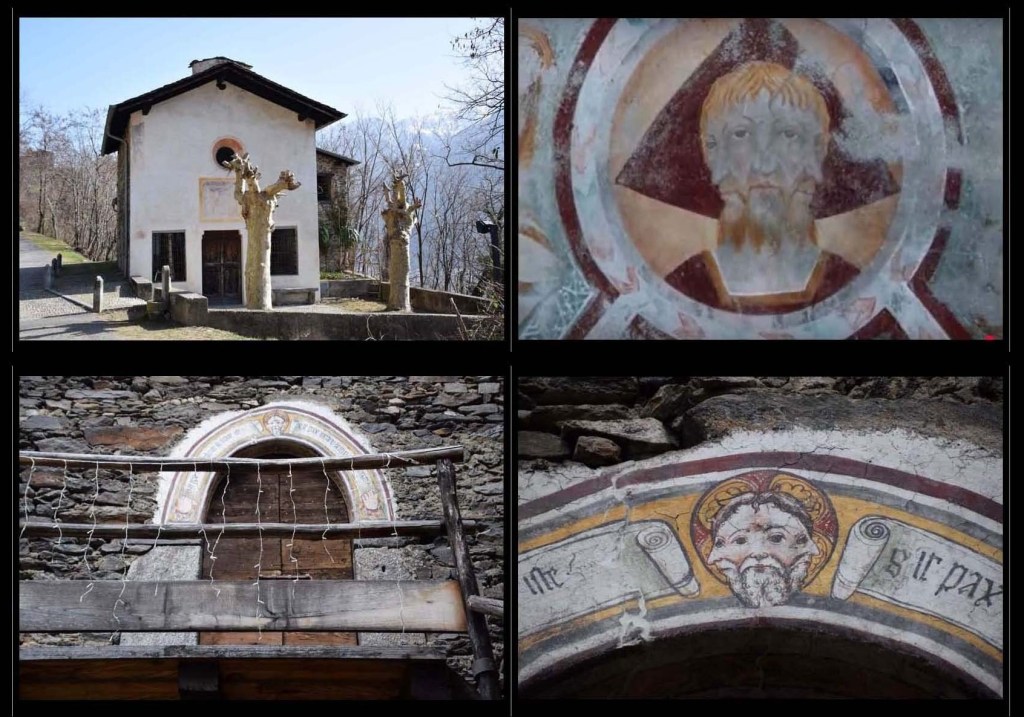
BOTTOM LEFT & RIGHT: SACCO mountain frazione of Cosio Valtellino! The Trinità Trifronte found on the lintel or architrave of the Museo dell’Homo Salvadego (“Homo Salvadego” is Latin for “Man Saves” but I think in this case it means “Wild Man”). The building dates to the 15th century and was privately owned.
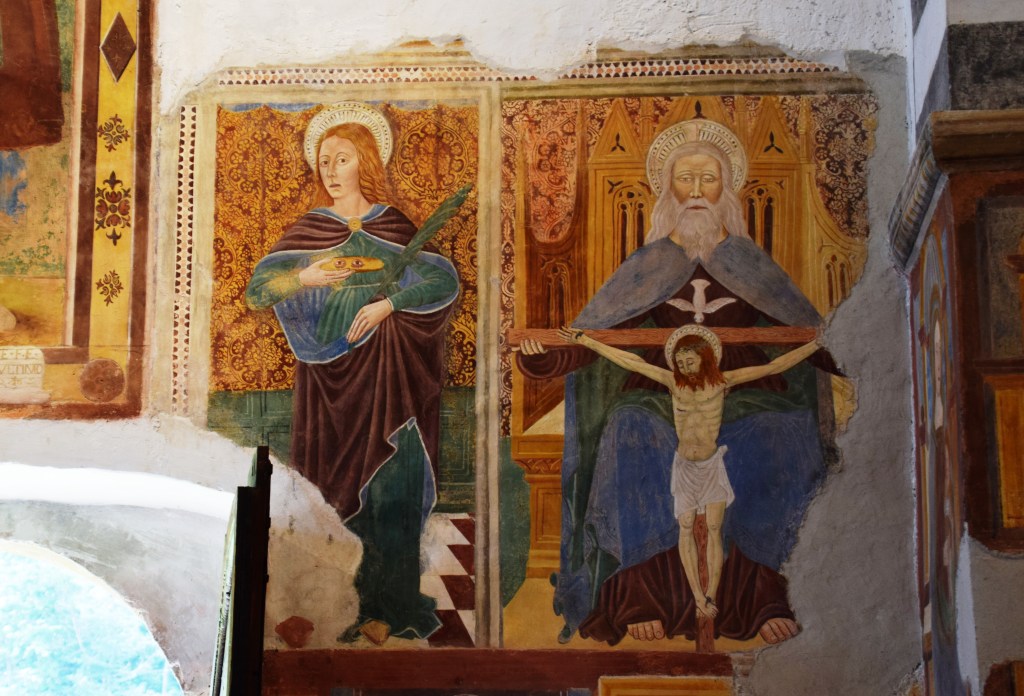
Although the imagery of the presbytery apse of the Chiesa di Santa Croce of Naro diverges slightly from the expected representations of that time period I still believe it is best described as a Trinity. I offer an example below from the Chiesa di San Giacomo Vecchia in nearby Livo. Interestingly, the fresco depicts the Sicilian saint Santa Lucia next to the Trinity.
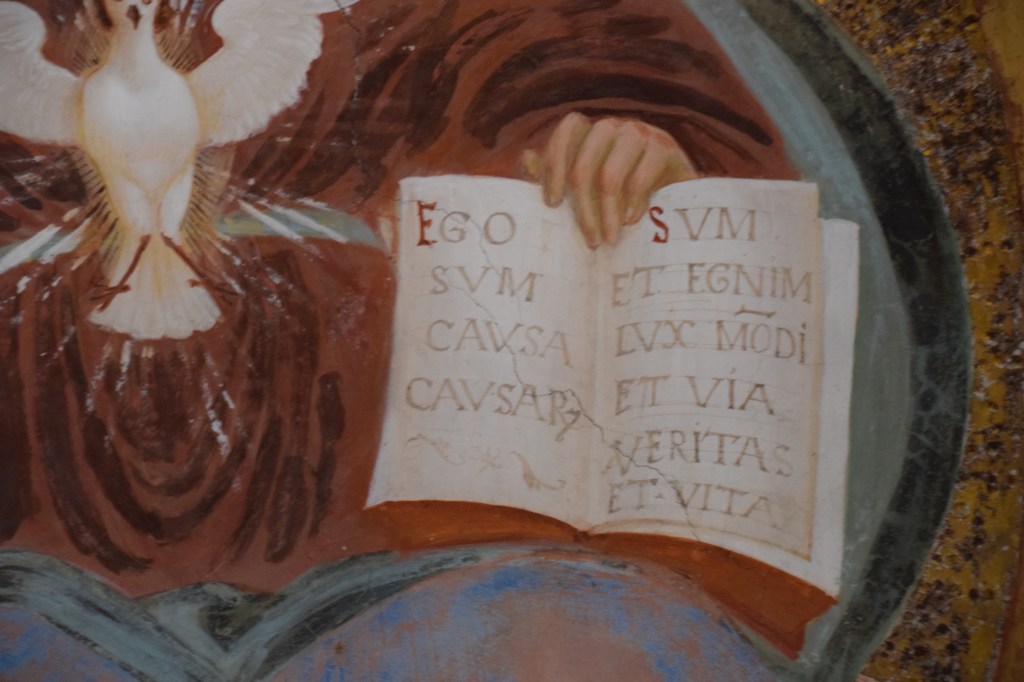
Additionally, the vault fresco presents God the Father enthroned in a sacred mandorla surrounded by flames. The godhead offers a gesture symbolic of the triune godhead with his right hand and holds an open book in his left hand with the Latin inscription:
EGO SUM CAUSA CAUSAR[UM]: I am the Cause of causes
SUM ET EGN[I]M: I am the Enigma
LUX M[UN]DI ET VIA: The Light of the world and the Way
VERITAS ET VITA: The Truth and the Life
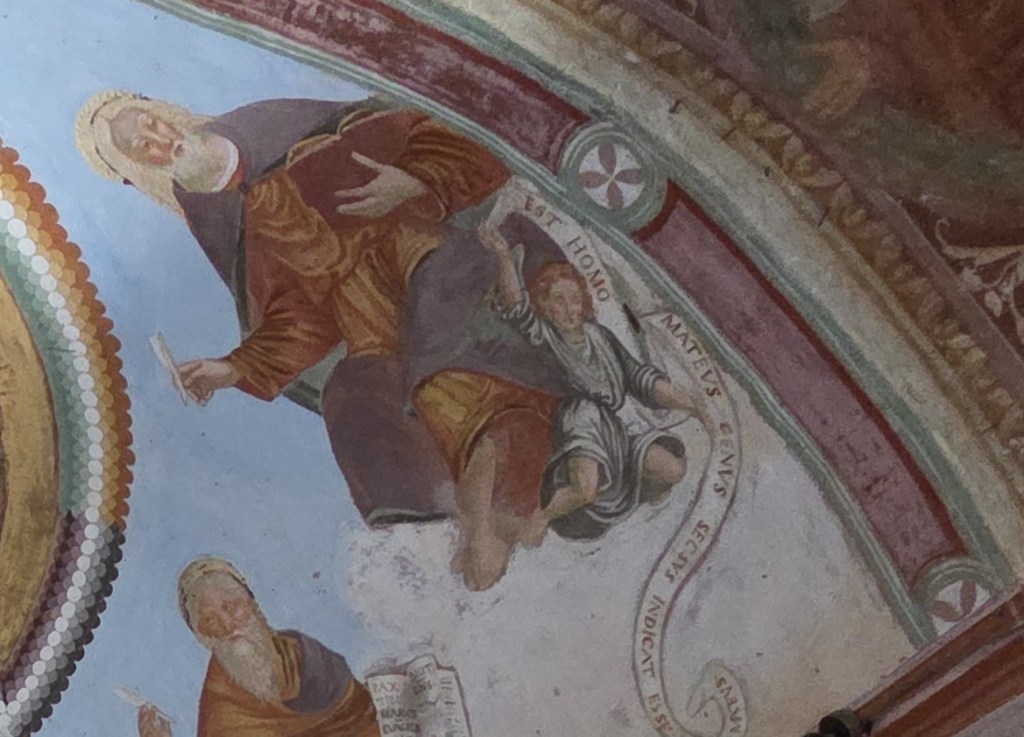
The four Evangelists – authors of the gospels – surround the enthroned Eternal Father. On the left at the top is an unbearded John the Evangelist. The Eagle with which he is usually depicted is eroded. The eagle symbolizes divinity. However, the furling banner proclaims his name. Some of the Latin words on that banner are: Trasuolat Ales Aues Ultra Volai …tra Iovanes. The phrase references ‘the wings of the eagle soar beyond the limits’ but the missing word makes the phrase incomplete. Beneath him is Luke who is depicted with an ox and a similar banner with his name in Latin. The banner is not legible. The ox symbolizes sacrifice. On the right at the top is Matthew with a winged man who symbolizes humanity. His banner is legible and reads: Est Homo Mateus Gensus Secsus Indicat Esse Mateus. I believe the phrase should read: Est Homo Matthaeus; Census Indicat Eum Esse Matthaeum – There is a man named Matthew; the book indicates that he is Matthew. Beneath Matthew is Mark with the lion that symbolizes royalty. Mark’s banner reads: Munere Clamoris Fit Marc Aus Imago Leonis – By virtue of his outcry, Mark becomes the image of the lion
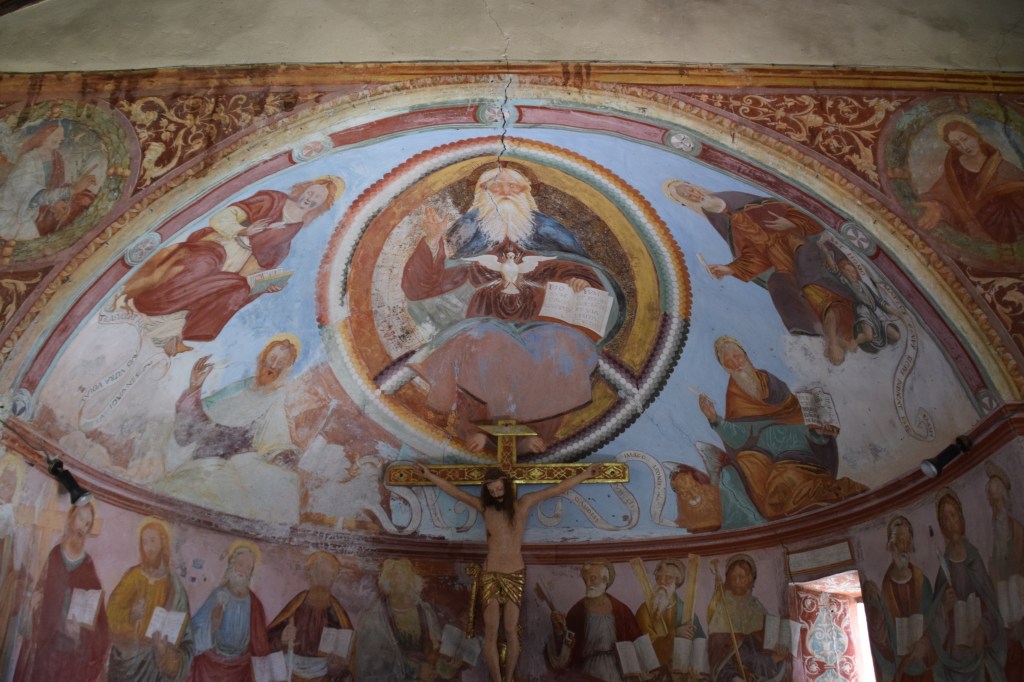
The apostles frescoed beneath the vault and behind the altar are identifiable by the book each holds in his left hand which proclaims his name – except for the apostle Thomas who holds the book in his right hand. Each apostle holds in his right hand an object associated with his life or martyrdom. For example, Andrew holds the saltire (X-cross) of his crucifixion. Simon the Zealot holds both the palm frond which is the generic symbol of martyrdom and a long strip of leather which is associated with him as the patron saint of tanners. Exceptionally, Thomas holds the object of his Martyrdom in his left hand – a lance. I note here for consideration that in the imagery of the apostles John the Evangelist is depicted as elderly with a white beard. As an Evangelist in the vault, he is young and unbearded. The only other unbearded male in any fresco is San Rocco from the north wall plague fresco which I attribute to Sigismondo De Magistris. Also, the addition of the crucifix ruined a thirteenth image frescoes in the center of the apostles. That image was almost certainly Jesus.
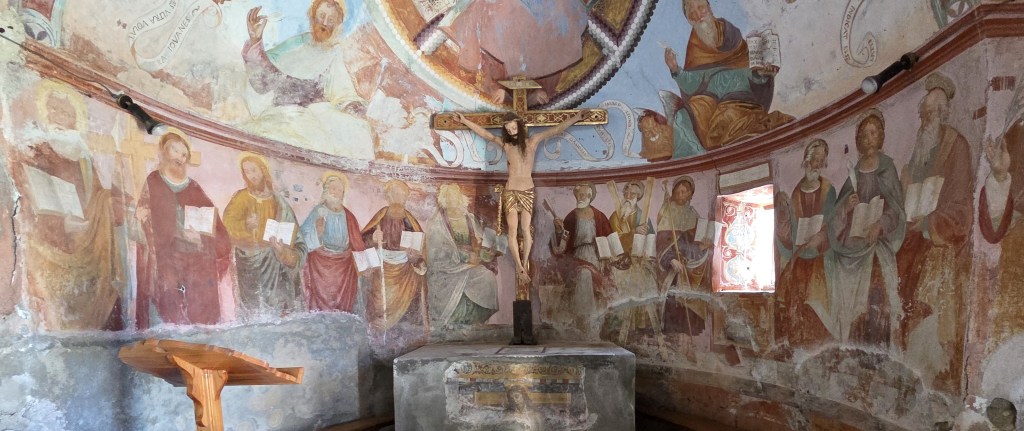
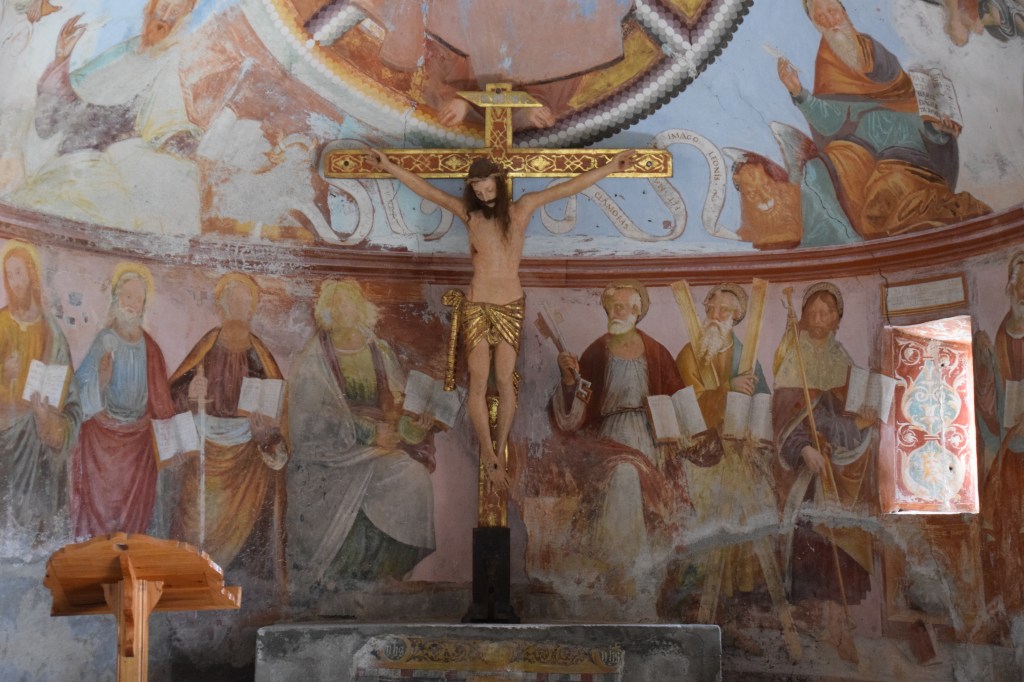
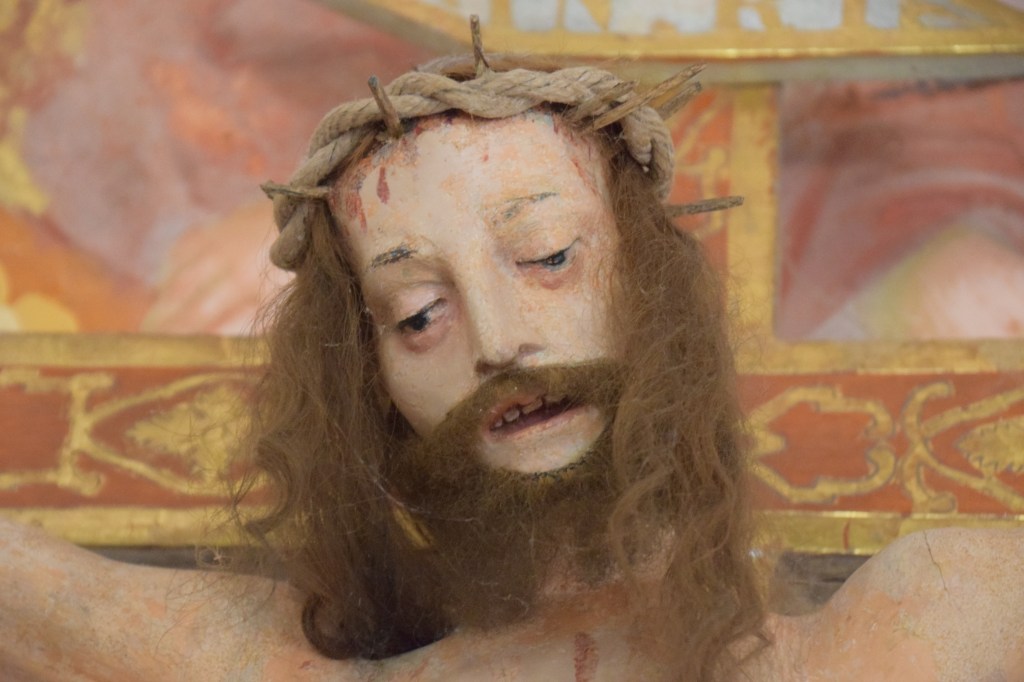
Attached to the vault and sitting on top of the altar is a crucifix. The figure of Jesus is distinctive in that actual human hair has been used for his head and beard. Further, his eyes are open which the caretaker Angelo considers unique. A close inspection of the figure of Jesus at the attachment point of his hands indicates that the cross and carved Christ were not originally paired. The cross has holes where a different sculpted figure with longer arms was previously attached.
The base of the cross had the stemma or coat-of-arms of the first donor of the crucifix. It has been removed. Online searches focused on this crucifix return results that stipulate the wooden sculpture is from the late 1500’s. However, because of the way the responses are written one cannot tell which is being dated – the figure of Christ or the cross. Since they were not an original pair, it is crucial to know which is being spoken of.
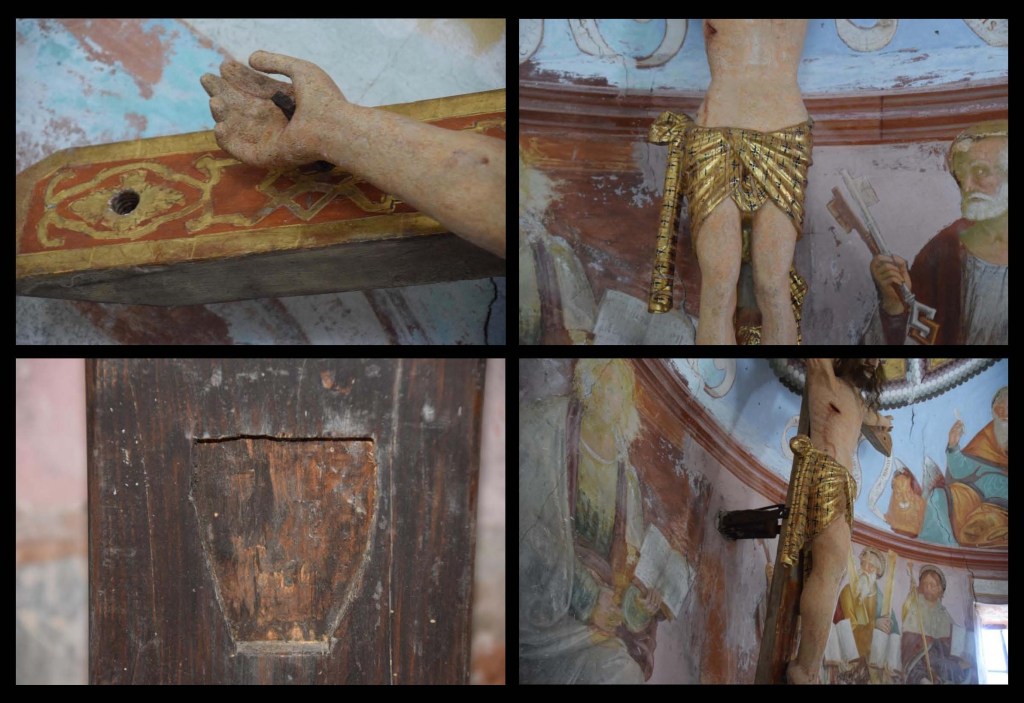
TOP LEFT: Attachment point for Christ’s hand showing the original body of Christ on the cross had longer arms;
TOP RIGHT: the golden loin cloth of Christ;
BOTTOM LEFT: Base of the cross with the incision where the original stemma of the donor was placed;
BOTTOM RIGHT: Attachment point to the vault which shows the ruination of a central 13th figure in the depiction of the apostles.
The figure of Jesus is clothed in a very colorful golden loincloth. This is not usual as one generally sees Jesus with a plain white loincloth. I do not know if the figure of Jesus and the cross are the same age. They may not be. According to the caretaker – Angelo – this cross was carried up to Naro by foot in a procession from Gravedona on the lake. A close inspection of the attachment of the cross to the apse fresco shows that there was a thirteenth figure flanked by six apostles to either side. Attaching the crucifix destroyed the original frescoed figure. That figure would have been Jesus.
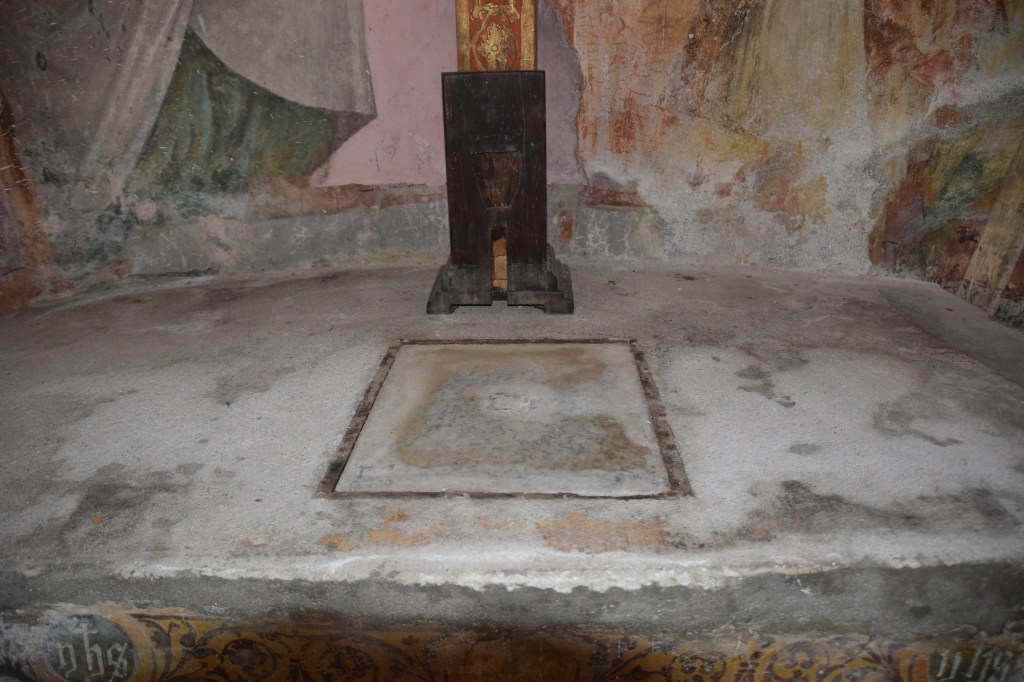
The front altar table on which the crucifix sits and which has the partially eroded remains of a beautifully rendered Man of Sorrows (historically called in Latin: Imago Pietatis – Christ of Pity) painted on the frontal by Sigismondo De Magistris, also is inset with a cavity into which relics would have been placed. The stone that sealed the cavity would have been consecrated during a solemn ceremony. There is some doubt as to whether or not the Chiesa di Santa Croce contains saintly relics historically mandatory to make a Catholic church eligible for consecration. I note that the online searches of the church claim that there are no relics here. However, for most of Catholic history some part of a saint was needed for any Catholic church to be consecrated. The Chiesa di Santa Croce dates to the 12th or 13th-century and was frescoed in the first half of the 16th-century. The original consecration crosses still decorate the interior walls. (The caretaker Angelo believes these are the marks of the Templar Knights!) Hence, I take the strong posiiton that the altar must contain relics of a saint since the practice was mandatory until the second half of the 20th-century.
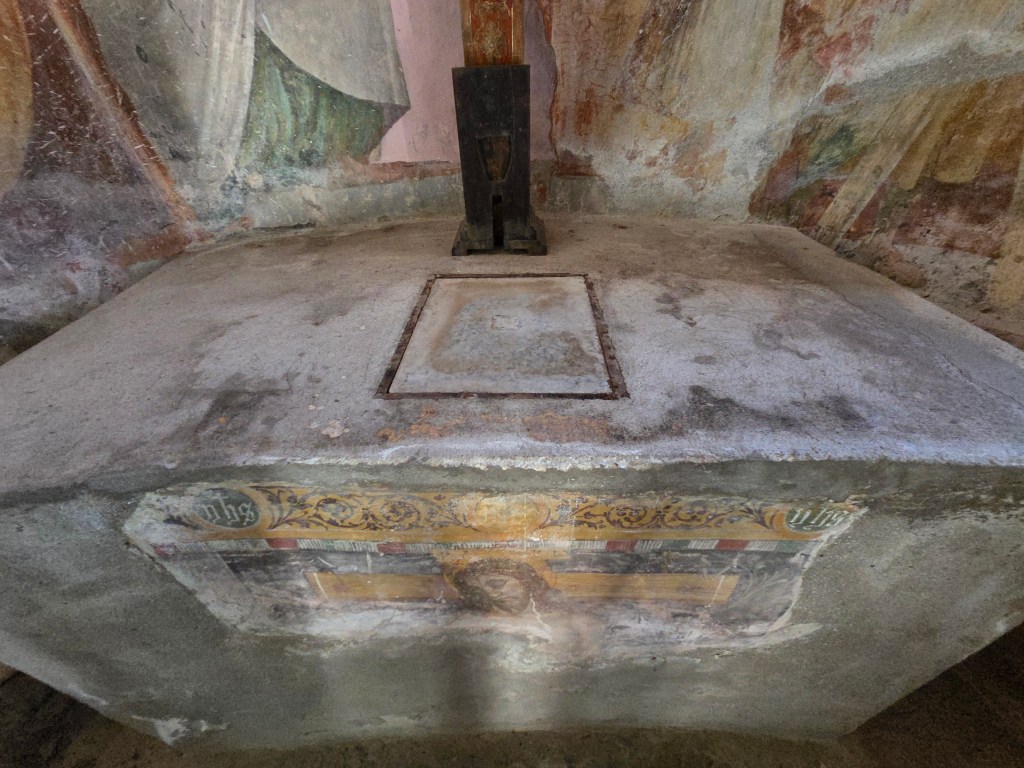
Today the practice has been loosened somewhat (since the late 1960’s) and is considered obligatory but not mandatory. But at the time this church was consecrated it was mandated by church law being made so in 787 at the Second Council of Nicaea https://www.papalencyclicals.net/councils/ecum07.htm
For the modern practice, see: https://www.vatican.va/archive/cod-iuris-canonici/eng/documents/cic_lib4-cann1205-1243_en.html
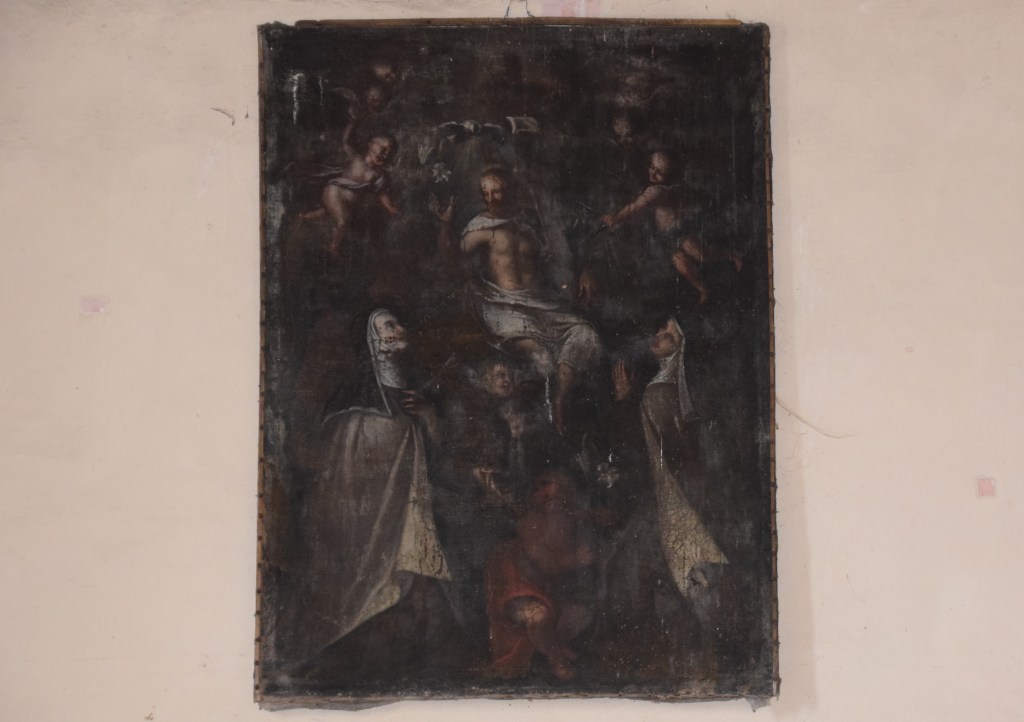
Above the church entry doors on the west wall is an unframed painting by an anonymous artist that could be dated to the 18th or 19th-century. Because my focus has been the frescoes of the Chiesa di Santa Croce, I have not discussed this artwork. It is very dark and badly in need of cleaning but it depicts a Trinity with an ascended Christ venerated by two Carmelite nuns one of whom is most likely Saint Theresa of Avila (1515-1582). This creates a lovely symetry between the presbytery apse Trinity of the east wall at the front of the church and this Trinity on the west wall at theback of the church both embracing the worshippers in the theology of myteriesand miralces on which Christinaity was founded.
If the west wall painting of the Trinity is from the 19th-century the other nun in the work could be Saint Theresa Lisieux (1873-1897). Both Theresa’s are doctors of the church and, hence, often depicted together. If the painting is older the other nun is probably Blessed Ann of Jesus who was the companion of Theresa of Avila.
Alternately, the nuns may be generic and the painting a transverberation – the veneration of a vision of an ascended, crucified Christ by Carmelite nuns whose hearts are pierced by his love. A close inspection of the work shows the left arm of Jesus around the cross with the Holy Spirit and God the Eternal Father above. The sacred beings are surrounded by cherubs and the nuns below are, also, surrounded by cherubs. The artist of this work was talented. The painting was rendered on canvas and it may have previously been in a frame. It looks like someone placed it there for balance – a way to fill and large white space and to fill it in a meaningful way.
I began writing this post with the modest goal of righting four errors/discrepancies/omissions that I found in the available online literature about the church – which literature is far from extensive and not at all sufficiently informative for the curious. As I started to explain my reasoning and offer evidence for my positions, the narrative simply kept growing until it reached its present state of dozens of photos and over 10,000 words. For your information, below are the reasons I engaged this task:
Error (1): The Chiesa di Santa Croce does not contain saintly relics historically mandatory to make a Catholic church eligible for consecration. The church does hold the relics of a sant in its altar.
Omission (2): The discussion of the presbytery imagery is incomplete and not fully informative. There is no mention made in any of the literature that the presbytery apse fresco was intended as a Trinity. Nor is there any discussion of the addition of a crucifix which ruined the frescoed figure of what was certainly Jesus standing between his apostles (which would be further evidence of the rendering of a Trinity in the presbytery apse by Sigismondo De Magistris).
Opinion (3): There are declarations that Santa Rosalia di Palermo was painted over a previous fresco on the left pilaster of the triumphal arch. However, there is no mention of who was depicted in the original fresco nor any mention made that it was certainly the original work of Sigismondo De Magistris. The original pilasters featured two protomartyr saints – Vincenzo on the right which remains intact – and Stefano on the left which was painted over with an image of Santa Rosalia – both the work of Sigismondo De Magistris.
Error/Discrepancy (4): The south wall fresco – a plague Madonna with Santa Lucia di Siracusa, San Rocco, the Madonna & Child, San Sebastiano, and Sant’Antonio Abate – is identified in some sources as being painted by Sigismundo De Magistris. This fresco was actually painted by his father, Andrea De Magistris, whose signature is inscribed in a tondo in the base of Mary’s throne.
The Chiesa di Santa Croce, localitá of Peglio, in the Alto Lario, approachable only by foot on an age-heaved stone and dirt sentiero, embraced by chestnut woods, ancient, tiny, host to Templar Knights, beloved of long dead local emigrees, and still bright with mid-Renaissance art actualized in the Romanesque style deserves more discussion, more examination, more accurately crafted and informative sources – and more than one visit!
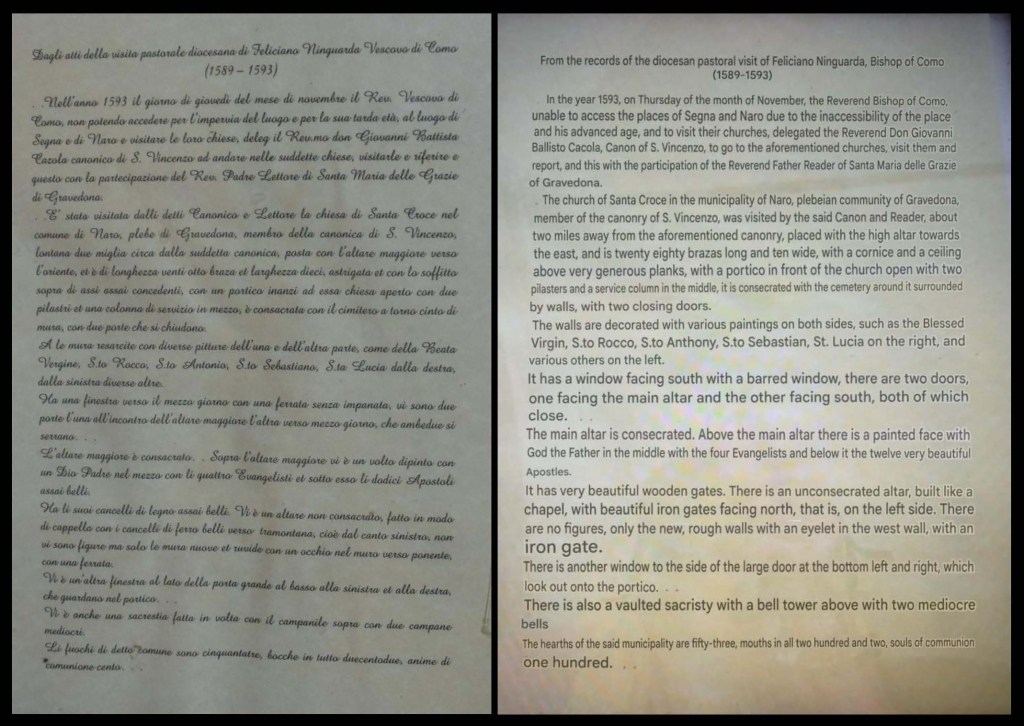
POST SCRIPT: The church has a plaque which displays the discussion of a pastoral visit to the church made in 1593 by the Reverend Don Giovanni Ballisto Cacola, Canon (an ordained member of the clergy assigned to a specific parish) of the Chiesa di San Vincenzo which lies on the lakefront in Gera Lario. This documentation confirms a number of things: 1: the south side door was present; 2: the sacristy and bell tower were present; 3: the current crucifix was not present; 4: the side chapel dedicated to Santa Rosalia was established but undecorated at that time and the altar was unconsecrated; 5: the front altar had wooden gates; 6: the main altar was consecrated which means the relics of a saint had to have been installed; 7: there were 202 residents living in 53 residences (this does not means there were 53 distinct houses); 8: only about half of the residents were eligible to receive communion which means there were many children and/or a population of residents who were not Catholic; 9: getting to Naro was a difficult walk since the priest in change had to send a younger man to do it; and 10: the size of the church was measured using the length of the Milanese “braza” – the length of a man’s outstretched arms. At the time 1 braza = 59.49 centimeters. The church being 28 x 10 braza was equivalent to: 166.572 meters x 59.49 meters or 54.65 feet x 19.5 feet.
CITATIONS:
NOTE ON THE IDENTIFICATION OF GIOVANNINO AS ARTIST
*Guide to the Province of Como: Western Alto Lario. Revised English Edition, 1997. ISBN 88-7185-053-5
NOTE ON THE ARTIST MENCIO ANESI DA BORMIO
**The historian of Alta Valtellina, Ilario Silvestri, has established, through his research and historical documents available in Sondalo and Bormio, that Giovannino da Sondalo was a dignitary and patron, not an artist. The paintings attributed to him in Valtellina and Alto Lario were actually created by Mencio Anesi from Bormio, who worked with his brother Nicolò. I quote some quotations for reference: Illario Silvestri, The Baths of Bormio and the Sources of San Carlo, Page 41 (and footnote 6) of Giornati Bormiesi di Cardiologia, Extract from “The Waters of Alta Valtellina”, Bormio 2014, Edited by Livio Dei Cas and Leo Schena, Illario Silvestri, The Baths of Bormio and the Sources of San Carlo
Illario Silvestri, Menico Anesi e il crocifisso del Cortivo, Centro Studi Storici, Bolletino 18/2015, p. 143-165
In the town of Sondalo the information sign for the Chiesa di Santa Marta notes: The frescoes, of “careful, tasty, almost Flemish workmanship, technically similar to miniature and even more so to engraving”, due to a misunderstanding that arose in the 1960s, are commonly attributed to Giovannino del fu Stefano di Sondalo (Giovannino son of the late Stefano from Sondalo); this influential local figure, believed by many to be the author of numerous works of art distributed in the Bormio area, does not, however, seem to have ever tried his hand at painting himself. Archive documents only show him as the patron of a fresco (now lost) in Morignone, in Valdisotto. Cipriano Valorsa and Fermo Stella, on the other hand, certainly worked in the church.
 Wall Madonna's of the Valtellina