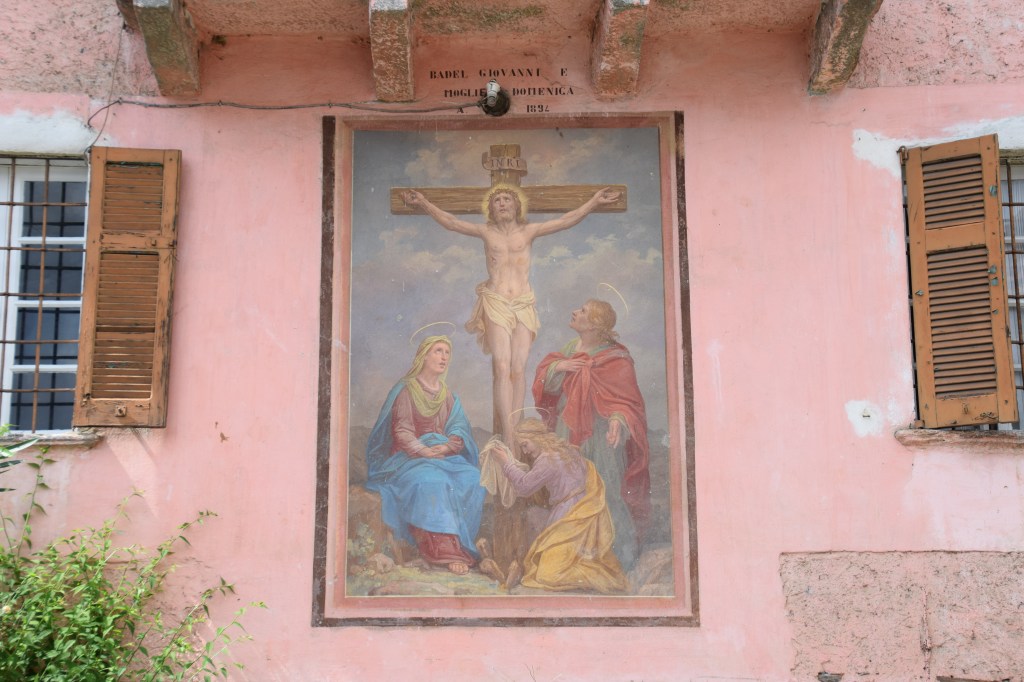
Because I was in the commune of Montemezzo to revisit the 16th-century frescoes by Aurelio Luini in the 14th-century parish church of San Martino, I decided to explore a nearby frazione – Burano. Actually, I wanted to get above the church to take a photograph. To do that I walked up the old mulatierra that leads into the mountains – first to the last of Montemezzo’s five frazioni – Montalto – and then up to Alpe Piazza at 1260 meters – 758 meters above Montemezzo.

I walked far enough – or rather high enough – to capture a photo – marred unfortunately by electrical wires and a home sitting next to the frescoed church that I love – when I saw a Madonna shrine and continued on for more photos.
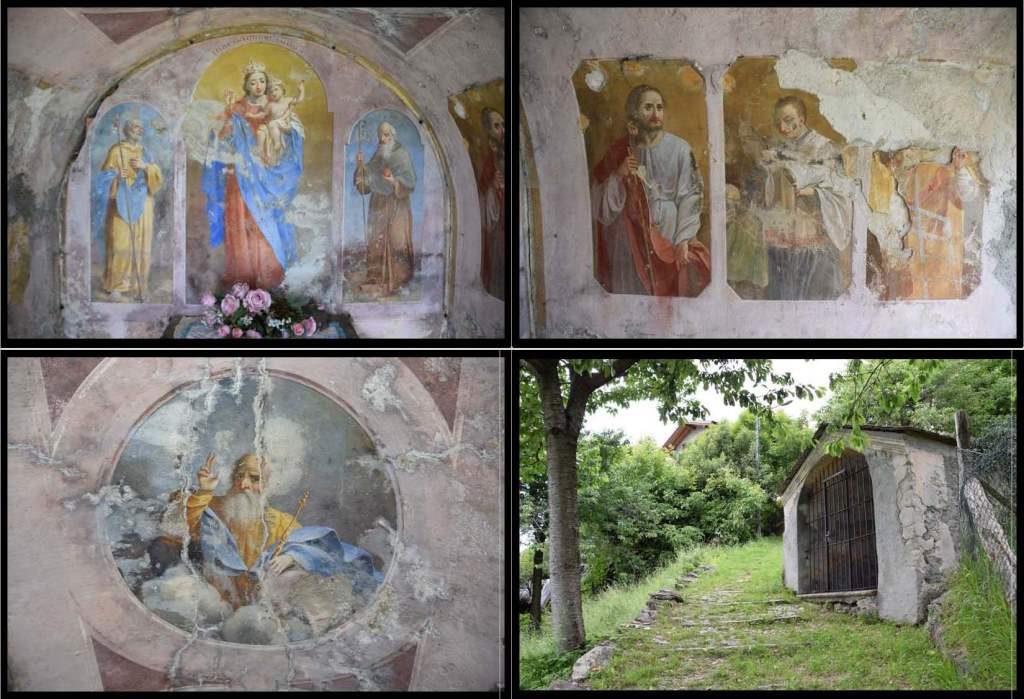
The shrine sits at the edge of Burano – 30 meters above Selva – the frazione where the Chiesa di San Martino is located. As can be seen even in its deteriorated state, this is still an elaborate shrine. The Madonna and Child are flanked by St Giuseppe on the left and San Antonio Abate on the right. The right part of the triptych shows three male saints. I know for sure that the saint on the far right is the protomartyr Santo Stefano. I think the saint on the left might be St Joseph. The center saint – I honestly do not know but he is clothed in more modern priestly attire. The left triptych section is gone completely but the saint’s names remain. They were all female and they stood – left to right – St Rosalia – St Agnes – and the Magdalene. The ceiling has the lovely painting of God the Father.
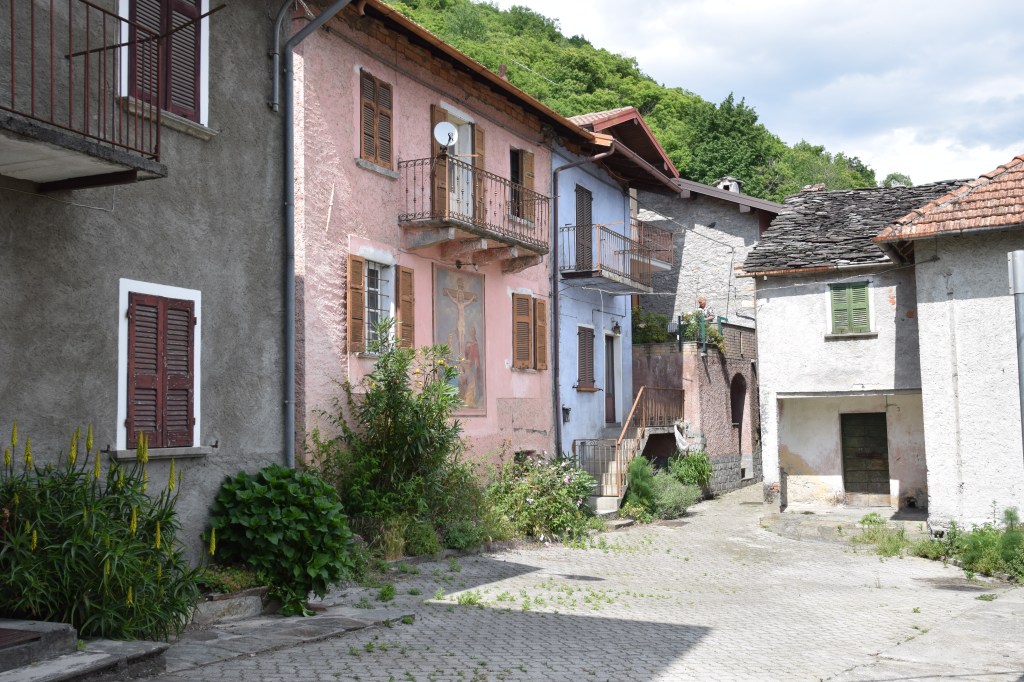
And since I was there and because I saw a sign above for ‘Piazza Vecchia’ – Old Square – I thought I might find some Wall Madonna’s. I did! This small frazione of ninety inhabitants has a cluster of houses around a central and very narrow ancient street. That street – via Sceresin – was Wall Madonna paydirt!
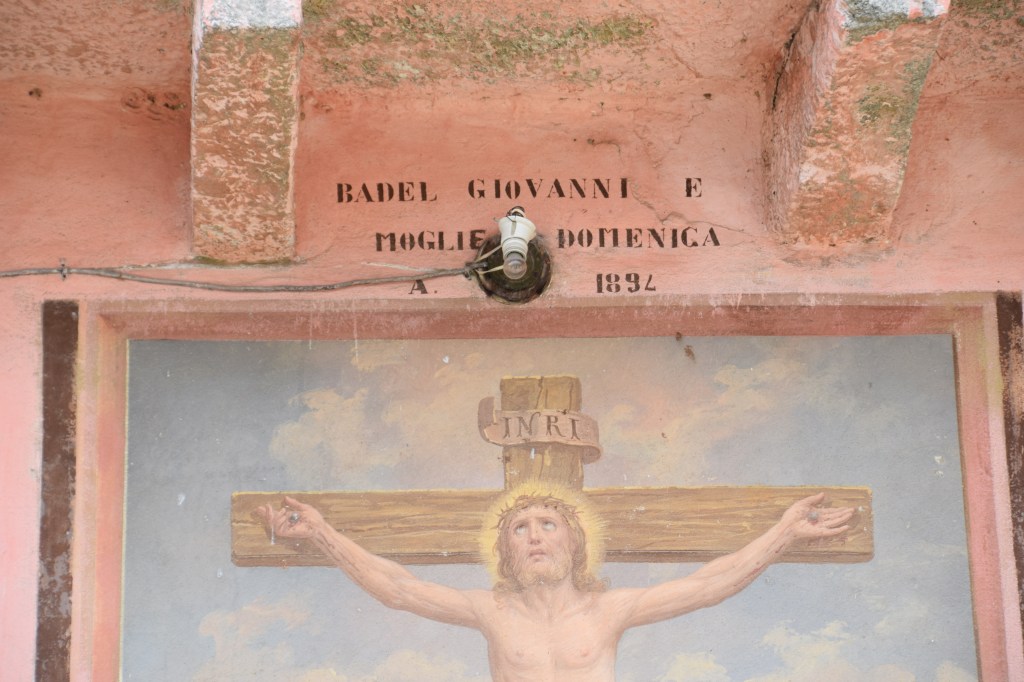
The fresco was painted in 1894 and dedicated by Giovanni Badel and his wife Domenica. As is often the case, the addition of a ‘modern’ electric light to illuminate the artwork and ‘broadcast’ the devotion of the donors, mars the wholeness of the artwork and obscures what was the specific month and day the fresco was finished. But although not what one might do today – the desire to make the dedication more public by lighting the fresco at night shows the importance of the language of faith to the local inhabitants. It is important to note that it is usual to paint the three Mary’s at the crucifixion. The intentional omission of Mary – the mother of the sons of Zebedee – and in favor of St John (Giuseppe in Italian) may reflect a courtesy to the donor – Giuseppe – who shares the saint’s name.
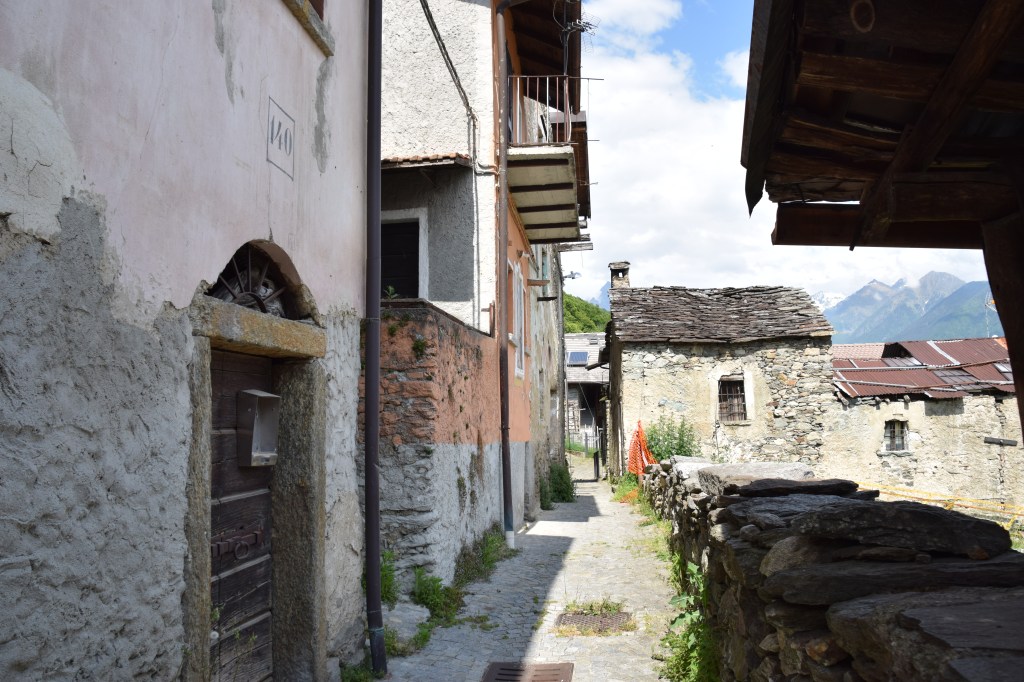
This is via Sceresin. It travels the length of the small hamlet and at its center is the Piazza Vecchia. The street is narrow and the homes here grew outwards slowly from this central way that connected to the mulatierra – the only road to these altolario villages in the past. There is no way the access these internal homes by car. one must park in lots and spaces on the ‘new’ carriage road that snakes its way up the mountain from Lake Como and through all the frazione. The road – officially called Strada Provinciale 1 (SP1) – changes names once it reaches a hamlet. Hence, where is initiates at the lake it is called via Montemezzo. As it passes through Montemezzo the names changes to via Burano.
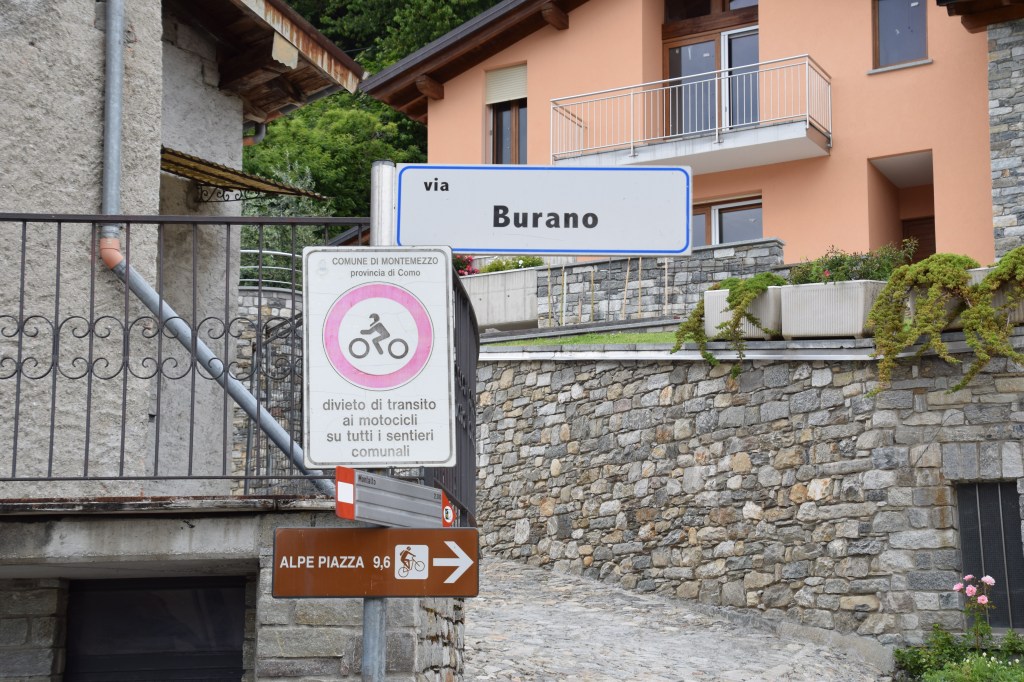
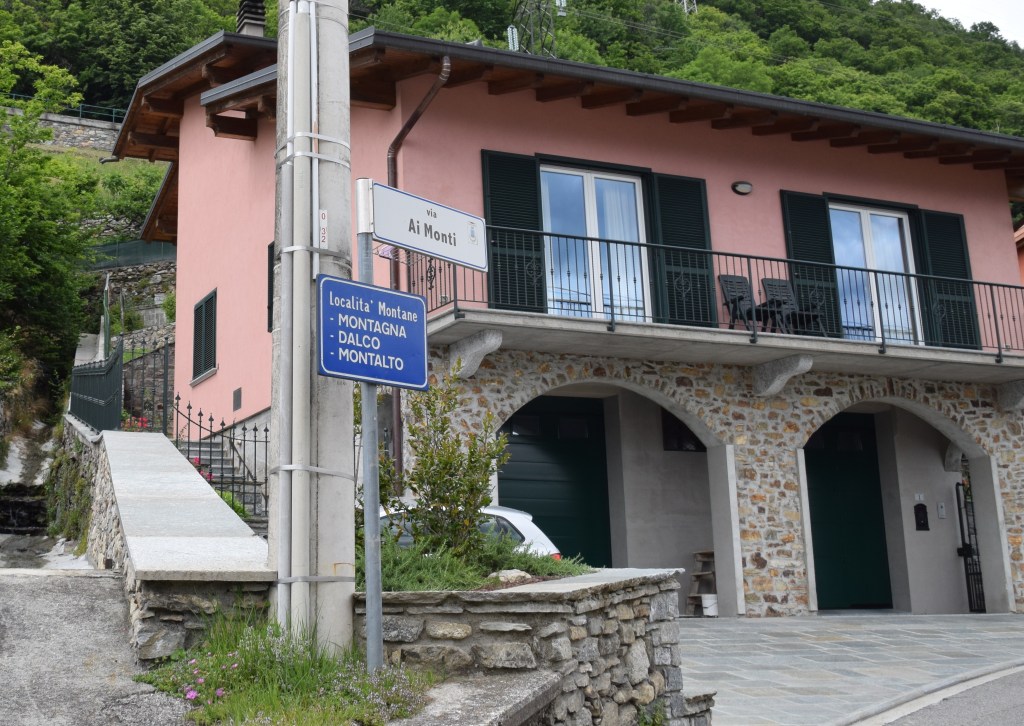
Through the center of Burano the road is called via Ai Monte (road to the mountains) but once past the edge of the village the signs say via Montagnola! From there one finds via Dalco, via Montalto, and, once again, via Ai Monte! The journey to the mountains announces each tiny hamlet ensuring one is never lost – a impossibility since this is the only road!
Via Sceresin was surely once a Wall Madonna forest! I found six remaining frescoes and one modern ceramic Wall Madonna. But considering the size of the village this is a significant number and implies that there were once many more. Here is a Wall Madonna painted in 1870 – the years my Italian grandparents were born.
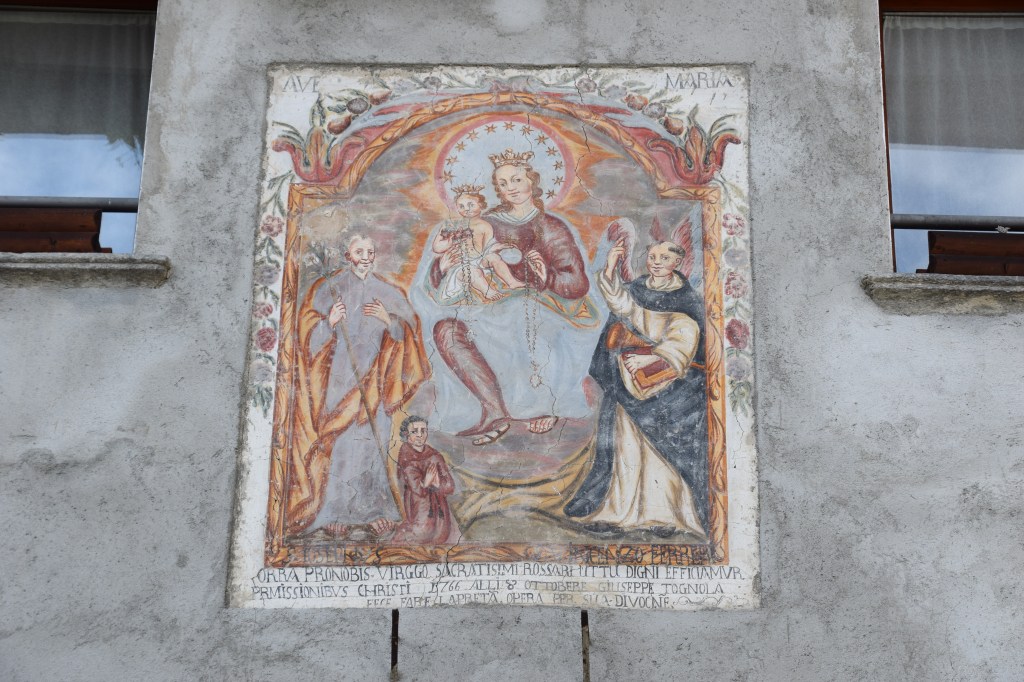
This is a beautiful fresco – preserved and restored. It is a Madonna del Rosario. The Madonna and Jesus are flanked by San Vincenzo Ferreri on the right and San Giuseppe on the left. The names of the saints are written in the painted frame under their feet. San Vincenzo Ferreri (1350-1410) was a Dominican whose sermons and books were very popular. He worked to bring a settlement to the Western Schism which divided the church over the authority of the pope. He seems an odd choice for a saint and it is likely the donor had some connection to him. Ferreri was Spanish and perhaps that was the link. I would not think there would be a philosophical link as most people were still illiterate at this time. The kneeling man is the donor – Giuseppe Tognola. It is common in formal paintings (not Wall Madonna fresco) to include the donor or donors in the imagery. They are commonly painted much smaller in size than the saints in positions of devotion. The inclusion of St Joseph – Giuseppe in Italian – is likely in tribute to the donor who shares his name. This beautiful Wall Madonna was painted October 8 in 1766 and dedicated by Giuseppe Tognola for his devotion. My dear friend the scholar, polyglotm and transaltor offers this insight for us – the inscription reads:
ORRA PRONOBIS VIRGGO SACRATISIMI ROSSARI UT TU DIGNI EFFICIAMUR PROMISSIONIBUS CHRISTI 1766 ALLI 8 OTTOBERE GIUSEPPE TOGNOLA FECE FARE LAPRETĀ OPERA PER SUA DIVOCNĒ
This is what it would be in correct Latin and Italian:
ORA PRO NOBIS, VIRGO SANCTISSIMI ROSARII UT TU DIGNI EFFICIAMUR PROMISSIONIBUS CHRISTI––1766 L’ 8 OTTOBRE GIUSEPPE TOGNOLA FECE FARE LA PRETTA OPERA PER SUA DEVOZIONE
Here it is in English:
PRAY FOR US, VIRGIN OF THE MOST HOLY ROSARY THAT [YOU] WE MIGHT BE MADE WORTHY OF THE PROMISES OF CHRIST––ON ACCOUNT OF HIS DEVOTION, GIUSEPPE TOGNOLA HAD THIS ORIGINAL WORK MADE ON OCTOBER 8, 1776.
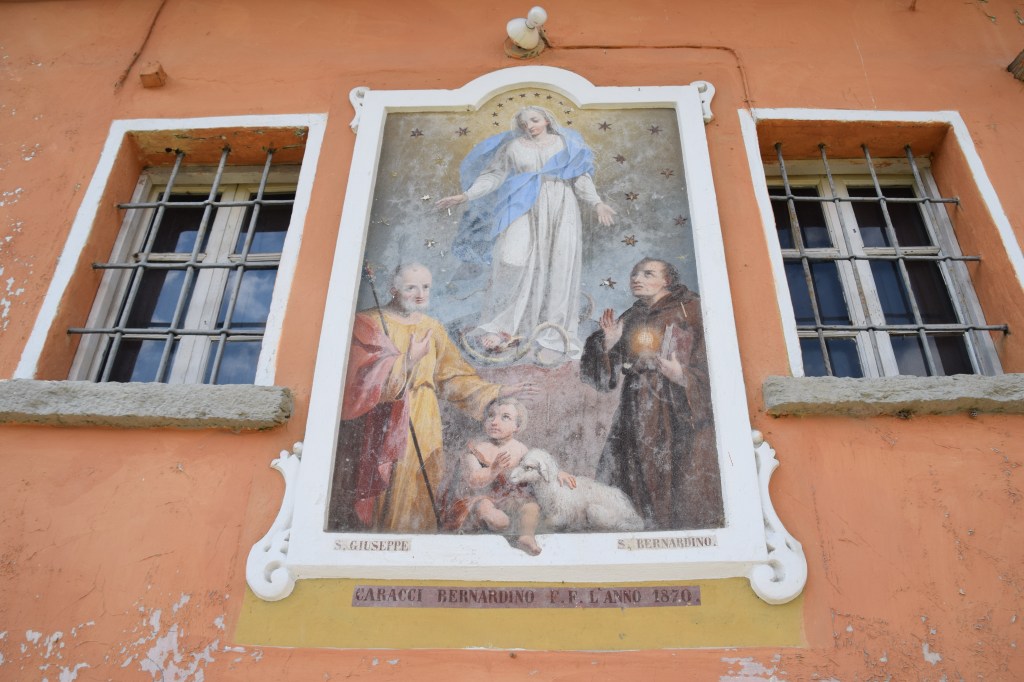
Still on via Sceresin one finds thia Wall Madonna painted in 1870 – the years my Italian grandparents were born. My nonno – Cesare Merlini was born in Regoledo on via San Ambrogio. My nonna – Maria Virginia Rizzi – was born in Montevideo, Uruguay where the family had immigrated to from Dongo on Lake Como. This fresco shows a Virgin – Our Lady of Grace – standing on the globe, her bare feet crushing the head of a snake – Satan – who represents the evils of the world. Mary stands between San Giuseppe and San Bernardino. Jesus sits between them petting a lamb – the symbol of Christ as the redeemer who suffered and overcame suffering. The donor of the fresco is Bernardino Caracci and, he, too, may have chosen a saint with whom he shares a name. The Wall Madonna is adorned with metal stars embedded into the cement. It is important to note the Great Virgin is the only saint who wears of halo of stars.
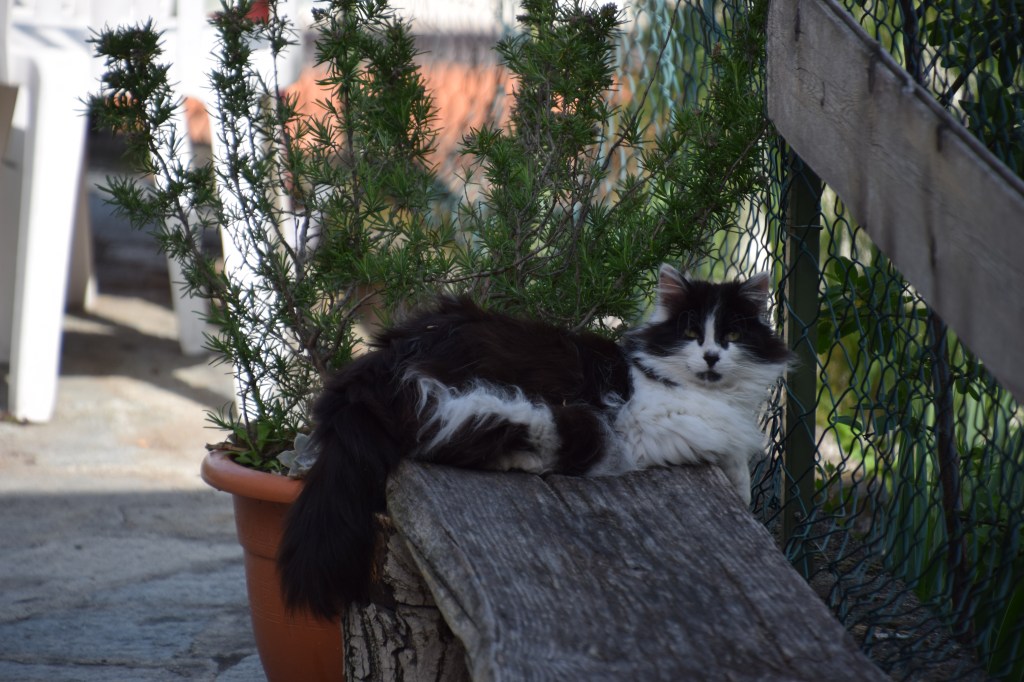
This is a lounging cat who was unmoved by my intrusion. Animals – including dogs – are often let to roam free in these small towns – something that would not be allowed in the United States!
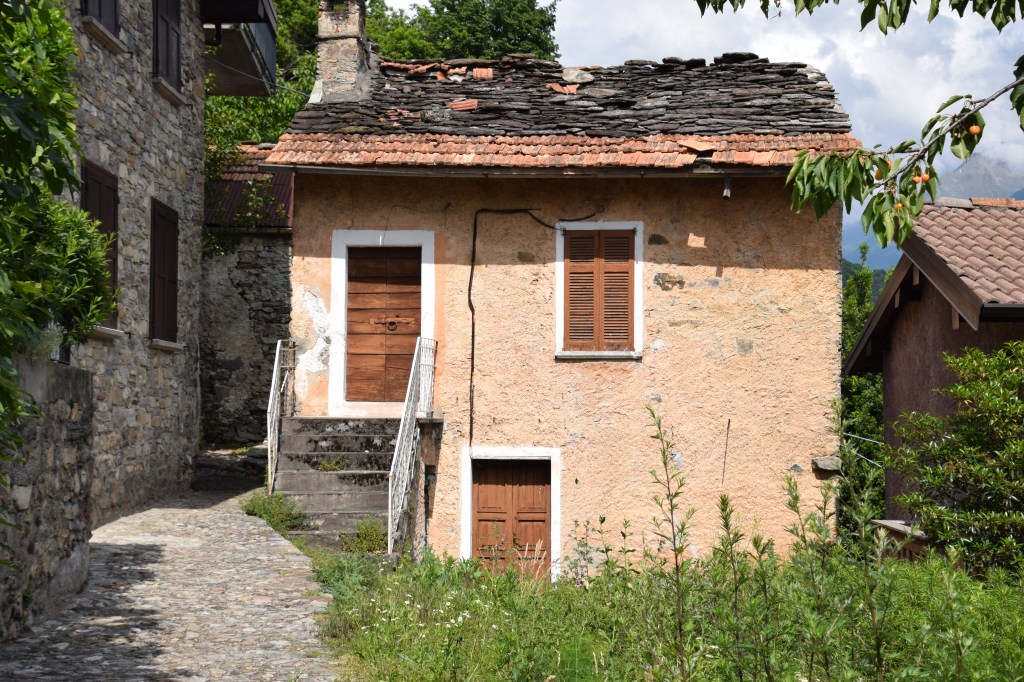
This was likely a two-family home with one family in one room above and one family in the room below. Most of the homes pre-dating the 20th-century – were only one room. This is why when purchasing a historic home in the area one finds no internal staircases to reach the upper floors. There was separate homes so there, logically, would only be external access. The small sizes of the old homes – many of which are only about 12-feet wide – results in the need to install spiral staircases to reach the upper floors.
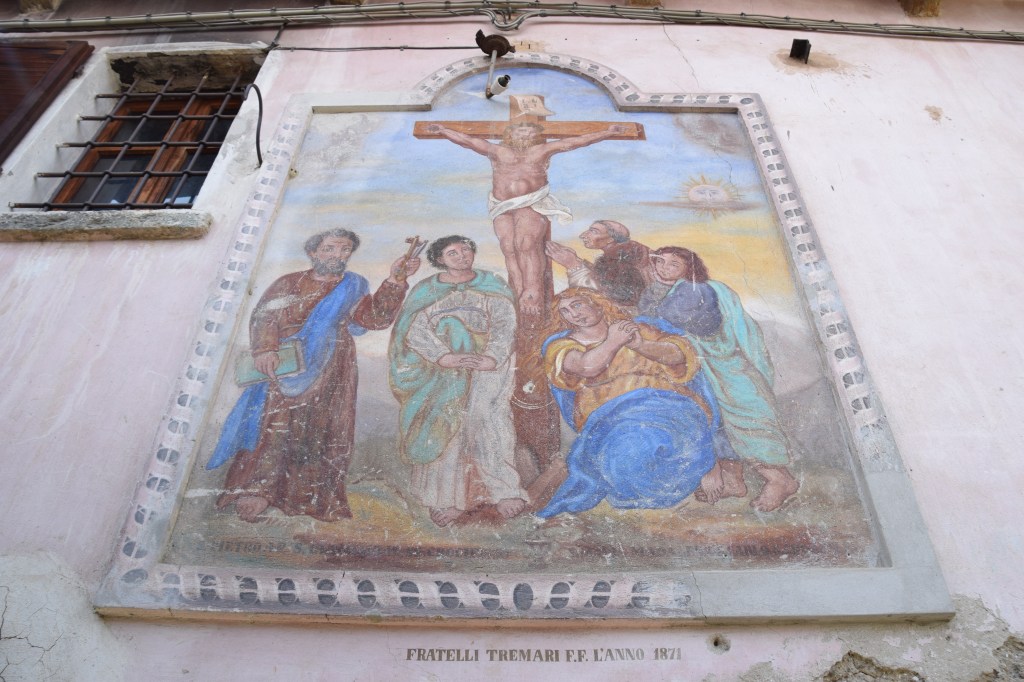
This Wall Madonna depicts a crucifixion painted in 1871 and dedicated by the Tremari brothers. The F.F. stands for Fece Fare – he had made. The full abbreviation and inscription would be F.F.P.S.D. – FECE FARE PER [LA] SUA DEVOZIONE – He had made for his devotion. The saints in the fresco from the left are: St Peter, a saint whose name begins with C, the Magdalene, St Bernard, and I think St Stephen. The names are painted below but I cannot read them well.
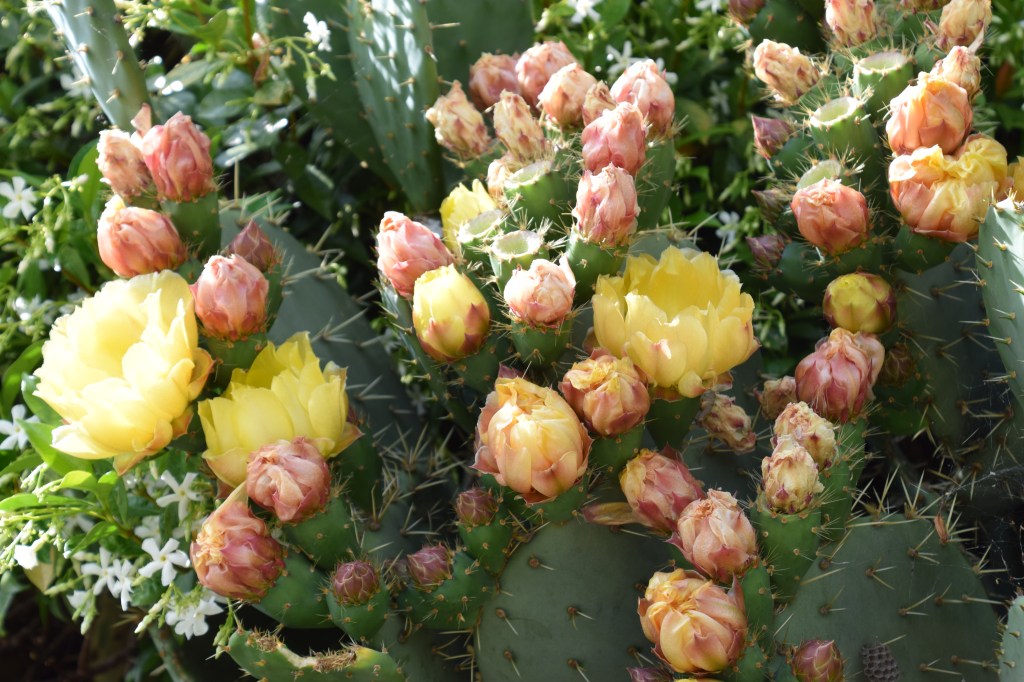
There was a very large cactus – about six feet tall and wide – that stood against a tall stone wall surrounding a house. The entire cactus was in bloom. I had never seen a cactus in bloom before! It was gorgeous and overwhelming!

Even when a fresco is eroded beyond discernable imagery, home owners leave it be – perhaps in deference both to their belief in its sacredness and to the family members for whom it spoke. I encountered a number of completely vanished Wall Madonna’s on via Sceresin and chose this very badly eroded Trinity as an example. The fresco depicts Jesus on the cross – crucified. God that father holds the cross-bar of the cross and the Holy Spirit as a dove hovers above his head. Here is an example of the traditional representation from the Chiesa di San Giacomo Vecchia in Livo. The fresco was painted at the end of the 14th-century:
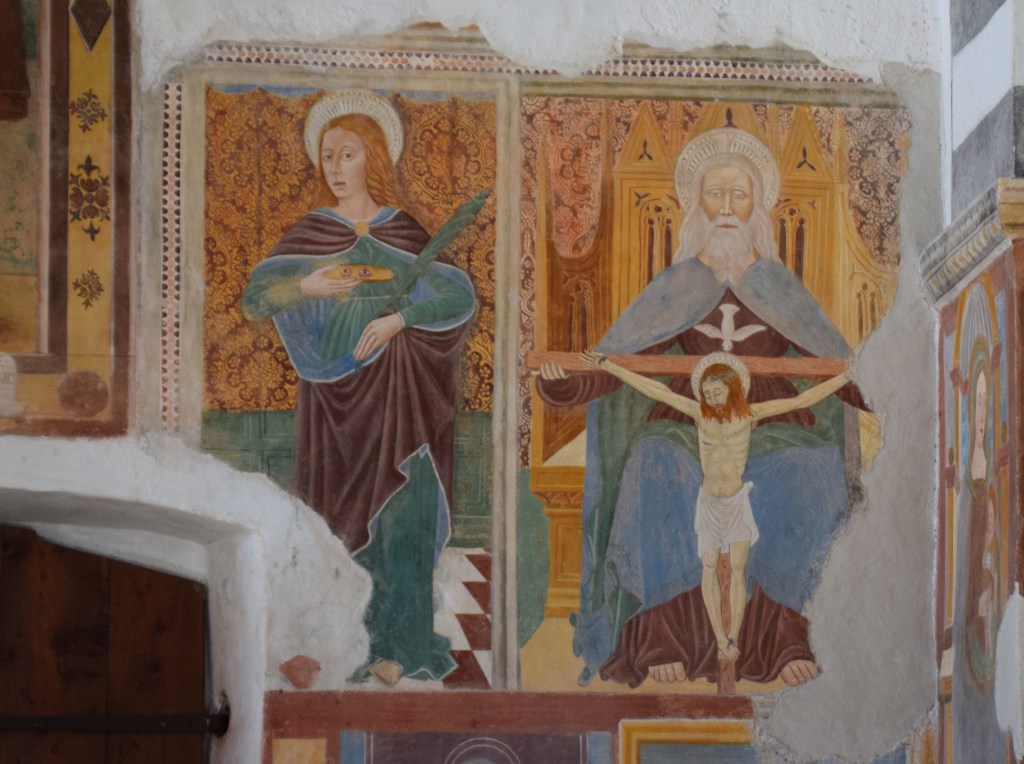
The Burano fresco would have been similar to this with that same imagery. However, I think that it displayed the crucified Christ as central and only shows the heads, arms and partial torso of God the father. The important point is the display of the Triune Godhead in a triangle made by the crucifix and the arms of the Father.
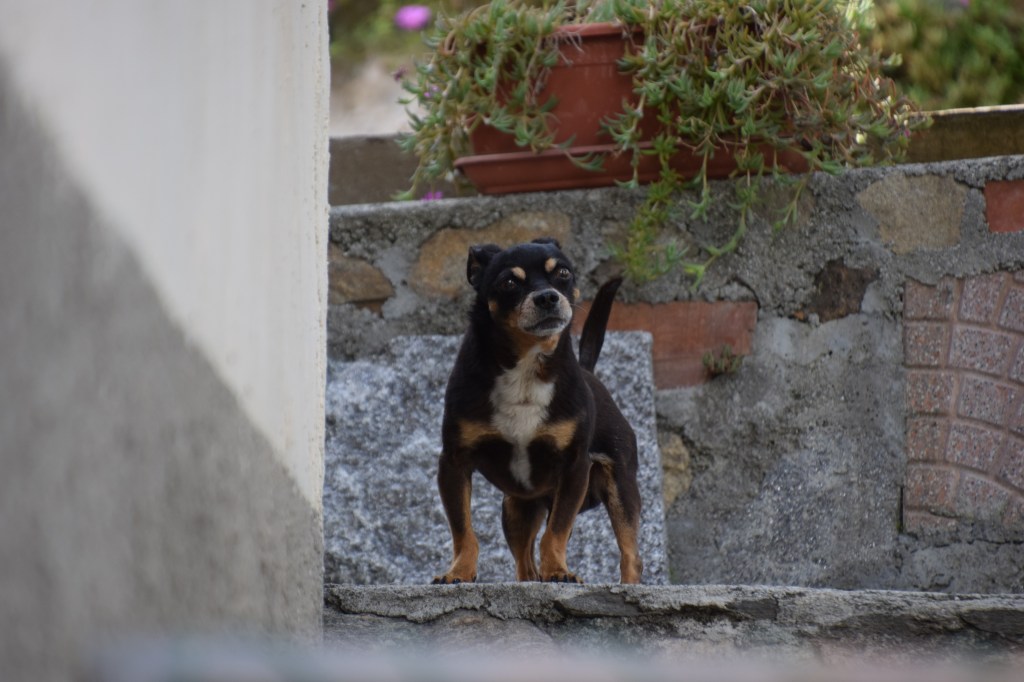
Unlike the cat of the previous photo, this small dog was unhappy with my presence.
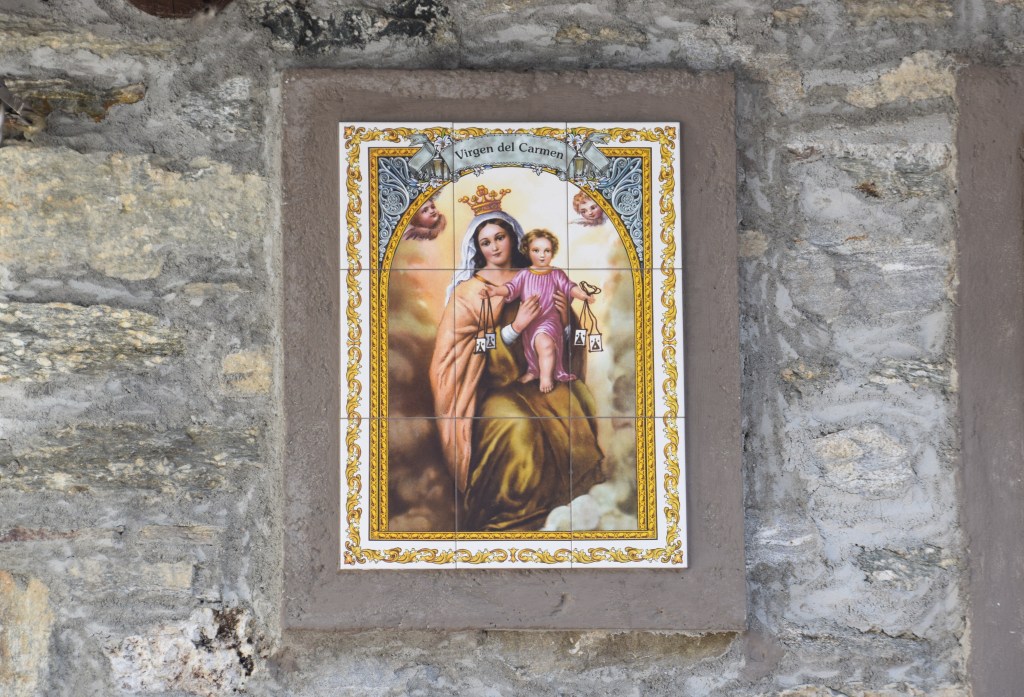
Still on via Sceresin- this is a modern ceramic Wall Madonna – a Vergine del Carmine. This is Nostra Signora del Monte Carmelo – Our Lady of Mount Carmel. The imagery is representative of the establishment of the Carmelite order of monks and nuns. In the 11th-century some monks went to Mount Camel in imitation of the prophet Elijah or the bible where they desired to live a life of prayer and contemplation separated from the public. This Marian cult was formally established to pray for souls in purgatory (the temporary hell-ish weigh station for souls on their way to heaven. He they were toasted in the fire until their sins were incinerated and they were pure enough for the pleasures of Heaven and the sight of God.) The cult is represented by scapulars – according to legend – a gift from the Virgin to Saint Simon Stock (1165-1265). The scapular is a type of garment worn across the shoulders. Jesus is holding scapulars in the artwork.
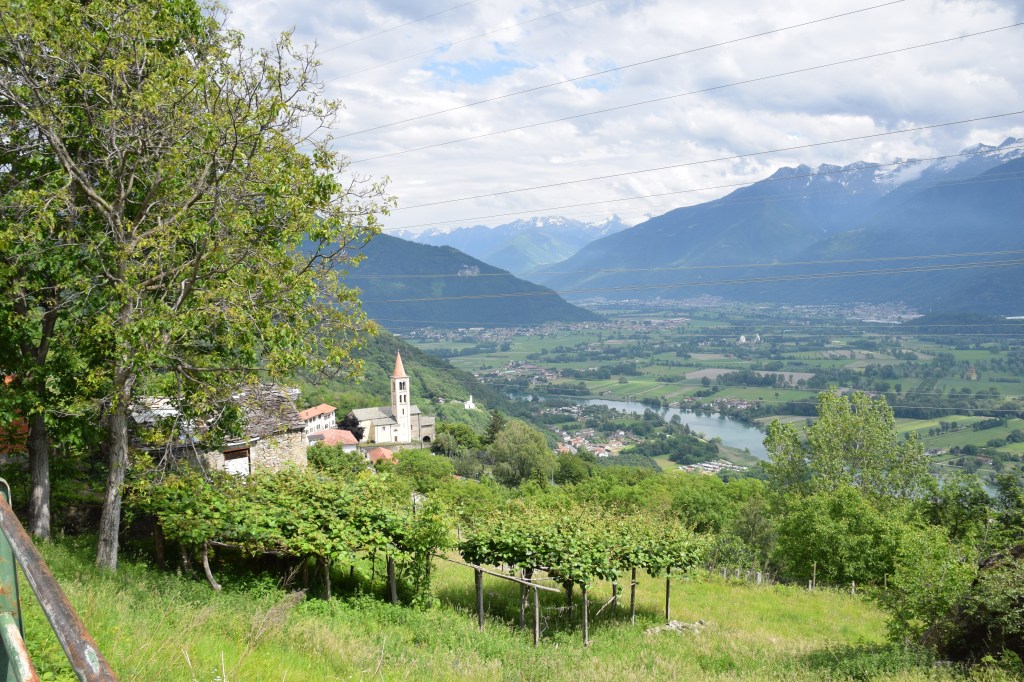
A more inclusive view of the Chiesa di San Martino in Montemezzo from the mulatierra as it reached Burano. The body of water below is the River Mera and one can see the begining of the Valchiavenna as it travels north from the end of Lake Como. The Valtellina goes east.
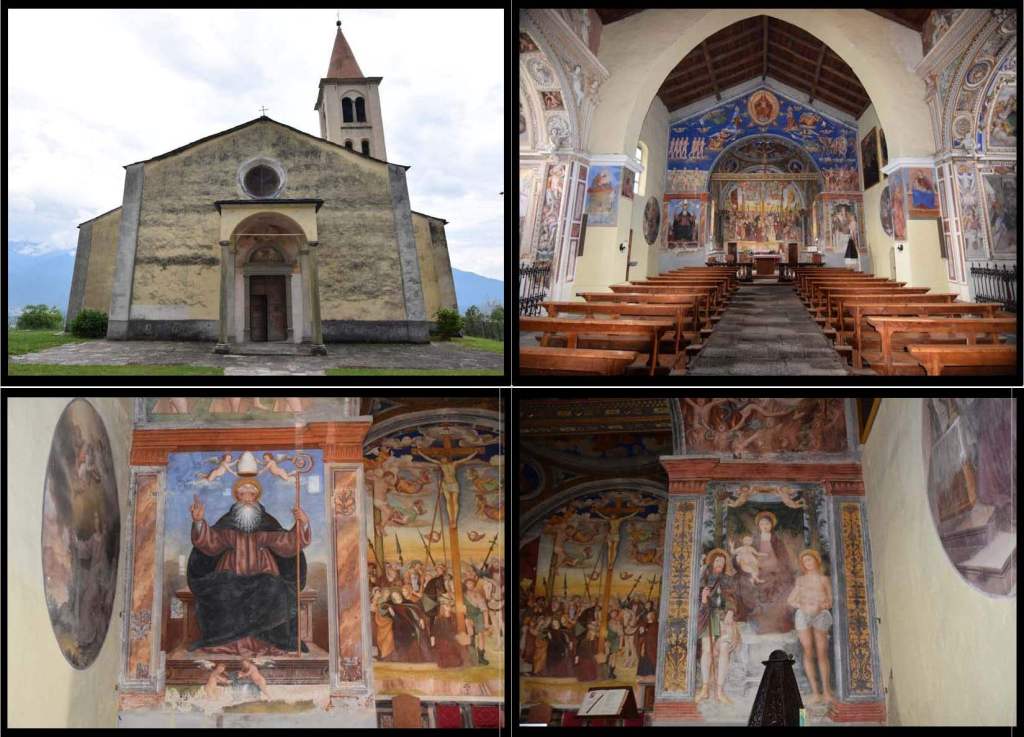
This is a montage of the14th-century Chiesa di San Martino. The montage shows – clockwise from the top left – the church; the front altar with all the mid-16th-century frescoes by Aurelio Luini; a fresco of San Antonio Abate; and a plague Madonna – Mary and Jesus are flanked by Saint Rocco on the left and Saint Sebastion on the right. The side chapels were frescoed in the early 17th-century by Giovanni Bastista della Rovere (1561-1627) known as Il Fiammenghino.
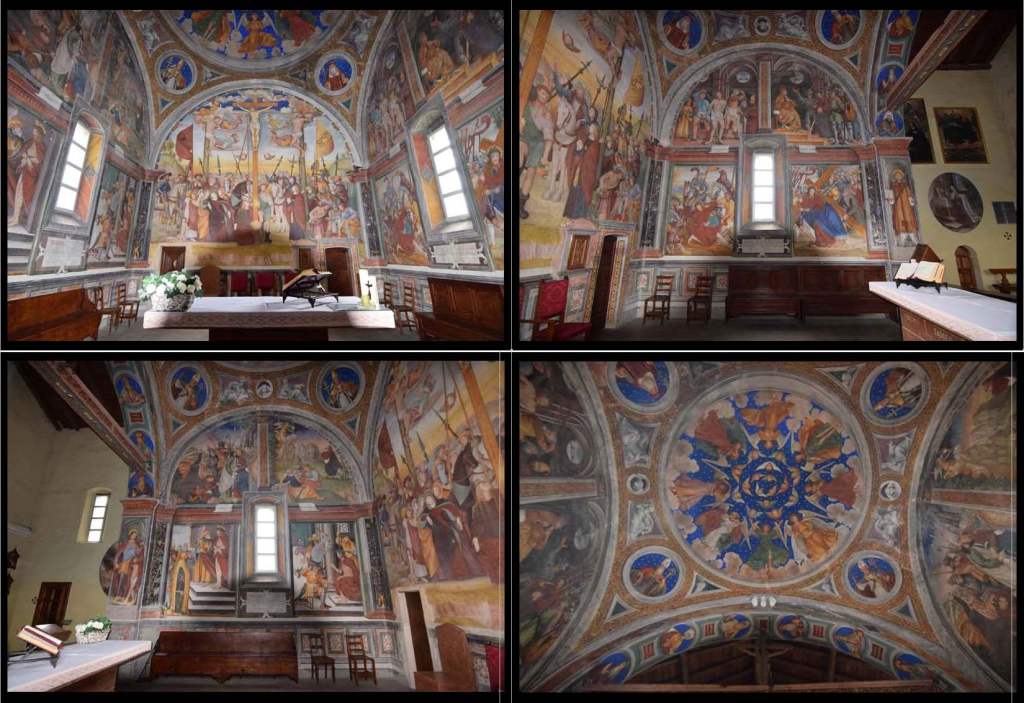
This is the reason for my trip to Montemezzo. These incomparable frescoes of the front altar and altar facade. This montage shows – clockwise from the top left – the center front altar fresco of the crucifixion; the right side fresco of the scenes from the life of Jesus; the gorgeous dancing angel ceiling; the left side fresco of the scenes from the life of Jesus. I took these photos with my wide-angle lens and that is the shadow you see from the light source not being wide enough to traverse the edge of the lens shield.
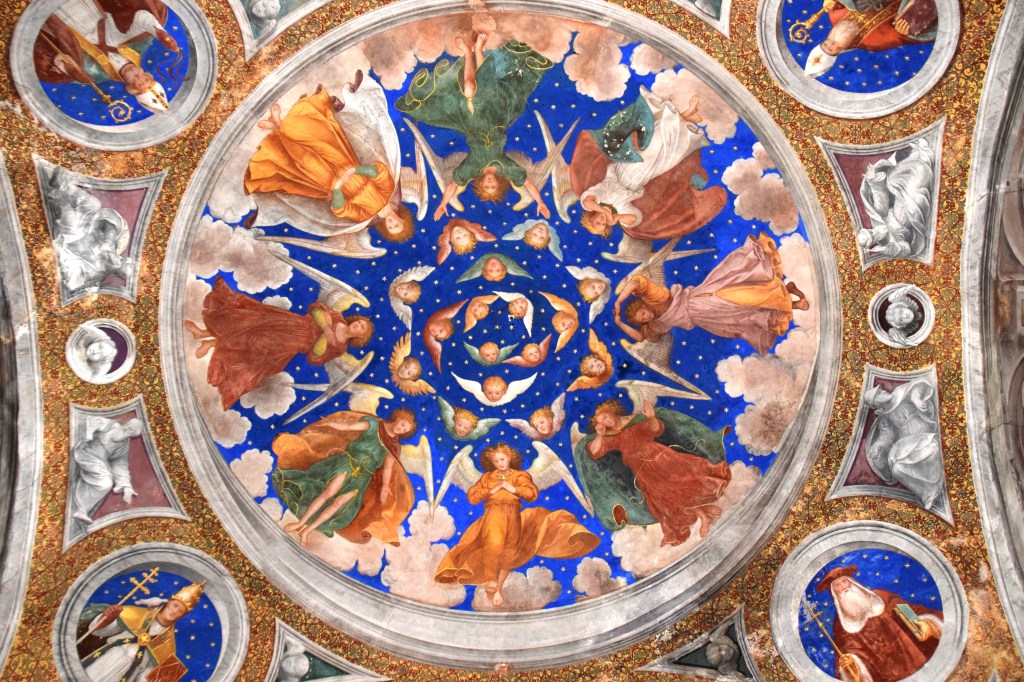
For your pleasure – a better view of the ceiling and the dancing angels!

These two saints flank the interior edge of the altar wall facade. They are the patron saint of Montemezzo – San Martino – to whom the small church is dedicated and the protomartyr and patron saint of the nearby lake villages – Santo Stefano. Here is some information on the saints – their hagiography according the church legend and belief:
San Martino di Tours (born in Sabaria (Hungary) 316 died in Candes (France) 397) was a soldier forcibly conscripted into the Roman Legion by an edict that required the service of all sons of veterans. He served as on a night patrol and during a harsh winter came upon a beggar without a coat. Martin cut his soldiers mantle in half and gave it to the man. He then had a dream that Jesus was the man he clothed and because of this vision he caused himself to be baptized into the Christian faith. San Martino is the patron saint of Montemezzo.
Santo Stefano Protomartire (born in Greece in the last years BC and died in Jerusalem 36 AD) – a protomartyr is the first Christian to die for his faith. St Stephen was stoned to death. Santa Stefano is the patron saint of Sorico (just below Montemezzo), Dongo, and Menaggio on the west side Lake Como.
I hope you enjoyed the Wall Madonna’s of Burano and understand my love of the Chiesa di San Martino. This church is an unknown gem – exceptional for its artwork and its relative anonymity.


Beautiful description of this small village and his lovely details. 🙂 saluti da Montemezzo.
LikeLike