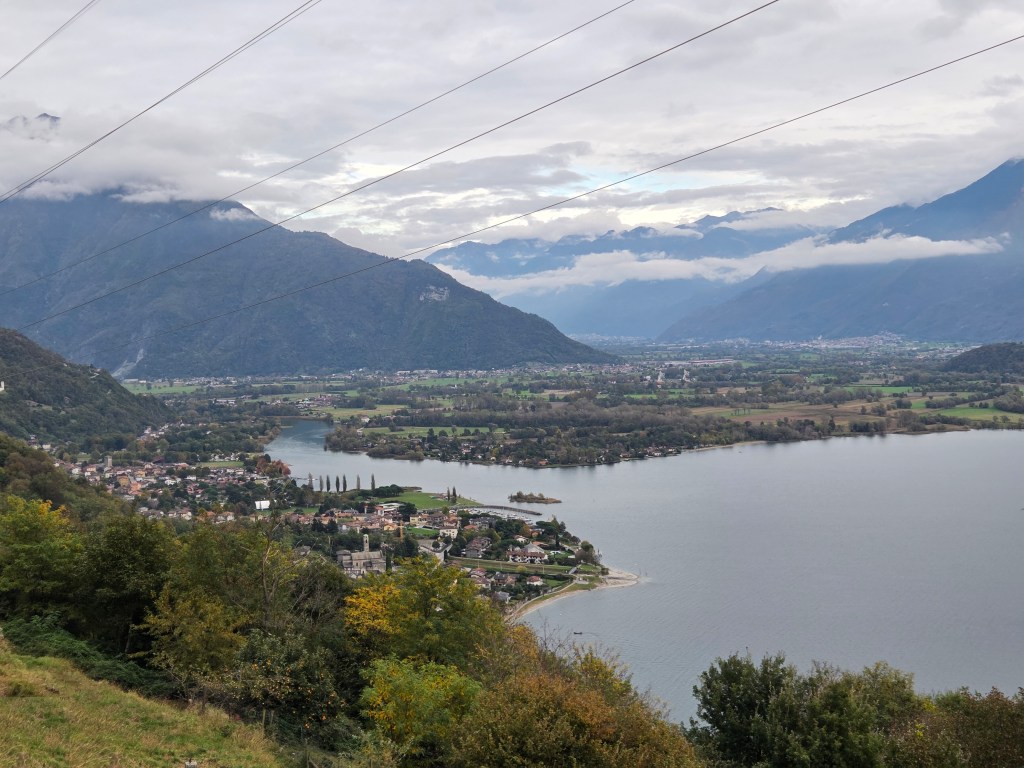
AUROGNA is the Medieval frazione that belongs to Trezzone – the comune behind and above Gera Lario which sits directly on Lake Como. Trezzone encompasses a few frazione along the road leading to Aurogna. The total population of the area was 212 people at the time of this narration.

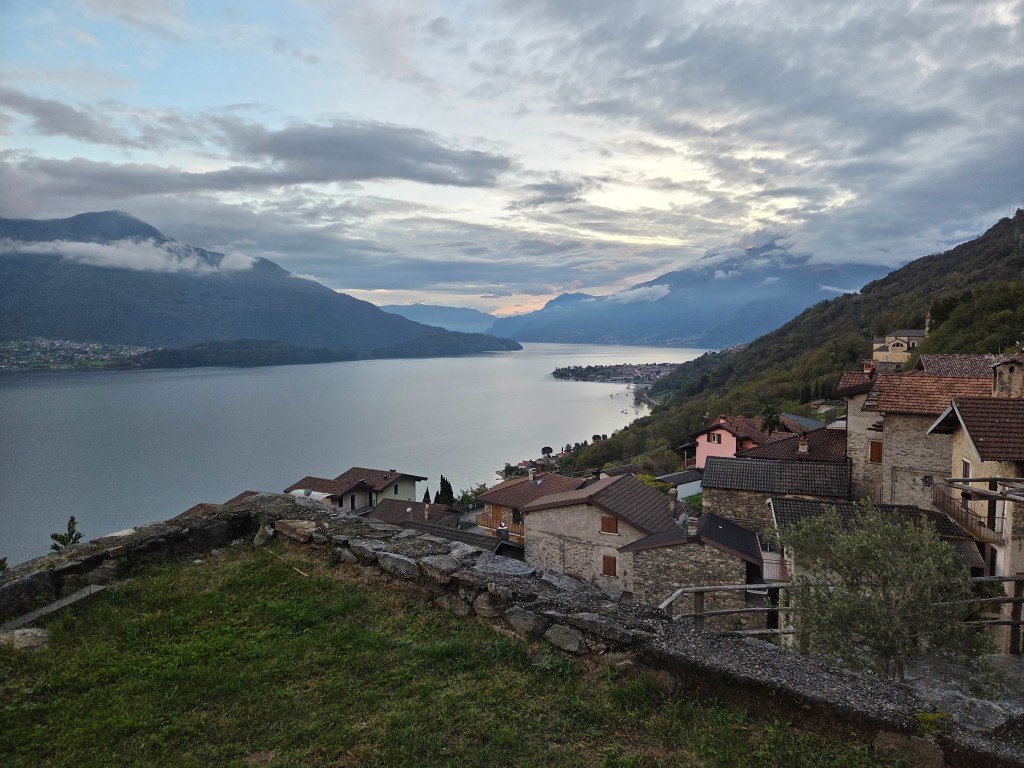
Perched at 430 meters above Lake Como on its sunny western shore in Aurogna one finds a tight cluster of ancient stone homes with the most fabulous views of the lake and Monte Legnone! Here live mostly weekenders and summer visitors the proof of which one sees in the high prices for a tiny “rustico” – homes needing total rehabilitation – restoration being too generous a term for what often remains.
The new carriage road and the old mulatierra for the borgo initiate at the 11th-century Chiesa di San Vincenzo on Lake Como. San Vincenzo, which belongs to Gera Lario, began its life as a Roman villa in the 2nd century evidenced by the datable Roman floor mosaic uncovered in the 1960’s during restorations.

Aurogna is the last village in the climb for the mountains and surrounding summer pastures dotted with clusters of baita – summer huts once used by families and shepherds grazing their herd animals making cheeses from their milk and fattening others for the winter larder.
I waited until Fall to revisit the two late 15th century frescoes that I found in Aurogna on my first visit in 2019. Because Wall Madonna’s are often located on old, public village paths that are now considered private because of the renovations of convenience, in Autumn I run less of a risk of being seen as an interloper.

As before, I parked near the beautiful but closed parish church, the 15th-century Chiesa di Santa Maria delle Grazie. Hence, I remained parked in the cemetery lot and used the visit to walk the remaining stretch of mulatierra that leads to Aurogna. I hoped to be able to see the frescoes from the first years of the church that still abide its walls. But the Chiesa has no regular open hours other than the weekly Sunday mass and since I avoid weekends for Wall Madonna searches, I will need to return specifically during the Sunday service to see and photograph them.

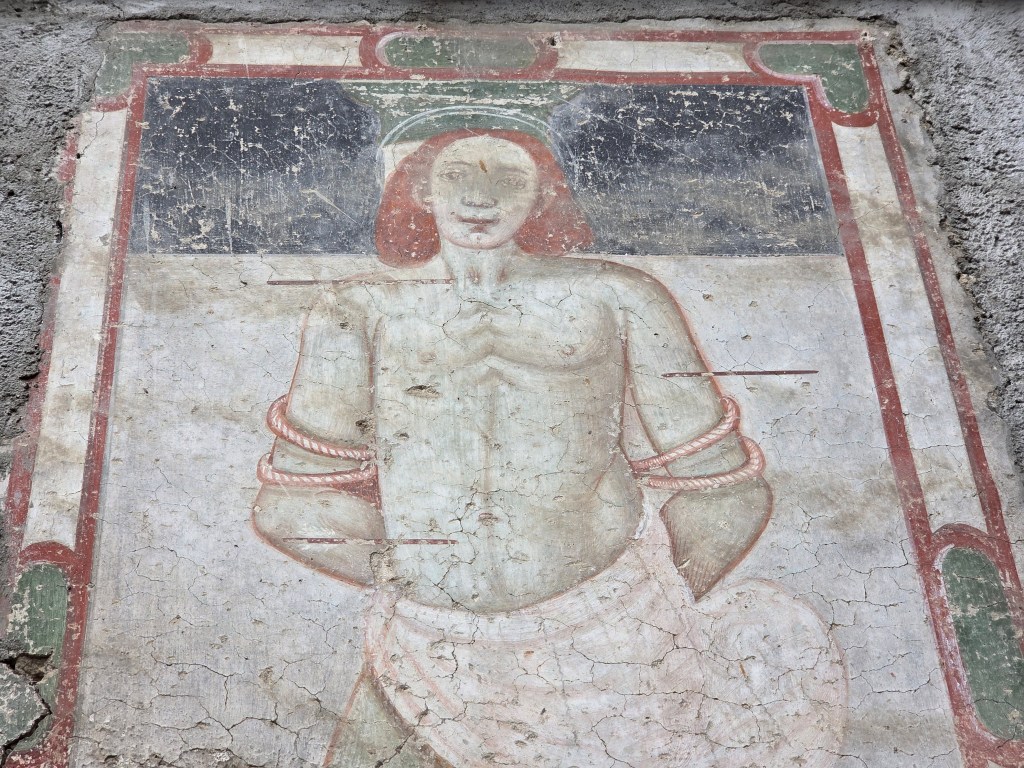
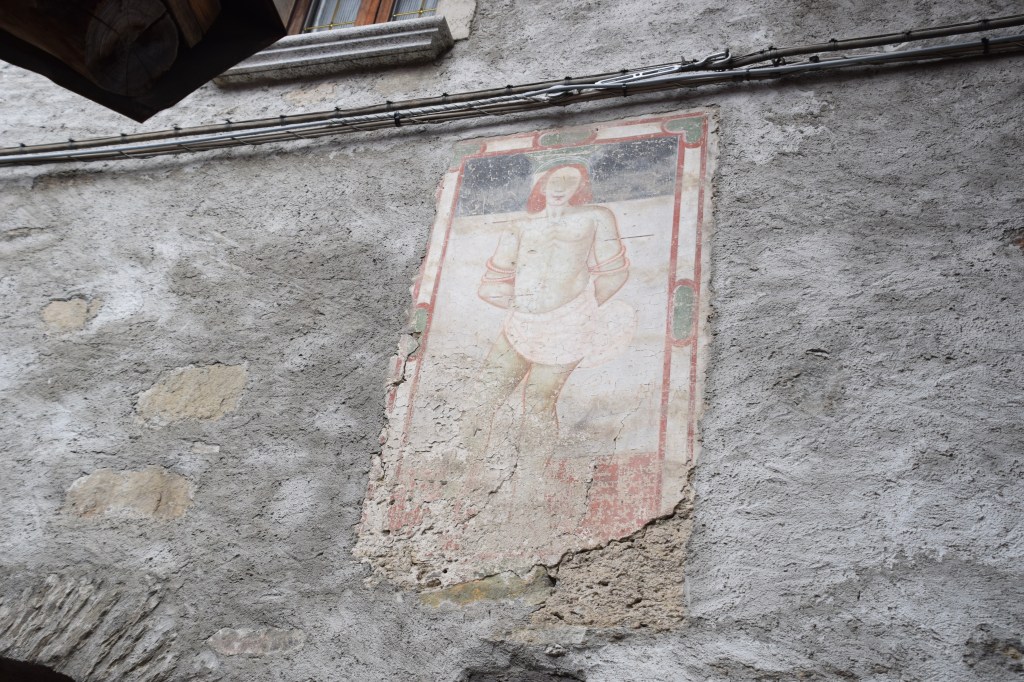
The beautiful frescoed ciancett featured above this text sits along the sentiero that leads from the parish church below to the borgo! “Ciancett” means ‘a place to bend a knee” in the local dialect. These small capellette are found along the sentieri and mulatierra that were the via’s for reaching the villages and borghi of the Lake Como and Valtellina areas. One especially finds them just outside a village and at the confluences of pathways. This one is restored but likely dates to the 17th or 18th century. The recent restoration may or may not be true to the original image. This is a suffering Christ crowned by thorns.
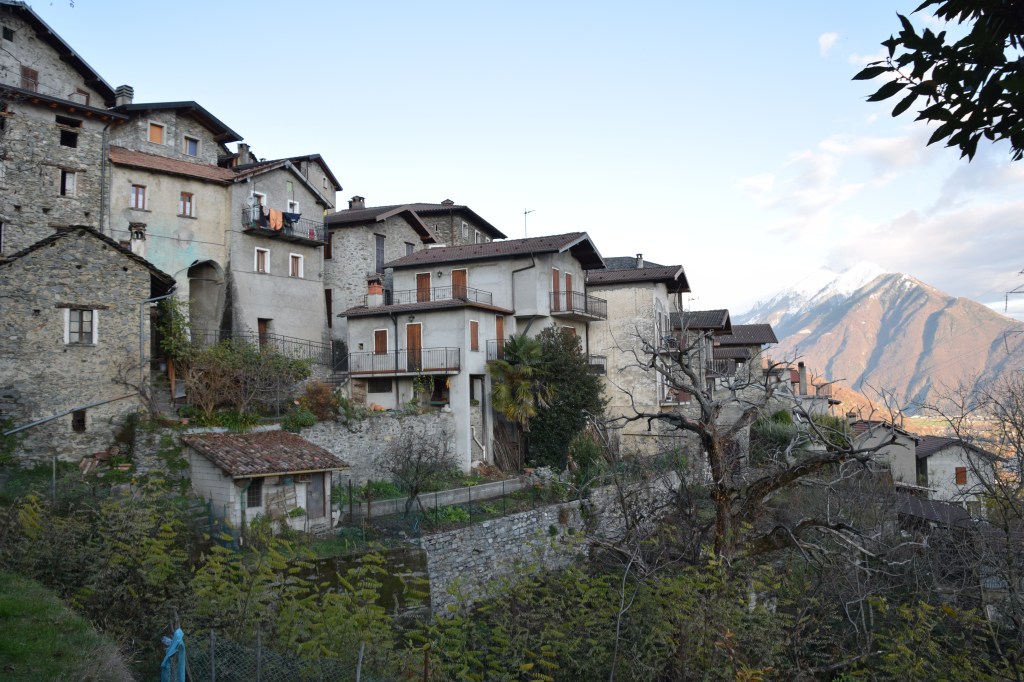
Taking advantage of a grey, cloudy day, which is great for glare and shadow-free photos, I ventured for the second time to Aurogna to further scour the nucleus of packed houses for Wall Madonna’s. Because the borgo until recently was not favored because of its elevation, lack of parking, and the reality of having to navigate narrow cobblestone lanes and steep stone staircases to reach one’s home, I was sure there were still some remaining 15th and 16th-century frescoes on the abandoned and long-occupied houses.
Now the lure of Lake Como views and a new, large parking area has fomented interest in the village – at least on weekends and holidays. I fear new renovations may result in the loss of the more eroded artworks – as there surely were once more works centuries ago especially along the via Regina that has most of the newly renovated homes. And I did find more frescoes on this visit. What follows are the Wall Madonna’s one finds in Aurogna.
The Wall Madonna’s are a mix of modern devotions and ancient totems of faith. The older frescoes, in general, are eroded – all having lost the bright colors of their original paints and most the beyond the ability to identify the included saints. However, that they still exist in the space dedicated to them on renovated homes and that new devotions now take the place of ancient ones lost to time and weather testifies to the sacredness of their meaning for the past and current homeowners and residents of the village.
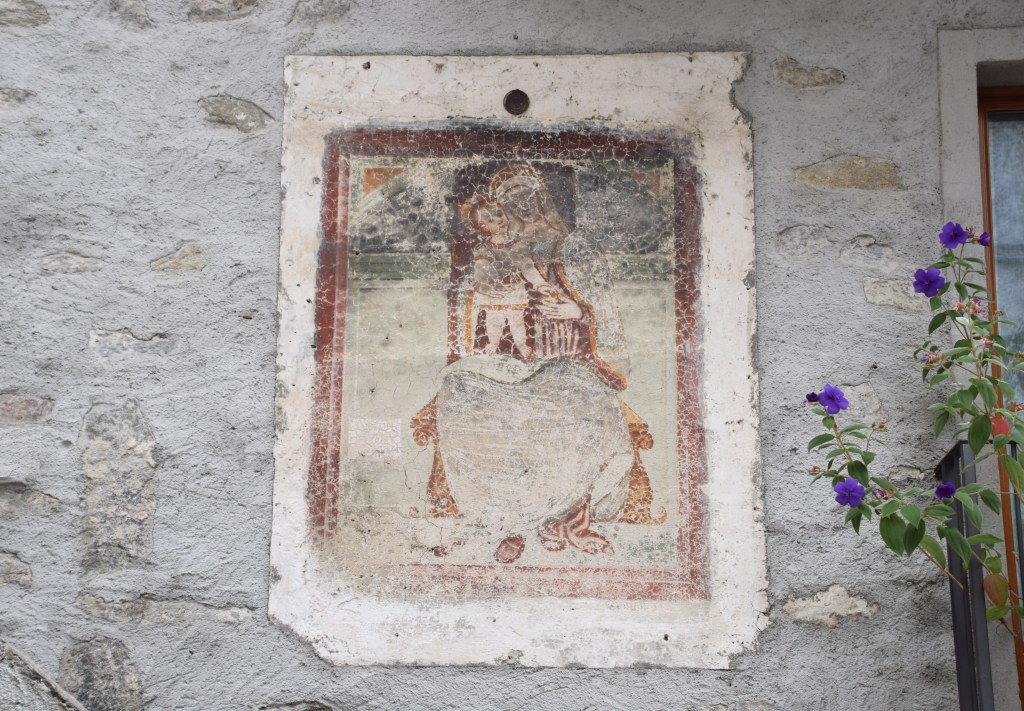
Above is a 15th-century enthroned Madonna and Child. The fresco is found close to the northern end of the village which is the side by which the carriage road passes. It is on the main footpath through the village, the via Regina. The home on which it is located is occupied and restored but the Wall Madonna is preserved unmarred. What is seen is a common depiction from the 15th -century – the Madonna and Jesus alone with no venerating saints. Jesus is holding a wooden crucifix in his right hand. With his left hand he is reaching for an object held by Mary. I am not certain what the object is. It might be a ball. One can clearly see that the restoration of the old home was careful not to damage the integrity of the ancient fresco.

This is a montage of the previous fresco. The original colors are lost and what was once the bright blue of Mary’s mantel has faded to a washed-out black. The change from blue to black is the result of using either azurite (a copper carbonate mineral) or smalt (a potash glass containing cobalt) to create the tint. The more stable paint – ultramarine – made from crushed Lapis Lazuli was very expensive and these two substitutes were often used instead. Both fade to black over the years with azurite sometimes fading to a greenish-black that is caused by the copper in the mineral. The description of the montage is thus: Clockwise from the top left: view of the Wall Madonna from the vaulted walkway that was not original to the main path through the village – via Regina; a close view of the two figures – Mary and Jesus. One can see that the fresco has been affected by the settling of the wall on which it was painted; a view of the Wall Madonna next to the entry door of the ancient home that hosts it; the remaining salutation to the left of the seated Madonna. I believe it contains the name of the donor/s.
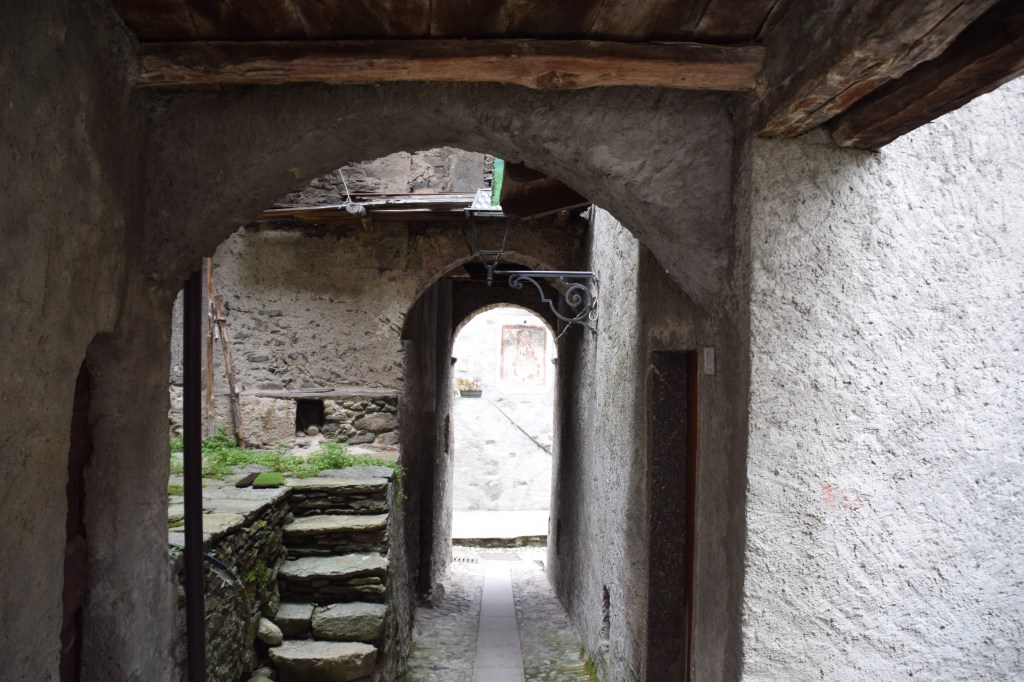
This vaulted walkway spans two large villas on either side of the via Regina. As one reaches the end of the covered way, one emerges in front of the 15th-century Madonna & Child discussed previously. On the left wall, with a carved lintel awning reaching to the top of the vault is another 15th-century Madonna and Child. The fresco is badly faded and almost completely black. But the figures of the Madonna and Jesus and a female saint on the right are still visible as ‘shadows’.
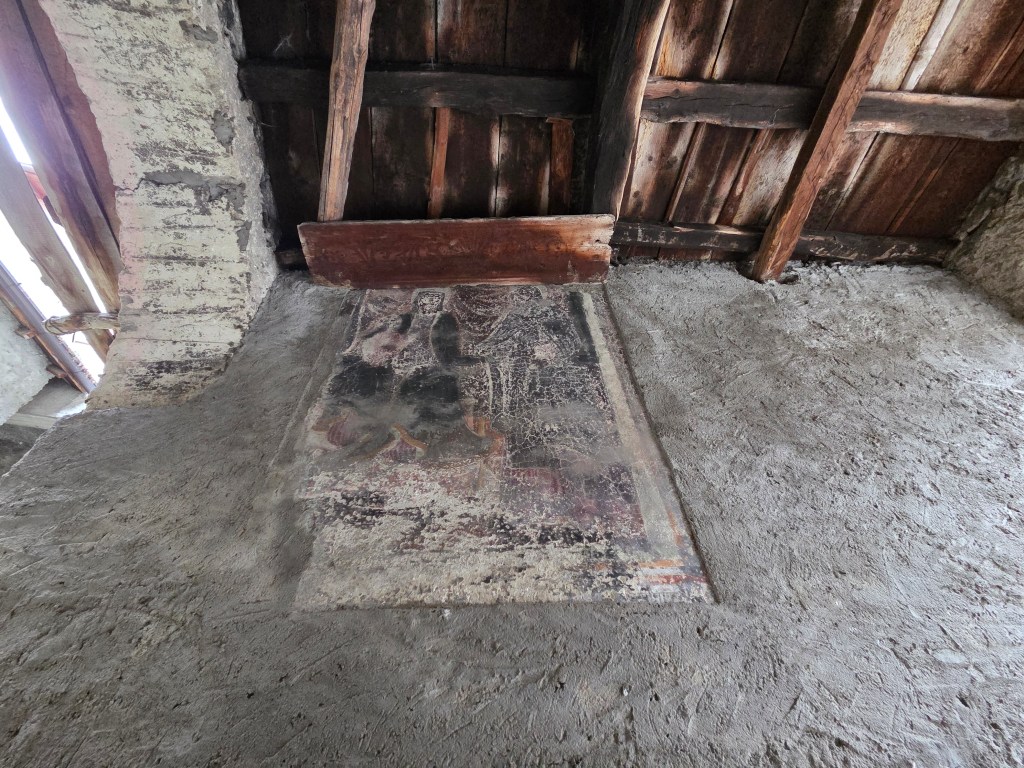
As one can see, the images of this this late 15th to mid-16th century fresco exist as blackened shadows. The Madonna is enthroned and Jesus sits on her lap. His tri-radiant halo is still visible. The greenish-black of Mary’s mantle suggest that it was originally a bright blue painted with azurite. The female saint to Mary’s left is not truly identifiable without hypothesis. However, one might suggest that it is Saint Anne. The Madonna & Child with the mother of Mary and grandmother of Jesus was a popular depiction in frescoes, paintings, and statuary in the time period of the fresco and Anne was often painted to Mary’s left – a popular artistic convention. The author of the work was aware that one would need to look up to view the fresco and he (as was most usual) included a carved lintel awning to protect the work and frame the imagery. That the top of the fresco almost abuts the under floor of the vaulted walkway implies that the vault was constructed at a date after the fresco was executed. It perhaps allowed the merging of two smaller homes into one larger one. As with all the remaining frescoes in Aurogna, the renovations of the home on which this fresco is found carefully preserved the entire remains of this once grand artwork.
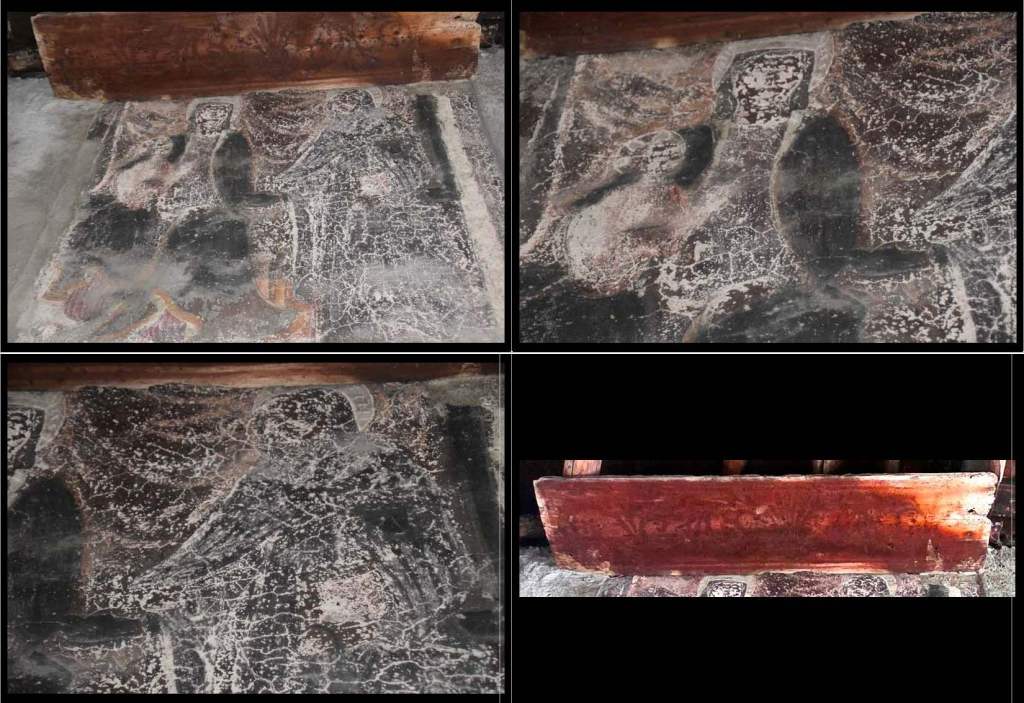
This montage offers some closer views of the figures and the carved lintel awning. One can see that Jesus was depicted as an infant and he is seated with his head framed by a tri-radiant halo – a type used only for members of the Holy Trinity where each ‘ray’ symbolizes one of the three members of the triune God-head. The halos of Mary and Anne are similarly formed. Parts of the throne are still visible with original paint near Mary’s feet to the left. The draping of the mantle and veil of the figure who I believe is Saint Anne makes clear this is a female saint. The fresco is only a few centimeters from the wooden vault floor. That, the faded colors, and the narrowness of the walkway make this Wall Madonna easy to miss.
My favorite find in Aurogna was a once glorious and colorful 16th-century Plague Madonna featuring an enthroned Madonna and Child between San Sebastiano on the left and San Rocco on the right. The fresco is next to the second story entry door of an abandoned home. This Wall Madonna retains some of its original colors and Mary’s robe still has a slight blue hue.
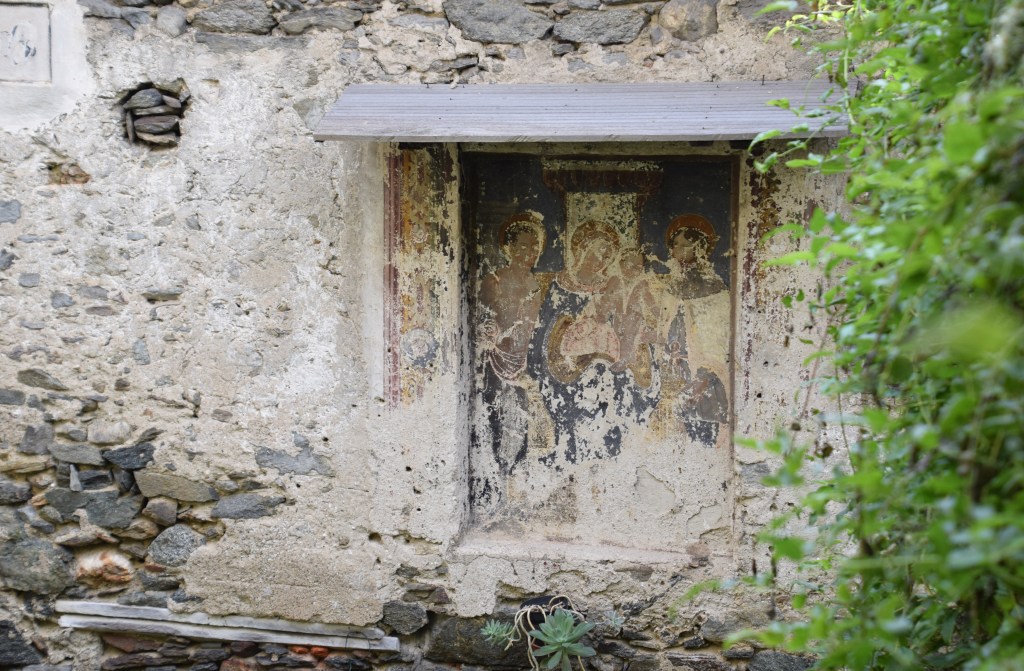
Frescoes depicting the Madonna and Child between Saints Rocco and Sebastian are popular throughout the Valtellina and Lake Como region. Because of the trade routes along the shores of Lake Como and through the Valchiavenna and Valtellina and the many conflicts over territory which brought mercenaries into the valleys and lake area, the villages suffered much devastation from localized plagues. When the pestilences subsided and the populations began to recover artists were hired to create frescoes featuring the Madonna between Saint Rocco who is believed to have survived the plague and Sebastian who is believed to have survived an initial attempt to execute him with arrows. These two saints are invoked against disease and are considered powerful intercessors along with the Great Virgin in begging the mercy of the Catholic deity. For these reasons I have named these types of frescoes Plague Madonna’s.

The second story location and narrow lane provided no opportunity for a good photo. But the house directly across from the fresco looked like it had a terrace that I could stand on for a level photo. So I climbed a set of broken stone steps only to discover a collapsed roof – not a terrace. I took the photos with one foot on the ledge of the remaining wall and one foot on the stairs. The faded grey of the Virgin’s robes could indicate that the artist used smalt to make the blue paint and if so, this use can help to date the fresco since smalt is no longer used to make blue paint more stable pigments being available. Smalt is a type of blue glass colored with cobalt that was crushed and ground to make an affordable blue pigment. Smalt and azurite were common substitutes for ultramarine which was the very expensive crushed lapis lazuli from Afghanistan that only affluent donors could afford.
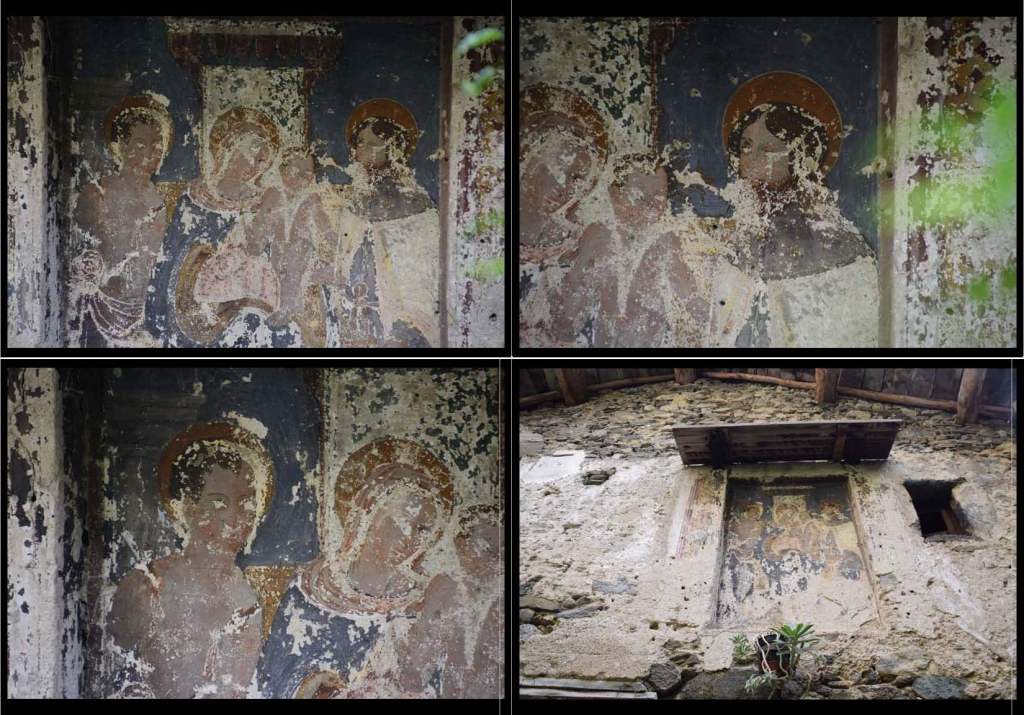
The montage allows one to see the details of the depictions of the Madonna, Jesus, and saints. A careful examination shows that the artist was talented and the original work was quite beautiful. The skin and demeanor of Mary’s face are well-crafted. Jesus is painted as a young toddler and he has a tri-radiant halo the rays of which remain visible and golden. Saint Rocco is dressed in his traditional garb and one can still see the traditional coloring of his mantle. A couple of the arrows piercing Saint Sebastian can still be made out. And one must notice that this Wall Madonna has been carefully cared for even though its home is long vacant. A new lintel awning was added to protect the sacred art from the sun and weather, and the bottom right image shows a potted plant placed beneath the fresco to honor it. The home is part of a cluster of small houses in the center of the borgo where the neighboring homes are in differing states of ruin and surrounded by foliage that is wildly overgrown. But the reverence for this work remains vibrant with the space and imagery – no matter its state of erosion – considered sacred and, thus, still revered.
I found only one more Wall Madonna that predated the 20th-century. In the final row of homes on the southern end of the borgo where the mulatierra passes across the back of the village, is a badly eroded fresco with only the top fourth of the imagery remaining.
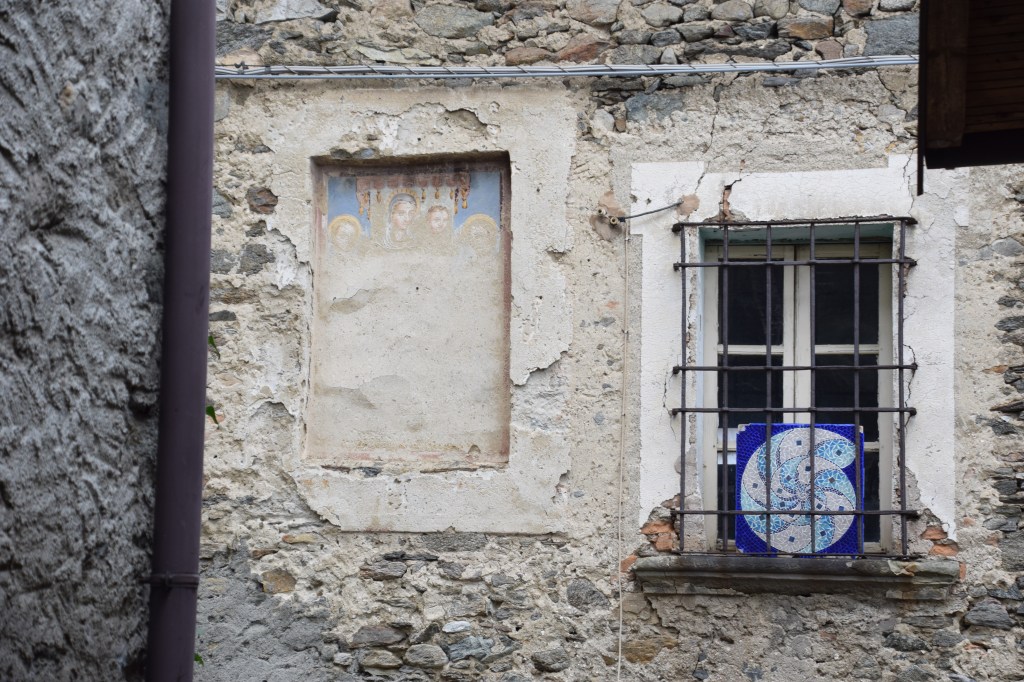
That such a ‘young’ Wall Madonna is found in a more ruined state than much older works is testament to the more durable works created by the buon fresco technique and the greater talent of craftsmen from the gothic era. During this time-period the third layer of gesso on which the paints would be applied was mixed with powdered marble. Boys who learned their trade as young apprentices training in the workshops of established artists or who belonged to a family of artists plying an inherited craft studied the techniques of frescoing in much the same way people studied for other manual labor work of that time such as carpentry or stonemasonry. It took skills developed over time to paint in the final, wet layer of plaster where mistakes could not be corrected as the paint amalgamated with the adulterated gesso. Unlike today where artists are scarce and only those seen to have a gift may claim the title, fresco painting in this era was a job who some were better at than others. This fact accounts for the commonality of styles one encounters in frescoes of the same era and zones, and the clear differences in the quality of the imagery.
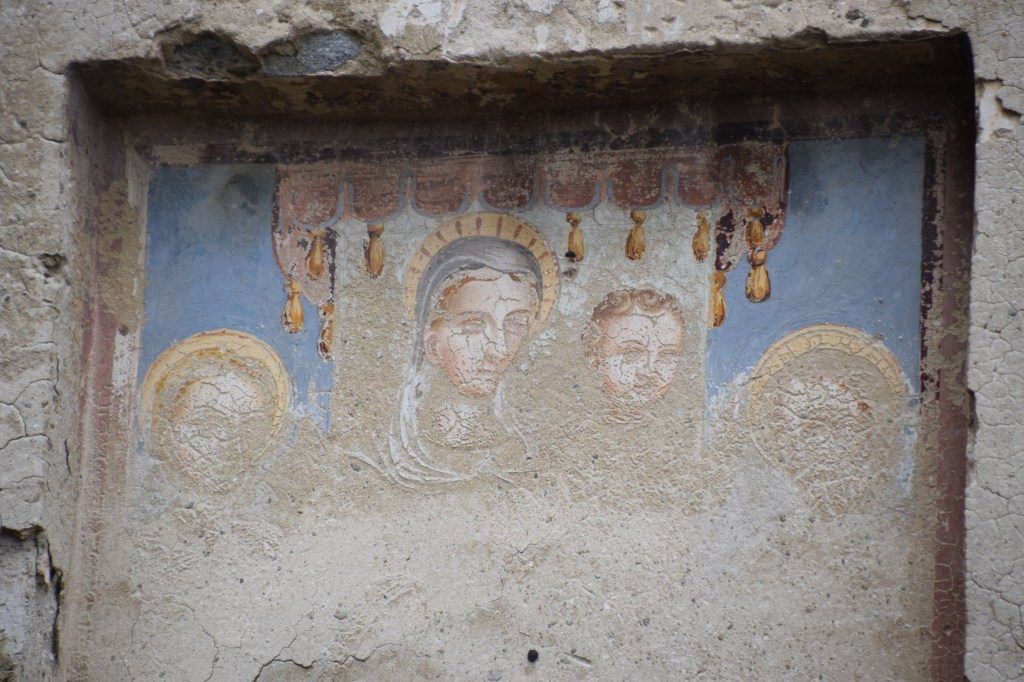
This slip of remains likely dates to the 18th century and the full fresco was once colorful and impressive. The enthroned Madonna and Child are venerated by two saints. I believe the saint on the left is tonsured. The saint on the right is bearded. However, because so little of the symbolic imagery remains, one can only speculate as to their identity. Doing that one might observe that San Lucio di Cavargna is the patron saint of Trezzone so the bearded saint on the right could be him. And because of the tonsuring and local preferences, the saint on the left might be San Antonio di Padova. But – my guess is only based on eroded remains and intuition coming from a familiarity with the fresco art found in this area. Additionally, I think this fresco may have been restored in the relatively near past. The blue paint of the background seems to be of a different type than was commonly used in older frescoes while the blue of Mary’s mantle is fading to black and implies the use of smalt or azurite. Additionally, the decorations of the throne are more elaborate than one would expect to find in more ancient Wall Madonna’s. And a final observation – I do not think the young Jesus was depicted with a halo. There is no ‘shadow’ of a halo left in the eroded and still eroding layers of gesso where one would expect to find some remnant. Depicting Jesus without a halo in ancient art (before 500 AD) occurred when he was painted at an age that would precede his baptism. This was the choice of the artist or the donor who hired him. However, after this date it is not common to see the young Jesus without the symbolic representation of the halo. But more ‘modern’ works do sometimes depict the young Jesus sans halo. The lack of a halo, hence, can be used to help date the fresco and/or any restoration.

The previous photo offers view of the home and second story location of the fresco as seen when one walks down the narrow alley in front of this row of homes. The home has been renovated and is occupied. Again, one notices that the almost completely lost fresco and the entire original space have been preserved (as has the original wooden door).

The remaining frescoes found in Aurogna are modern and composed of modern materials – some crafted by true artists and others manufactured and mass produced. What is persistent in their language is the expression of faith by the residents that these works represent. What is consistent in their representation is their continued placement near the entry doors to the houses and the village fountains, and the reproduction of the long popular sacred imagery of the Great Virgin and Jesus. And what is undeniable in their existence is the need felt by the people to include these totems on their walls – tattoos that mark their homes and lives in ways unevolved and staid.
Madonna’s are commonly found near the fountains of a village. The two Madonna’s below are modern but still placed near the water that the village uses for drinking and washing clothes. The first fountain is located near to the southern end of the borgo and the second is located at the northern entry to Aurogna where the carriage road passes and continues on into the mountains.
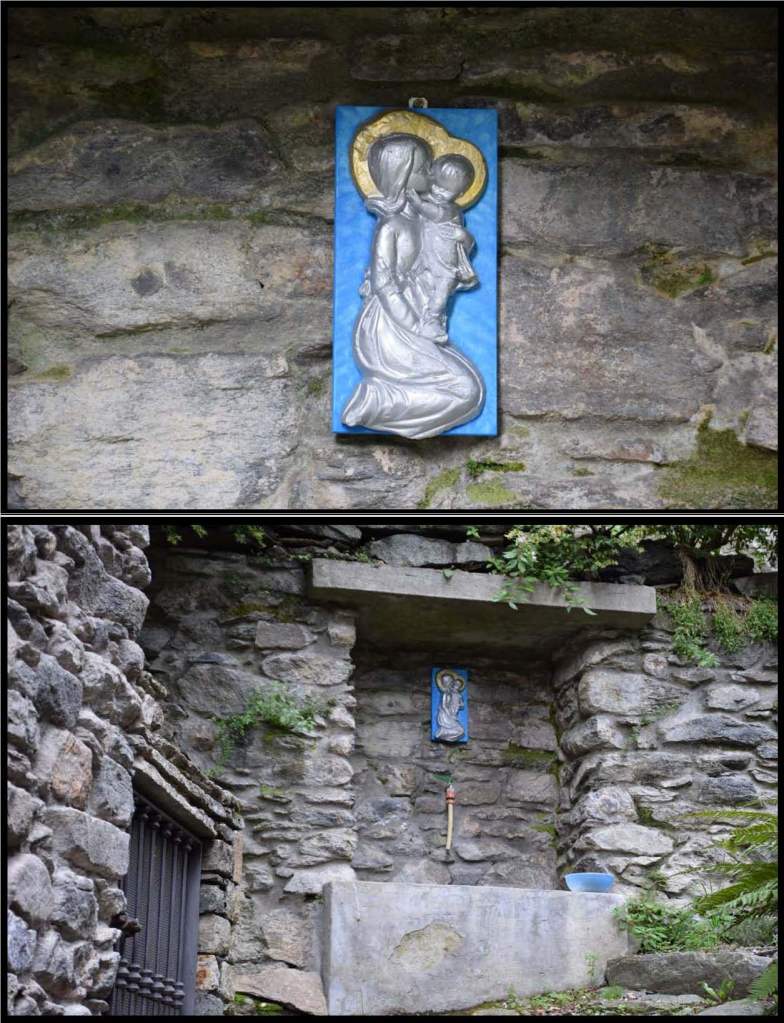

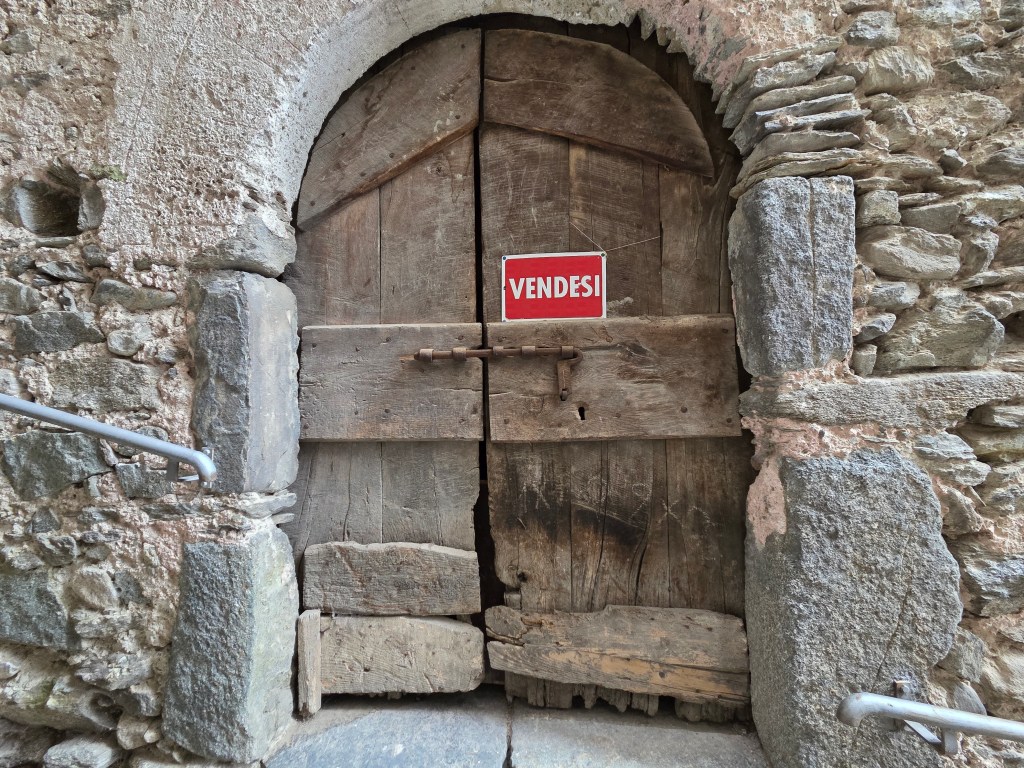
Pictured above is a montage showing a small Madonna shrine on a stone wall across from the renovated town fountain. This modern fountain, probably, replaces what might have been a large, double trough for watering animals and drinking. The shrine may date to the time of the original fountain or not. One cannot tell for sure. But as is still the norm, a sacred image must bless the sweet waters of a village that sustain the lives of the people and their animals. Pictured below is a charming old wooden door with a sign advertising a rather expensive rustico for sale (a rustico is a home needing complete renovation).
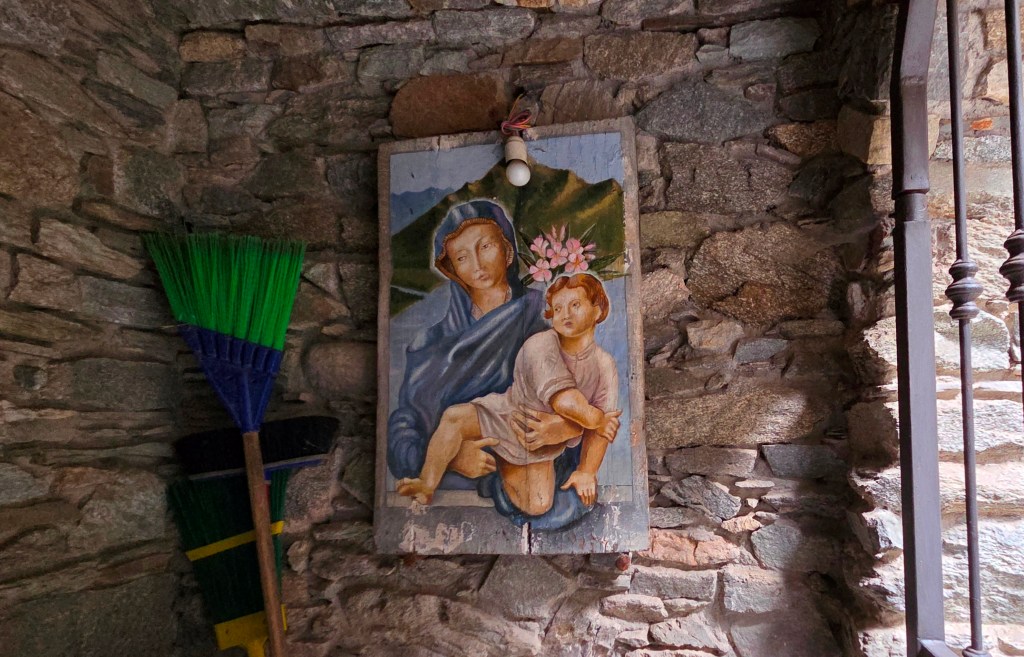
This beautiful Madonna and Child faced the entry door of a renovated home. Because of the steel-grate door that gates the vestibule housing the Madonna, I could not get a good frontal image. Although a bit crooked, the photo still illuminates the beauty of the Wall Madonna. As one can see, the modern artist painted the sacred images without halos. The medium is paint on a wood panel.
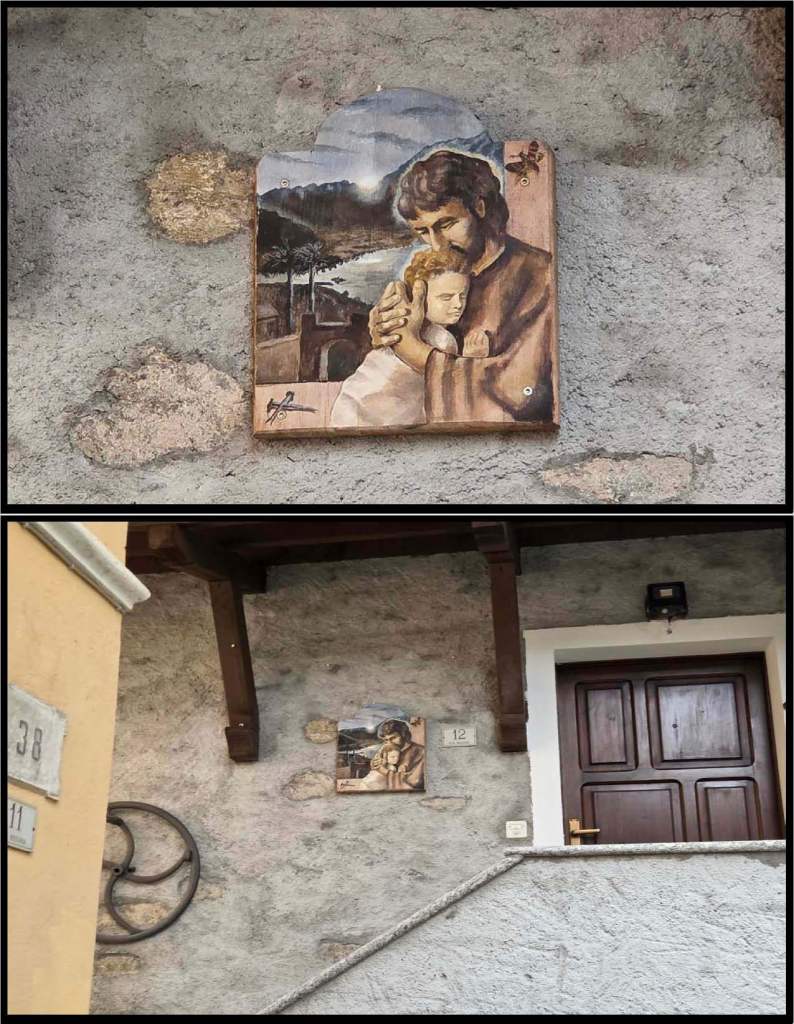
Below is a modern fresco depicting Joseph with Jesus. As with the previous fresco, there are no halos announcing the sacredness of those depicted. In the background are the nails used for crucifixion making this a poignant and prescient image. A moth is featured in the upper right corner. In the ancient Christian and Catholic traditions a moth represented the impermanence of material possessions and wealth and physical life with true treasure only being attainable in the presence of God after death. One cannot know for certain if the artist was conveying this meaning, but it is an interesting addition to the artwork, regardless, and since the totality of the rendered scene is highly symbolic, it is likely the symbolism of the moth was intentional. And the moth is a creature of the night perhaps harkening to the coming darkness of Jesus’ crucifixion which is a theme of the piece. Finally, I note that it is a shame that the integrity of this wonderful painting was violated by the four screws used to attach it to the wall. There are other less destructive ways to accomplish this. As with the previous fresco the medium is paint on a wooden panel.
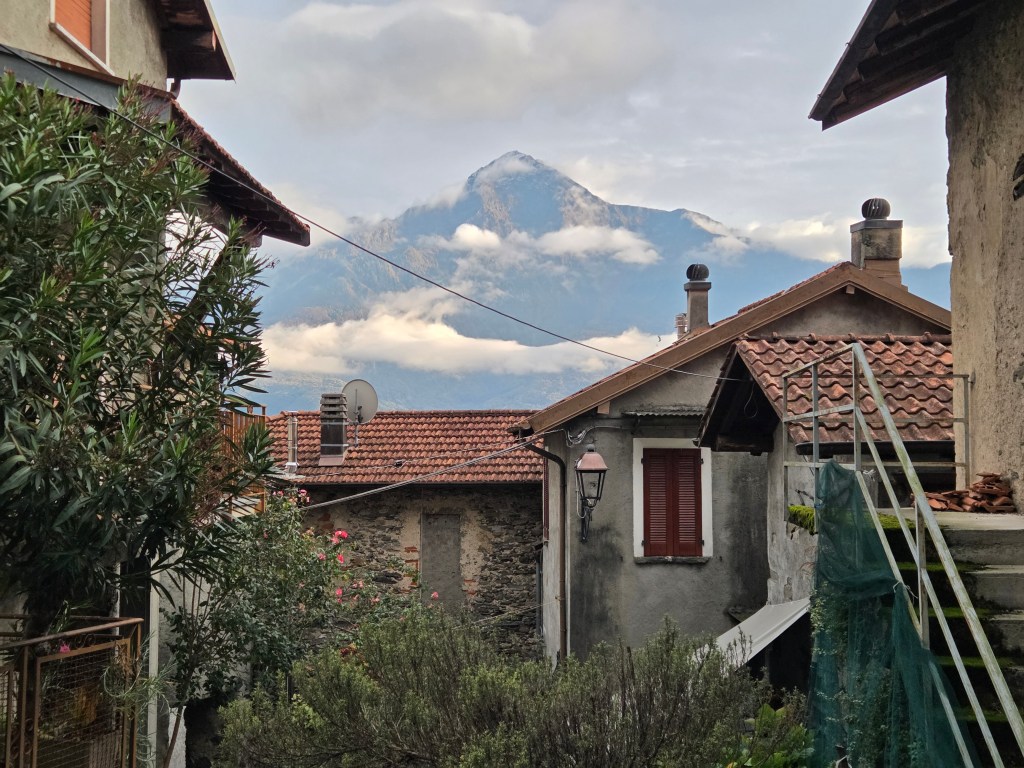
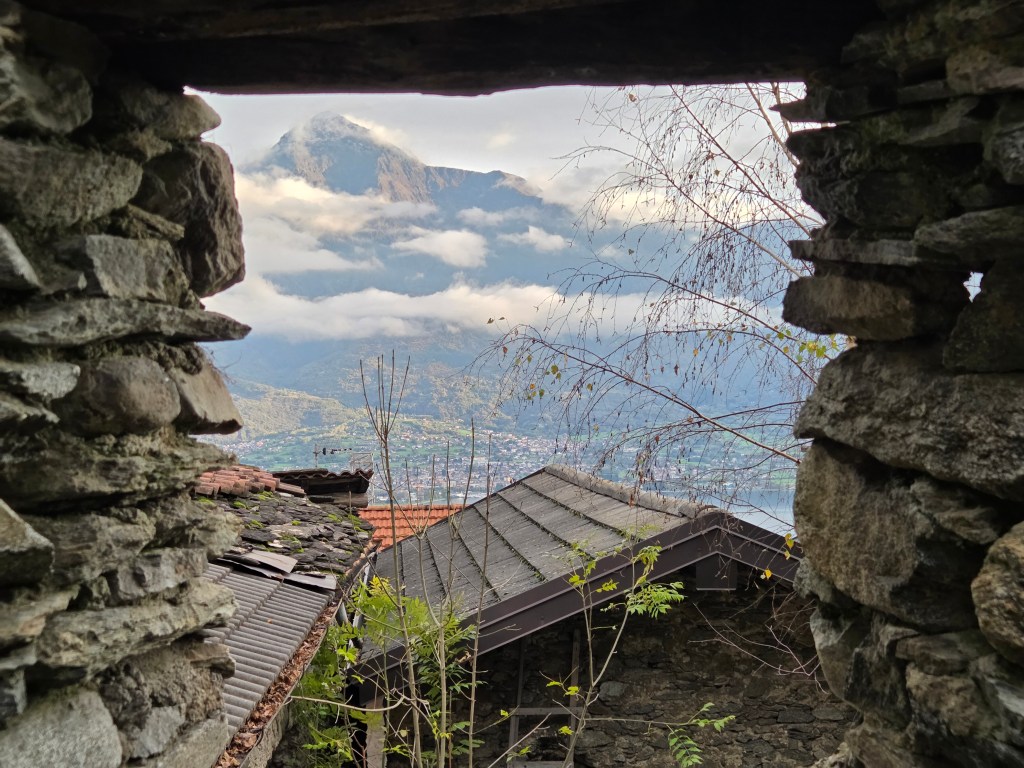
This is a view of Monte Legnone through what was left of a window in a home the roof of which was missing. All that remained was this wall and window frame. Aurogna has beautiful vistas from everywhere and every home in the borgo.
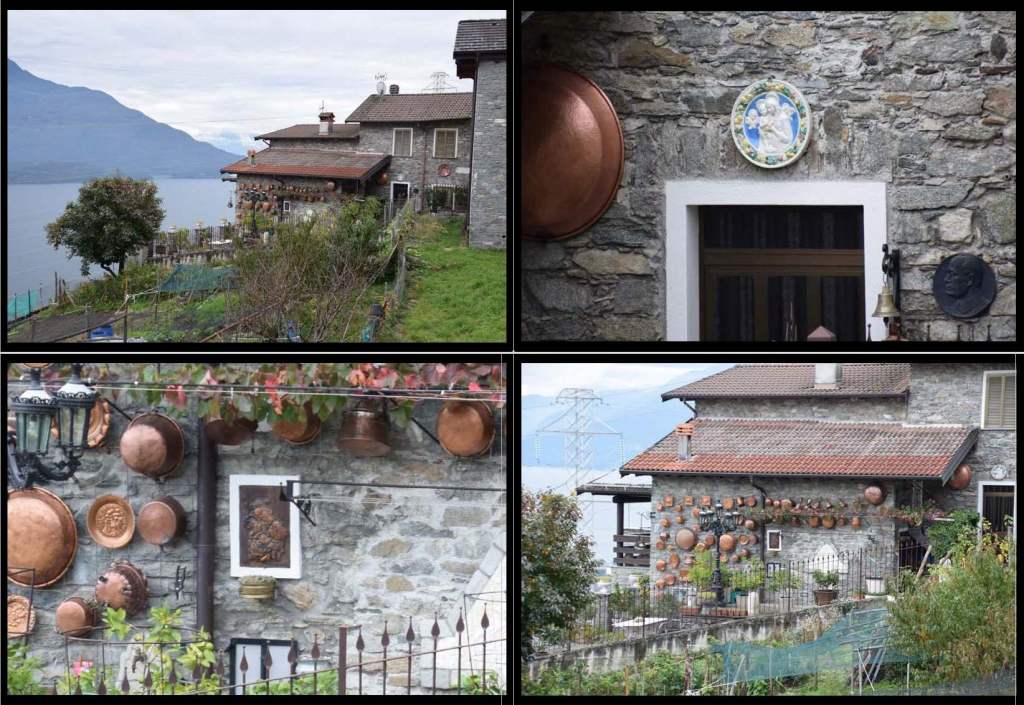
When entering Aurogna from the carriage road the first house one sees is this one (below). The owners have decorated it with copper cooking utensils and the tools of subsistence living, and with two modern Wall Madonna’s. One is made of hammered copper and it is seen among the other copper furnishings. The other is above the entry door to the home and it is ceramic. Both depict the Madonna with Jesus.
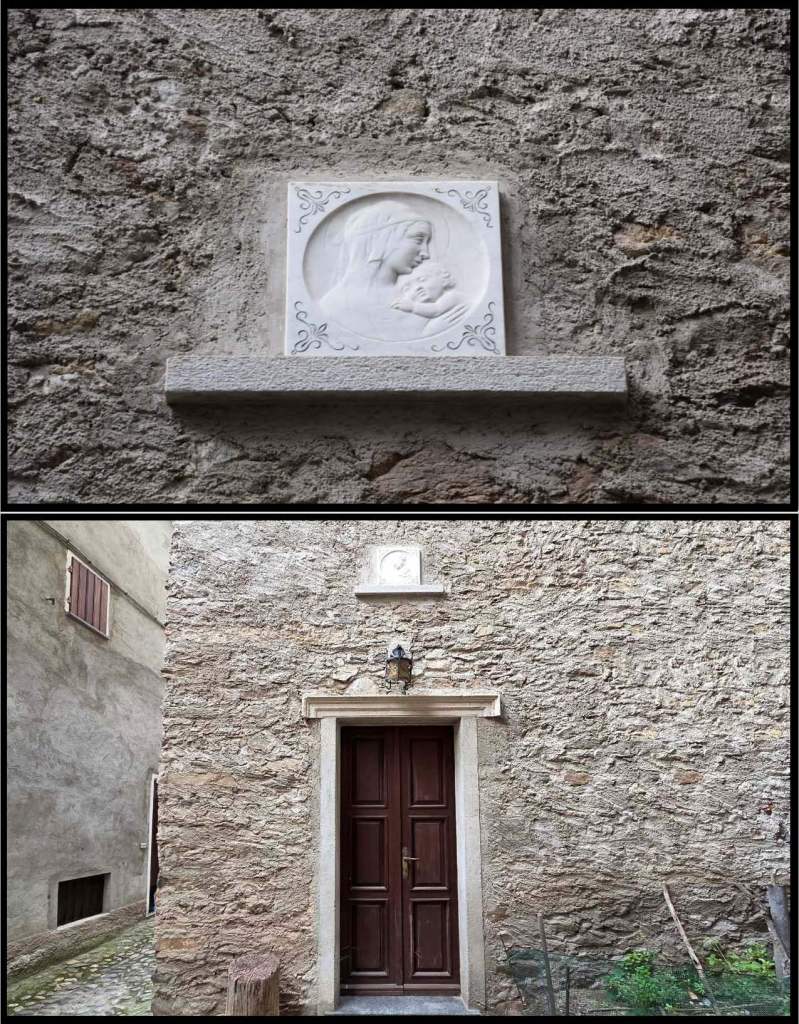
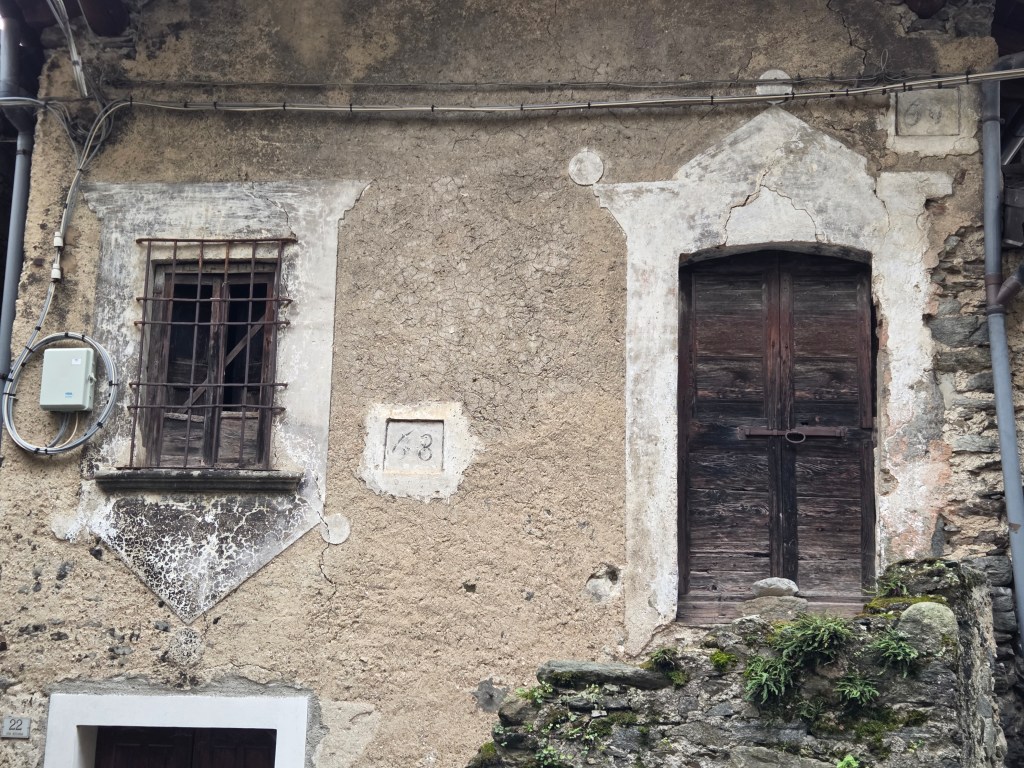
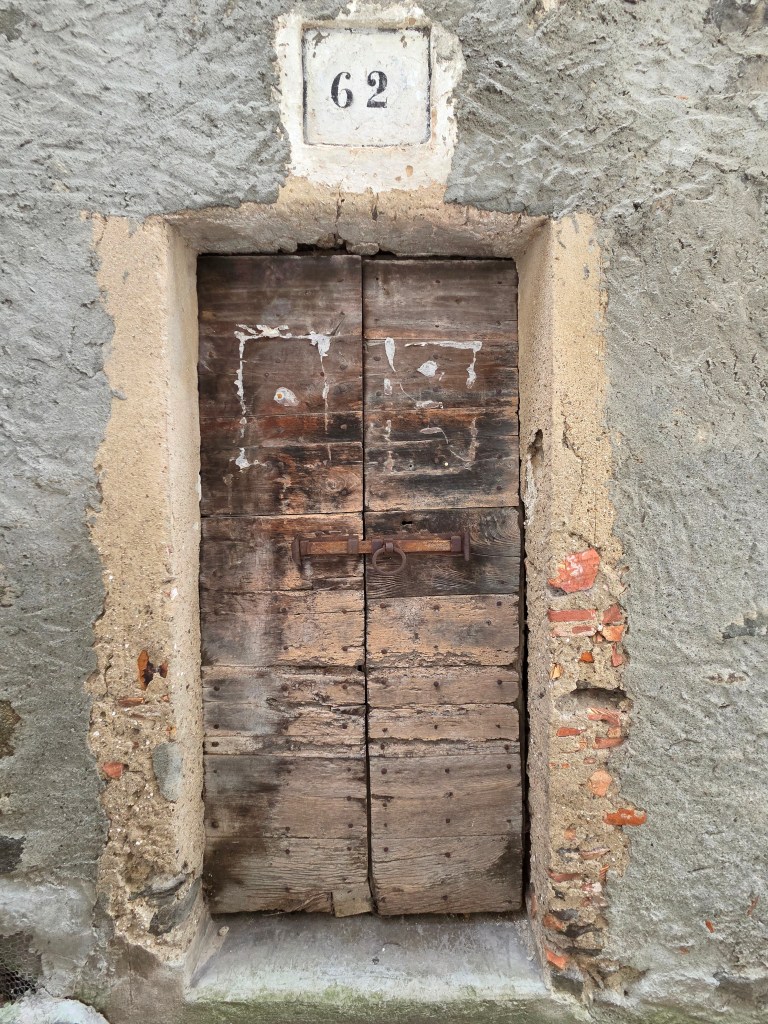
Above is a really finely crafted, marble Madonna & Child in profile. It sits on its own granite ledge that was added to the renovated home and made and attached to the wall solely to hold the sculpture. The carving renders the images gracefully and the work is impressive. Below is an old wooden door to a vacant home. The large numbers identifying the address were common in the early 20th-century. The numbers are no longer relevant but one often finds them accompanied by the newer and accurate house numbers.
In the montage below is an artful display of the tools of farming surrounding a framed picture of the crucifixion. The doors to two old homes that front the display are located in a small piazza and in a sort of cubbyhole made by what was once the upper balcony of a old villa which now seems to be ‘cut-off’ and half-replaced by a ‘newer’ and larger stone home. The owner has decorated all three walls with the utensils necessary to life in the mountains. Although the framed photo is nothing special, I really liked it and found the display compelling. This tiny piazza was a cacophony of old homes, cobbled ways, and staircases.


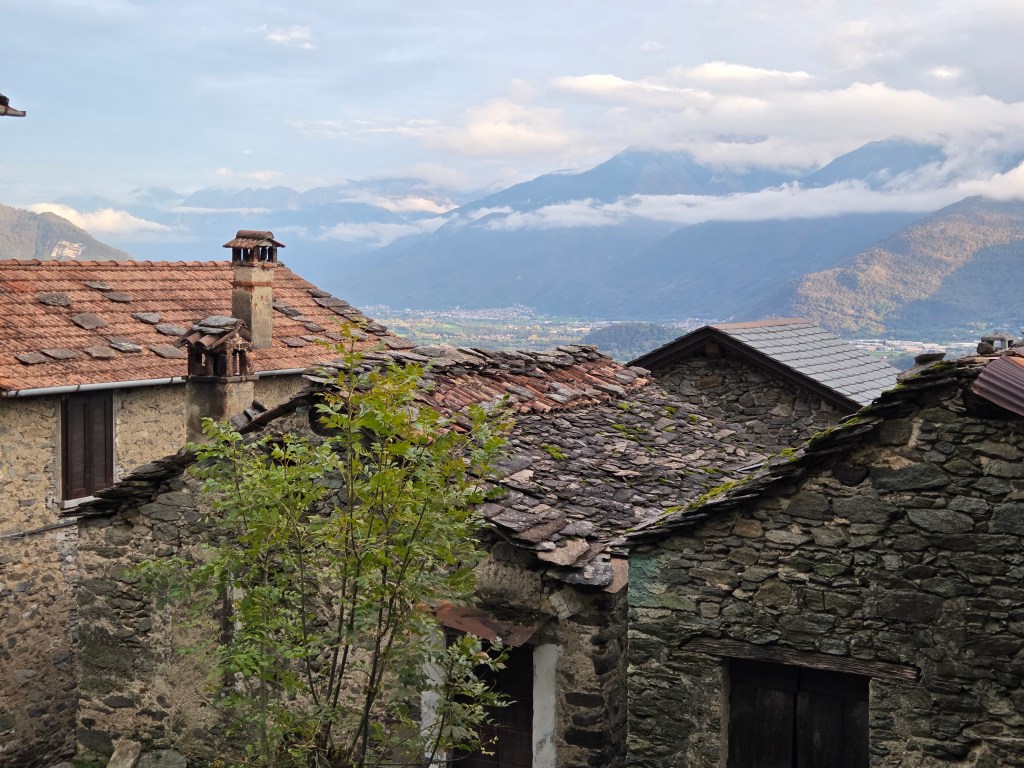
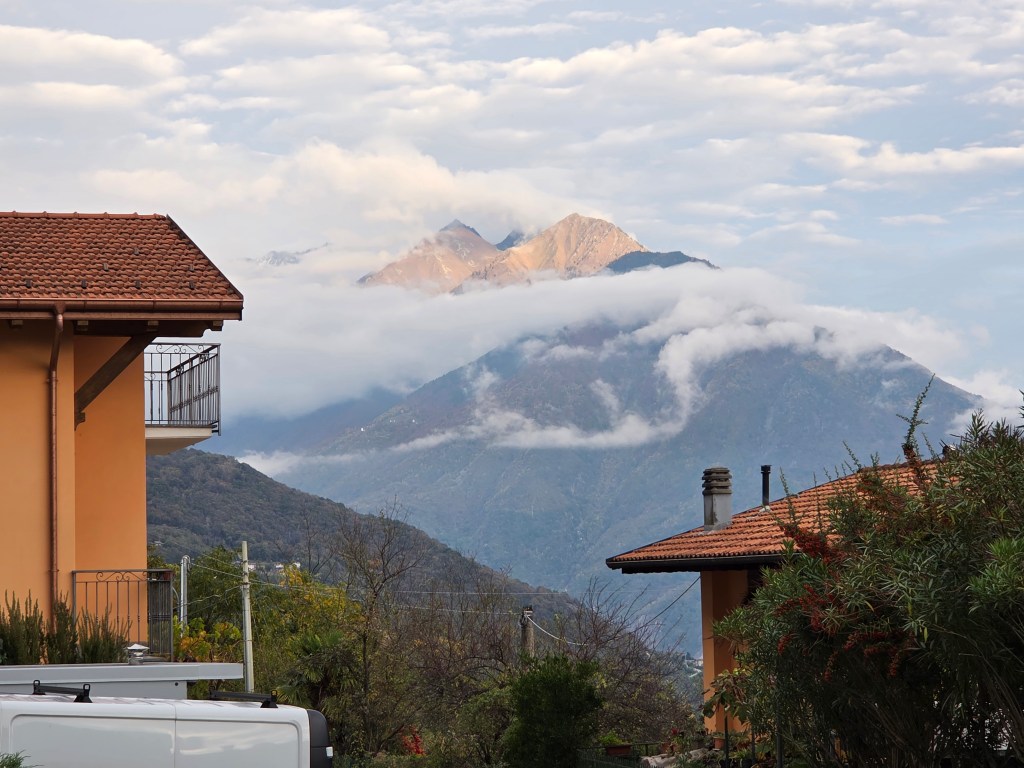
Above this text is a very small ceramic Madonna and Child placed next to the entry door of an updated home. The modern imagery is interesting for the use of different fruits as a frame for Mary and Jesus. Fruits have specific symbolism in Catholicism. Featured in the ceramic are olives, pears, and peaches. Pear and peaches are thought to represent fertility and olives symbolize peace. Below this text is another beautiful view of the Orobic pre-Alps.
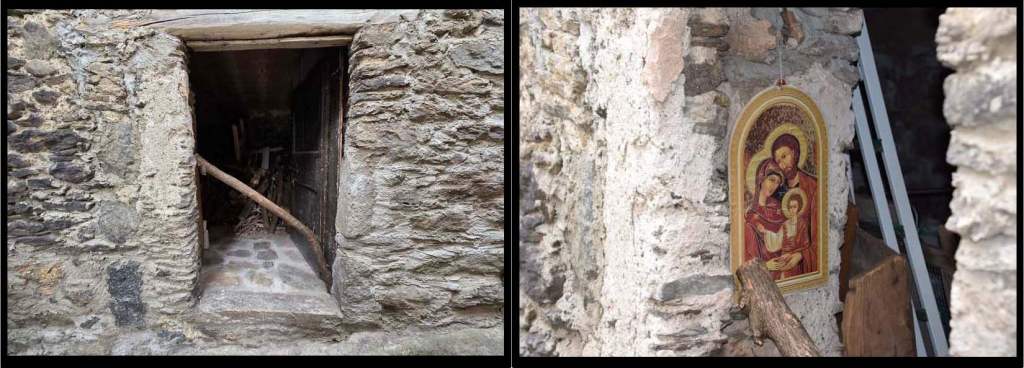
Walking through a village with old homes tightly clustered together can make seeing Wall Madonna’s difficult. The modern imagery seen below would be easy to miss since it is tucked away on the inner jamb of an old door that is propped open with a stick. The pretty Sacra Famiglia is only made of composite wood with what looks to be a glued-on reproduction of an artwork but it is a poignant offering of a sad faced Joseph and a Byzantine Madonna with a bowed head and woeful face. Jesus here is a youngster and with his right hand he is making a hand gesture associated with the Trinity. The room behind the door was used for storage and the door could not be closed without damaging the artwork, hence, the stick.
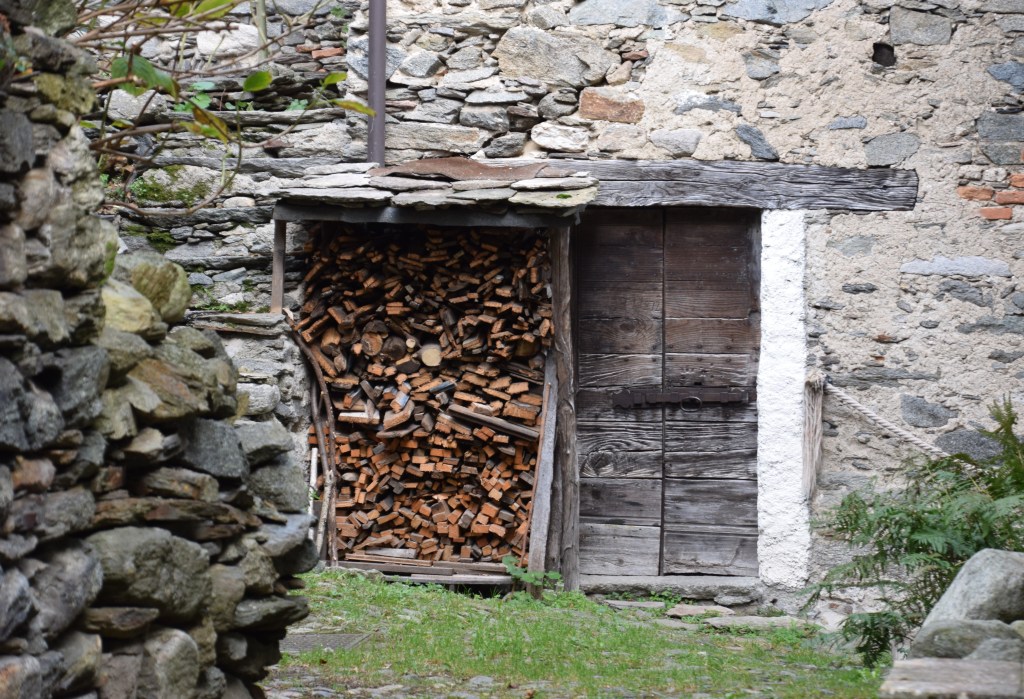
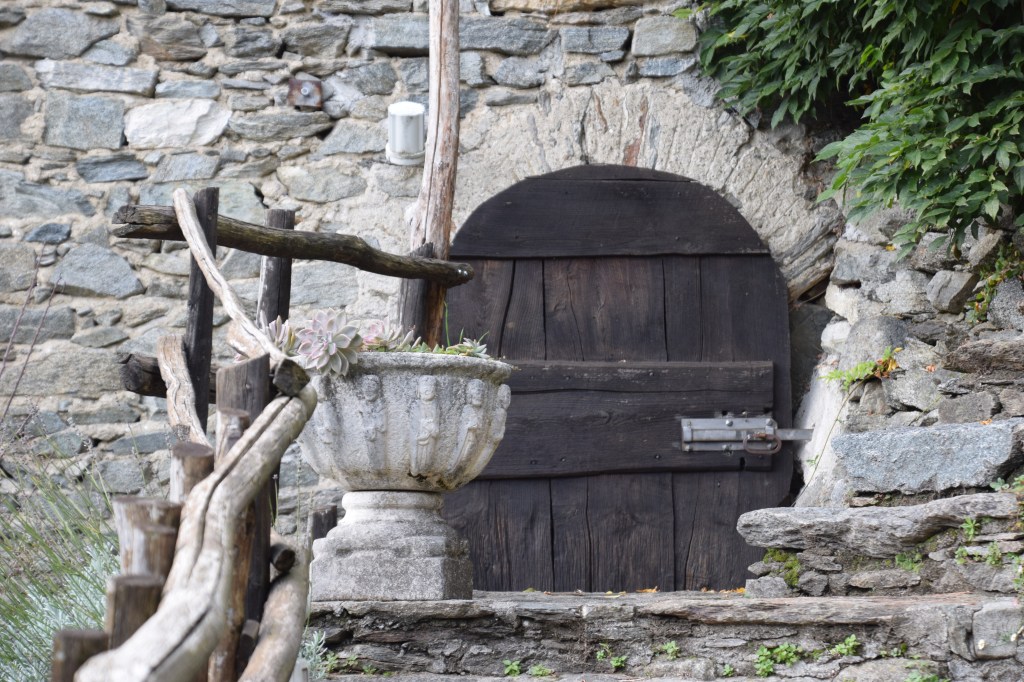
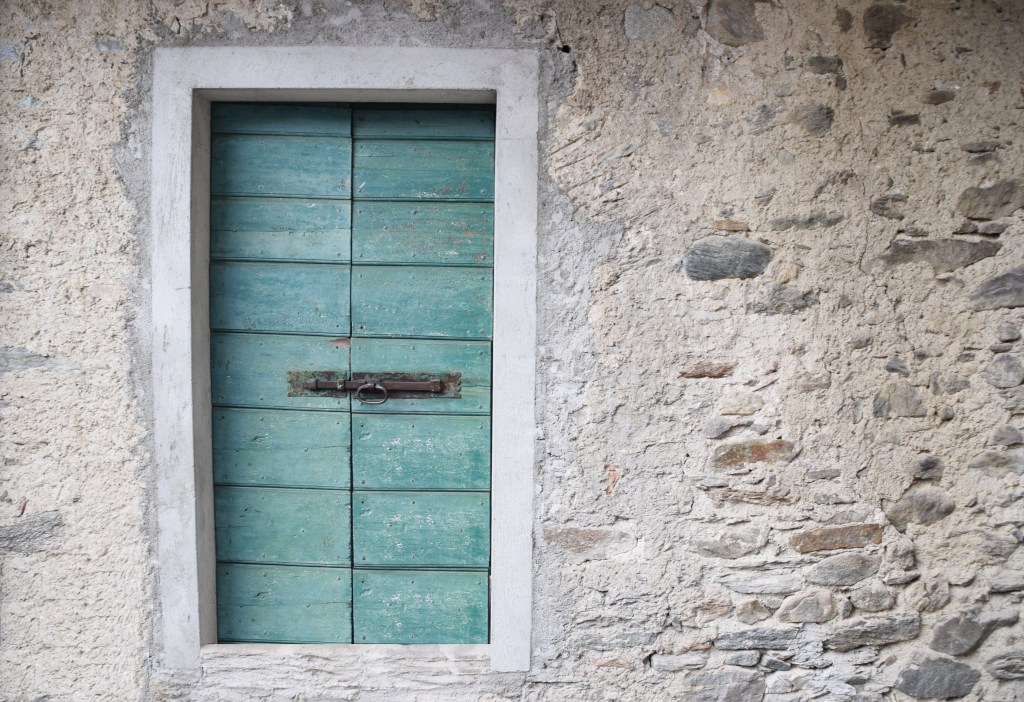
This door with wood stacked next to it is oddly attractive. The thick grey lintel over the faded wood of the door next to the browns of the different shaped firewood logs all in a stone setting make for a nice composition.
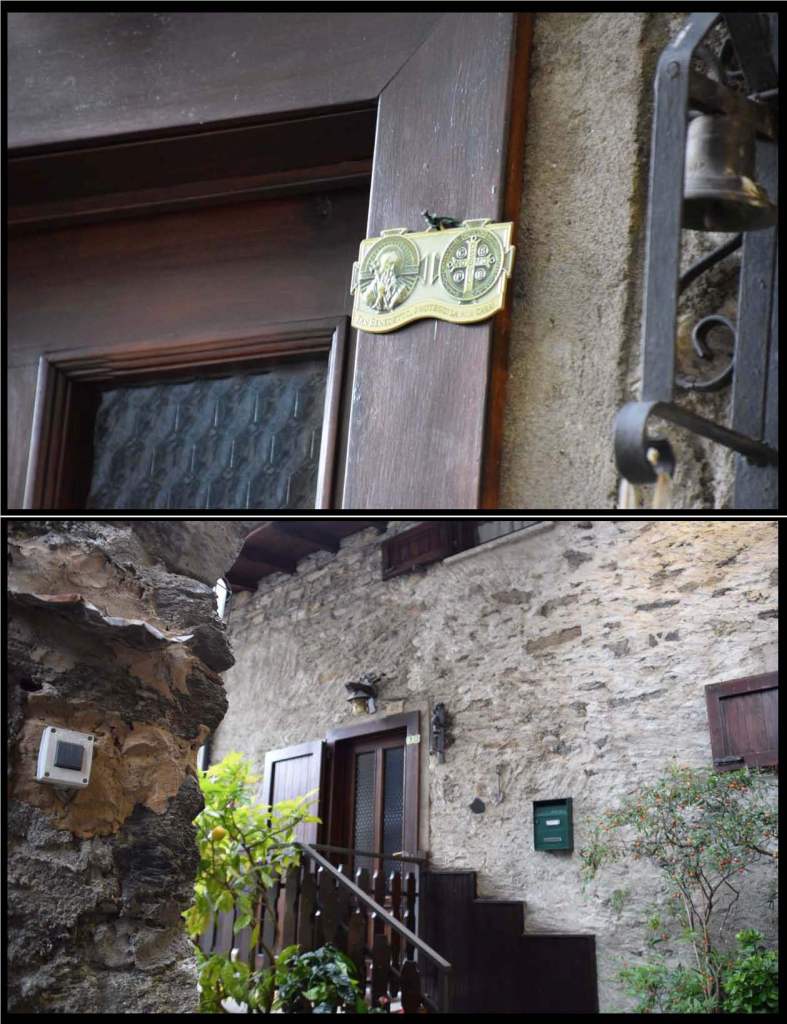
The montage above shows the only Christian imagery that I found in Aurogna which did not feature the Madonna and/or Jesus. This is just a small, plastic devotional to San Bernadetto da Norcia asking for his protection: SAN BENEDETTO PROTEGGI LA MIA CASA – Saint Benedict guard my house. Interestingly, and in keeping with the theme of salvation from the ravages of illness found in this area, San Benedetto protects one against ‘curses’ and diseases. Although not expensive or artful, the owner of the home felt the need for the blessing of a saint sought for patronage specific to the illnesses of the body and spirit .
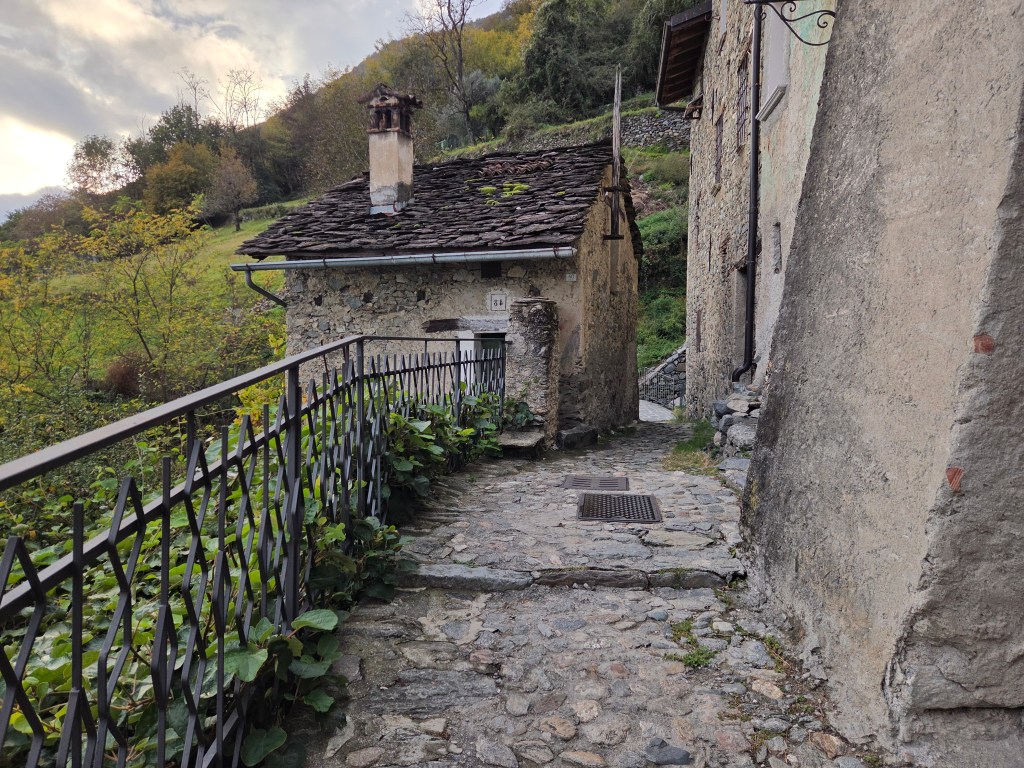
This home anchors the southern end of the village and is at the end of the via Regina – the main footpath through Aurogna. One cannot drive through the borgo. The narrow paths are for donkeys and feet only. Beyond this home on the mountain face are gardens and olive groves that are advantaged by the many hours of sun this side of the lake enjoys. The small home is not occupied but the owner keeps chickens on the farther side in a rickety, hand-crafted coop.
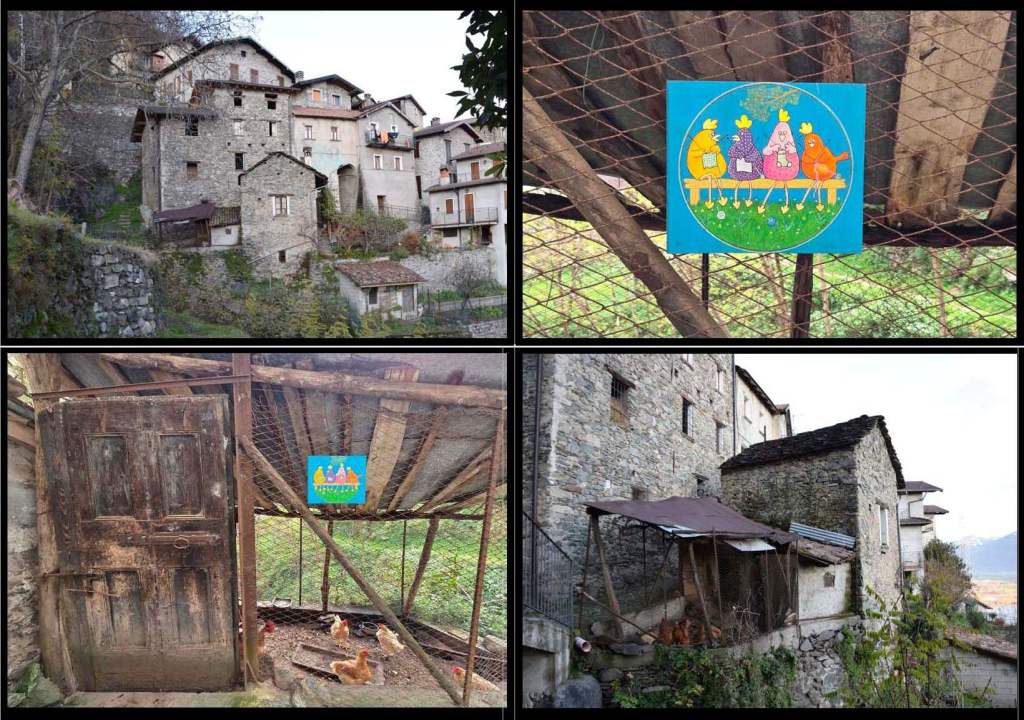
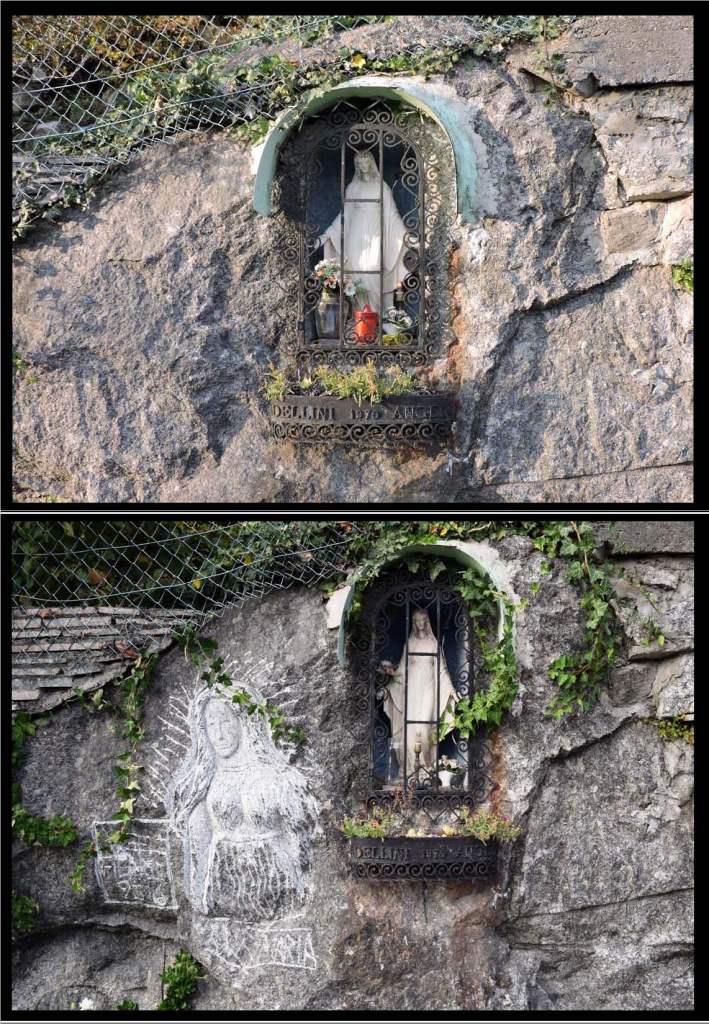
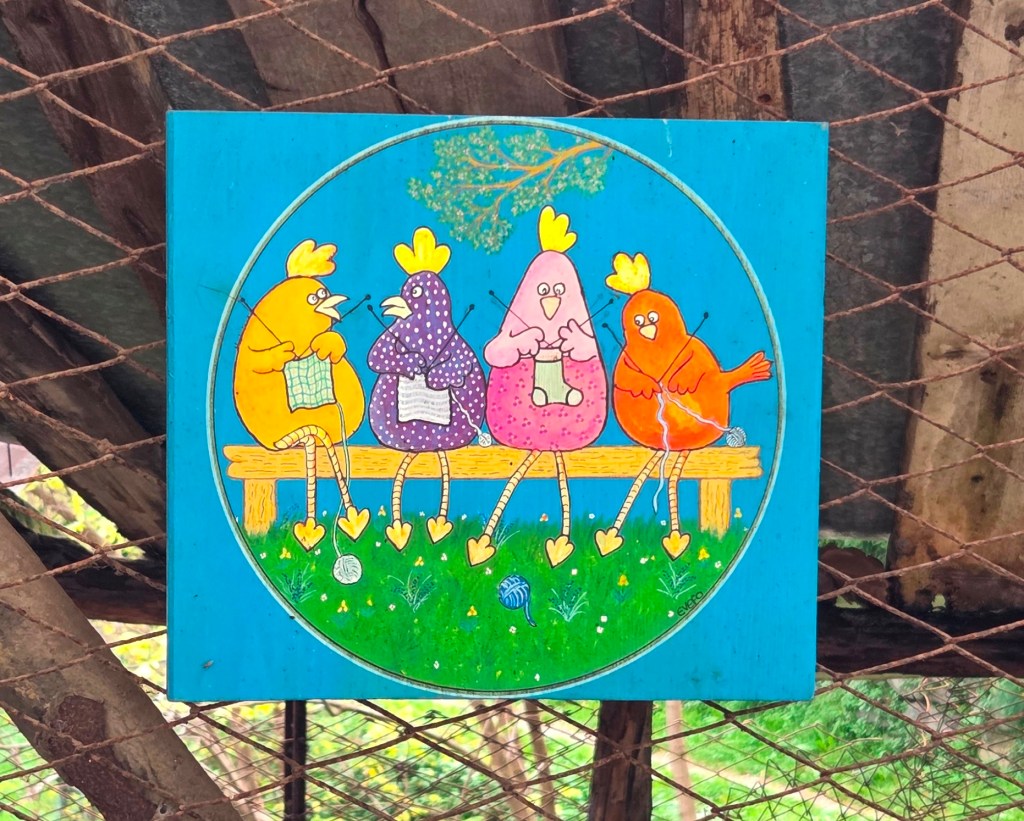
I finish this narrative dedicated to the Medieval village of Aurogna by giving space to the whimsical expression of devotion that this different Wall Madonna represents. As is the norm, the image guards and blesses the entry door to the home and the ‘Madonne’ depicted are engaged in a traditional occupation of women – knitting. Inside the residents – all hens but for one rooster – spend their lives in fertility – the singular occupation of the Great Virgin. It is fascinating the depth to which we are all affected by our cultural norms and prescriptions. This colorful imagery does not fail to reflect that socialization albeit in a humorous and light-hearted way! And if one examines the montage which uses photos from both my visits to Aurogna – first in December 2019 (top left and bottom right) and now in October 2025 (top right and bottom left) one will notice that the chicken coop was sans Wall Madonna in 2019. This type of change is why a return to villages can be fruitful. As further – and interesting – examples of changes to artwork found when revisiting villages, here are montages of two Wall Madonna’s found in the Valtellina – one from Cadelsasso and one from Polaggia, a small frazione of Berbenno di Valtellina. The first shows the addition of a beautiful incised sculpture of the Madonna by local artist Angelo Gabriele Fierro. Fierro, a living artist, is known for his work throughout the Valtellina and Lake Como area. The second shows the disastrous “restoration” of what was once a beautiful Virgin of Grace.

I hope you enjoyed this journey through Aurogna!
 Wall Madonna's of the Valtellina