It was a gorgeous early March day for a walk in the AltoLario from Selva – where the fabulous frescoes of Aurelio Luini are found in the Chiesa di San Martino – up to Montemezzo and the località Montagnola, Dalco, and Montalto. Walking allows one to look for frescoes on old houses that can be found along the way in the forest and in small località, and, also, affords one the opportunity to easily enjoy and photograph the views. This March day was filled with views but my Wall Madonna search was a loss. The only frescoes on this route are found in Burano. However, there are still about 5 kilometers to explore above Montalto so I will return soon and complete the mountain search. Here are the best of my finds for this day.
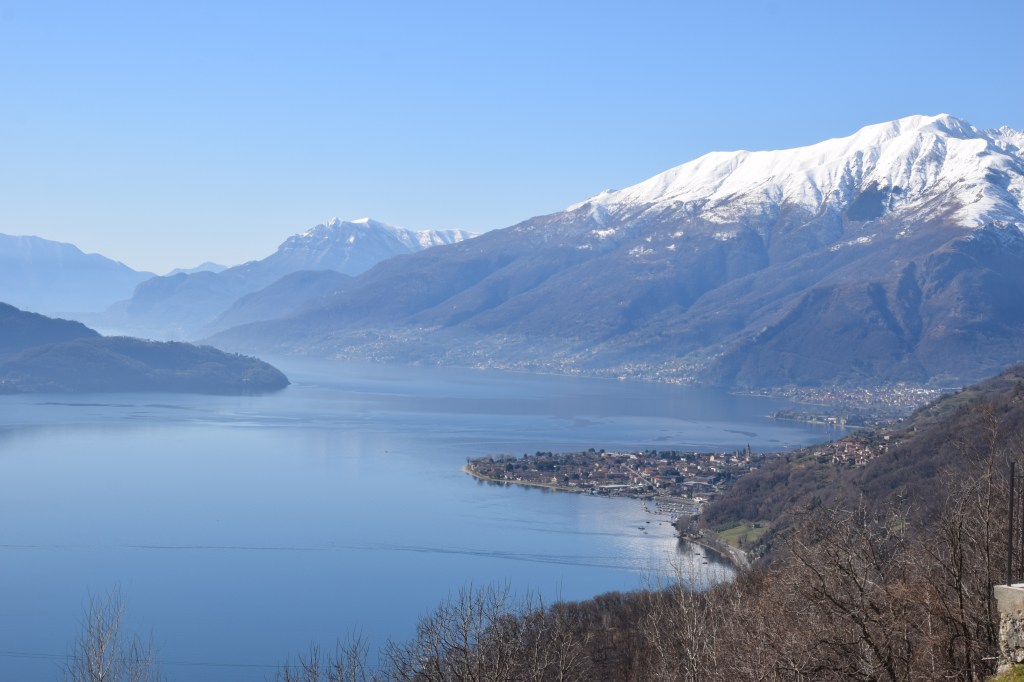
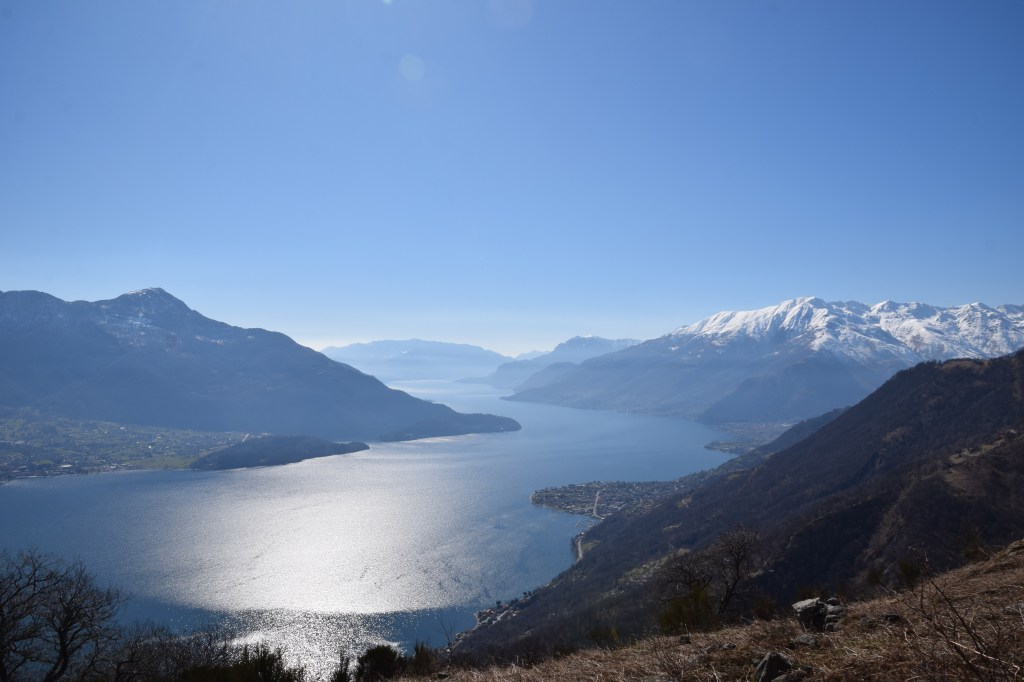
This is the view of Lake Como that one has for the entire 8-kilometer / 5-mile walk from Selva to Dalco and Montalto. That is Domaso protruding into the lake in the center fo the photo.

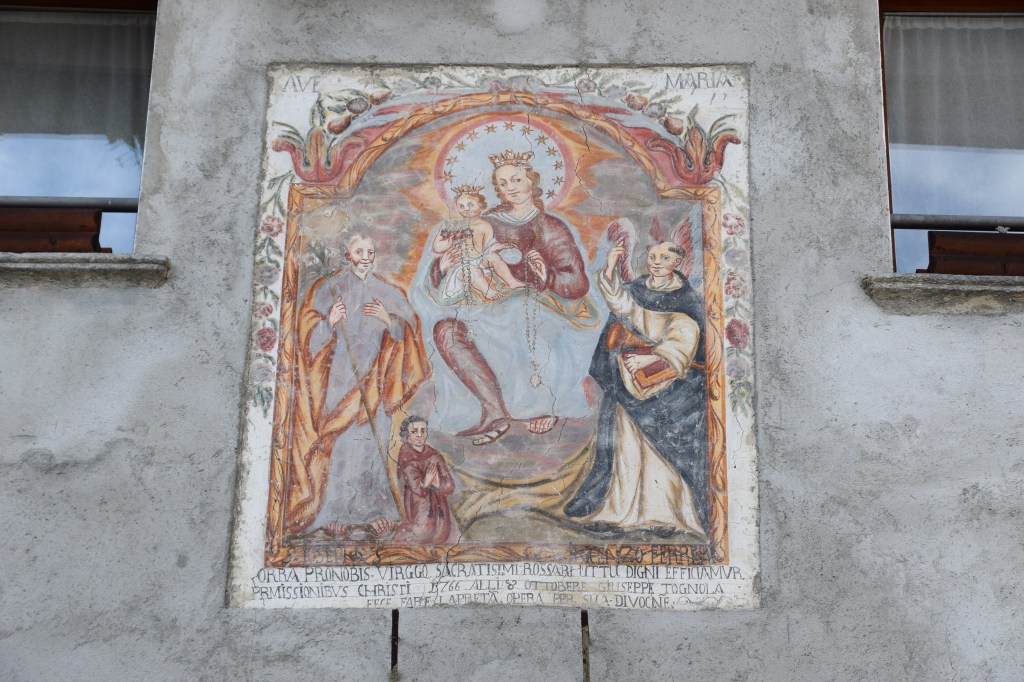
This Wall Madonna is dated 8 Ottobere 1766 and was donated by Giuseppe Tognola who can be seen kneeling at the feet of the Great Virgin & Child. San Giuseppe is to the viewer’s left and San Vincenzo Ferrer is to the right. The fresco is onomastic as the donor’s name-saint – Giuseppe – is depicted. One might posit that the name ‘Vincenzo’ was also a family moniker since Vincenzo Ferrer is not a commonly depicted saint in this area.

The inscription reads: ORRA PRONOBIS VIRGGO SACRATISSIMI ROSSARI UTTU DIGNI EFFICIAMUR PRMISSIONIBUS CRISTI 1766 ALLI 8 OTTOBERE GIUSEPPE TOGNOLA FECE FARE LAPRETA, PER SUA DIVOCNE. Although the Latin is imperfect, the inscription is thus: NOW, O MOST HOLY VIRGIN, WE CALL YOU THE ROSARY, THAT WE MAY BE MADE WORTHY BY THE PROMISES OF CHRIST. 1766 ON 8 OCTOBER, GIUSEPPE TOGNOLA MADE IT, FOR HIS DEVOTION
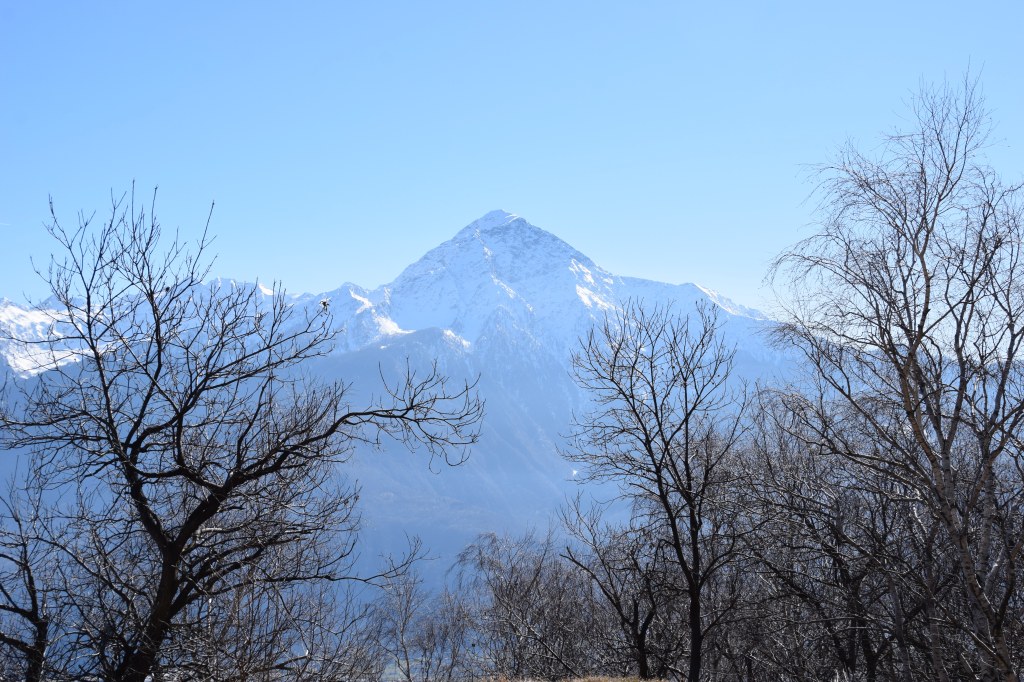
This is Monte Legnone – a mountain in the Bergamo Alps. At 2610 meters it is the tallest peak in the province of Lecco and in the western Orobie Alps. Hiking to the top – which has a large crucifix – is popular. But the trek needs to be undertaken with caution. The last section to the peak is along a narrow, rocky path with a sheer drop of 1,000 meters. Watching a YouTube video of the hike before attempting it is a good idea! Here is a link to one such video: https://www.youtube.com/watch?v=d7mfGXZL1EA

A ciancett – a place to bend the knee in dialect – on the mulattiera to Montalto. This shrine is ancient and this is where the old mulattiera crosses the newer asphalted road. The mulattiera is actually beautiful – wide and in very good shape. The frescoes of this small chapel are long gone and have been replaced by small framed pictures of the Holy Family, Pope John XXII, Mother Theresa, Don Guanella, and the Madonna & Child.

In the Valtellina area, these small shrines are called ‘ciancett’ or ‘cincett’. These words are dialectical and come from these dialectical words – incinet and inchinati. The related modern verb is ‘inchinare’ – to bend the knee. These were Christian way stations situated on roads to offer respite and a place to pray to the traveler. This ciancett is at the point where the old mulattiera crosses the modern carriage road.
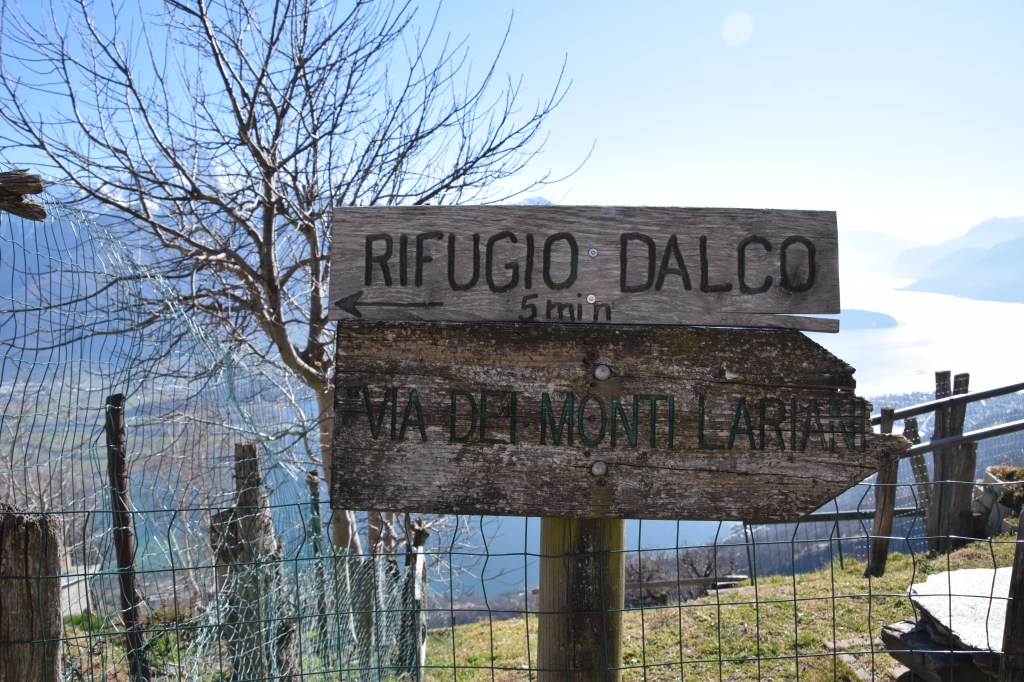
A hand-hewn sign directing the traveler to the Rifugio Dalco which is actually a one-star hotel with a great restaurant and an old stone-paved sentiero that leads from Montalto in the mountains above Lake Como.
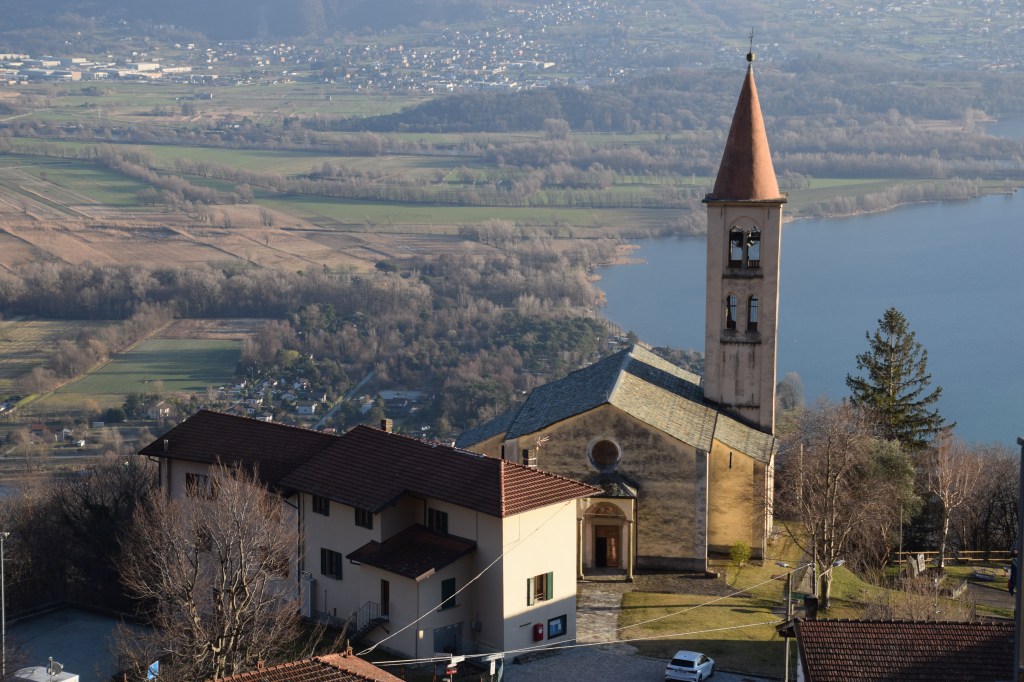
This is a view of the 15th-century Chiesa di San Martino in Selva from the road above. The church is famous for its frescoed interior. The presbytery apse area was painted in the second half of the 16th-century by Aurelio Luini (1530-1593). The two side chapels are the work of the Fiammenghino – Giovanni Mauro Della Rovere (1575-1640).
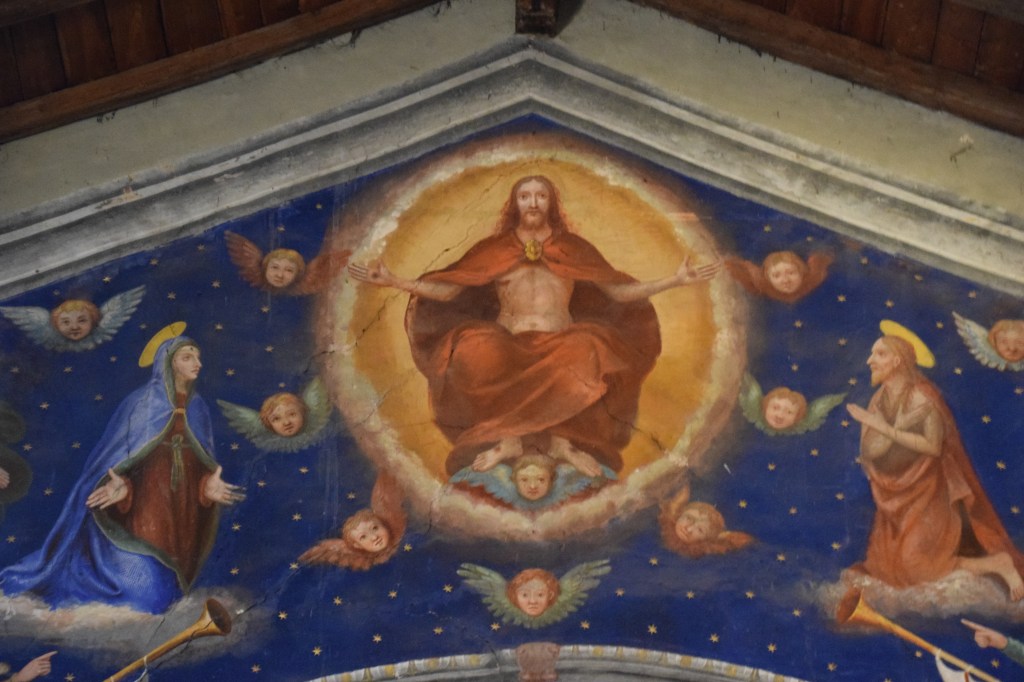
The triumphal arch features the Last Judgment. Here, in a detail, is Jesus in a sacred mandorla flanked by Mary and Joseph and surrounded by Cherubim. Aurelio Luini was the fourth and last son of Bernardino Luini (1481- 1532) the masterful artist of the Italian High Renaissance who worked directly with Leonardo da Vinci.
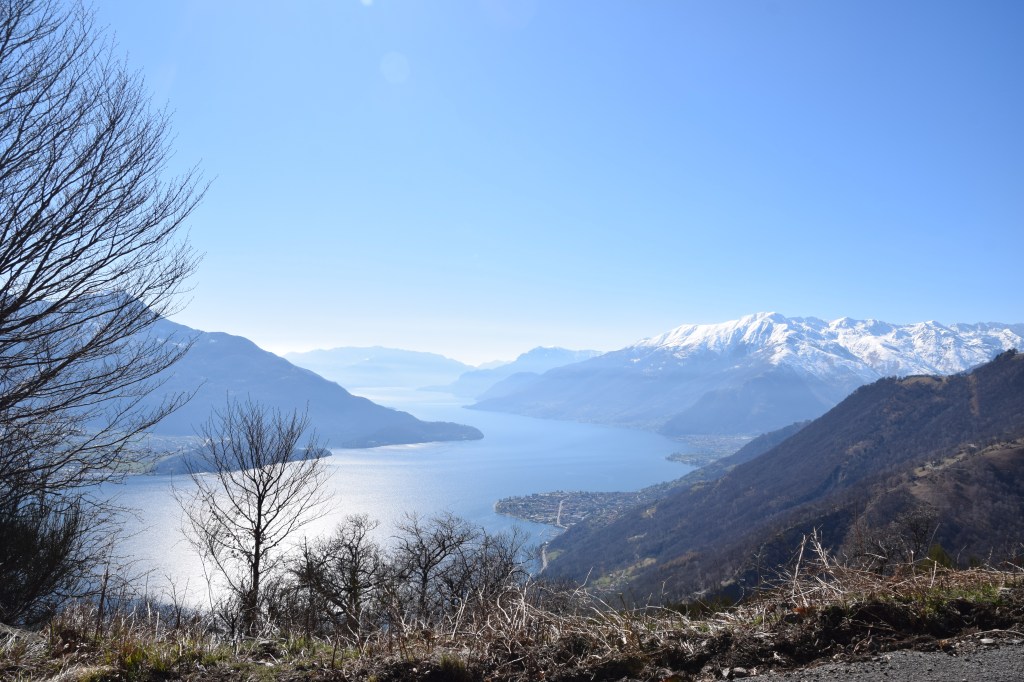
Another beautiful view of Lake Como!

This is the only Wall Madonna I found on my walk above the lake. Found on a renovated home in Montalto, this modern Madonna is carefully crafted and lovely.
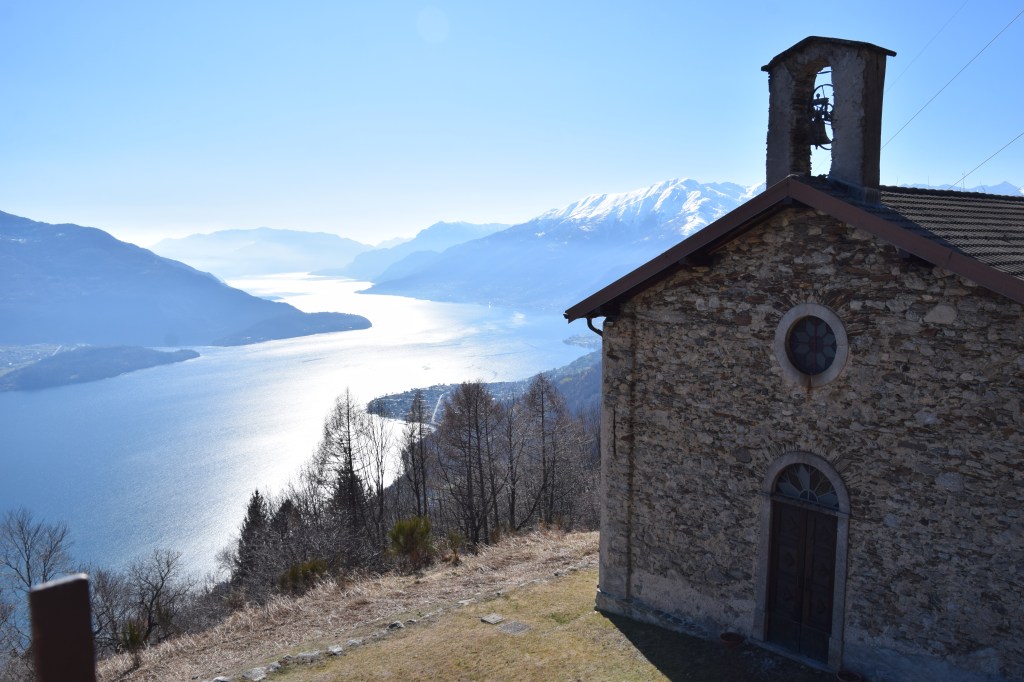
The small Chiesa di San Lorenzo Martire in Montalto. This church was built in 1900 according to the Lombardia Beni Culturali website (link below). But my feeling is that, like most churches, it sits on a site long used for worship by the peoples who came before. https://www.lombardiabeniculturali.it/architetture/schede/CO250-00587/

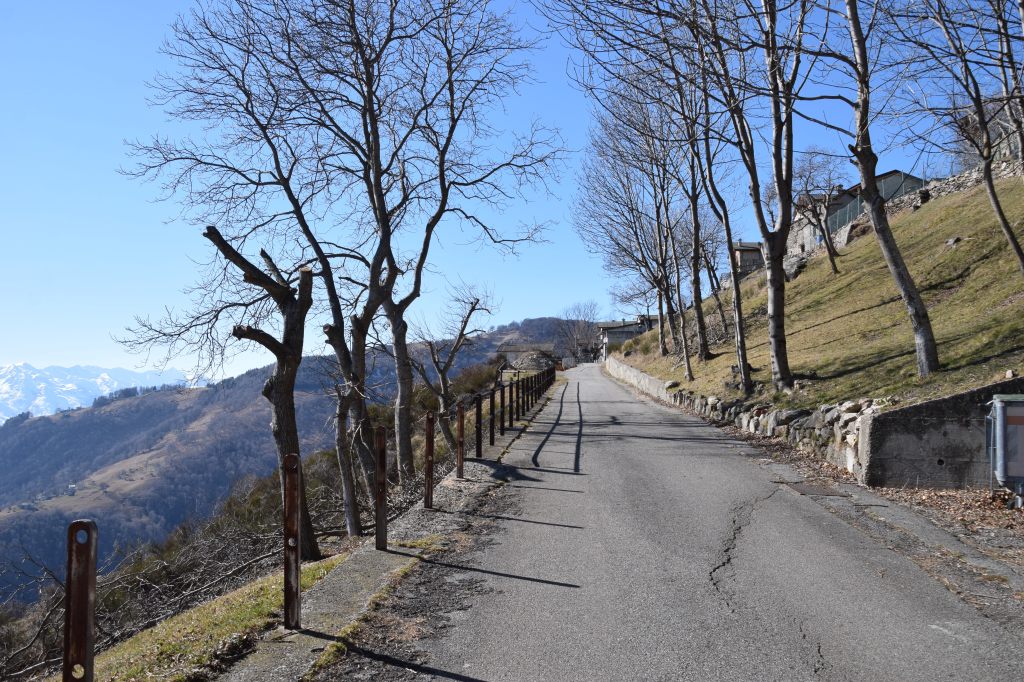
Walking to Montalto along the carriage road offers astonishing views the entire way. Because the modern road uses parts of the old mulatierra there are stretches that are quite steep. Photos cannot capture the incline which can be sharp enough to be uncomfortable going up or down.
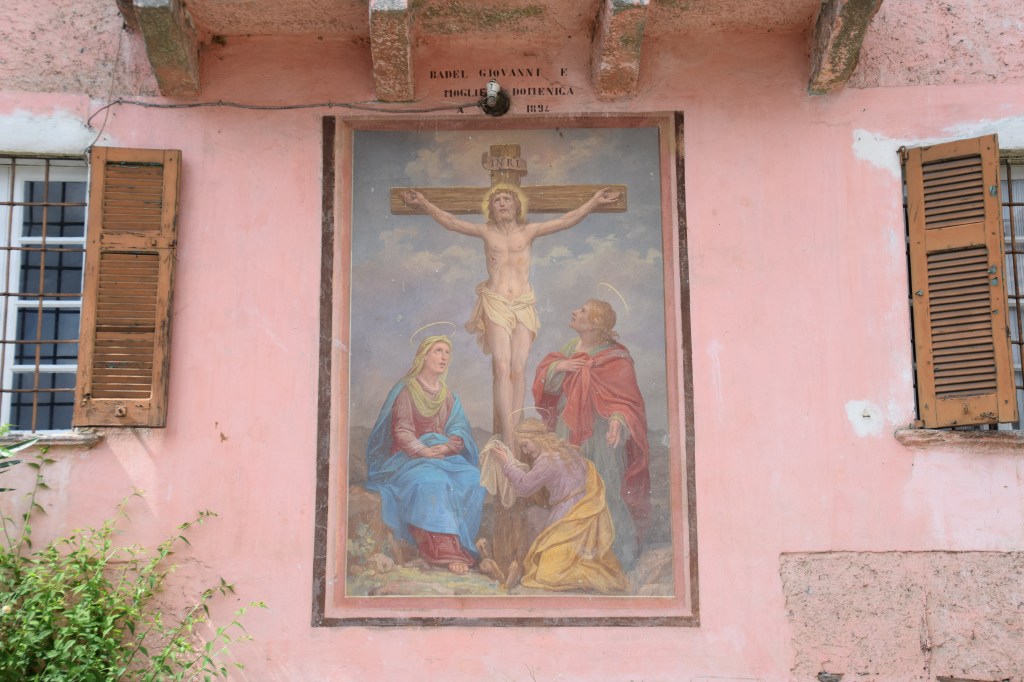
In the center of the frazione Burano is a old, cobblestone street with a small piazza. This fresco is found there. This is a crucifixion with the Great Virgin, Mary Magdalene, and Saint John the Evangelist. The fresco is dated 1870 and was donated by Giovanni Badel and his wife Domenica. The work is onomastic as San Giovanni Evangelista is the name-saint of the donor Giovanni Badel.

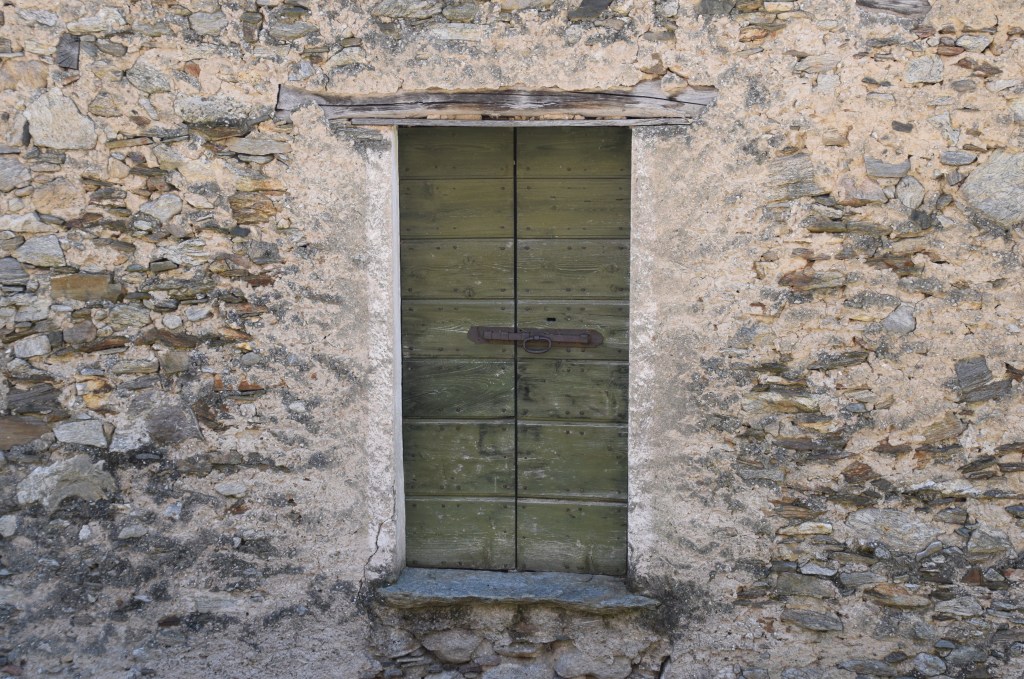
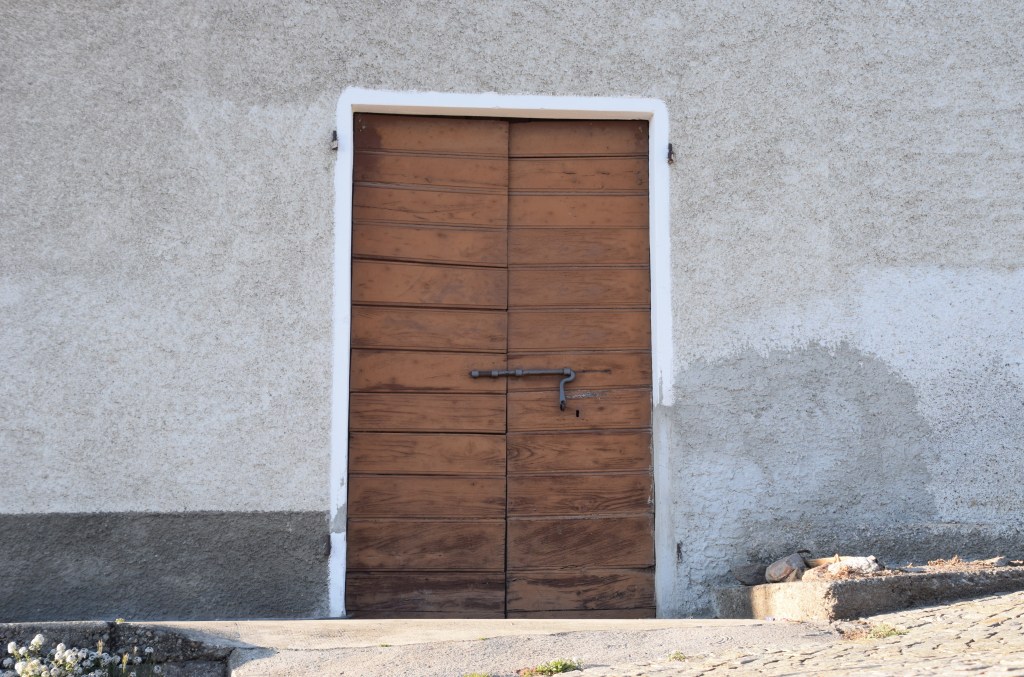
The door to a home in a tiny località that can only be reached by narrow footpaths between the old stone homes. Regardless of the extent of renovations, people repair and preserve these ancient, solid wood doors.
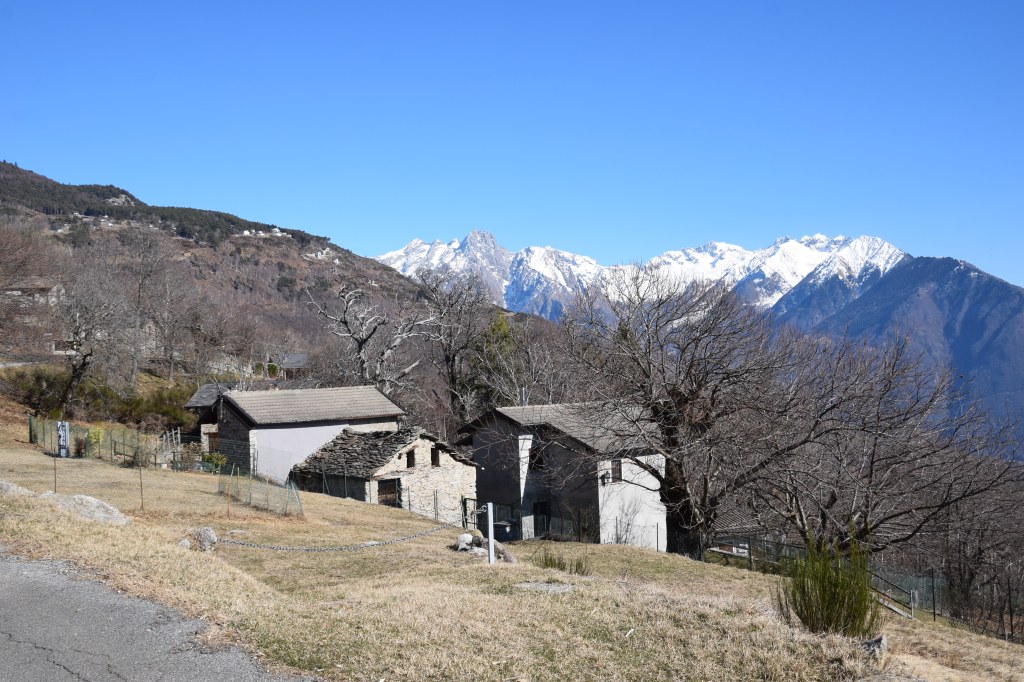
These summer baite – huts – are often inherited or attached to the sale of a home closer to the lakeside. There are few year-round residents up here even though there is an asphalted road and electricity available all the way to the mountain top. When homes like these are renovated they are generally used only in the summers or on weekends. As beautiful as the area and scenery are there is nothing up here but these old homes – no trattoria, no bar, no small shop for sundries. One needs to be committed to relaxation and/or uphill hiking to enjoy time here.
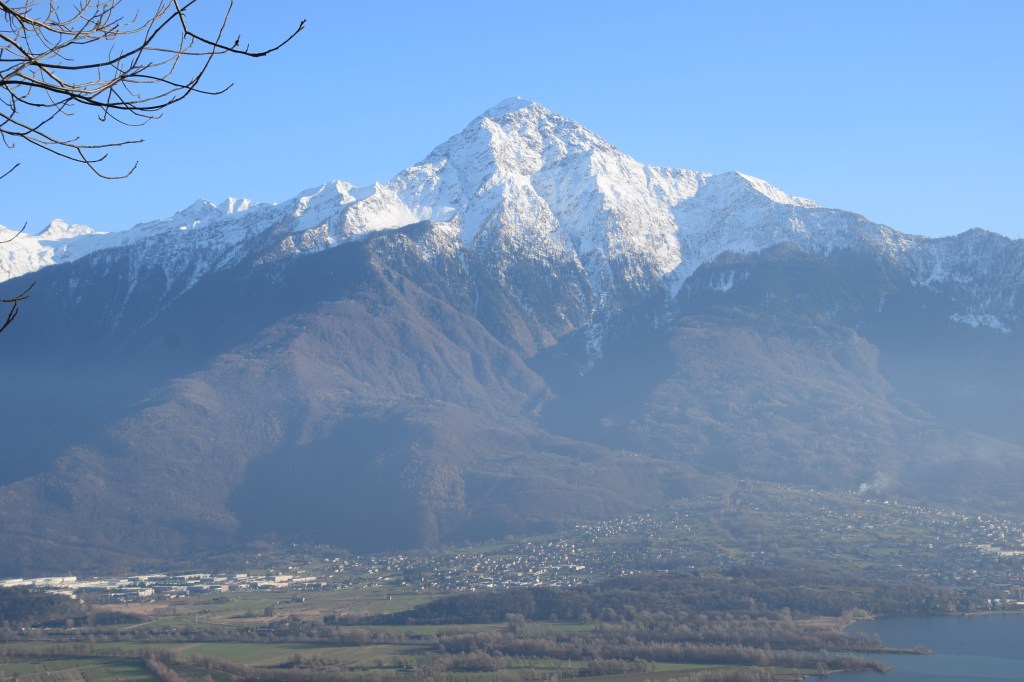
The ever-present Monte Legnone is in the Bergamo Alps and at 2610 meters (8563 feet) it is the tallest peak in the province of Lecco and this section of the Orobie Alps. The mountain top is a popular destination in late spring and summer, and less popular but still hiked in winter. Curious, I have watched YouTube videos of the hike to the summit and after the rifugio one encounters on the way, the hike is far from safe. The steeper climbs up rocks have fixed chains and some steel handles. But for long stretches, the path is very narrow, rocky, and with a sheer drop down the side of the mountain that would result in certain death. Anyone considering the hike should explore a few of the available videos of the path.
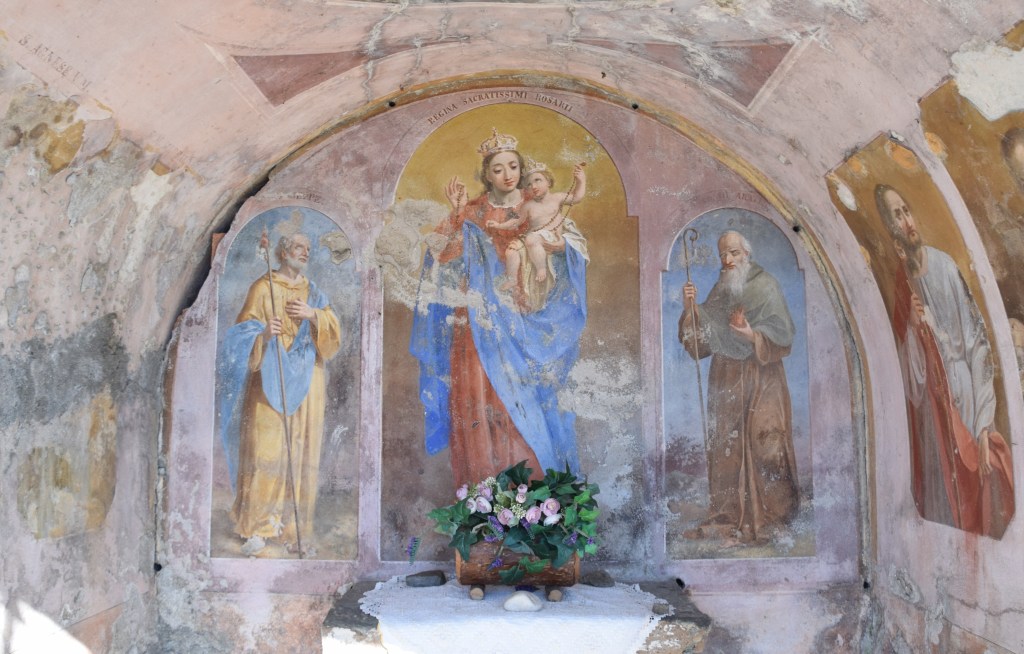
The central imagery of the ciancett – place to bend a knee – on the mulattiera that leads from Selva to Burano and then up to Montalto. About halfway up the short walk between frazioni – if one is inclined to walk the stone mule-path rather than the much longer asphalted road one will have the pleasure of this wonderful, very elaborately frescoed madonella. The small chapel was originally beautifully frescoed with eight saints. The imagery of the three female saints on the left wall is completely eroded but the saints’ names are still visible– Rosalia (a Sicilian saint brought to the Altolario by men who traveled to Sicily for work and then returned), Agnes, and Mary Magdalene.

The saints seen in this photo and constituting the central imagery are Saint Joseph, the Madonna & Child, and Saint Anthony Abbot. The three male saints on the right wall are Saint James the Great, a saint I have not yet for certain identified but who might be Saint Gerardo Maiella, and Saint Lawrence. The artist was talented as can be seen in these photos.

A note on the speculated identity of the saint: the imagery is of a man who is called the “Il Barone al Cimitero” – The Baron of the Cemetery. This ‘anonymous’ individual is the first corpse buried in the holy land set aside for the dead. The only saint I have found associated with this imagery (at this time) is Saint Gerard.

The località just below the Rifugio Dalco. I thought the lack of restoration might mean that there were some Wall Madonna’s to be found but I was wrong.
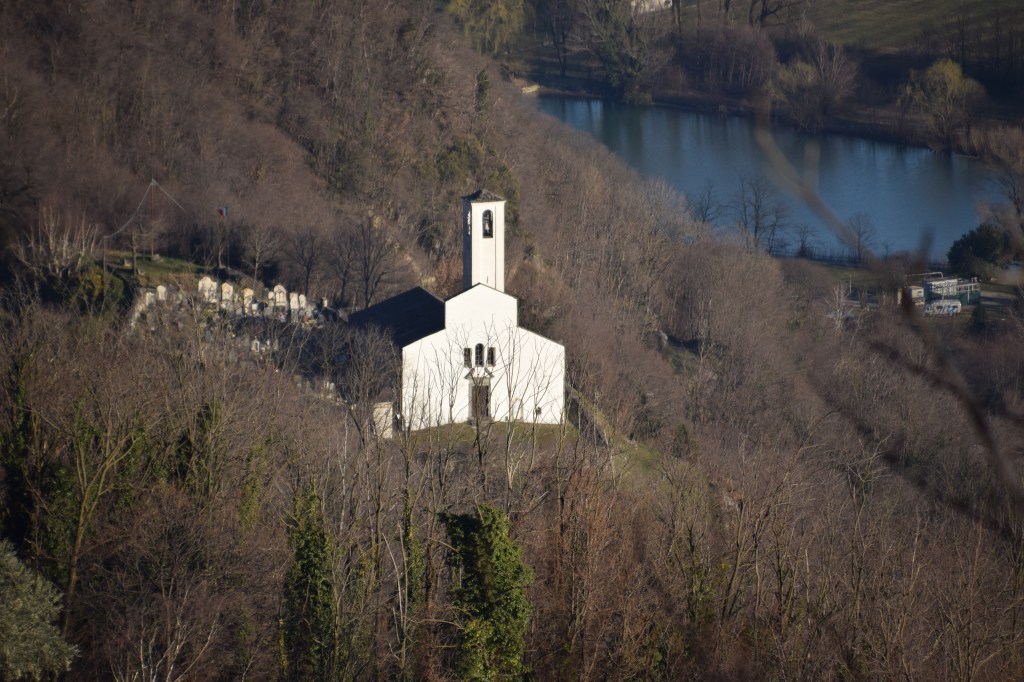
A view of the 12th-century Chiesa di San Miro in Sorico from the road to Montalto. The interior of the church was frescoed in 1526 by Sigismondo De Magistris (1490 – after 1548). This church can only be reached by an ancient mulattiera from the Antica via Regina. I note though that there is an old mulattiera – via Gaggiolo – from the road to Albonico that is drivable if one is brave and has a small car. Behind San Miro is a B&B (Casa Eden) and the woman who owns it and lives here does make the drive. The Chiesa di San Miro is locked and to see the interior one must have a tour guide or go to a mass there.
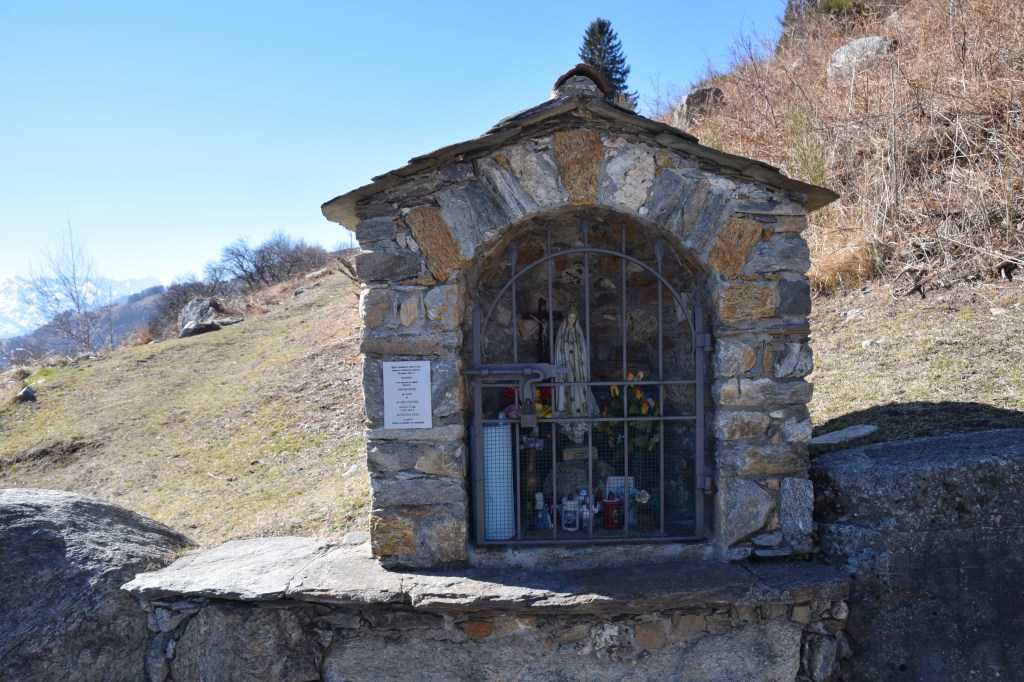
I found a small madonella on the road just before the località Montalto. As is the common practice, this shrine was paid for by private donors. The dedicatory sign on the left reads:
QUESTA CAPPELLETTA VOLUTA DA UN GRUPPO DI VOLUNTARI IN SEGNO DI DEVOZIONE VERSO LA MADONNA, E STATA REALIZZATA SUL TERRENO CONCESSO DA ZARDONI DAVIDE NEL 2004 DA DE CARI AGOSTINO ALL’ETA DI 75 ANNI E CON L’AIUTO DI BATTISTESSA DIEGO DI ANNI 10 ESEMPIO DI CONTINUATA’ TRA GENERAZIONI
THIS SMALL CHAPEL, COMMITTED BY A GROUP OF VOLUNTEERS AS A SIGN OF DEVOTION TO THE MADONNA, WAS BUILT ON THE LAND GRANTED BY ZARDONI DAVIDE IN 2004 BY DE CARI AGOSTINO AT THE AGE OF 75 AND WITH THE HELP OF BATTISTESSA DIEGO, AGE 10, AN EXAMPLE OF CONTINUITY BETWEEN GENERATIONS

An image of the Madonna associated with the Miraculous Medal. Here the Madonna stands on a globe crushing the head of a serpent with her foot. This depiction of the Madonna is based on one of the apparitions of the Madonna experienced by Catherine Labouré (1806-1876). Labouré was French and a nun with the Daughters of Charity of Saint Vincent de Paul. The belief is that the Virgin told her to create a medal with this imagery. This Wall Madonna uses the Miraculous Medal imagery and shows the Great Virgin with San Giuseppe and San Bernardino da Siena and a young San Giovanni Battista. The fresco is dated 1870 – just 50 years after the vision that lent its symbolism to this work – and it was donated by Bernardino Carracci. This is another onomastic work since Bernardino is the name-saint of the donor.


The località Montalto lies at 1050 meters above Lake Como. I found this modern crucifixion shrine in the cluster of homes that comprises this summer habitat. One cannot drive to one’s home here. One parks outside the località and walks the narrow pathways to one’s door.


The Rifugio Dalco which is currently closed and not open yet for the season. Here I found a defibrillator that could be needed after one completes the 8-kilometer / 5-mile walk to Dalco! This life-saving machine was donated by the family of a young man killed in a motorcycle accident.
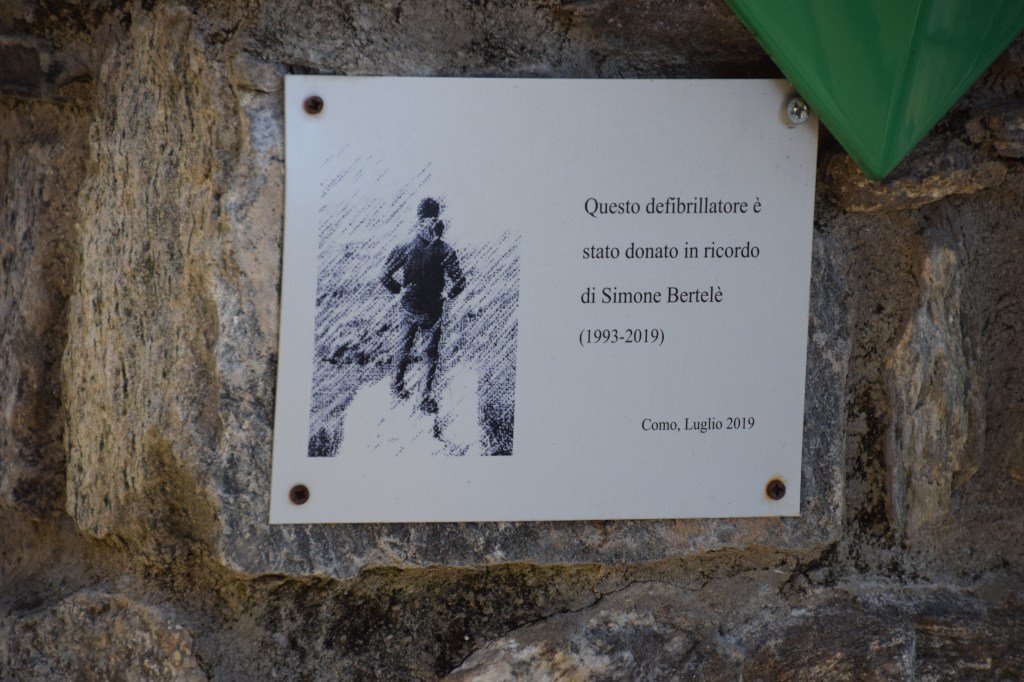
The dedicatory sign reads:
Questo defibrillatore e’ stato donato in ricordo di Simone Bertele’ (1993-2019)
This defibrillator was donated in memory of Simone Bertele’ (1993-2019)
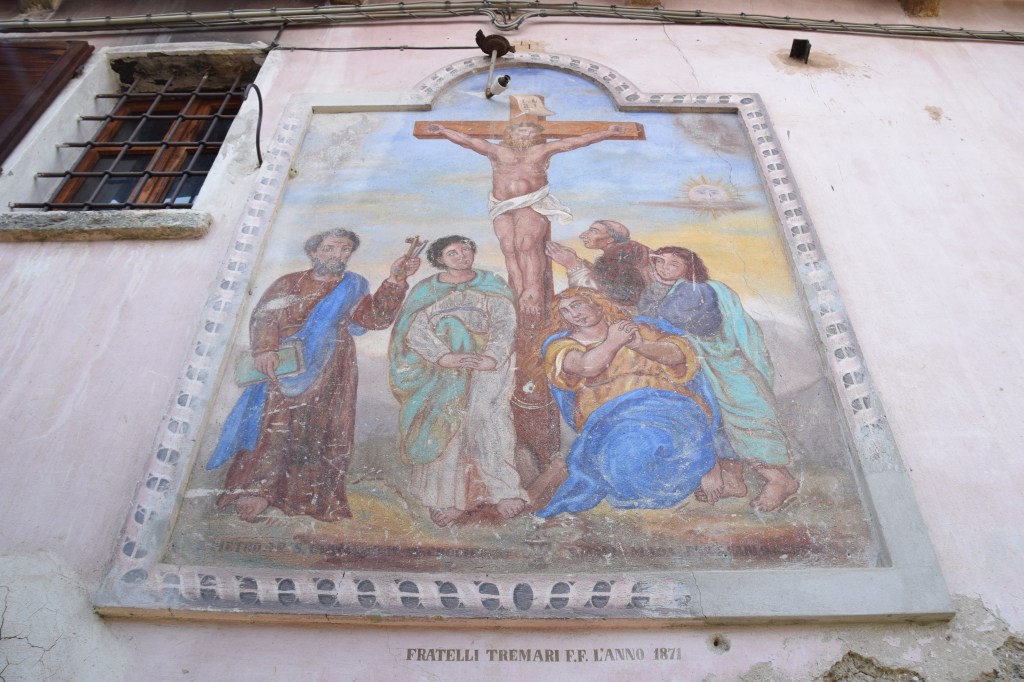
This fabulous fresco is dated 1871 and was donated by the Fratelli Tremari – the Temari Brothers. This is a crucifixion with San Pietro, San Giacomo, the Magdalene, San Carlo Borromeo, and San Giovanni Evangelista. One is tempted to assume that these saints are the name-saints of the brothers Tremari as would be the norm. And given that there are three saints not usually found in a crucifixion scene – San Giacomo, San Pietro, and San Carlo, I think such a theory is warranted.
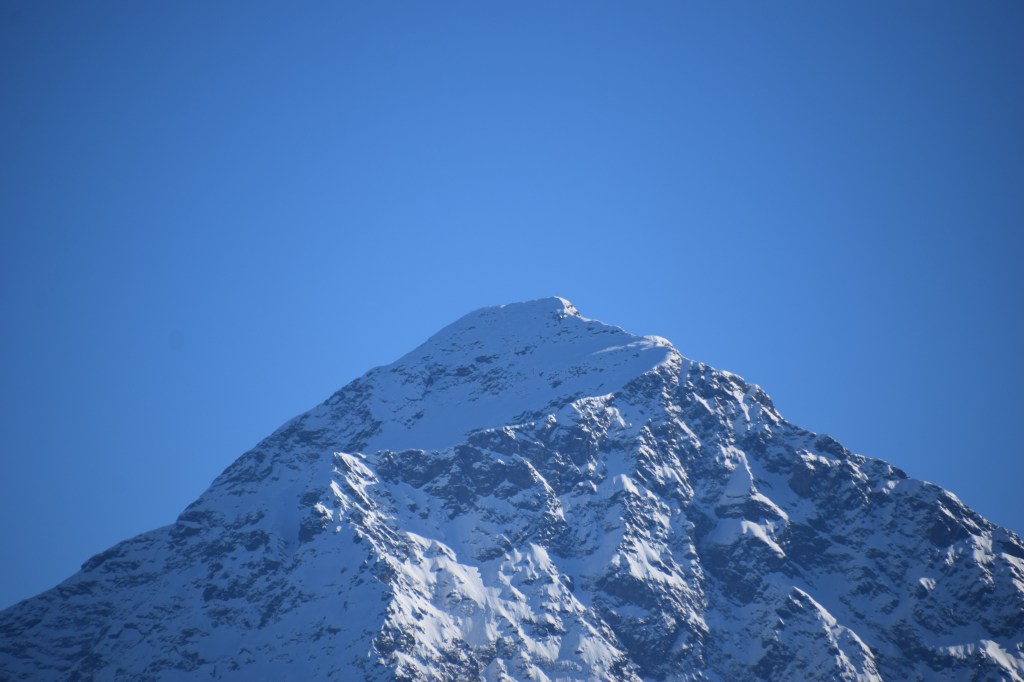
This is the best close-up view I could get of Monte Legnone. I was hoping to be able to see the large crucifix at the top but it is not visible.

The wash house – lavatoio comunale – of the località Montagna! I thought there might be a Wall Madonna on one of the old stone houses here but I was wrong. There was a sign forbidding entry on the private paths of the rather large cluster of stone homes – most of which were in disrepair. But no one was about so I ventured in to search for frescoes. I was disappointed yet again.

A modern Sacra Famiglia – small but lovely and being used as a convenient hook for what looks to be some kind of drawstring for a blind. For some reason I find this charming.
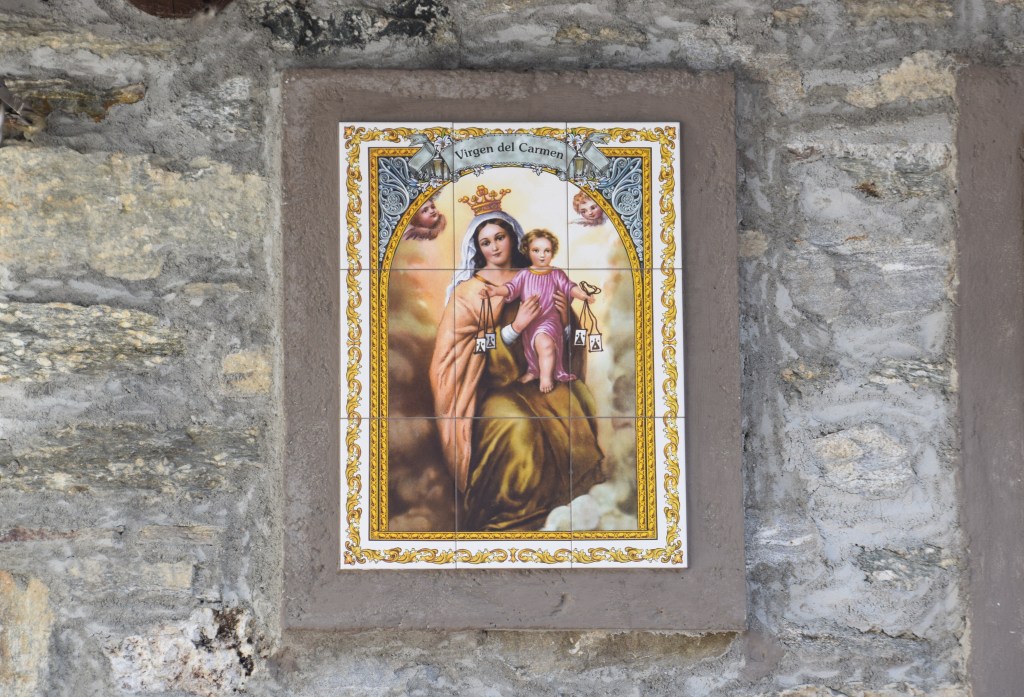
This modern, tile Madonna & Child is pretty but caught my eye because of the inscription which is Spanish – Virgen del Carmen. “Vergine del Carmine” is the Italian and “Our Lady of Mount Carmel” is the English.

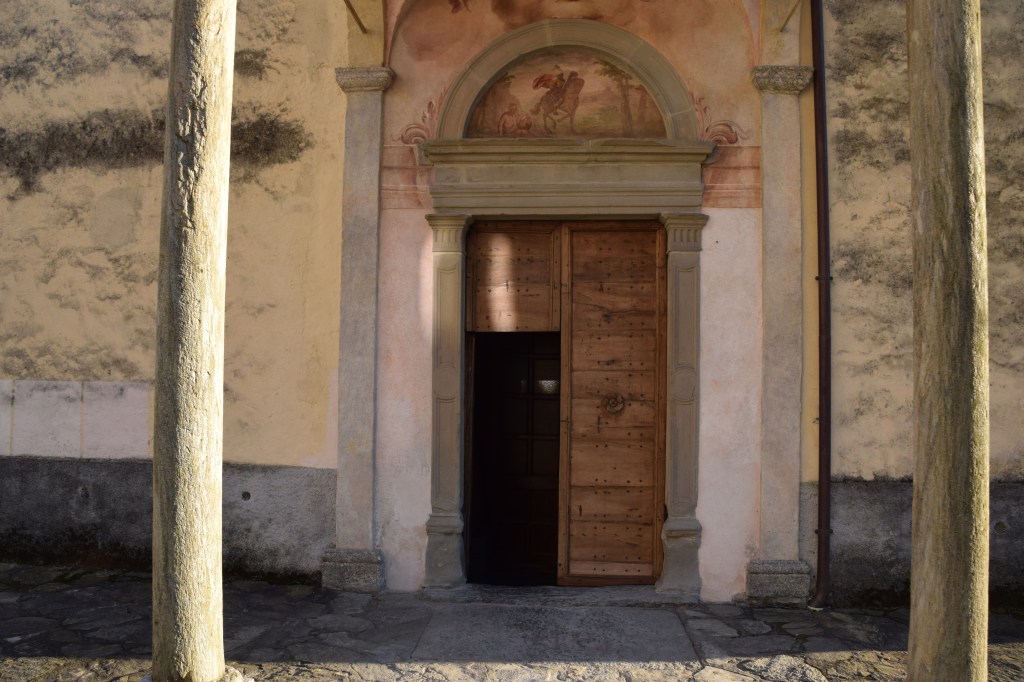
The beautiful entry doors to the 15th-century Chiesa di San Martino a Burano in Selva. Each door has a hand-carved rose. My trek necessarily included a visit to one of my favorite churches and the first time I encountered the astonishing frescoes one can find in churches of this area. Unlike many of the ‘painted’ churches in the Lake Como and Valtellina areas that are closed, San Martino is open every day – a beneficent gift to us all!

The marvelous altar frescoes of Aurelio Luini (1530-1593) in the 15th-century Chiesa di San Martino in Selva. The triumphal arch and the presbytery are fully frescoed with the life of Jesus. My wonder at this artwork is unending and I come here often to admire this original work.
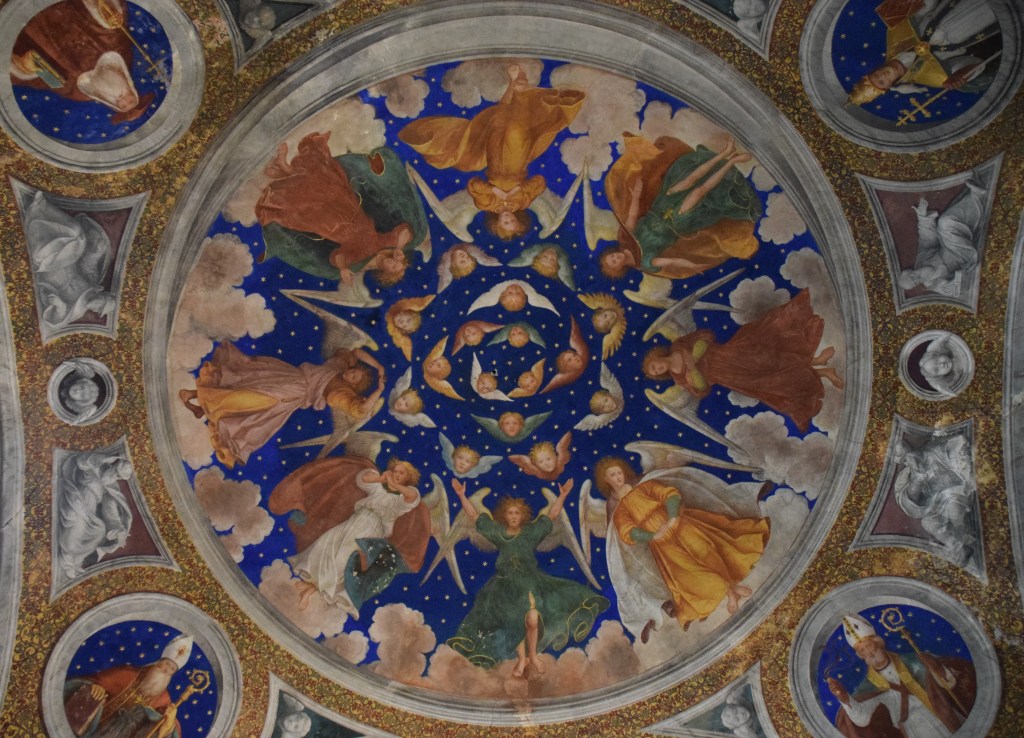
The marvelous frescoed apse ceiling of the 15th-century Chiesa di San Martino in Selva. The presbytery apse – painted by Aurelio Luini (1530-1593) – depicts eight angels surrounded by cherubs. In the corners are the four Latin Doctors of the Catholic Church – Ambrose, Augustine, Jerome, and Gregory. The parish has generously left the altar without an alarm so that we can step up into the presbytery to admire this magnificent work.
I hope you have the chance to visit Lake Como especially the Chiesa San Martino and the frazione of Burano with its wonderful Wall Madonna. Although the walk to Montalto failed to yield the frescoes I so love and admire, the views for the entire trip made the walk a treat.
 Wall Madonna's of the Valtellina