
Peledo is a tiny località of Sorico. It is about 2 kilometers outside of Bugiallo and about 750 meters above Lake Como. There are no year-round inhabitants and the cluster of small, ancient stone homes is embraced by forest and privileged with cool airs in summer. Most of the houses are tiny – likely having been huts for the summer grazing of animals. There is electricity there and lots of renovations have transformed the stone cottages into modern and beautiful weekend retreats.
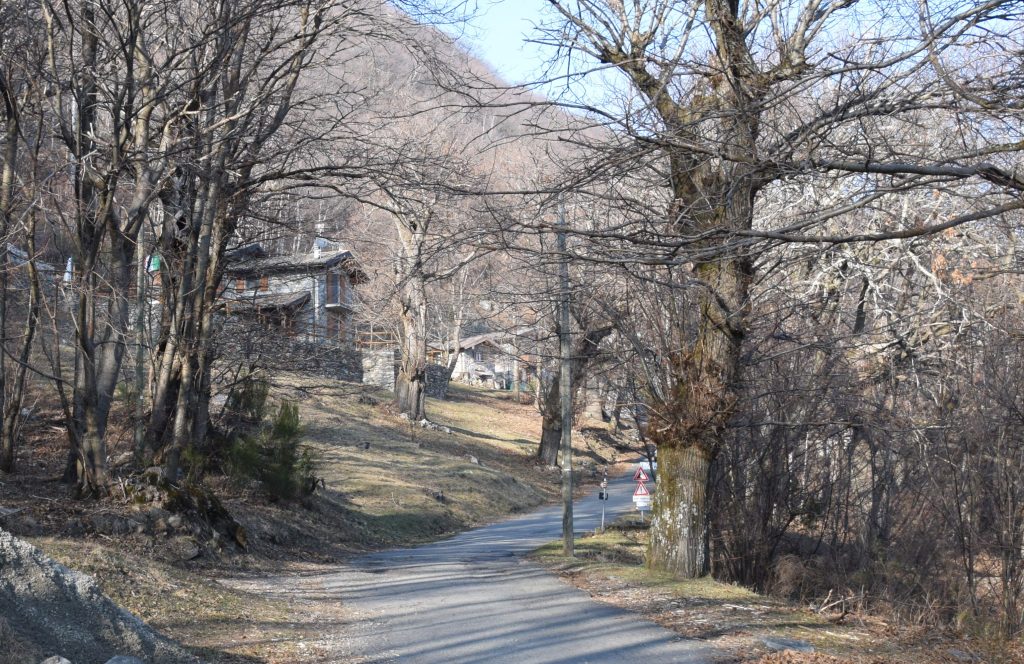
I had not been to Peledo since 2015 and I had not intended to return today. But in my quest for frescoes in Bugiallo I met a local woman who told me of a fresco there. I am grateful to the signora for her kindness because without it I might not have found this fresco.
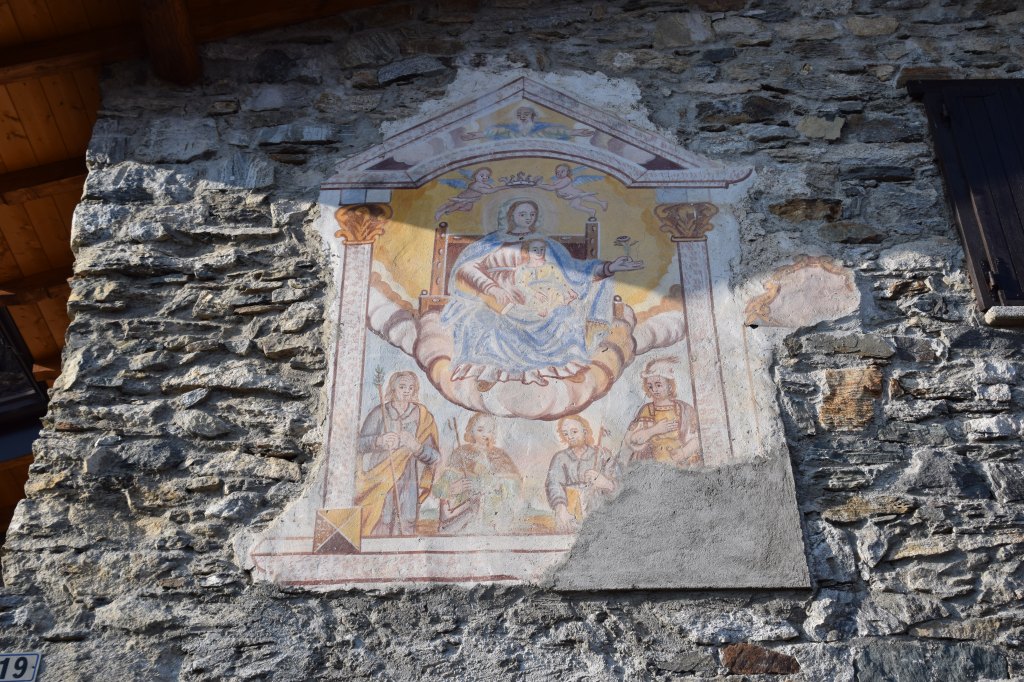
The beautiful 18th-century Coronation of the Virgin. The Madonna sits on a throne that floats in the clouds. The Great Virgin is crowned by cherubs and her enthronement is overseen by God the Father. In her right hand Mary holds a gospel and in her left a flower that I would like to say is a rose but it has two different types of leaves – of a lily and of a mum – and a detailed flower-head, which is not familiar to me. To Mary’s left are a soldier saint who looks like Saint Julian the Hospitaller and another male saint who might be Saint Paul. To Mary’s right is Saint Joseph and a male saint who might be Saint Martin. The fresco is fresh and it may have been restored at least once. The imagery is too ‘simple’ to be original and the bold outlines used are indicative of a restoration. This fresco was worth the trip here!
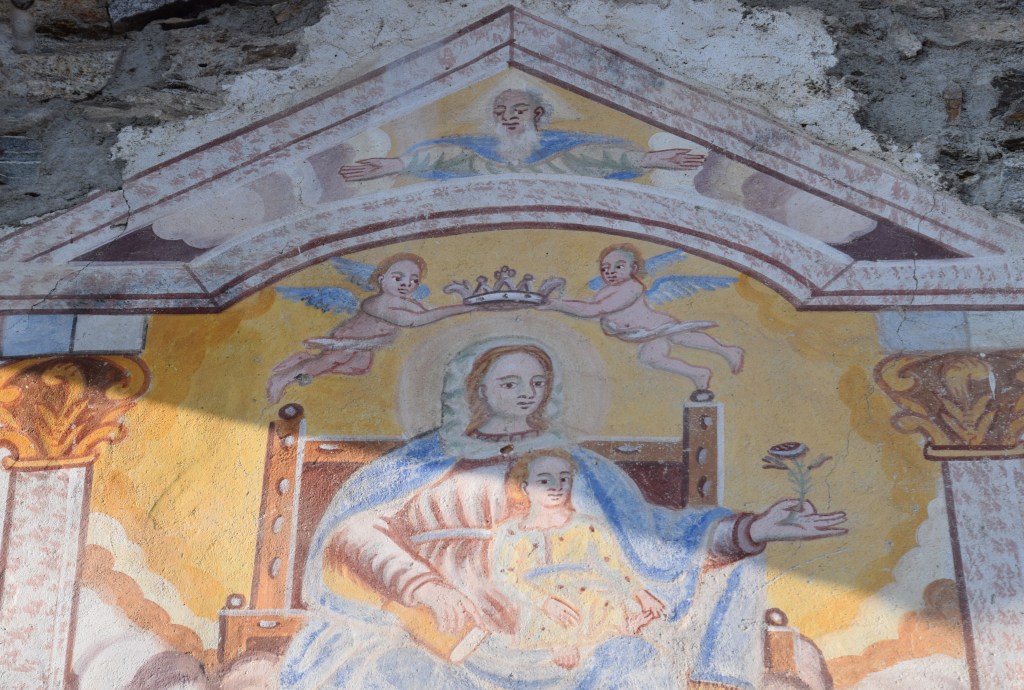
This beautiful Coronation of the Virgin is on the front face of a renovated home on a hill which sits behind a broad and tall, permanently foliaged magnolia tree. To even see the fresco I had to unlatch a private gate and invade a private yard. One must credit Peledo for its lovely location, its beautiful birch copses, its historic lavatoio communale which earned it a place on the Google map, a beautiful Madonna shrine, and the fabulous Madonna Enthroned.
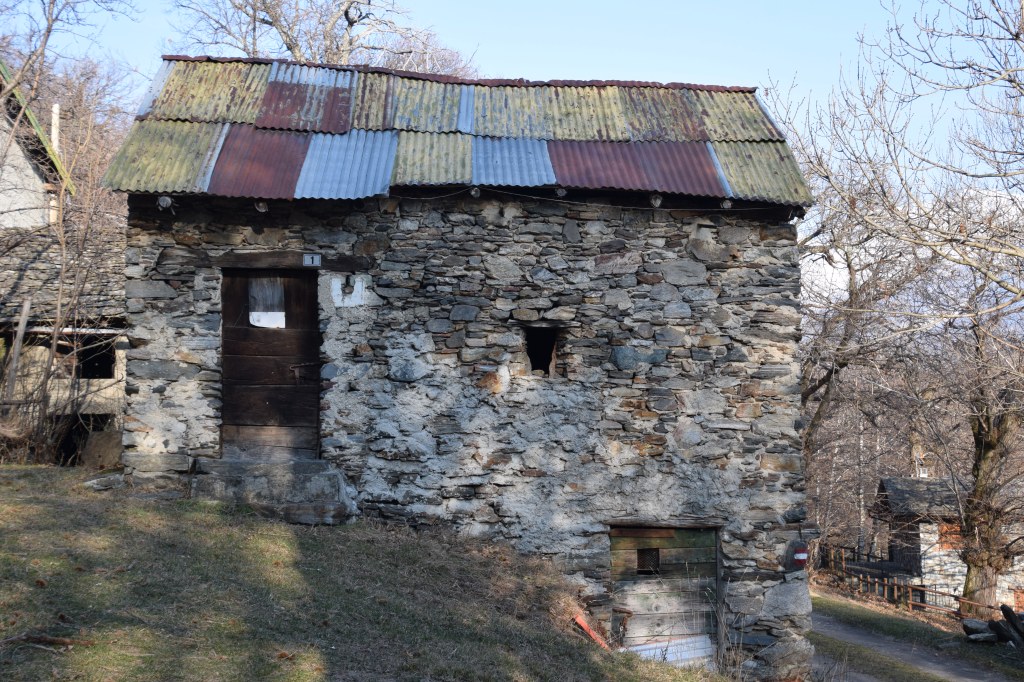
This is what the small huts look like before renovation. A località is a cluster of homes that lie outside a frazione. There are two few homes for the habitation to be called a village, borgo, or frazione. In general, a località is established by families who use the homes there for a limited season. For example, they might bring their cows, sheep, and goats to the higher alpine forests to graze.
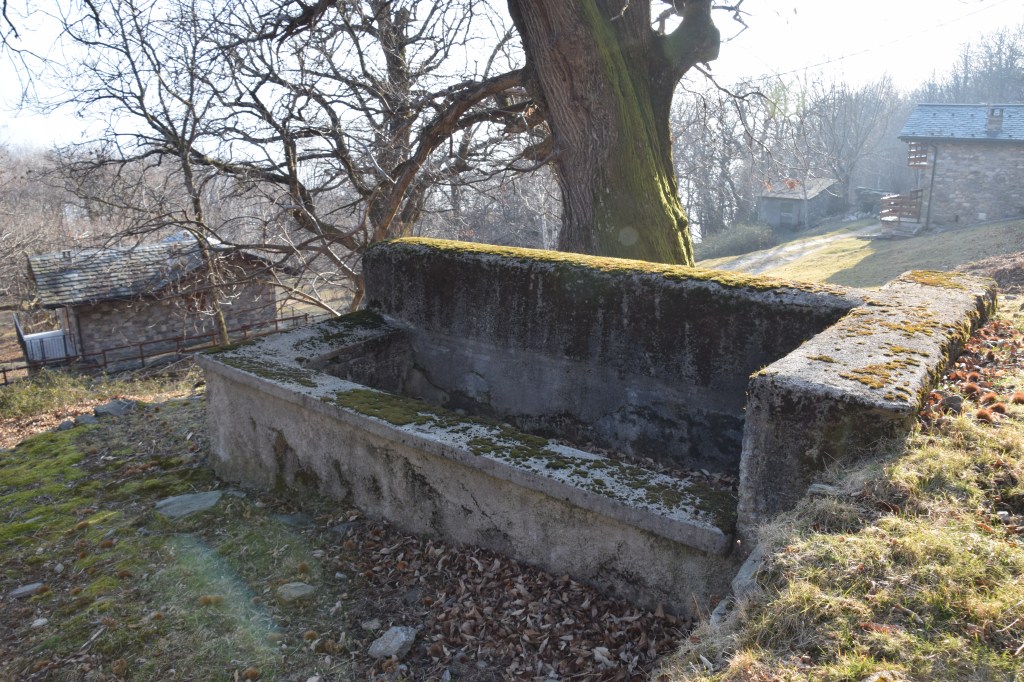
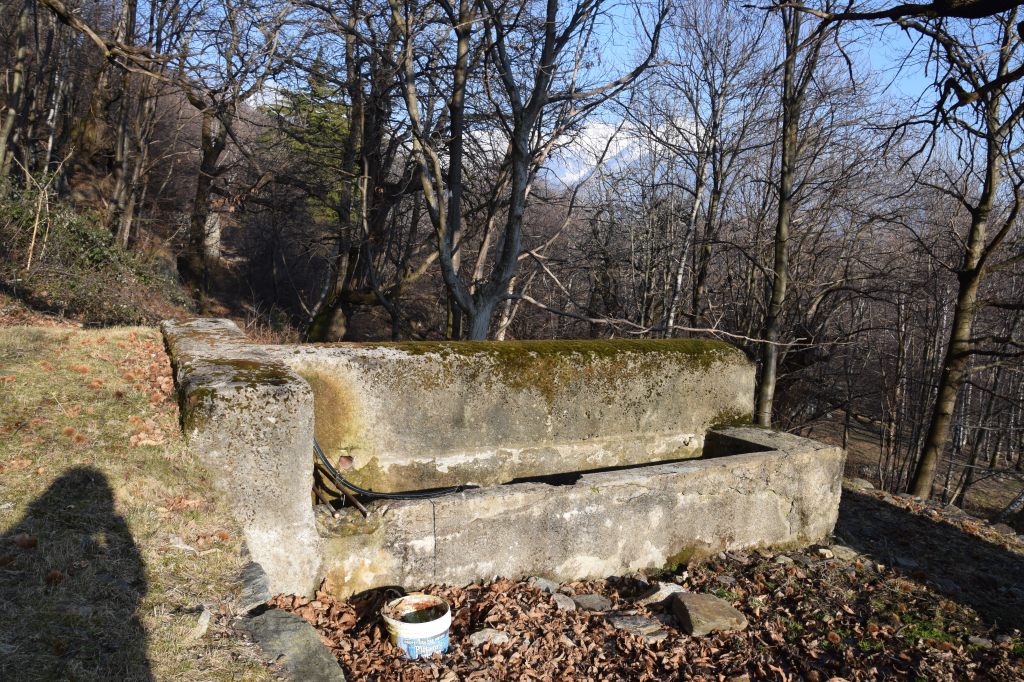
This is the historic Lavatoio Communale of Peledo. It is double-sided with one side for the collection of water and the other for washing laundry. There is a very large chestnut tree in front of it. The wash-basin sits in the middle of the remaining homes – one bank of homes on the road leading to the mountain località San Bartolomeo at well over 1000 meters and the other on a road leading to the Chiesa San Miro in Sorico.
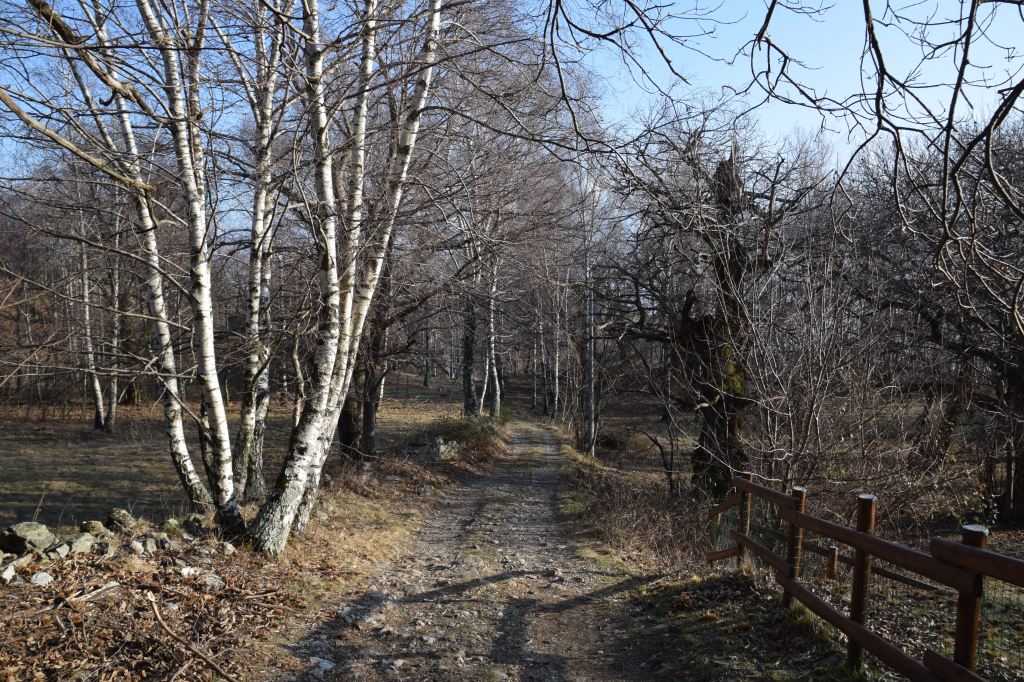
There are many old paths in the mountains above Lake Como. Many are ‘paved’ with cobblestones. Some have low walls that run on either side. Others are wide enough for mules and carts. The latter are called ‘mulattiere’. Well-used areas with homes lived in year-round or seasonally by the residents of a frazione often have wider roads.

The via dei Monti Lariani is a 125 kilometer/78 mile path composed of sentieri and mulattiere that runs from Cernobbio – near Como – to the Nuova Torre di Sorico. The Nuova Torre di Sorico is ancient and is believed to have been a place where duties were collected on goods being moved along the ancient via Regina. The tower is now privately owned and on the path that leads from the via Regina to the Chiesa di San Miro.
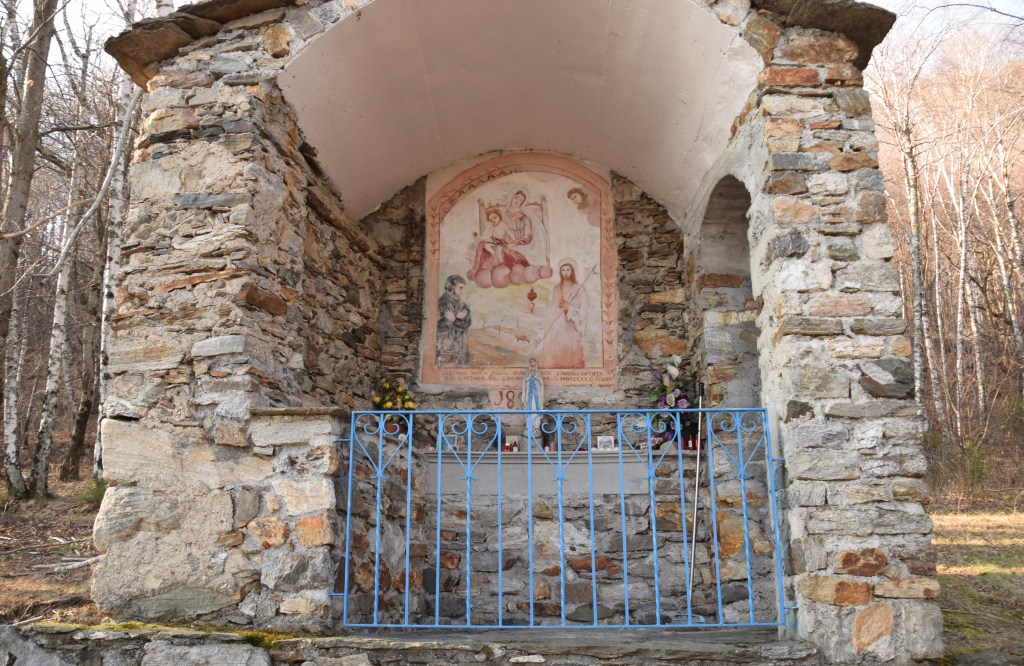
This is a beautiful early 19th-century Madonna shrine. The fresco is dated 1820 below with the more specific date of 4 July 1829 at the foot of the imagery. The Madonna Enthroned was donated by the brothers Gaetano and Giacomo Armanni. Featured are the Madonna with a young Jesus holding what looks like a chestnut. In the background is a pastoral scene.

The saints are identified in the inscription from the left as: San Gaetano (Saint Cajetan) , Maria Mater Divina Gratia (Mary Mother Divine Grace), and San Joannes Baptista (Saint John the Baptist), followed by the date: MDCCCXX IV LULI – 1820, 4 July. As is common, one of the saints – San Gaetano – carries the name of a donor – Gaetano Armanni.

The previous photo documents a church in the village of Bugiallo the dedicatory saint of which is San Gaetano. The saints in frescoes can serve multiple representative purposes. For example, frescoes on private homes or frescoes in churches that were paid for by private donors often feature onomastic saints with whom donors share names. The dedicatory saints of the village, also, feature in frescoes as well as saints that can be invoked for protection against illness or for professions common to an area.
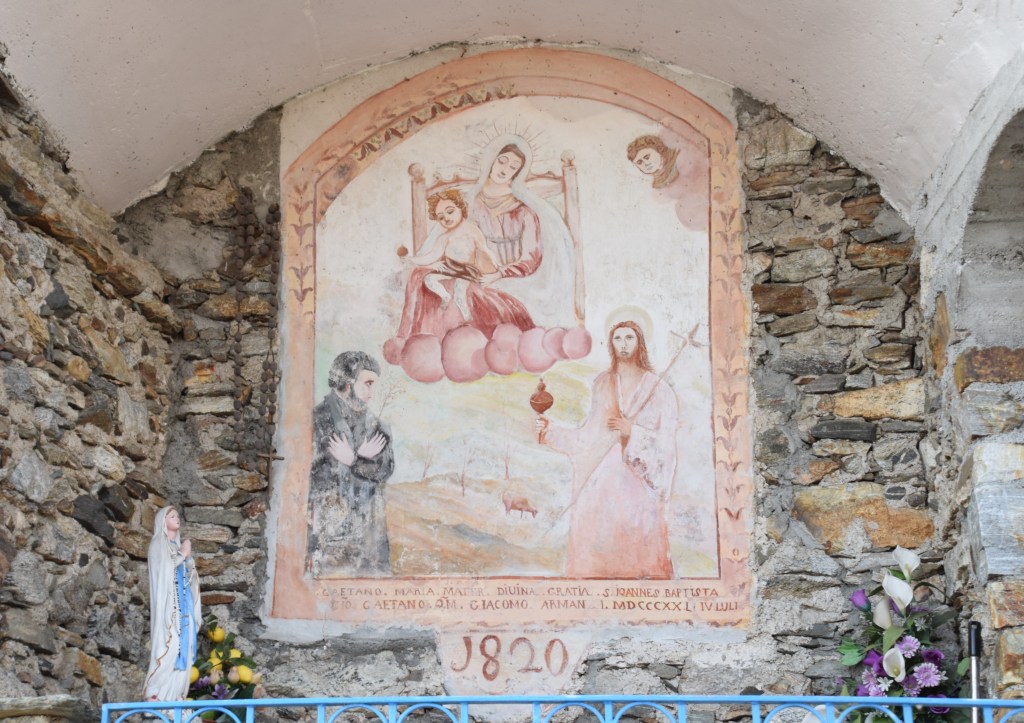
This is a closer view of the fresco. This shrine is beautifully restored and well-kept.
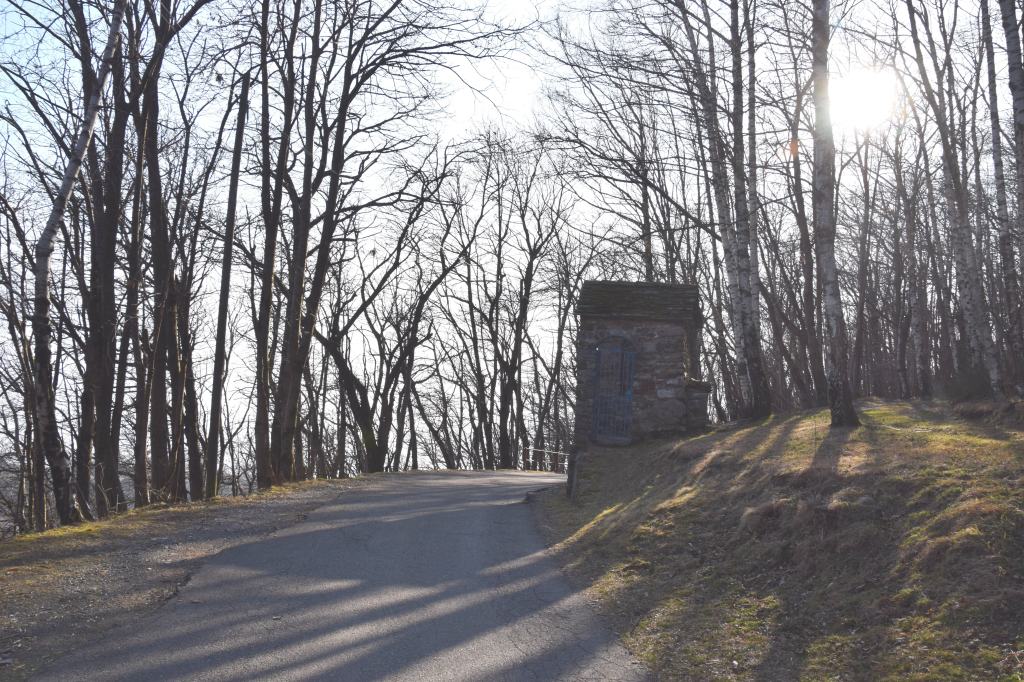
This is a view looking back down the road toward Bugiallo. One can see the shrine on the side of the road. All the roads around the lake have these shrines – mulattiere, sentieri, percorsi, and carriage roads – have shrines like these. They offer the blessings of the Catholic faith to those who pass by and a respite from one’s journey.
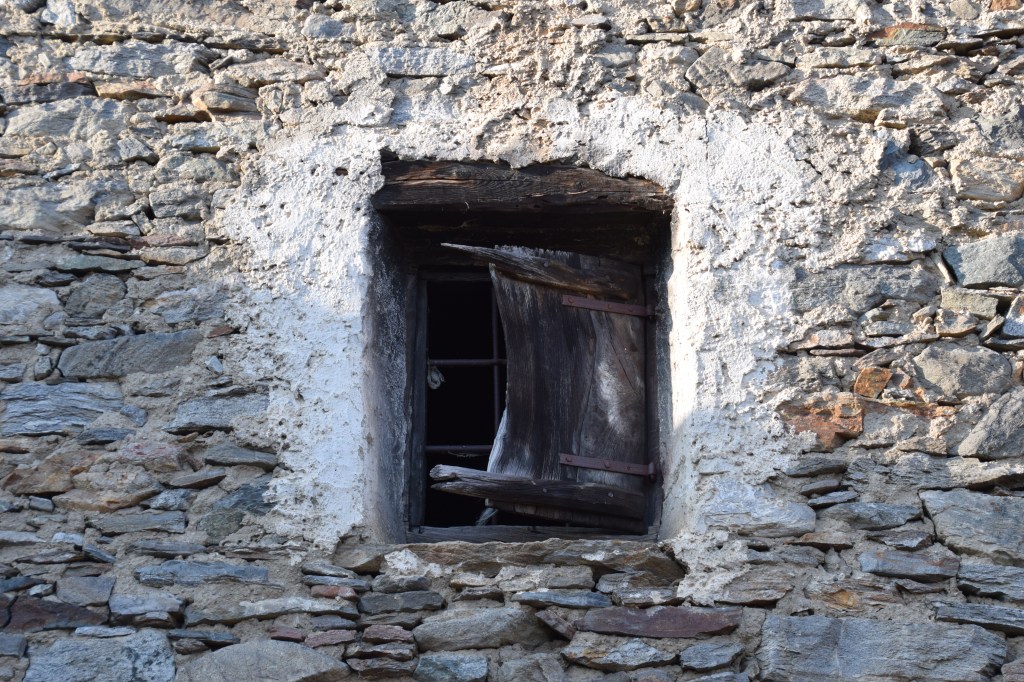
This is the window on an old, unrenovated hut. I liked the chestnut shutter that allowed one to close out the cold. One can see how solid these homes were and how thick the walls. They were built of local stone and made sturdy by thick walls, generally, about two feet thick. The huts of the località probably date from the 1600’s.
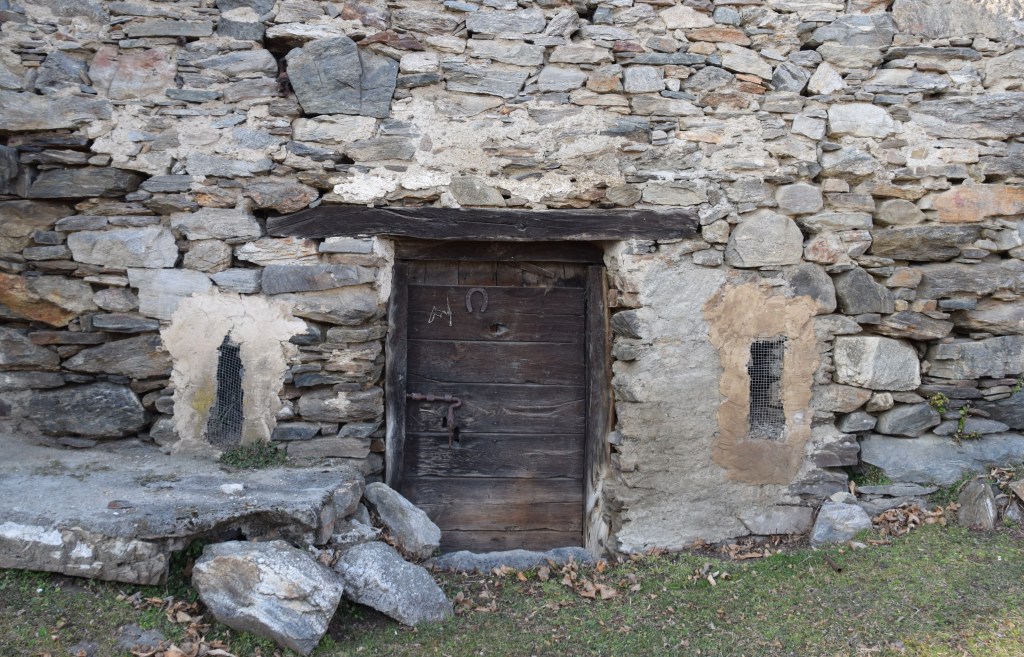
My visit to Perledo was brief because the località is small. The two frescoes are worth a drive here as are the beautiful birch copses and views of Lake Como. To complete this post I offer a picture of the entry door to an old stone home. The lintel is a robust piece of chestnut as it needs to be to support the thick stone wall. The door is a good two feet shorter than one would expect nowadays. This is typical of these old homes. I have to wonder if the size was for some type of conservation – of heat or wood, or to accommodate the heavy load of the stones, or because people were shorter a few hundred years ago. Regardless, the owner has placed a horseshoe on the door for good luck. In Italy the horseshoe is turned down to keep the luck in the house. In the United States we do the opposite and turn the horseshoe up to prevent the luck from spilling out. Either way, good fortune is the goal!
 Wall Madonna's of the Valtellina