It has been was sunny and cool lately – gorgeous days in the Valtellina. I have wanted to walk the four lateral roads that connect the mountain towns of Cercino and Traona. Two of the roads are unnamed and three are mostly unpaved. Only one can be called a modern, asphalted carriage road. This is the road on which one traverses the scant 1/2 kilometer to meet the lower of the last two tornante’s on Strada Provinciale 5 – SP5 – into Cercino. Above this paved road is another much older road – via per Traona. And above that is an unpaved, agricultural road – still drivable – that leads to Pianezzo – the largest of three hamlets belonging to Traona. The first lateral road between the villages – just outside Piussogno – is the via Ca’ Rossa along which thrives a vibrant viniculture.

Traona is a beautiful and ancient village on the Costiera dei Cech. A 5th-century tomb found within its confines and discovered during excavations in the 1980’s dates the town to that time. The first written mention of Traona was in 829 AD – found in historical documents about the Valtellina. Across the intervening centuries, the village was a hub of commerce and trade in the Adda River valley and a customs house was located at the Medieval gate to the city where duty was collected on goods and cattle moving throughout the valley. Walking in and around the Traona offers many pleasures – fabulous views of the Valtellina, wonderful old stone homes on cobblestone paths, and many marvelous Wall Madonna’s.

The via per Traona – the primary focus of my walk for its three, large and fresco-promising villas – was once a mule path – a mulattiera. It is partially paved at the Cercino end, has the traditional smooth cobblestones for a scant 10 meters in the center – where it is undrivable – and then becomes a drivable, unpaved road on which sit the three large villas.

I hoped the history of the old mule path and its current untamed state would be fertile ground for one or two remaining Wall Madonna’s. Prosperity usually resulted in homes graced by Wall Madonna’s – the talent of the artists of which reflected the wealth and devotion of the villa owners. The via per Traona connected the villages hundreds of years ago and, originally, both ends of the road brought one to the front doors of the parish churches in the centers of Cercino and Traona. That fact too – the walk by villagers to their church on the only road leading there – is predictive of Wall Madonna’s along the way. Hence, I hoped to find some frescoes on the via per Traona – and I did!

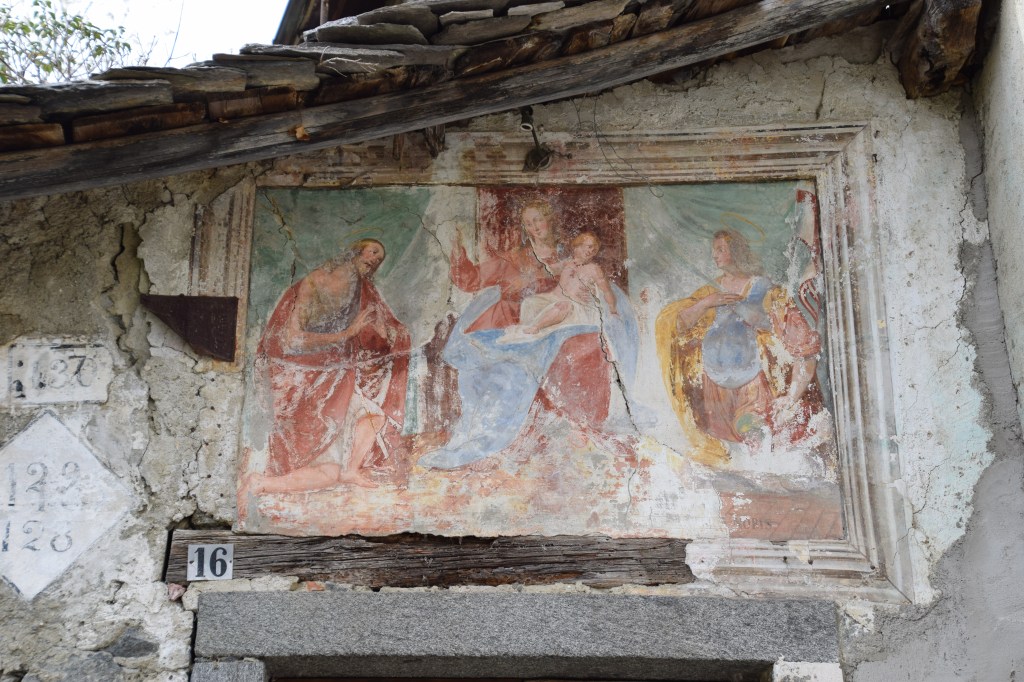
This glorious Wall Madonna was my best find! Posted as a montage here and, also, the fresco posted under the title of this blog – the sacred art features a Madonna del Rosario – Madonna of the Rosary – with San Giovanni Battista on the left and San Martino on the right. The young Jesus is wearing a coral necklace which associates this Wall Madonna with the Lombardians who migrated to southern Italy for work and returned home to Lombardy prosperous. There is some scripture left on the bottom right of the fresco – ‘nobis’. This was likely from the phrase Ave Maria, ora pro nobis – Hail Mary – pray for us.

I speculate that the date for this fresco is late 17th to mid 18th-century based on a number of things: 1. the mule path on which the large villa is located, 2. one of the other houses on the via per Traona with a cornerstone dated 1695, 3. the depiction of Mary, 4. the imagery, and 5. the fact that Jesus is wearing a coral necklace. The addition of the coral necklace identifies the donor as having some association with southern Italy and the migration to Sicily for work. Perhaps the owner of the home was a migrant who returned Traona affluent! If anyone has another analysis or theory – please comment! I welcome the insight!

This fresco is located on the entry door of a very large villa and vineyard that is currently being restored. It is the second house in from the Traona end of the mulattiera. One can see all the old house numbers – 370, 128/129 (indicating two residences), 16, and the current number – 4. The home is large and was once beautifully decorated. I included a photo of some of the embellishments above. This was and is still an impressive home!
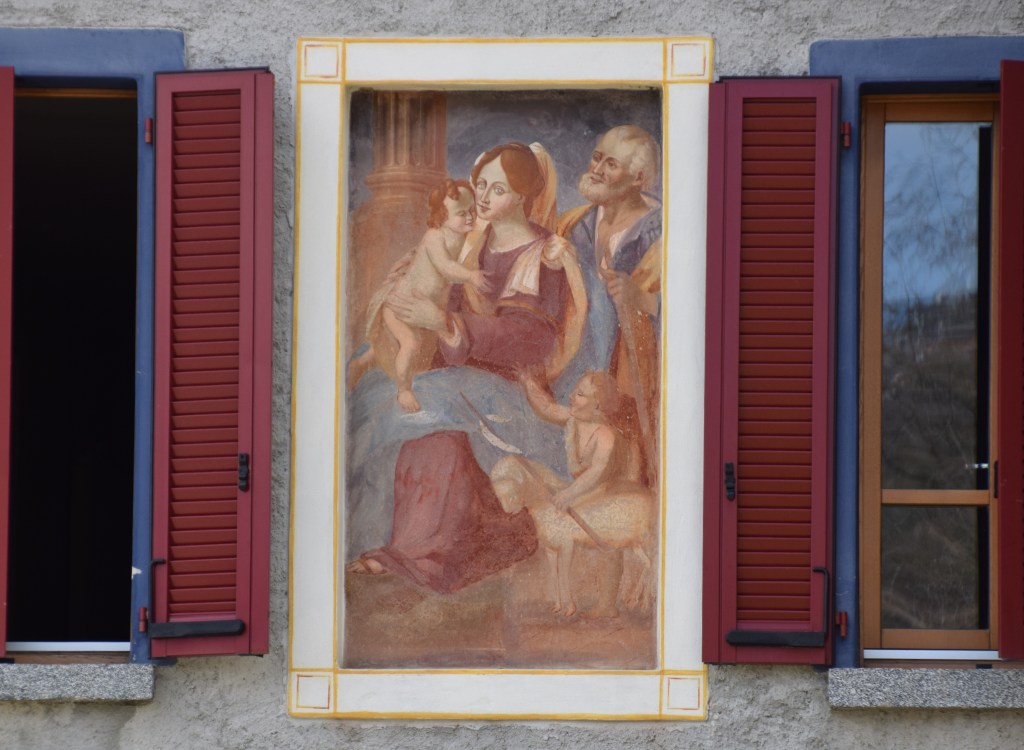
This is the first house on the old mule path. This Madonna faces the via per Traona. The home is very large – 440 m2 – and has its own consecrated church. It is for sale on Immobiliare with no price listed. ‘Price on Request’ is noted in the ad. The fresco has been restored. It is a Sacra Famiglia with a young St John the Baptist.
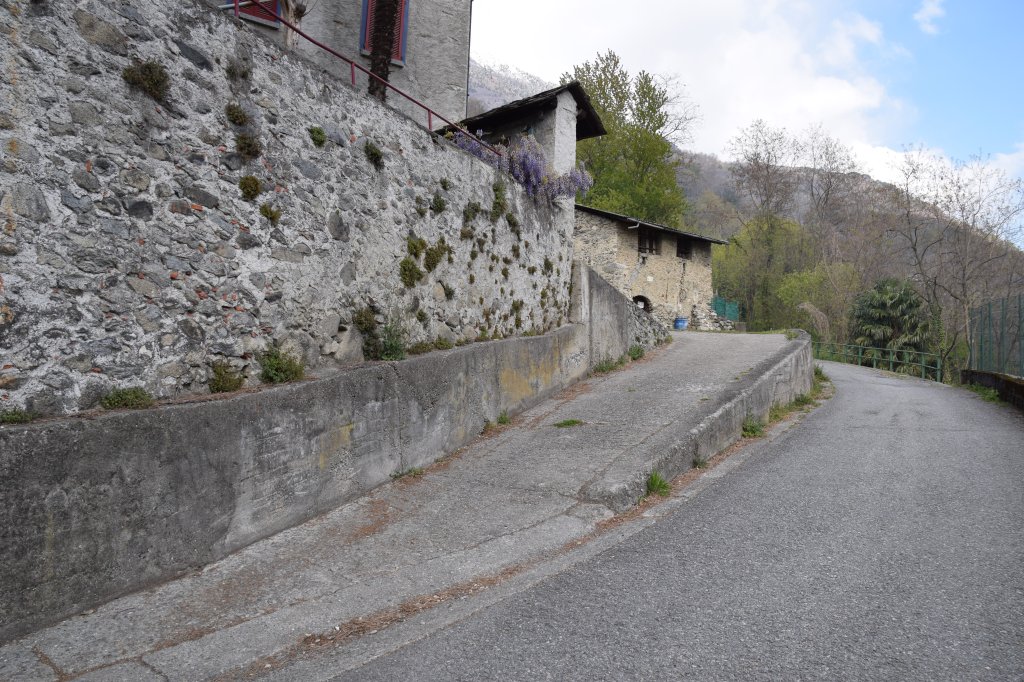
I actually did not realize this was the briefly paved end of the old mule path. I found this because I walked the other lateral road to Cercino and walked via Per Traona back to Traona. I knew where the road was in Cercino because there is a sign! The house on the left is the large home I described in the previous fresco. I posted this photo to show you all the road! Once one passes the driveway of the large home, the road is unpaved. I think it is likely that when the via Pianezza was built – which is the large asphalt road seen here – the mule path that probably went all the way down to the parish church – was dug up and this new ‘entrance’ to via per Traona was created. A section of the new via Pianezza which begins directly behind the parish church is cobbled – like the mule paths are.

The road on which I found this Wall Madonna is unnamed. It is wide and paved and is the main lateral road connecting Cercino and Traona. This fresco depicts a Madonna del Latte with two saints that I cannot identify. I think Saint Peter may be on the right. The fresco is not a high-quality painting and it has been restored – perhaps the reason for its lack of quality. It may be 19th-century since this is a newer road. However, the home is older so this fresco may be too.
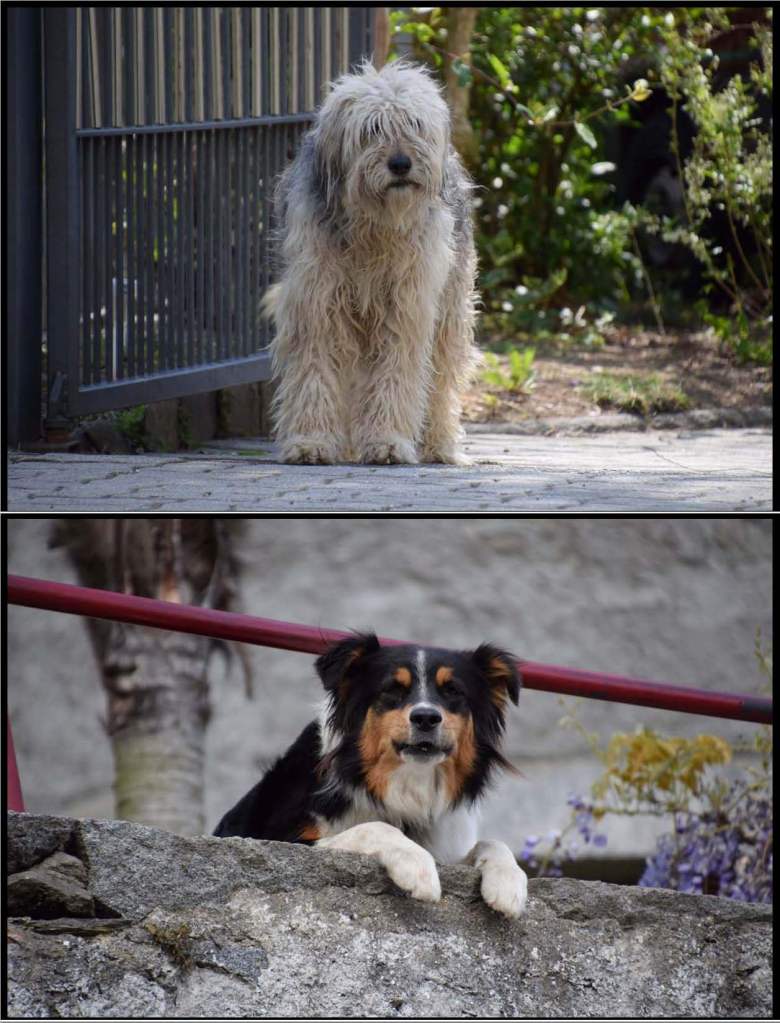
The only dogs I saw on this walk. The English Sheepdog lives on via Pianezzo and the very noisy Australian Sheepdog lives in the large home on via per Traona.
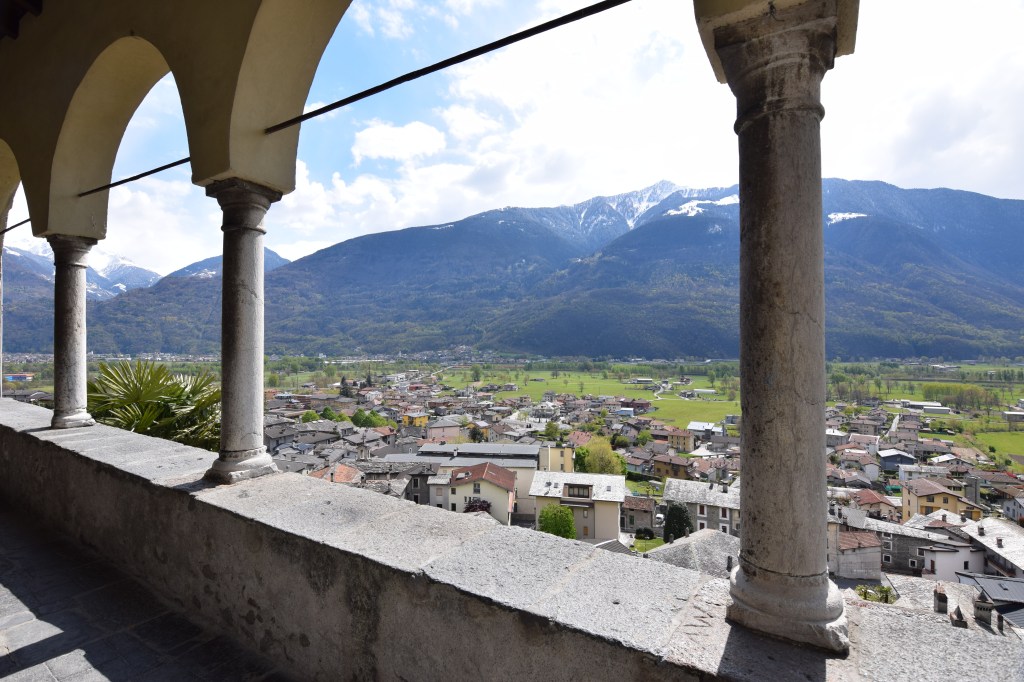
The Chiesa di Sant’Alessandro – the parish church – dates to the 13th-century when Traona was a power in the Valtellina with its own Podesta’ and a customs office which – when operating – sat next to the gates to the city. The town lies on the via Valeriana which was the main road through the Valtellina on the Rhaetian side of the valley. With Morbegno to the east, the two towns controlled trade along the river Adda.
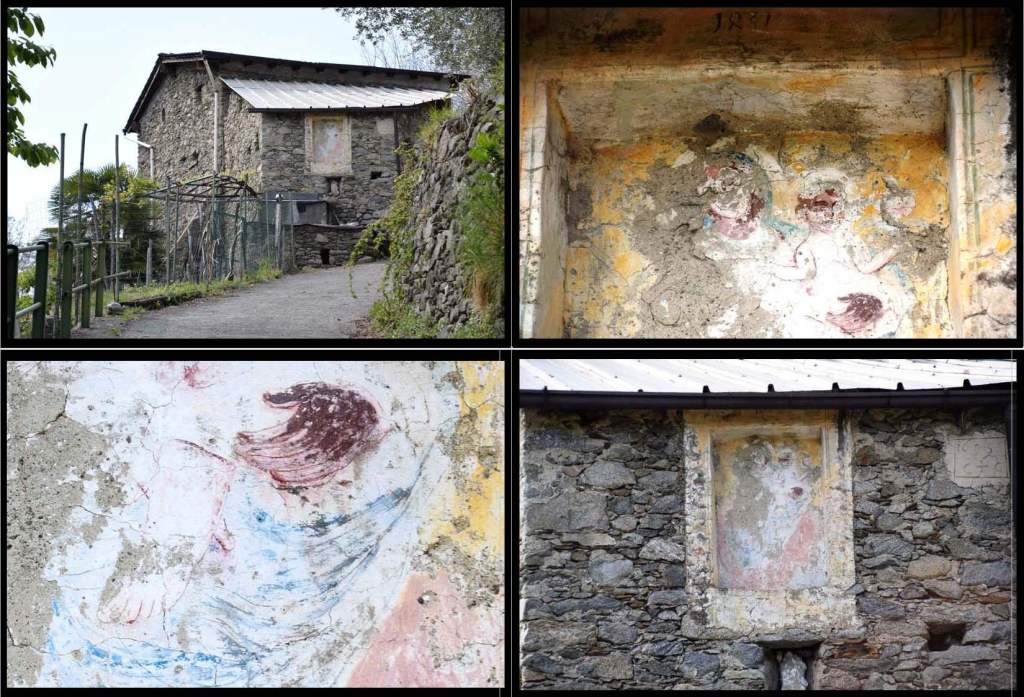
This home is one house in from the Cercino end of the road. The fresco faces in the direction of Traona. The house is dated 1695 and this fresco is dated 1831.
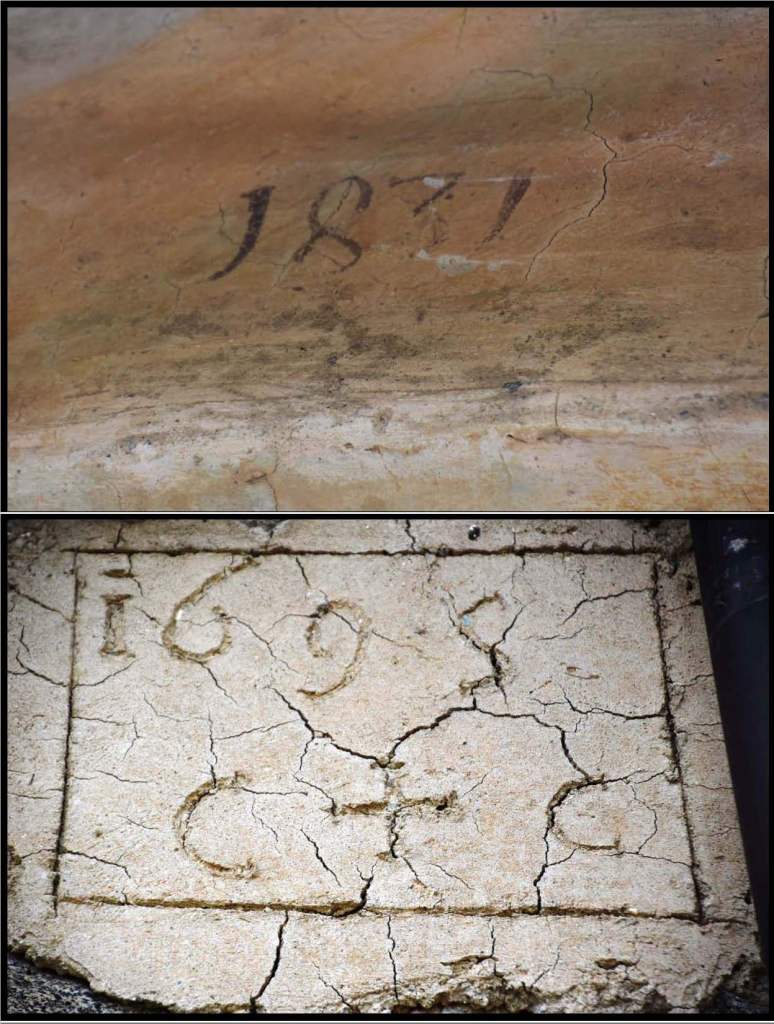
The date on the top of the fresco is 1831, and the stone dating the home is carved with 1695. I do not know what the C – cross – C means. That is a carving of a cross and is not a +. The date of the fresco is likely a date of restoration. The original fresco would be the same age as the home – late 17th-century.

Pianezza is the frazione above Traona at 472 meters. The road to the hamlet begins behind the Chiesa di Sant’Alessando. Walking the road to reach the three frazione above Traona offers a wonderful view of the valley the entire way. Old paved mulattiere intersect the newer carriage road. The first hamlet reached at 350 meters is Moncucco Basso. The small borgo has only eight homes.
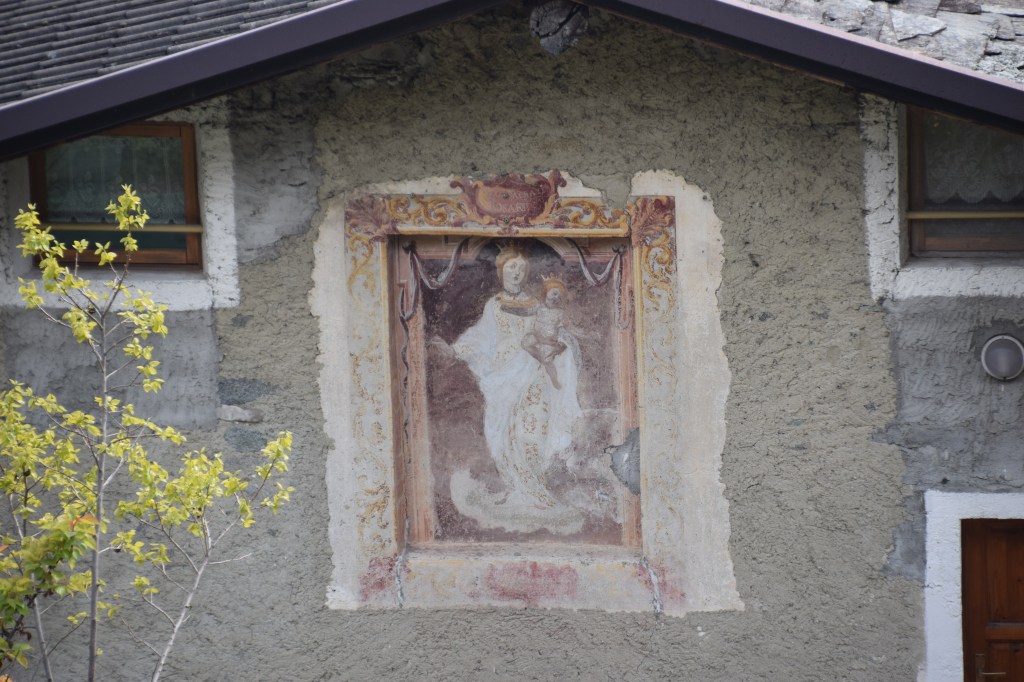
Moncucco Basso sits slightly below the road to Pianezzo. As one walks by the village – about some meters above it, this fabulous Wall Madonna is visible just behind an old persimmon tree. One can only see this second story – back of the home Madonna from the via Pianezzo. As one will see throughout the Valtellina, frescoes bless the traveler’s journey and announce and testify to the faith of the homeowners.
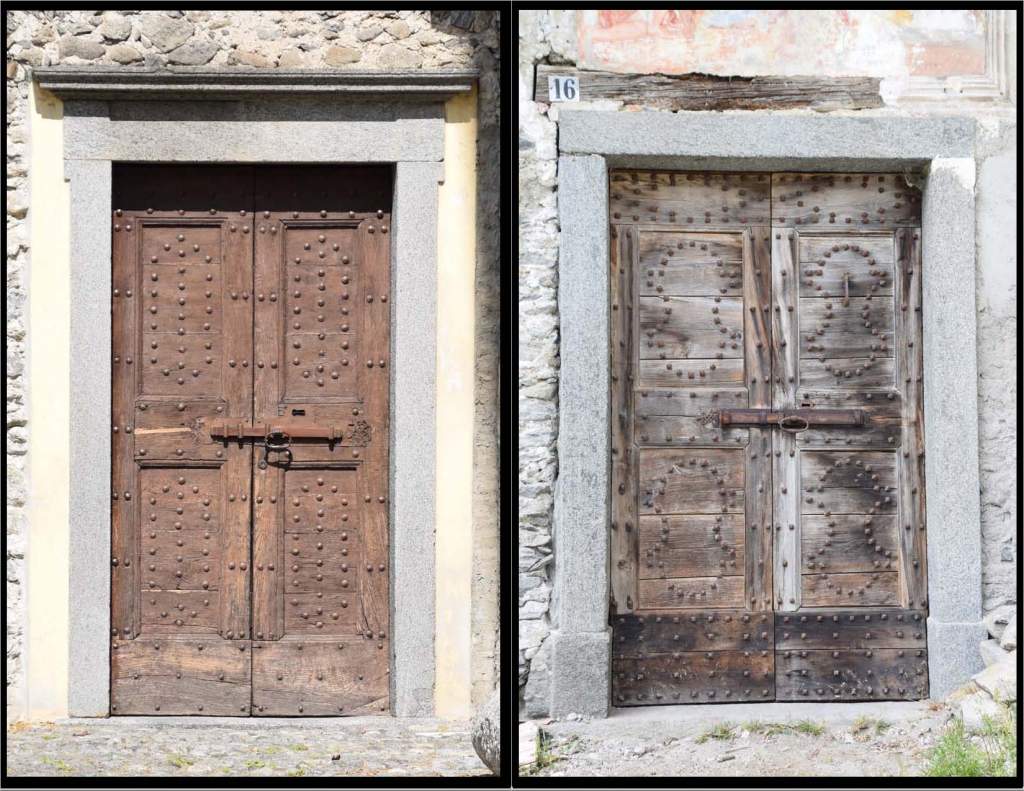
I offer this montage to demonstrate that these two doors have similar decorations and this helps to date the door on the right – which is the door of the first Wall Madonna I posted – and the fresco painted above it that originally covered the entire lintel. You can just see the fresco above the partially exposed lintel. The door on the left is the side entry door of the parish church Chiesa di Sant’Alessandro which was built in 1441. Perhaps copying this door decoration indicates the home is late 15th – or early 16th-century!

There are three shrines on the via Pianezzo. Two of them are Madonna shrines and one is a shrine depicting the martyrdom of San Bartolomeo who was skinned alive. Each of the Madonna shrines on via Pianezzo lies on an old mulattiera – mule path. These were the original roads people used to reach the three localita’s located above Traona on the mountainside – Moncucco Basso, Moncucco Alto, and Pianezzo. All the mulattiere are still kept clean and functional since one – via per Traona – is wide enough to be a carriage road, and the others are shorter routes to the homes above and access paths to the vineyards and olive groves on the mountainside.

I offer this Wall Madonna found in Mello – the town immediately to the east of Traona at 681 meters – to show that it has a similar design to the fresco painted inside the Madonna shrine posted previously. As with the shrine, we see cherubs holding an image of the Madonna & Child. Although the fresco inside the shrine is eroded, one can see that both frescoes have the same design – even the large golden halo above the two sacred personages. One might wonder if one artist painted both frescoes.
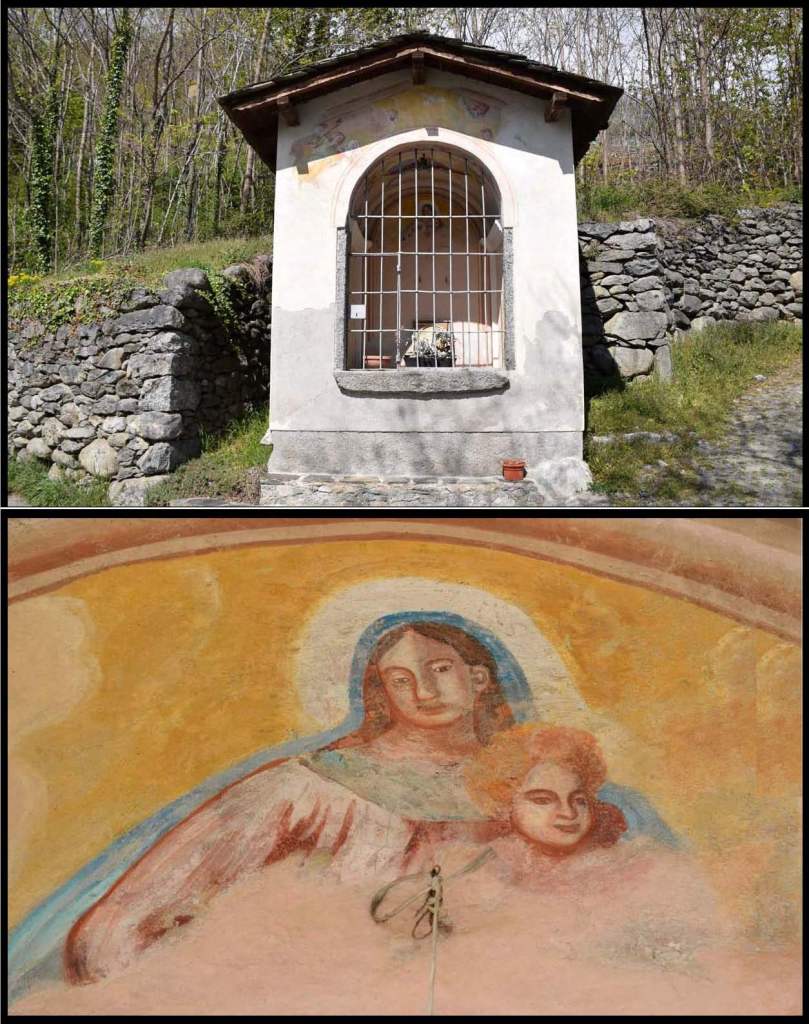
This is a montage of the second of three shrines on the via Pianezzo. This shrine is at the entrance to a mule path that leads first to Moncucco Basso and then up to Pianezzo. One can just see the cobbled mule path to the right.
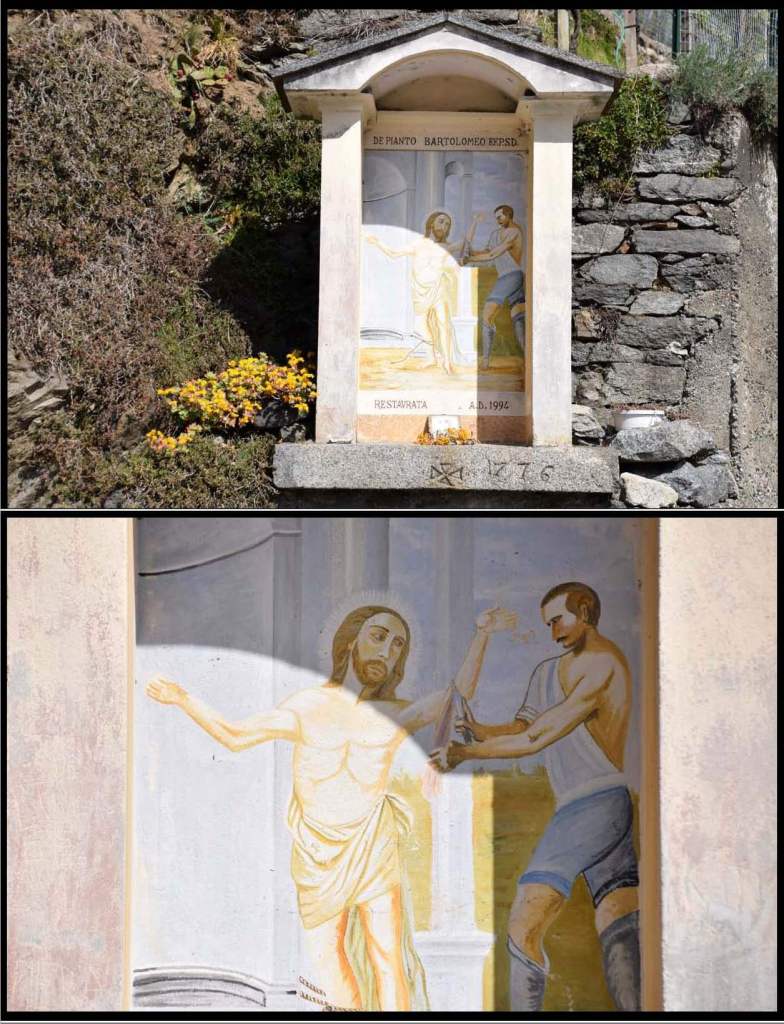
This is the third shrine on the via Pianezzo. It is dedicated to San Bartolomeo and the original stone of the shrine is dated 1776. The montage – which has photos marred by sunshine – shows a poor quality fresco of San Bartolomeo being flayed alive. The old dedication is preserved above the badly restored fresco and reads: PER PIANTO BARTOLOMEO F.F.P.S.D. (FECE FARE PER [LA] SUA DEVOZIONE) Tears for Bartolomeo (the donor has made this for his devotion).
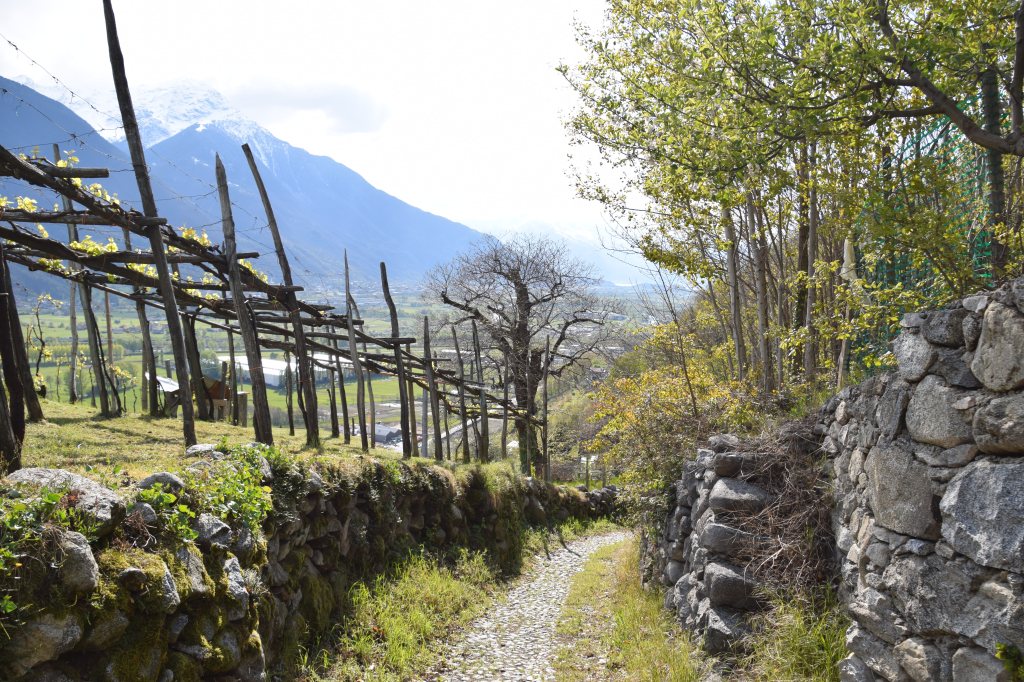
This is the beautiful mule path that originally led all the way to Traona and now ends on via Pianezzo and at a Madonna shrine. One can see the cobblestones – so well laid that they are still smooth and flat, and the path intact.

This is a modern piece of sacred art. It features a ‘relief’ of the crucifixion. It was difficult to see and even more difficult to photograph. The wisteria adds to the beauty of the art. This private devotion is part of the large villa that initiates the via per Traona outside Traona and which is currently for sale for an unnamed price.
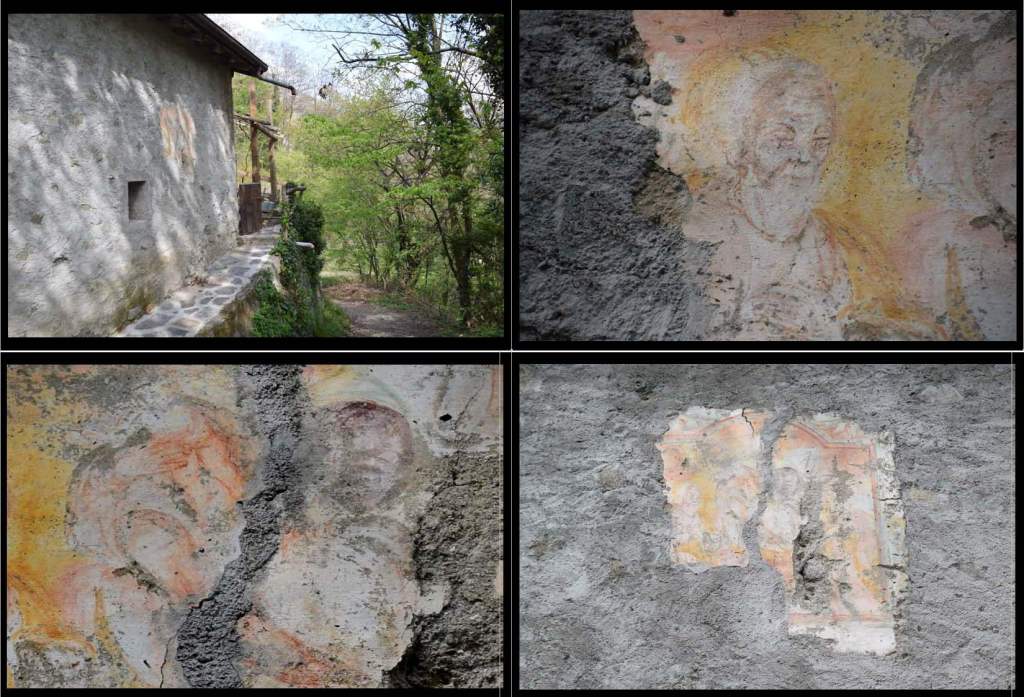
There are only five homes on the via per Traona. All have Wall Madonna’s. This once very elaborate but now almost completely eroded fresco is found on the second house in from the Cercino side of the via per Traona. The house was renovated and the fresco untouched. The art is clearly considered sacred – too holy to alter or cover over. The fresco faces the old mulattiera and as is common – it blesses the traveler. The section of road from Cercino is paved and the asphalt/cement ends here and reverts to cobbled mule path for a short stretch right in front of this house, Then the road is unpaved. There is a steep decline, a small torrente to cross, and then one is at the large villa with my ‘best find’ Wall Madonna. If it were not for this about 10 meters of road, the entire via would be traversable by car. Although this fresco is eroded, there is a still bright remnant of the saint who was on Mary’s right, and one can see two faces and a hand which are left from the center images of the fresco.
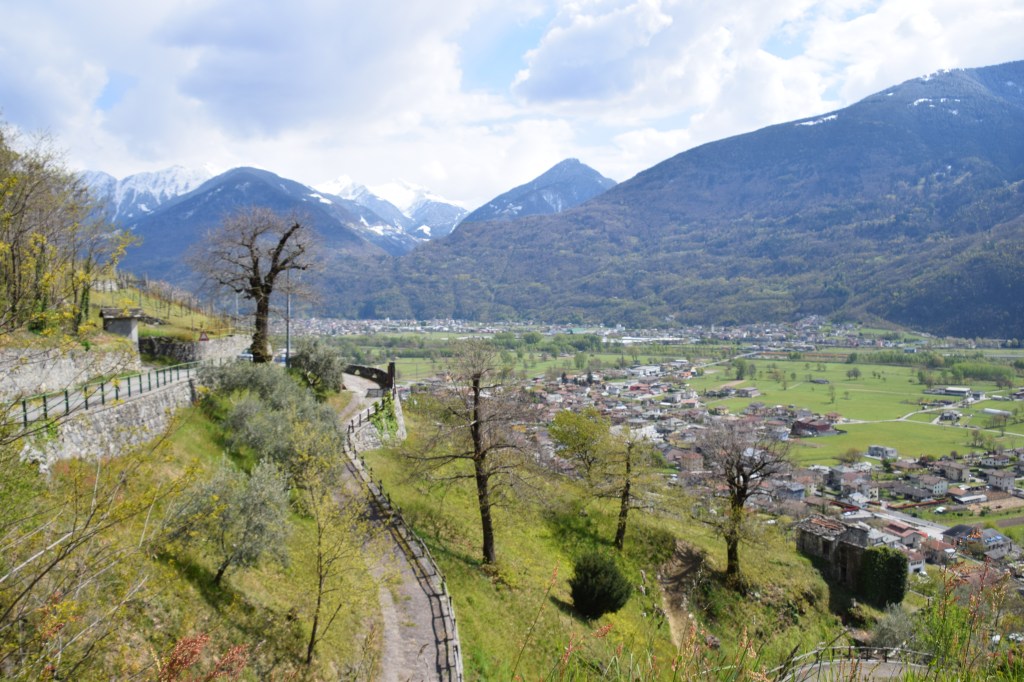
Walking on the via Pianezzo and looking back toward Traona while walking offers a fabulous early Spring view. The road winds back and forth up the mountainside and offers a lovely walk.

This Wall Madonna is on an old home being restored right at the foot of the road that passes in front of the 16th-century cemetery church – Chiesa di San Colombano – and leads directly to the ancient Arco della Dogana – the Customs Arch.

The Arco della Dogana – the Customs Arch – is the ancient entry to the old, once completely walled village. The arch dates to the early 14th-century and here were the tithes and taxes paid by traders in the Valtellina. Historical documents attest that in 1367 the gatekeepers and tithe collectors were the Della Porta family. The stemma – coat-of-arms – of the Parravicini family – a white swan on a red background – sits above the arch. A nobleman of Milan – Domenico Parravicini – escaping the wars of the Guelps and Ghibillines – founded Caspano in 1250 – a village located above Traona at 900 meters on the road to the Valmasino. The family became powerful throughout the Valtellina and built a palace in Traona. Walking through the arch leads to the historic center of the village. Here the Villa Paravicini now serves as the municipio – the Town Hall. The still cobblestoned path leads to the parish church and then to the via Pianezzo.
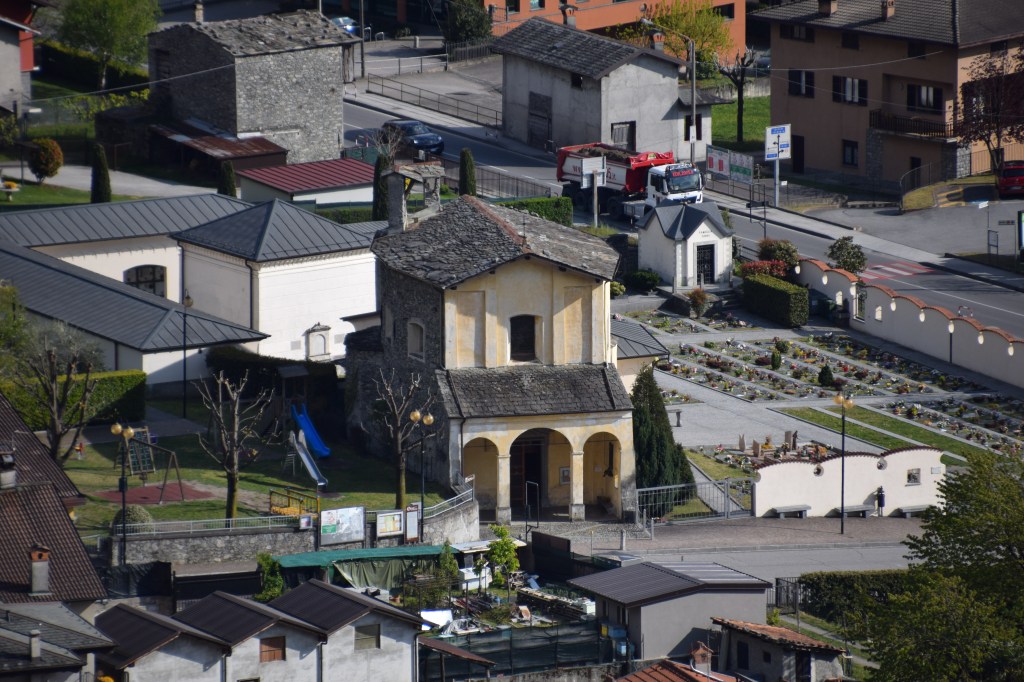
The 16th-century Chiesa di San Colombano seen from the belvedere of the parish church Chiesa di Sant’Alessandro. San Colombano is now the cemetery church and one can see the cemetery to the right. Directly past the church is the ancient gate of Traona – the Arco Dogana. The via Valeriana is called Strada Provinciale 4 – SP4 – in front of Traona and becomes SP10 just at the bridge and frazione of the same name – Ponte di Ganda – on the opposite side of the River Adda from Morbegno. This Strada Provinciale leads all the way to Cevo in the ValMasino where it becomes SP9 which ends at San Martino – a frazione at the mouth if the Val di Mello and the famous hot springs of the Bagni di Masino. Provincial roads are of differing qualities and widths here in the Valtellina and surrounding valleys. Some are wide and beautiful like the state roads – Strade Statali. Others are steep, narrow, and without guardrails – scary enough to cause a few grey hairs. But if one wants to see the beauty of Lombardy and the Valtellina – one drives the Strade Provinciali.
One might note that the address of the Chiesa di San Colombano is given as: Presso il Cimitero di Traona, Via Valeriana – At the Traona Cemetery, via Valeriana. Burials in ancient times occurred outside city walls to curb disease caused by bacteria from the decaying bodies. This was a logical approach to death and served both the requirements of Catholicism which forbade cremation and the public health needs associated with the many plagues that periodically – and rapidly – decimated the populations of the villages of the Valtellina. After bodies decomposed, the bones would be dug up and buried in a common tomb inside the parish church or in an ossuary in the church courtyard. It was common for there to be separate tombs for women and men, for clergy, and dedicated tombs for wealthy or powerful families.

This montage offers four wonderful, wooden doors: From the top left – the entry doors to Chiesa di Sant’Alessandro; top right and bottom left – doors found in Moncucco Basso, bottom right – a door from the second home in from the Traona side of the via per Traona. This door had a preserved colored frame from a totally eroded Wall Madonna. You can see some of the colors right above the lintel.

This is that door. The fresco is no more but the space remains sacred and preserved.
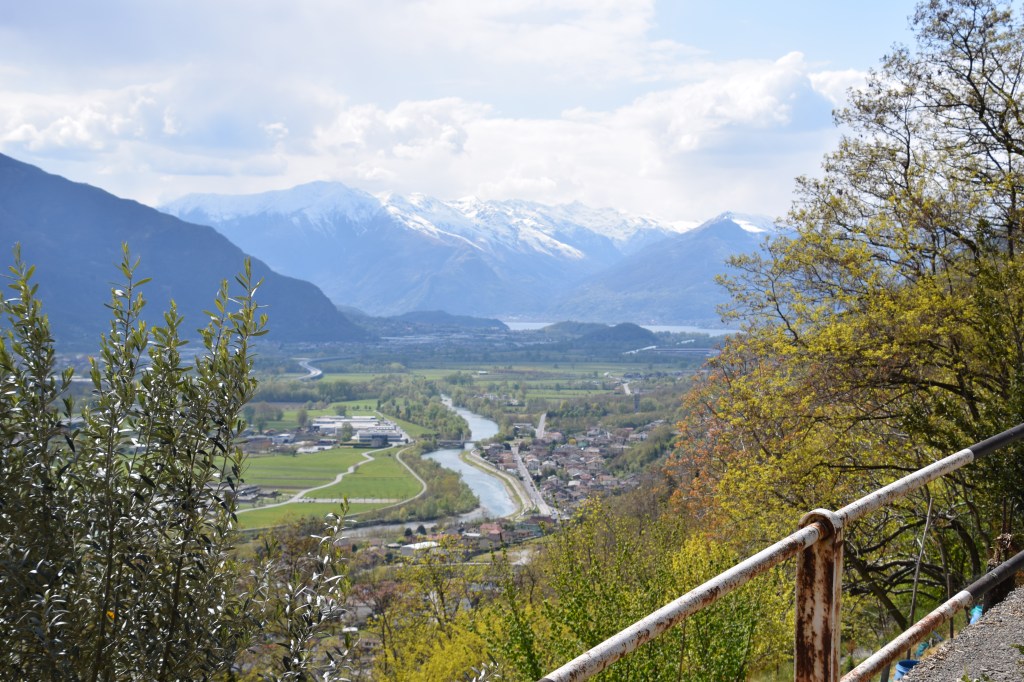
The vistas are unending. Here one can see the River Adda and Lago di Como – all surrounded by the pre-Alps!
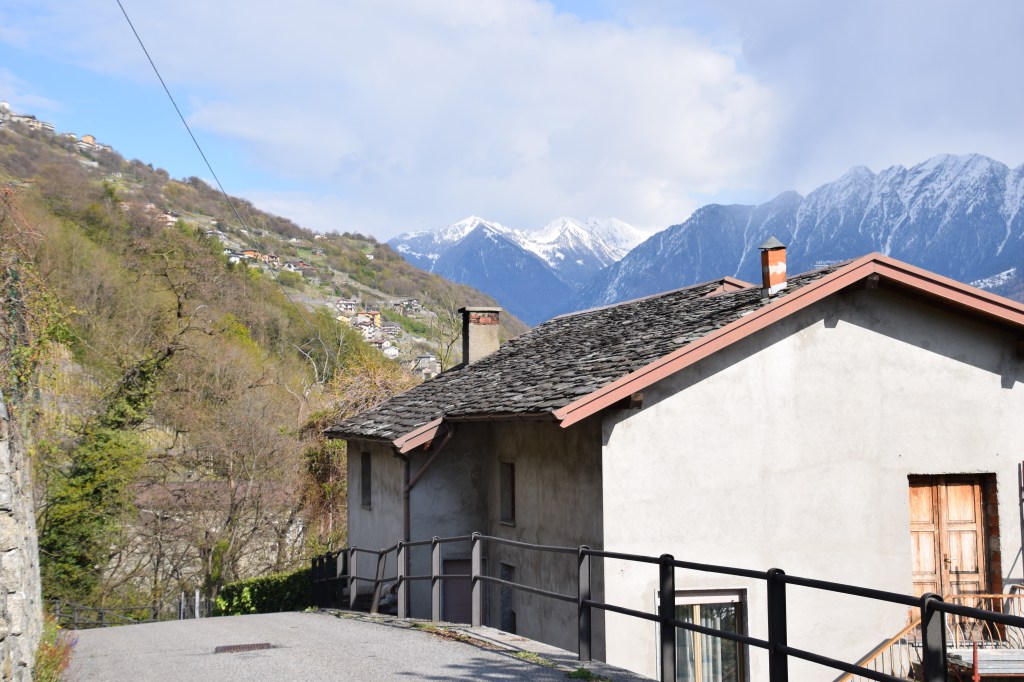
A glance back toward Mello to the east – spread across the mountain face. This is the beginning of the via Pianezzo just at the point where the cobblestone leading from the parish church ends and the asphalt begins.

There is one more road that links Cercino and Traona – the via Ca’ Rossa. The abbreviation Ca’ stands for ‘casa’ – house. The brief road is beneath the other paths between the villages and it is lined with vineyards and runs laterally from via Monbello snaking down to the valley and the west end of Traona. Two of the few old stone homes on the road have Wall Madonna’s. Here is a very faded Sacra Famiglia.
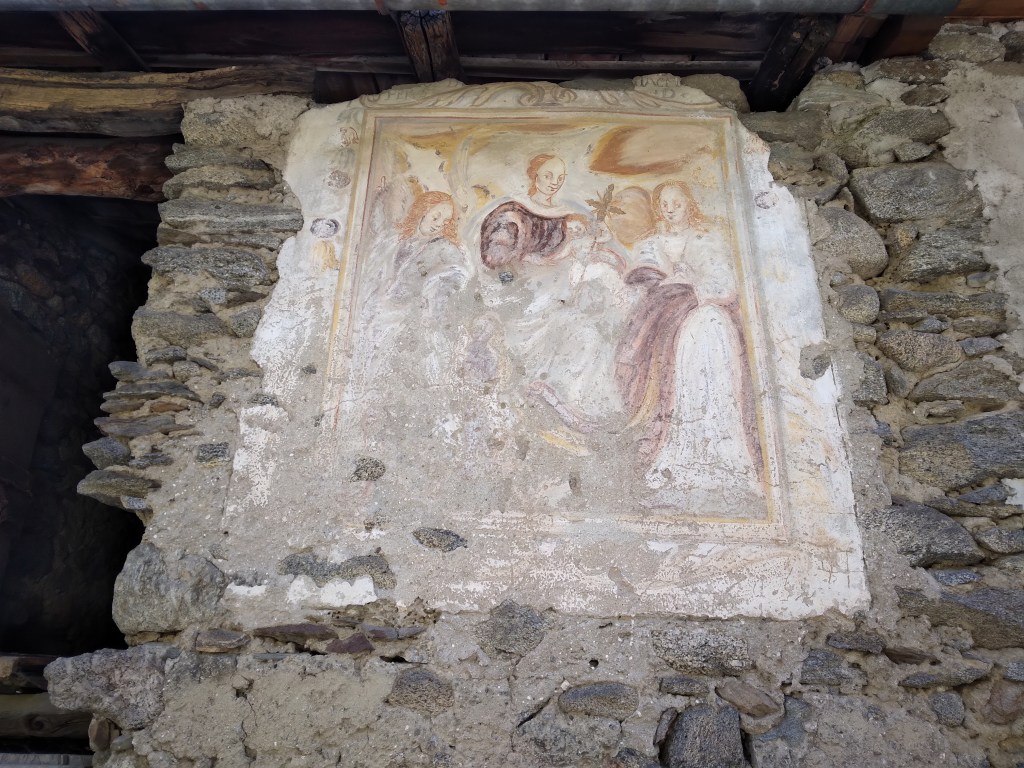
I end my walk in Traona with a Wall Madonna from the via Ca’ Rossa. This is a wonderful – poorly restored late 17th or early 18th-century Vergine Assunta. The Madonna is flanked by two Archangels. I hope you have the opportunity to visit the Valtellina and walk the roads of Traona enjoying the astonishing views and Wall Madonna’s!
 Wall Madonna's of the Valtellina