
The Antica Chiesa di San Giorgio is a small 12th-century church in Lurago Marinone – a village in the province of Como that sits on the border of a Lombardian protected area called Parco della Pineta di Appiano Gentile e Tradate – Pinewood Park of Appiano Gentile and Tradate. The church, in general, is not open to the public. However, the National Trust of Italy – the Fondo Ambiente Italiano – known as FAI, offers Spring Days each year where for one weekend FAI volunteers and towns collaborate to open historic venues to the public for one or two days.
A National Trust is a non-profit, private organization dedicated to preserving the culture, history, art – the heritage of a country. Italy’s National Trust – FAI – was founded in 1975. The FAI website: https://fondoambiente.it/
Currently, FAI owns twenty-two properties most of which are located in northern Italy. However, the organization is involved in many ways outside ownership in the preservation and championing of the many artifacts of humanity and nature in Italy. Of their many offerings for the public, the 2023 Giornate FAI di Primavera took place this past weekend – March 25 & 26 – in many provinces all over Italy. In the province of Como, fourteen venues in eight cities were opened to the public for free visitation. This year two venues in Lurago Marinone were available for visits – the Cortile Zaffaroni and the Antica Chiesa di San Giorgio.
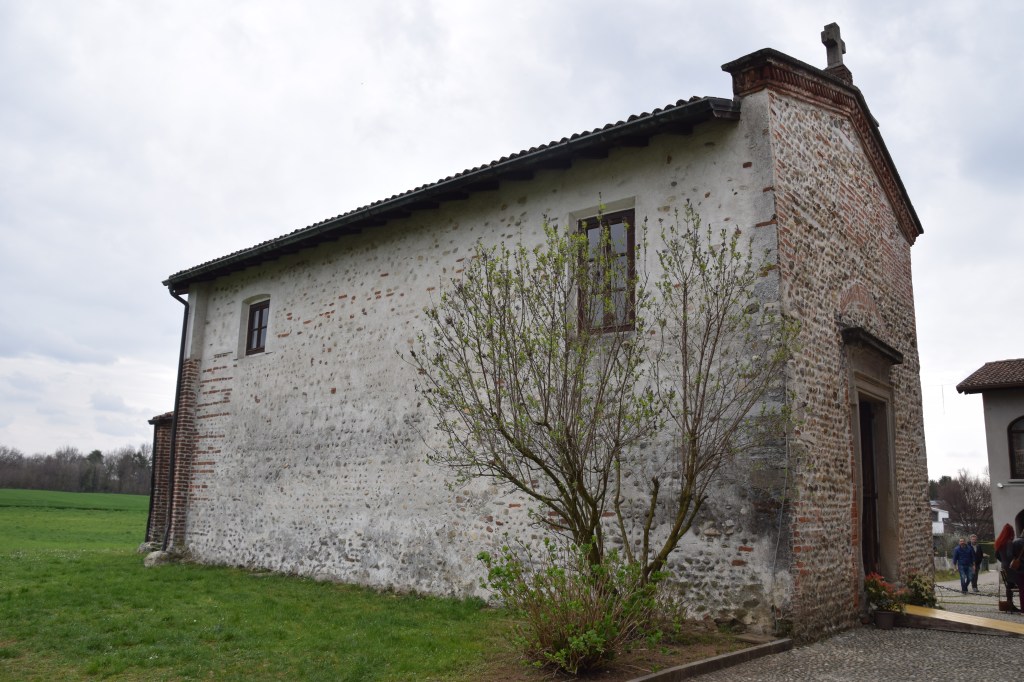
The chiesa is in the nucleus of the village near the old feudal castle currently used as the Municipio – the Town Hall. San Giorgio is surrounded by agricultural fields and once had its own olive grove and vineyard. Now there is but one lonely olive tree and a short, double line of vines. The FAI signs made finding the venues easy.
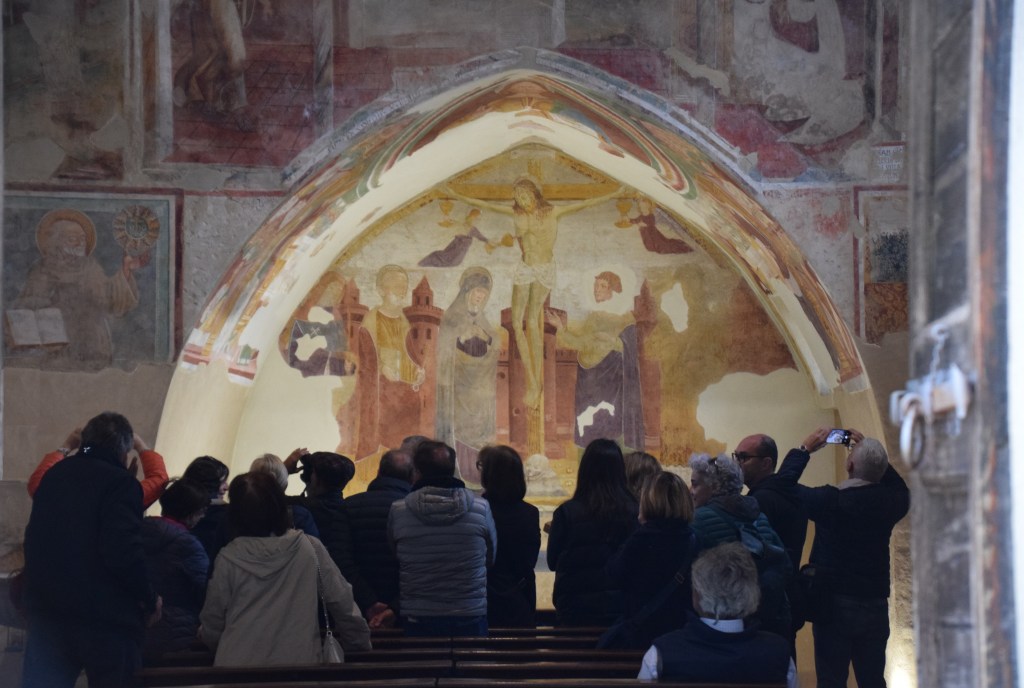
Given that March is ‘off-season’ for tourism at the lake, most of the visitors to the oratory were locals. The ancient art of Italy is beloved to Italians. This photo of the chancel wall (front altar) of the presbytery shows a group of enthusiastic visitors viewing the crucifixion scene. I love this photo for the joy in culture to which it testifies. The fresco dates to 1476. At the feet of the crucified Christ is (from the left) Mary Magdalene, Saint Peter, the Great Virgin, and John the Evangelist.

It is not possible to get a full view of the front of the small oratorio but this photo because captures the beautiful original brick and cobblestone of the building. One can see that the original church was significantly ‘shorter’. The newer bricks that are clearly seen above the lunette and to the right show the border of the old roof.

Here is an unobstructed view of the church interior facing the chancel to the east. Ancient churches always put the altar on the eastern end of the church so that when worshipping, adherents are facing the direction of Jesus’ place of birth and death, and where he lived his life. Standing at the threshold of the oratory, one can see that frescoes once covered the entire inside – walls, presbytery, and apse ceiling. One, also, can see the beautiful wooden, trussed ceiling. The clear ‘white’ border above the frescoes and around the upper walls, and the ‘short’ triumphal wall fresco is the result of the roof of the original church being raised. The large windows were added at that time also.
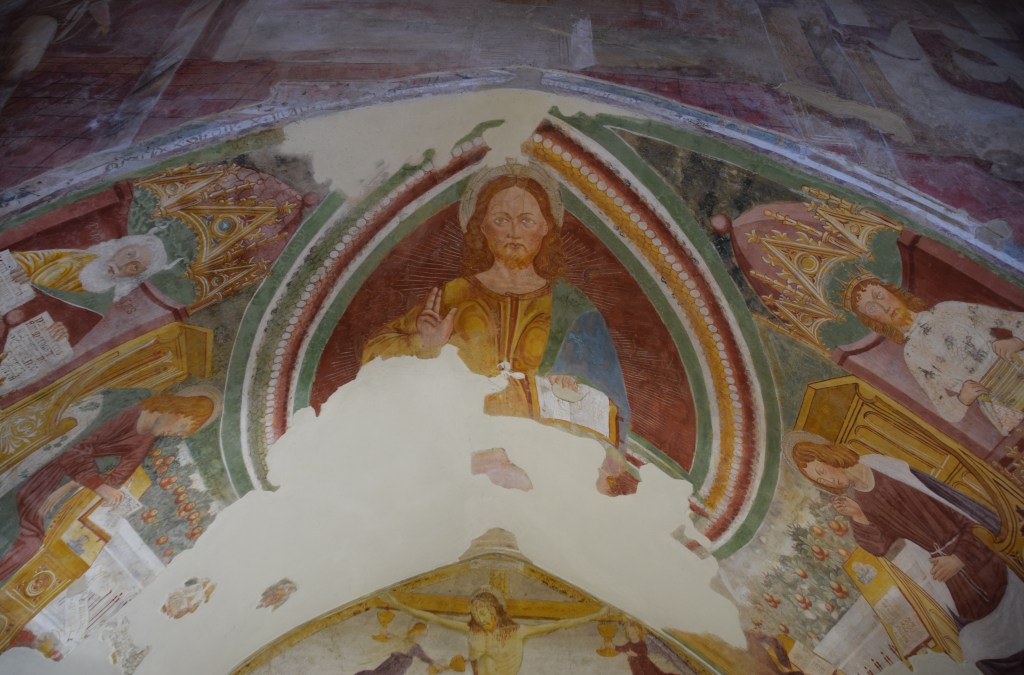
This is the fresco that completes the front altar decoration which offers adherents the traditional view east – towards the place of Jesus’ birth. The imagery is painted on the domed apse ceiling of the altar. Presented is Christ the Redeemer with his hand raised in benediction while making the symbol of the Trinty. Jesus is enthroned in the sacred mandorla – a glowing aureole used only for the deity and His mother. Christ is surrounded by the four Evangelists each represented with their Cherubic symbols – the lion for Mark, the ox for Luke, the winged man or angel for Matthew, and the eagle for John. Christ the Redeemer pictured enthroned in the sacred mandorla is a typical apse or triumphal arch fresco for this time period.
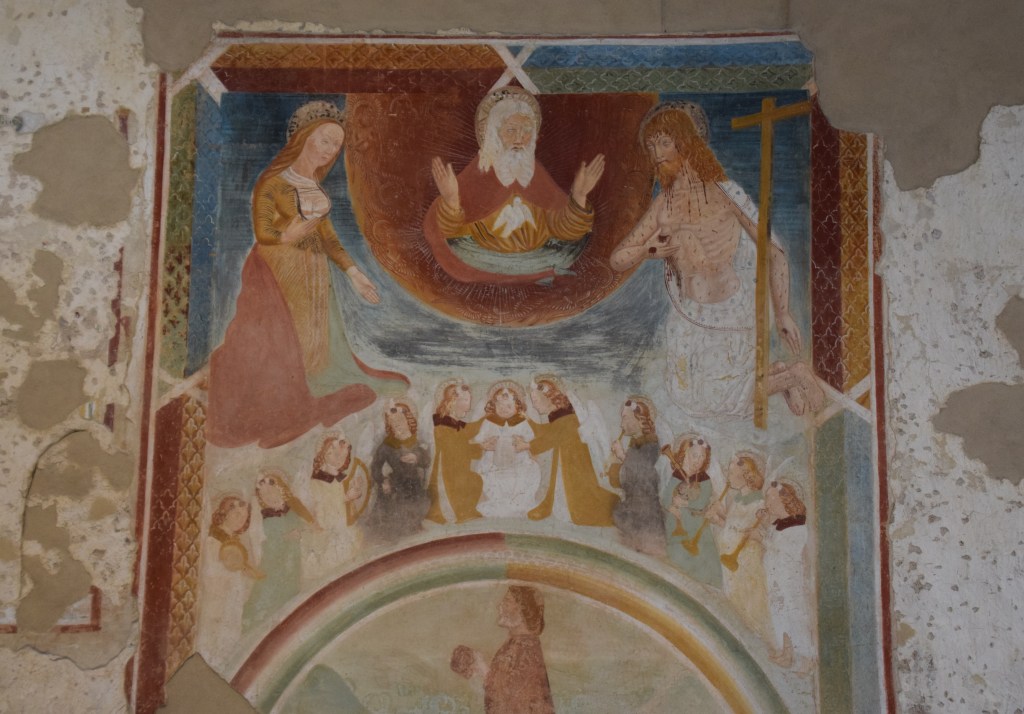
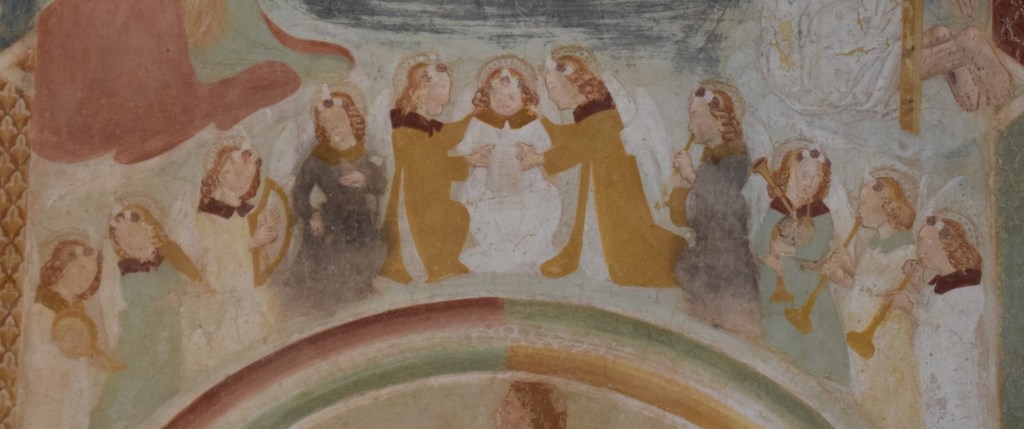
This fresco is located on the right or south wall. It depicts the Virgin Mary and a flogged, tortured, and crucified Christ newly risen from death. God the Father and the dove representing the Holy Spirit are in the center. The Father looks at Jesus who – along with his Mother – bows his head in deference. At the feet of the holy figures are musical angels. The center angel is singing from a sacred script that is being held by two flanking angels. Beneath everything is a kneeling donor – hat in hand – who is not identified but whose likeness may be authentically represented as was often the custom employed by artists.
The fresco is VERY interesting for the following reasons:
First, Mary is wearing a traditional – for the time period – open-bodice dress. The original fresco showed her naked breasts and exposed nipples in what may be assumed was a testament to her fertility and nourishment of Jesus. This imagery was likely a unicum of the local artist since one does not find Mary’s breasts exposed outside of frescoes showing her nursing an infant Jesus – the Madonna del Latte artwork – where only the feeding breast is seen. The white paint was added centuries later to cover Mary’s naked breasts and nipples. If one looks carefully just above Mary’s right hand at the strip of flesh left uncovered, her nipples are visible.

The second interesting aspect of this fresco is the musical angel – in green – and the third from the right – who is playing bagpipes! Although the bagpipes are an ancient instrument (which we currently associate with Scotland) I have never encountered a musical angel playing bagpipes. When I pointed this out to the docent she admitted this detail was not noticed. I love this wonderful fresco!! Such a fabulous work of imagination and vision by the artist deserves not to go unrecognized!!
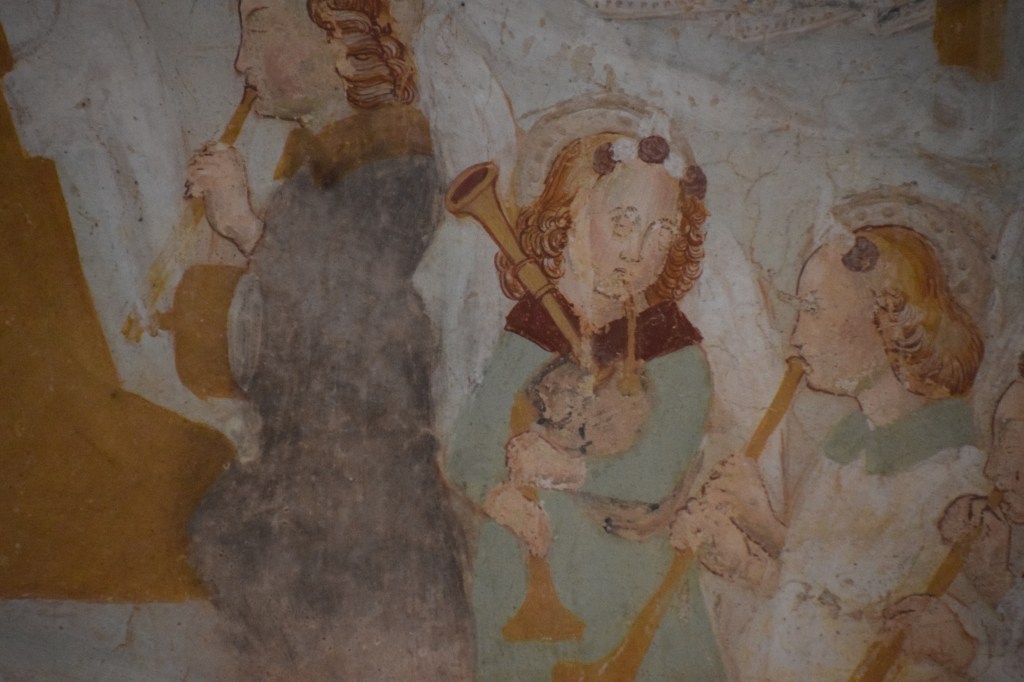
To offer some further discussion about the musical angels – the two angels on the right are playing a trumpet-like instrument called a Shawm. Then one sees the bagpipe-playing angel, followed by the angel playing a recorder and a timbrel. On the opposite side from the lower left: An angel plays a gittern, the next angel plays a rebec, the following angel plays a nevel or harp-like instrument, and the last angel plays a stringed instrument with a bow that is too darkened to conclusively identify. Given the implied size of the instrument and the way the bow is held, one could hazard a guess that this could be a hurdy-gurdy or another rebec.
In addition to the images of sacred personages – deities, angels, martyred saints – and historic events used to convey religious legend and belief to a largely illiterate parish, churches and other sacred religious buildings made certain to portray church leaders among the imagery.

This is an image of the French Pope Urban V (1310-1370) holding a box containing tiny ‘dolls’ of Saints Peter and Paul. Pope Urban was beatified but is not a saint. He is depicted with a halo though it speaks only to his saintliness and not to his sainthood. This pope was known for his promotion of education and his reform regarding the Catholic persecutions of Jews. Urban V imposed the penalty of excommunication on those who persecuted Jews or tried to force their conversion and/or baptism. He is typically represented holding the images of Saints Peter and Paul. However, this artist placed tiny saints inside what looks like a box. This is not a common depiction of any sacred personage. However, the dedication of the church to the deity is and that is represented by the saint, or religious authority handing a small model of the church to Christ, one might speculate that what looks like a box is actually an artistic rendition of the oratory.

This is a very colorful fresco of Sant’Antonio Abate. The Egyptian Saint Anthony is shown with his ‘fire’ above his head to the left, his bell for chasing away demons and temptation, and his shepherd’s staff/hook indicating his vocation and great age – he died in 356 at 105 years old! The fresco is on the bottom right of the Triumphal arch wall – the front of the oratory. To the far right one can see on the south (right) wall an original consecration cross. The interior and exterior walls of a church are anointed with holy oils or holy water by the bishop in order to ‘consecrate’ the church before it is considered sacred enough for the mass to be said.

This is an original consecration cross. Before a church is considered sacred for worship it must be consecrated by a bishop who blesses and anoints each interior and exterior wall at each cross. Consecration by a bishop of the interior and exterior walls is accomplished by anointing them with holy oil (chrism – mixed oil and balsam) or holy water thus moving the building and space from the secular or profane to the sacred – dedicated to the worship of the Catholic deity.
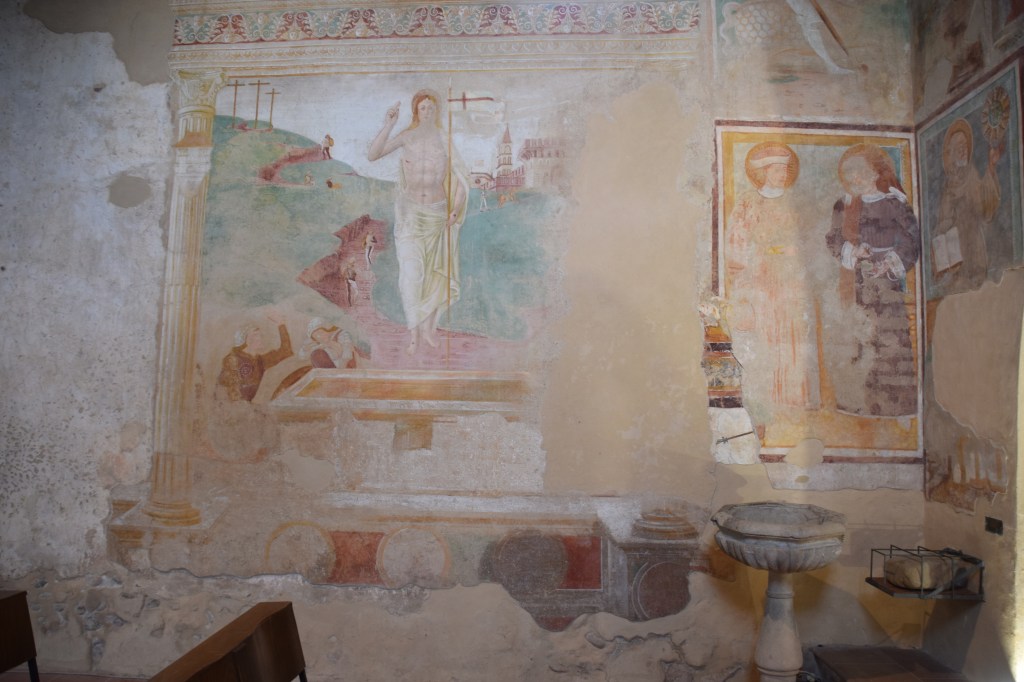
This fresco is on the north (left) wall and depicts a wonderful rendered Resurrection with Jesus holding the flag of the Redeemer and the ‘good’ or ‘buoni’ rising from their graves to join him in Heaven. To the right of Jesus is a fresco of the martyred twins – Cosmos and Damian – who were 3rd-century Arab physicians and Christians. The brothers who practiced medicine for free as a duty to their faith, were executed for that faith in Syria during the persecution of Christians by the Roman emperor Diocletian who reigned from 284-305.
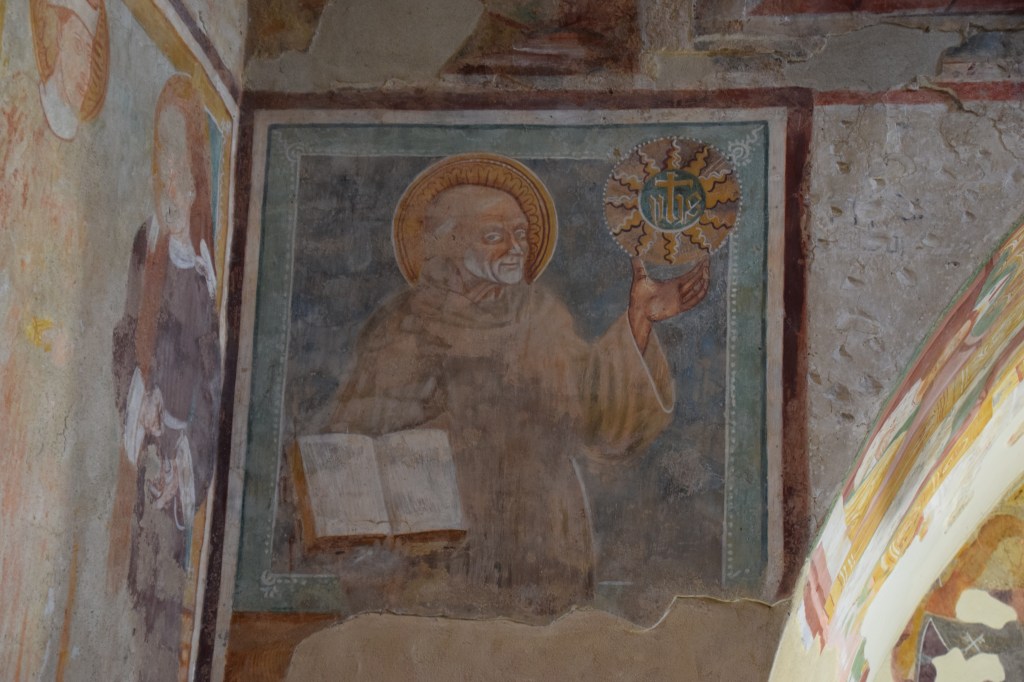
This is a beautifully crafted image of the recently deceased (for the fresco painter) San Bernardino da Siena (1380-1444) holding the Christogram that he ‘invented’ and ‘the word’. Bernardino was a zealot a dedicated missionary and an inspiring preacher. He created the Christogram medallion that he holds in his left hand and which is commonly part of any painting in which he features. The icon contains the first three Greek letters – IHS – of Jesus’ name on top of a rayed sun. The full name in Greek is ΙΗΣΟΎΣ. Bernardino insisted that Christians display the Christogram next to or on the entry door of their homes. Bernardino was a Franciscan, a missionary, and a zealot with whom is associated the book burnings called ‘the bonfires of the vanities’. The bonfires were communal burning of books and other objects condemned by priests and other religious authorities as creating occasions for sin. This fresco is on the bottom left of the Triumphal arch wall – the east wall – the front of the church.
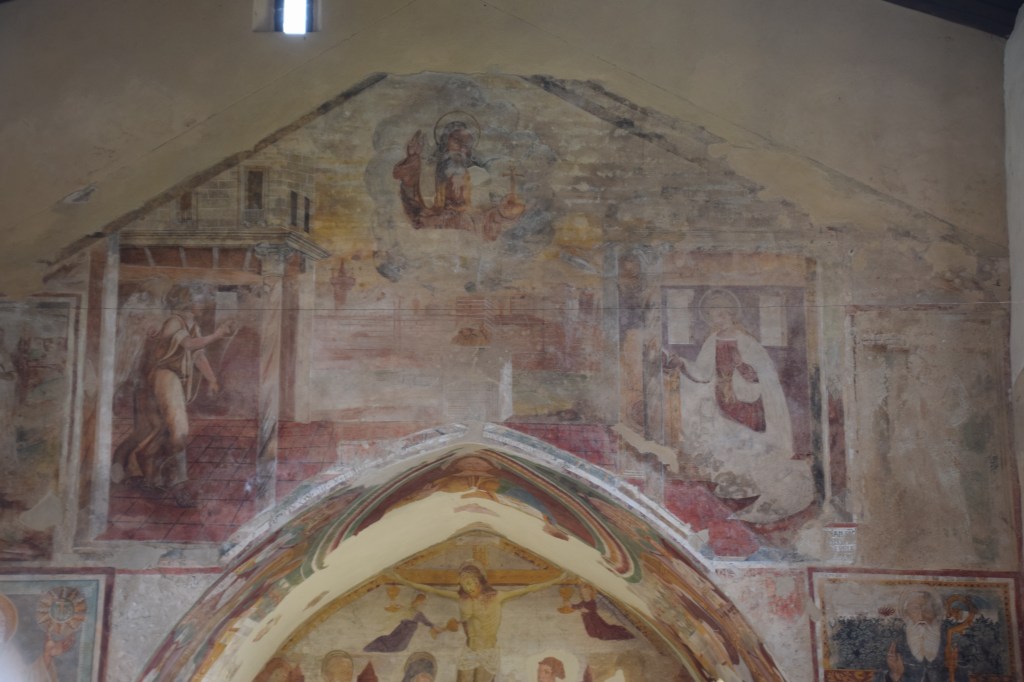
The triumphal arch is decorated with the traditional depiction of the Annunciation. The fresco is quite faded but shows the Archangel Gabriel to the left and the Virgin Mary to the right. God the Father is above them in the center and a barely visible Holy Spirit shooting beams of impregnating light can be seen above Mary’s head. To the far right was once pictured a ‘knight’ saint who was associated with Saint George – the patron saint of the oratory. He is not identifiable. Note that the fresco actually extended to the ceiling of the original building. The blank space is where the walls and roof were raised.
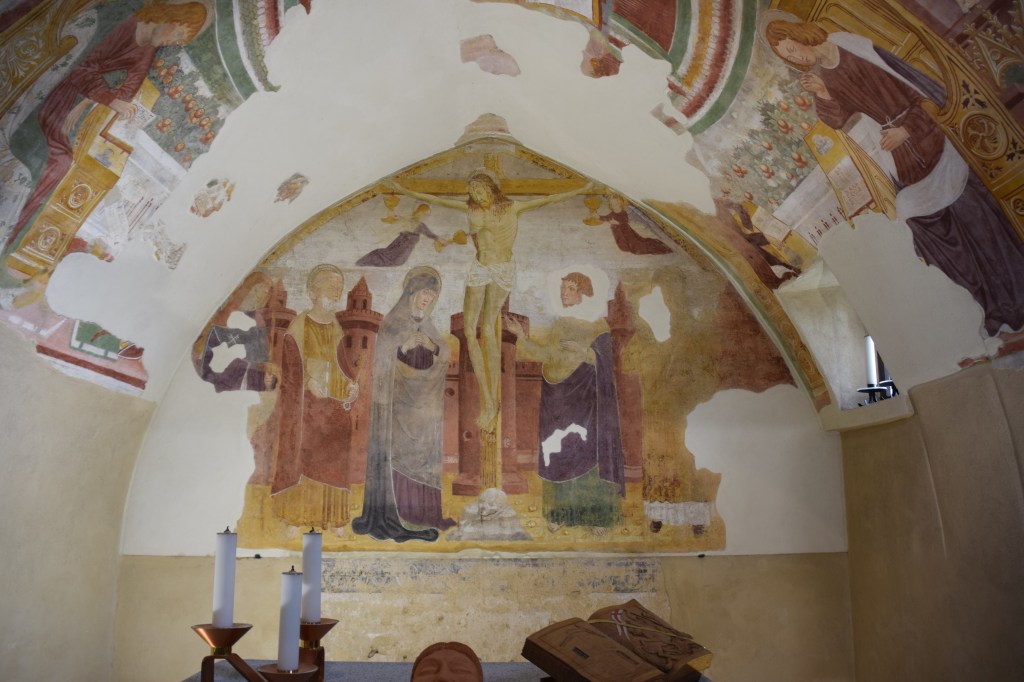
This is an unobstructed view of the chancel (altar) wall showing the crucifixion of Jesus with the Magdalene, Saint Peter, Mary the Virgin, and John the Evangelist. Above one can see the part of the apse ceiling painting that depicts Christ the Redeemer surrounded by the Evangelists.
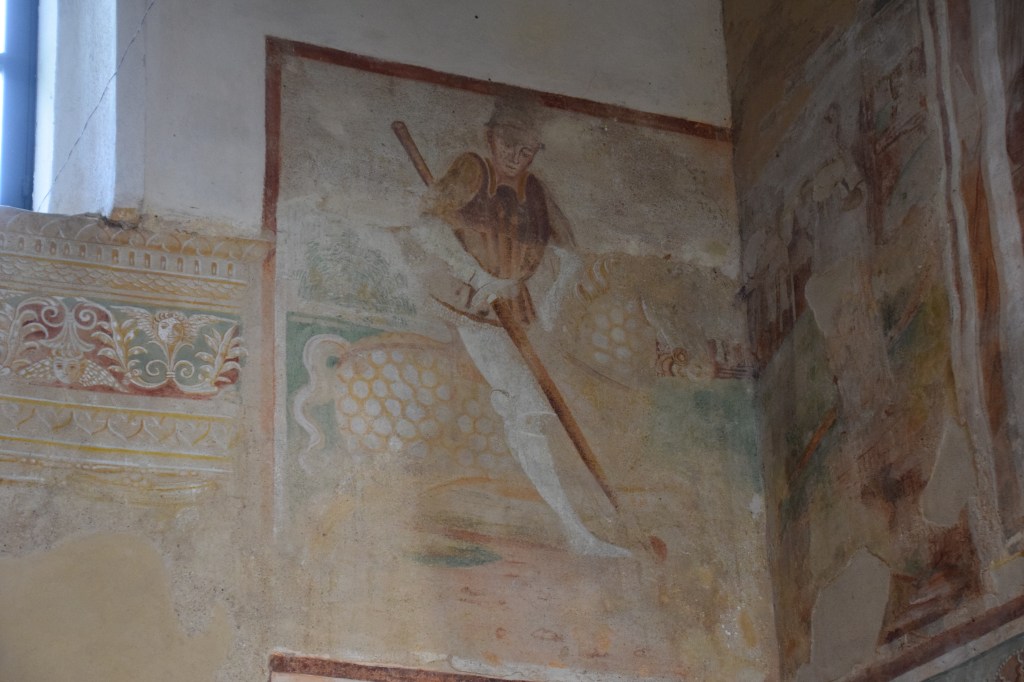
This corner fresco spanning the corner of the north (left) wall and the corner of the east (altar) wall shows the patron saint Giorgio (left) on his horse and rescuing the princess (right) from the dragon speared and dying at his feet. Legend holds that this event occurred in Libya and Giorgio’s only ‘payment’ for his deed was that all in the kingdom converted to Christianity. The flag San Giorgio carries is white with a red cross – the same flag that images of the resurrected Christ show Jesus holding. Saint George was from Cappadocia, Turkey and he was buried in former Lydda – now a part of Israel.
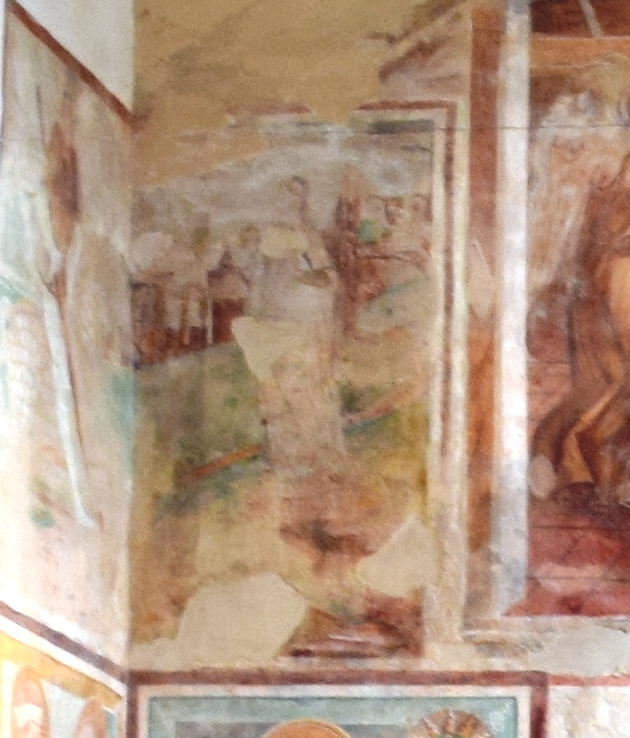
This is a detail of the previous fresco. It is quite blurry but a careful consideration of the imagery shows the princess that Saint George rescued standing in the foreground and surrounded by onlookers standing behind her.

On the south (right) wall abutting the corner of the east wall where the fresco of Sant’Antonio Abate is painted, are the remnants of a once magnificent enthroned Madonna and Child. The stylistic representation of the throne is reflective of the changes from the Romanesque depiction of a throne that is a stand-alone ‘chair’ to a recessed throne alcove. Little is left of the features of the sacred personages or their costumes, but one can clearly see that the Great Virgin was represented with the red hair common among the peoples of the Lombard region.
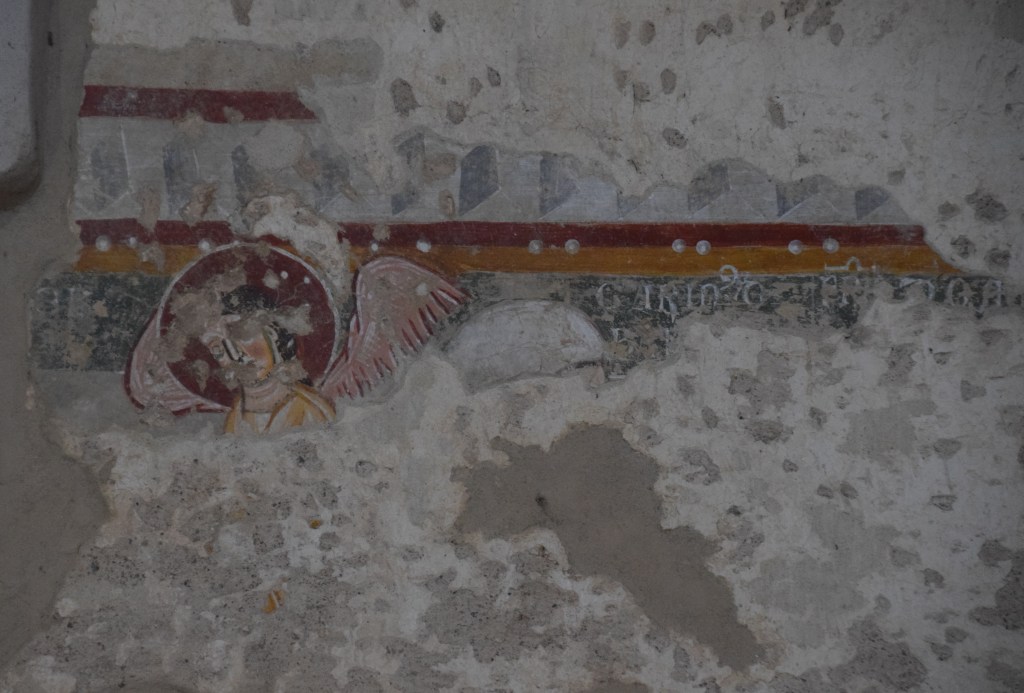
On the south / right wall is found a true treasure. This is a fabulous remnant of the original frescoes covering the walls of the oratory. The works were painted during the Romanesque art era. A major characteristic of the imagery of this artistic period was its lack of ‘naturalness’ or humanistic features. The faces and bodies look static and devoid of emotion and movement. Although not as rigidly executed as the sacred images found in the Byzantine icon painting, these frescoes in their ‘flatness’ can be easily recognized by even the amateur art lover. These ‘old-fashioned’ 12th-century frescoes were covered up and replaced with the ‘newer’ 15th-century frescoes we see today. We can thank the wall preparation and painting techniques of that time period for this fantastic image of an angel with colorful pink wings viewing a long-lost sacred scene or personage. Before a fresco can be painted, the wall must be prepared. The wall was covered with three layers of plaster – the final layer often being mixed with marble dust. Before the final layer dried – while still wet – the artist painted the images. Because the plaster was wet, the paint amalgamated with the gesso mixed with marble. Hence, the imagery did not sit on top of the plaster base. It was part of it. That is why we have the good fortune to be able to see what was under the newer frescoes. And if one compares this small image that is crisp and bright to the more faded and younger images the durability of this ‘lost’ technique of fresco painting is clear and easily recognized. The artists who used this method had to be exacting and very talented. There was no correcting an error by painting over a mistake. A mistake was forever merged with the wall.

This photo of the rear of the chiesa shows the original roof line. The altar apse was also changed from semicircular to squared. One, also, can see the lonely little vineyard, the olive tree to the right of the front entry door (not seen), and the bank of ancient homes that are nestled very close to the oratory and prevent a full-view photo of the front entry. One can clearly see the old roof-line on the back of the church and – on the side – the old, narrow, vertical windows that were covered up and replaced with the two large windows. The shorter annex is where the presbytery is located. This part of the original building was once semi-circular.

Here is a final photo of the lone olive tree that lives alongside the tiny church. The olive tree offers shade, oil for cooking, wood for cooking and for making eating utensils, and it symbolizes peace, friendship, and reconciliation. Most churches in Italy have an olive tree nearby. I hope you enjoyed this pictorial visit to the Antica Chiesa di San Giorgio in Lurago Marinone in the province of Como.
 Wall Madonna's of the Valtellina