
Saturday of the Giornate FAI di Primavera 2023 was a smashing success for me since, finally, after years of trying I was able to visit the exquisite 13th-century church – San Giorgio di Crebbio! From 14:00-16:00 the public could visit and view the fabulous 15th-century frescoes! And then, if desired, one could attend the 4:00 pm mass offered there. This fully frescoed and preserved church was worth the wait! At first step across the threshold of the old wooden entry doors, one can see the fully frescoed walls, triumphal arch, and presbytery and the open, wooden trussed ceiling. With eyes full, one breathes in the colors of the ancient past. The powerful faith of the long-dead who built this church on the sacred ground and foundations of the lake’s pagan past, and painted its’ walls with their belief truly embraces the visitor. Believer or not – worshipper or tourist – there is no escape from the power of this art!
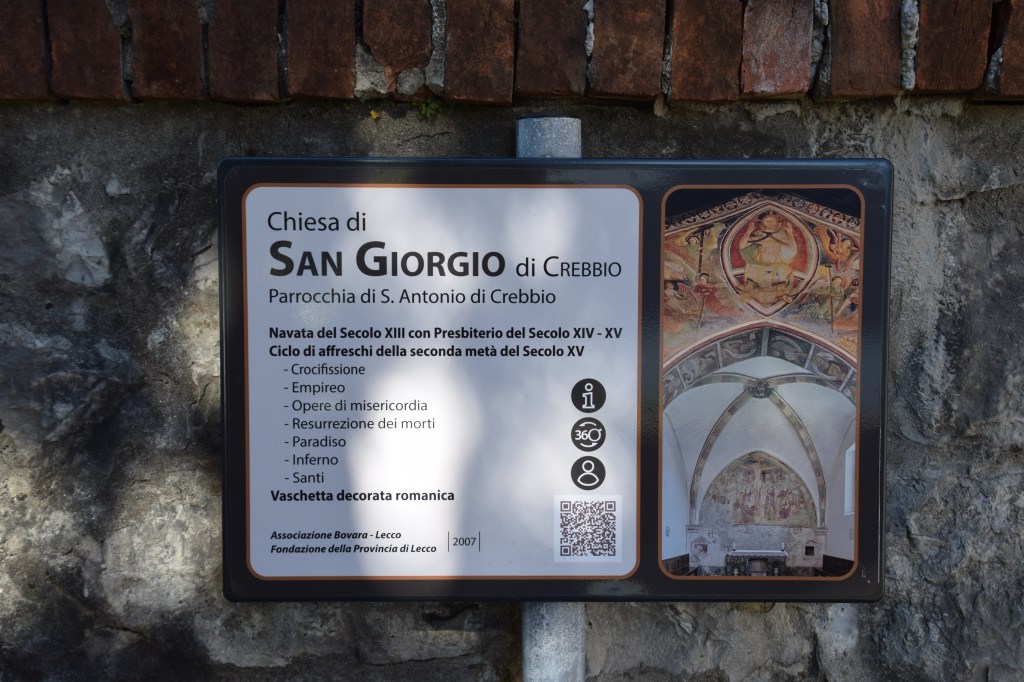
This beautiful sign identifies the church and offers information to entice the visitor and champion the church! Briefly presented is the age o the church and fresco and the themes one will find executed inside.

A full view of the Chiesa di San Giorgio di Crebbio. Beneath the wall, down a short flight of ancient stone steps is a small garden overlooking the lake. A picnic table has been placed there.

This is the view one sees upon entering the church. As with most ancient churches in Italy, the adherents or worshipers face east – toward the place of Jesus’ birth. One can see the fully frescoed walls, arch, and presbytery and the open, wooden trussed ceiling. Just breath-taking! The theme of the imagery is the Parusia as prophesized by Saint Bernardino of Siena. The term ‘parusia’ means ‘presence’ and refers to the ‘presence’ of the divine on earth. According to Christian belief, this refers to Christ’s return to earth at the ‘end of time’ – the time when Christ returns to earth after the Last Judgment. The frescoes were painted between the years 1475 to 1485. Experts posit that with the exception of the chancel wall crucifixion scene, the artists were from the Piedmont area near Torino. The crucifixion scene is purported to be by a local artist from the lake area.

This is the view of Lake Como from the courtyard of the church.
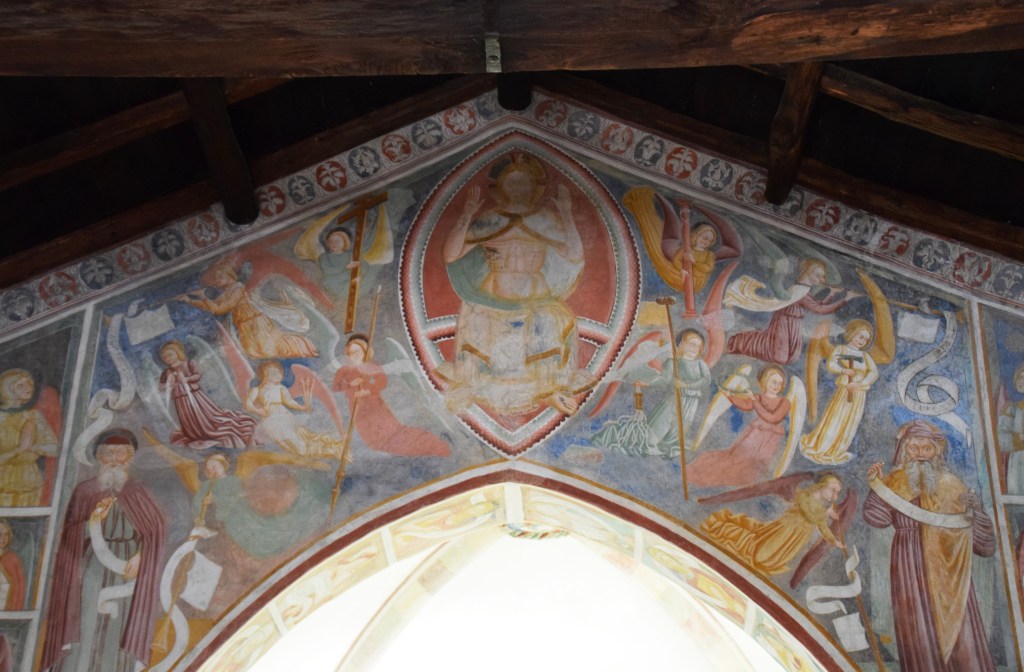
This is a detail of the magnificent triumphal arch showing Christ the Redeemer inside the sacred mandorla and surrounded by musical angels and angels holding the tools of his crucifixion.
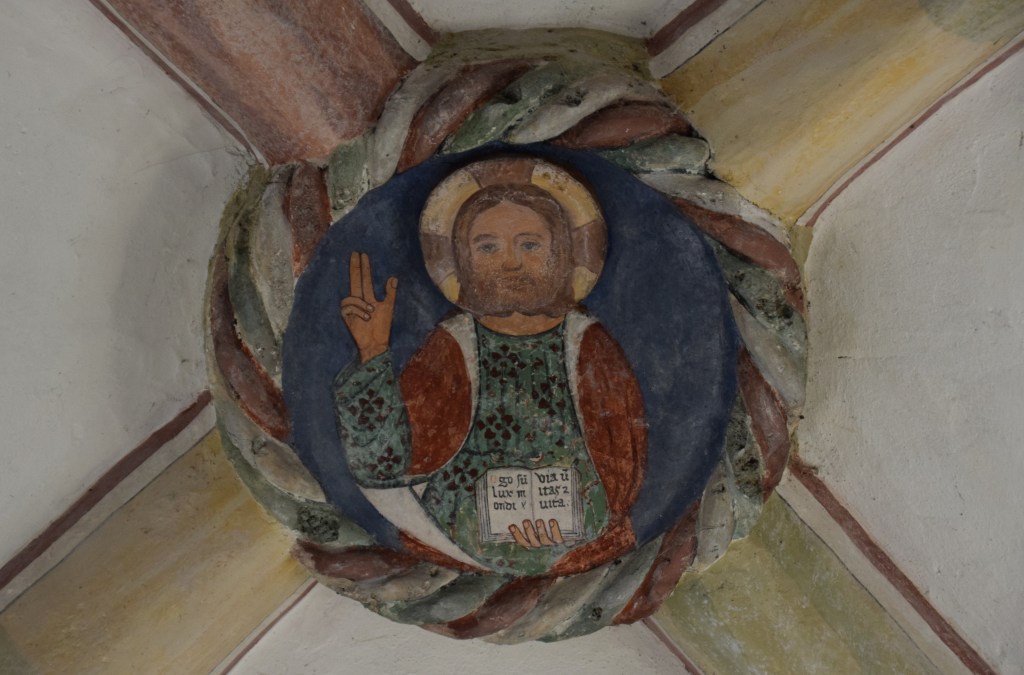
This is the exquisite keystone of the domed and arched altar ceiling. Here is Jesus offering the sign of the Trinity – the triune godhead of the Roman Catholic Church. Candy-cane-colored ribs lead to a similarly colorful – and sculpted – Jesus. Just beautiful!
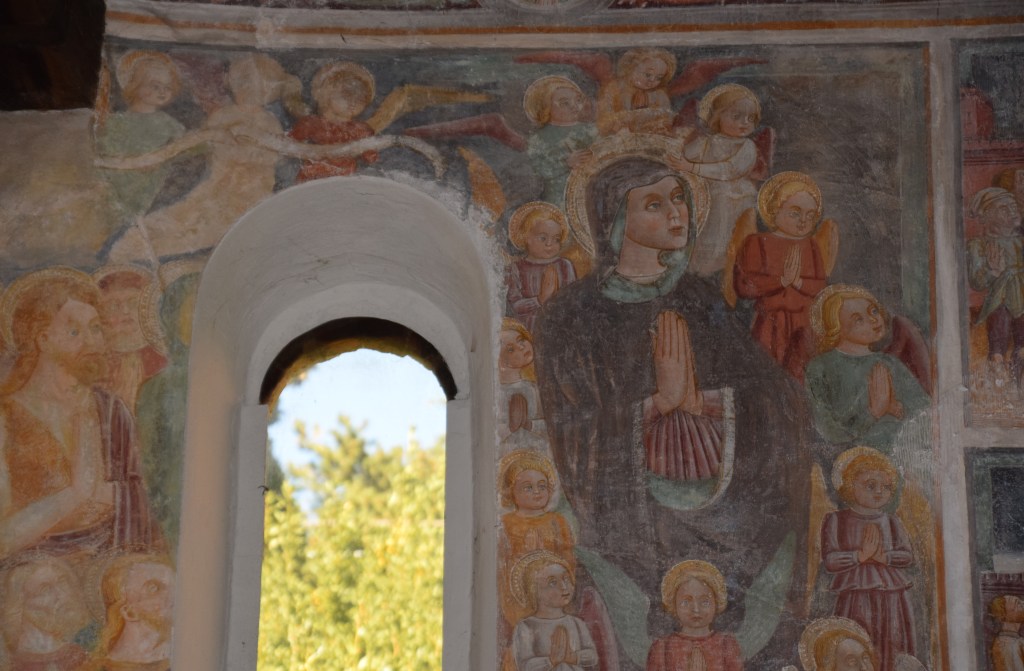
This is a detail from the fully frescoed north/left wall. The Madonna – surrounded by angels – prays as she gazes at Christ the Redeemer aglow in the mandorla – hands arms raised in the position of the orante – praying for humanity and the worshippers high above their heads on the triumphal arch.

The North / left wall – four frescoes. From the left: The Madonna & Child enthroned with a worshipping Saint Bernardino on the left offering Jesus the ‘word’. The infant Jesus has his hand raised in the symbol of the Trinity. The next fresco shows Saint Nicholas Tolentine and Saint Anthony Abbot. One then sees Saint Bernardino and Saint Rocco. Finally are seen Adam and Eve in the process of committing the Primordial Sin as Satan in the form of a snake with human head curls around the Tree of Life and hisses at Eve.
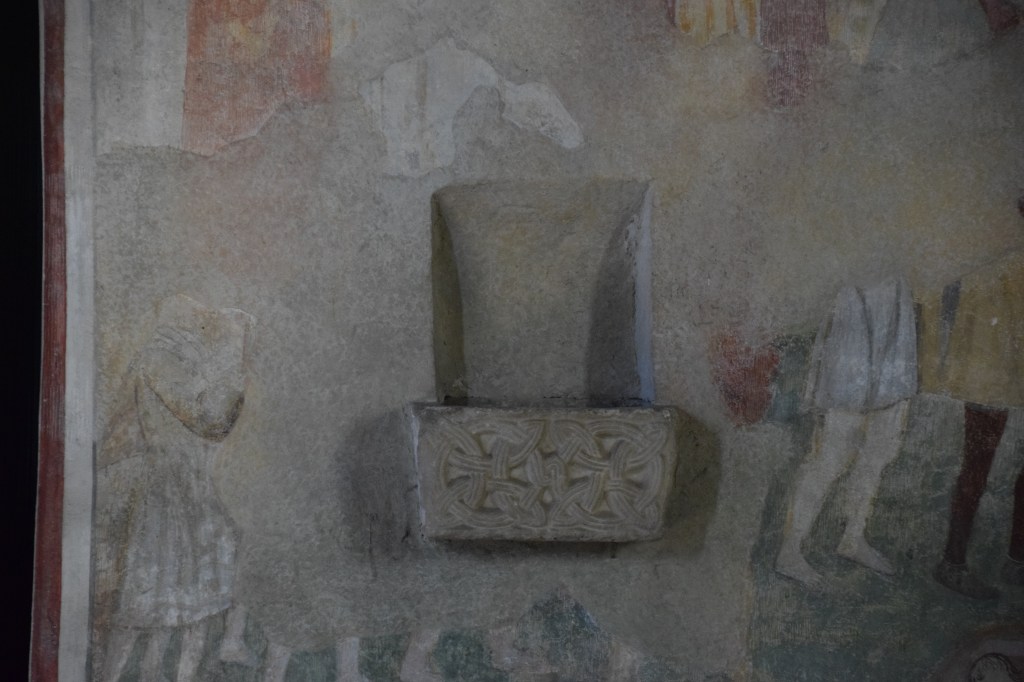
This is a beautiful 9th-century stoup or holy water container. The decoration’s geometric-interwoven motif was popular around the Lake region from the 6th-century to the 9th-century.
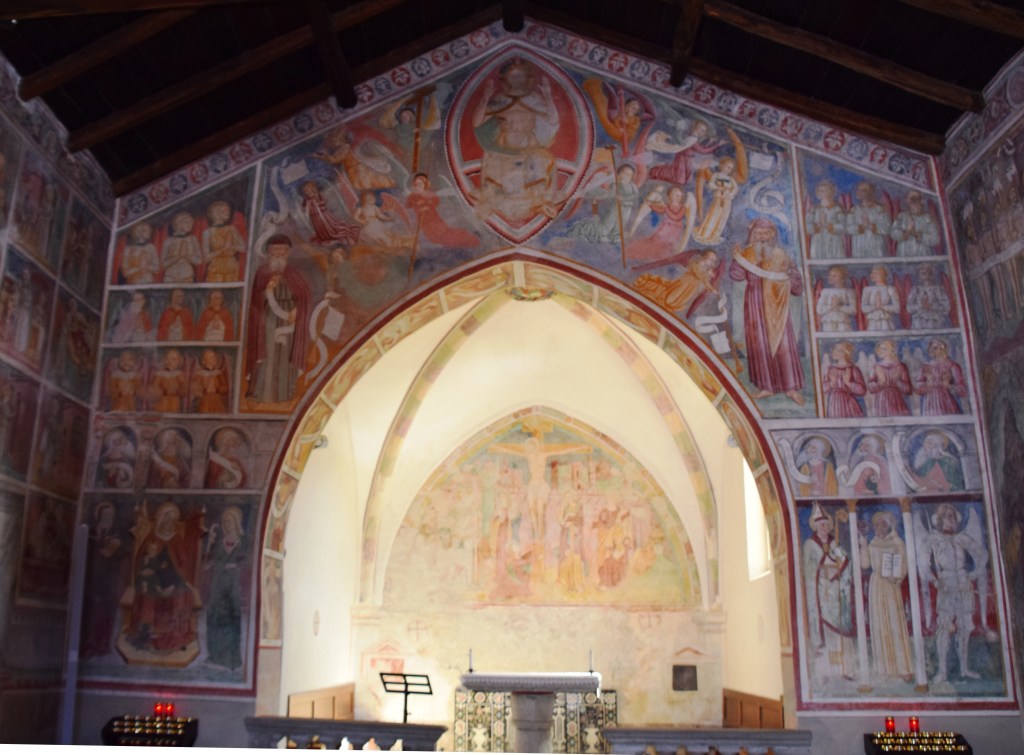
A full view of the magnificent Triumphal Arch with – at the bottom left: Madonna & Child flanked by Saint Bridget and Saint Agatha, and at the bottom right: Saint Blaise, Saint Bernardino, and the Archangel Michael. Directly above are saints and above the saints are three rows of angels. On the arch itself is Christ the Redeemer inside the sacred mandorla (used only for the deity and his Virgin mother). Two prophets – Ezekiel and Isaiah – flank Christ below and He is surrounded by musical angels playing the instruments common to the medieval era such as the shwam, the rebec, the trumpet. Angels are also depicted carrying the tools of Jesus’ crucifixion. This complete 15th-century work of art is just astonishing!!
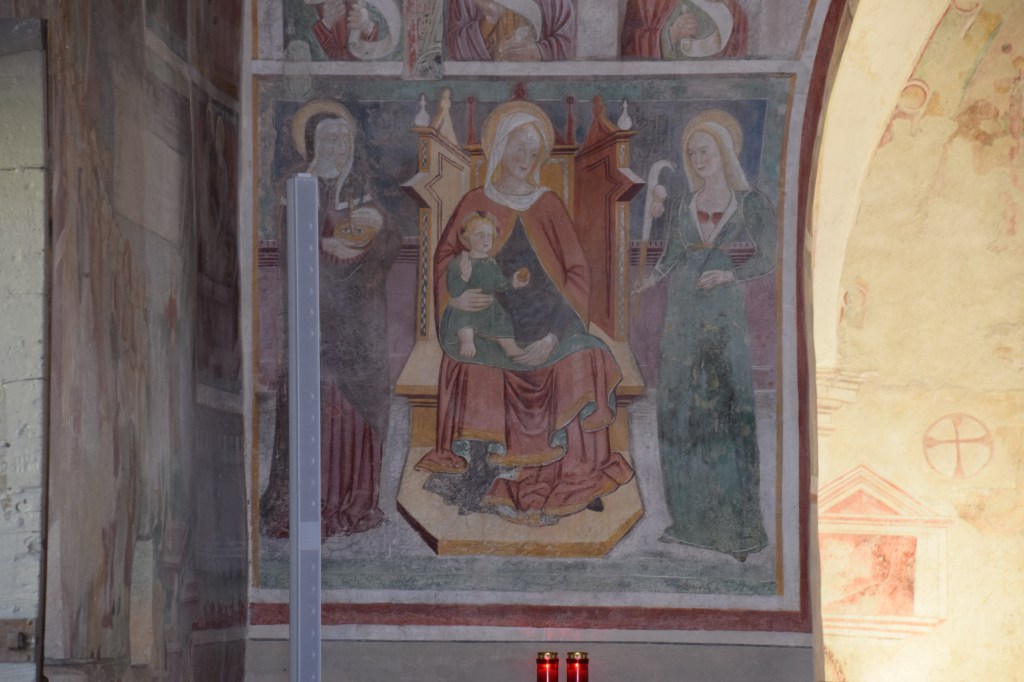
MANDELLO DEL LARIO – CHIESA DI SAN GIORGIO di Crebbio, 13th-century – A detail from the lower left of the Triumphal arch on the east wall. This is the Madonna and Child enthroned with the martyrs Saint Lucia and Saint Agatha displaying the evidence of their torture and martyrdom. Santa Lucia holds a knife and a plate on which lay her plucked-out eyes and Sant’Agata stands with a scythe on which are hung her sliced-off breasts. A close look at the saints shows that Lucia’s face still has eyes but Agatha’s chest has dark areas where her breasts once were.

A detail from the lower right side of the Triumphal arch showing Saint Blaise, Saint Bernardino, and Michael the Archangel.
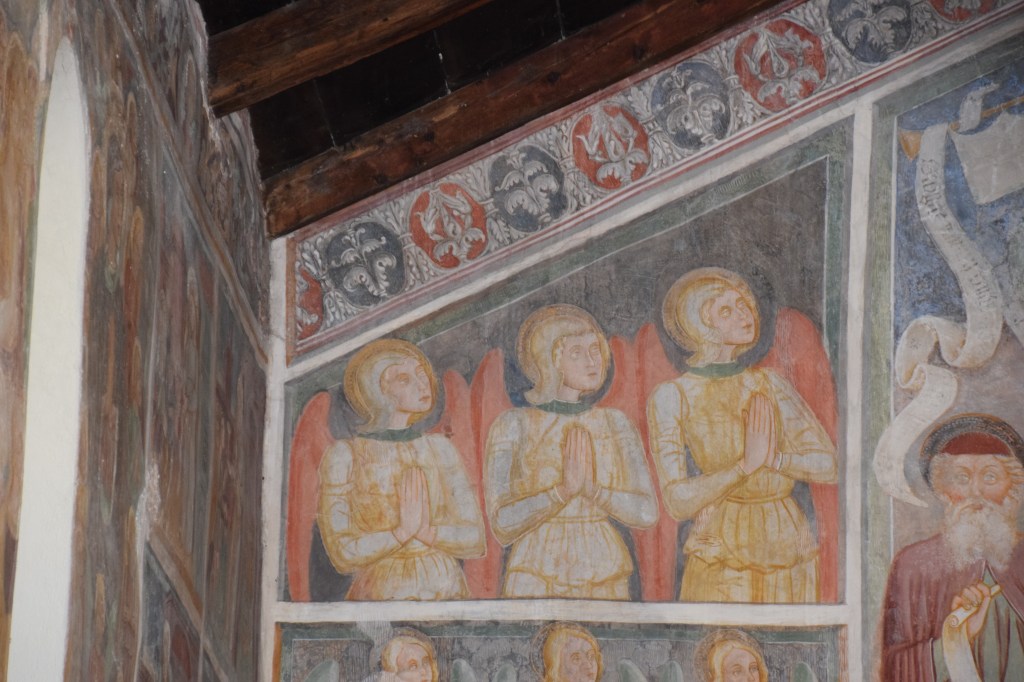
A Detail from the left side of the Triumphal wall showing a triad of angels – one row of the four angelic hosts accompanying Christ. On each side, there is one triad of prophets and three rows of angelic hosts.
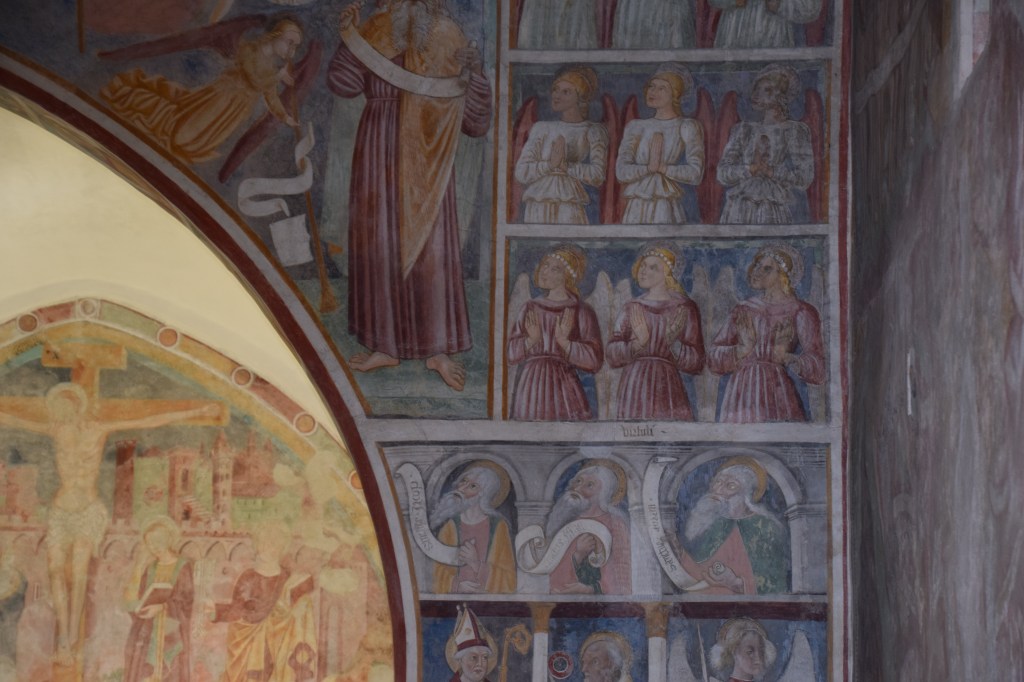
A detail from the right side of the Triumphal Arch showing a triad of prophets and three triads of angelic hosts.

An original consecration cross. Before a church is considered sacred for worship it must be consecrated by a bishop. Consecration by a bishop of the interior and exterior walls is accomplished by anointing them with holy oil (chrism – mixed oil and balsam) or holy water thus moving the building and space from the secular or profane to the sacred – dedicated to the worship of the Catholic deity.
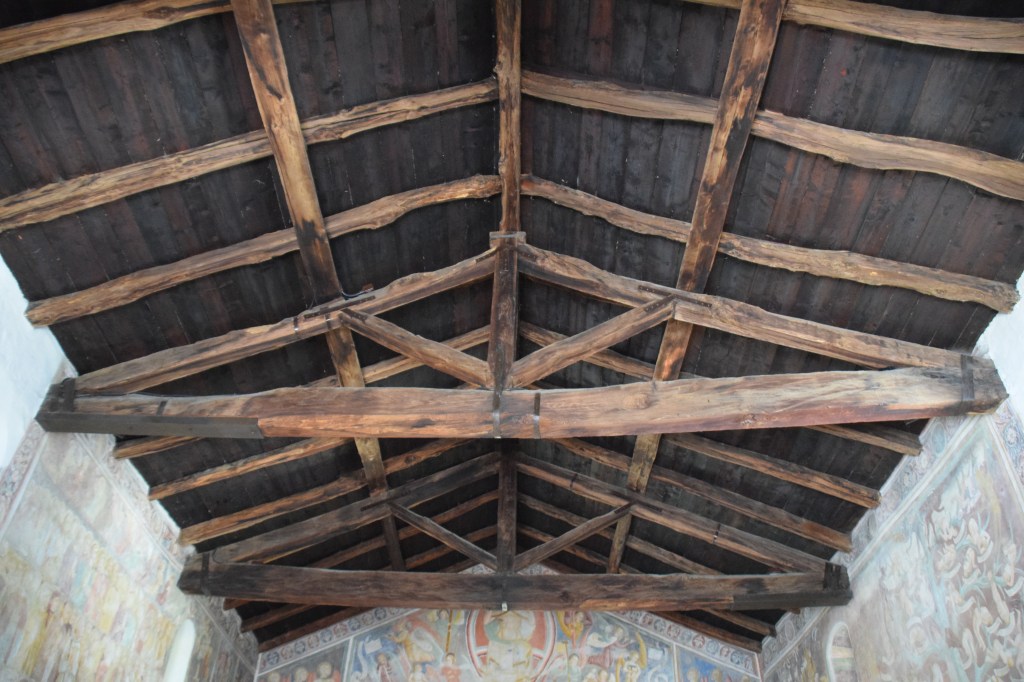
The beautiful wooden trussed ceiling.
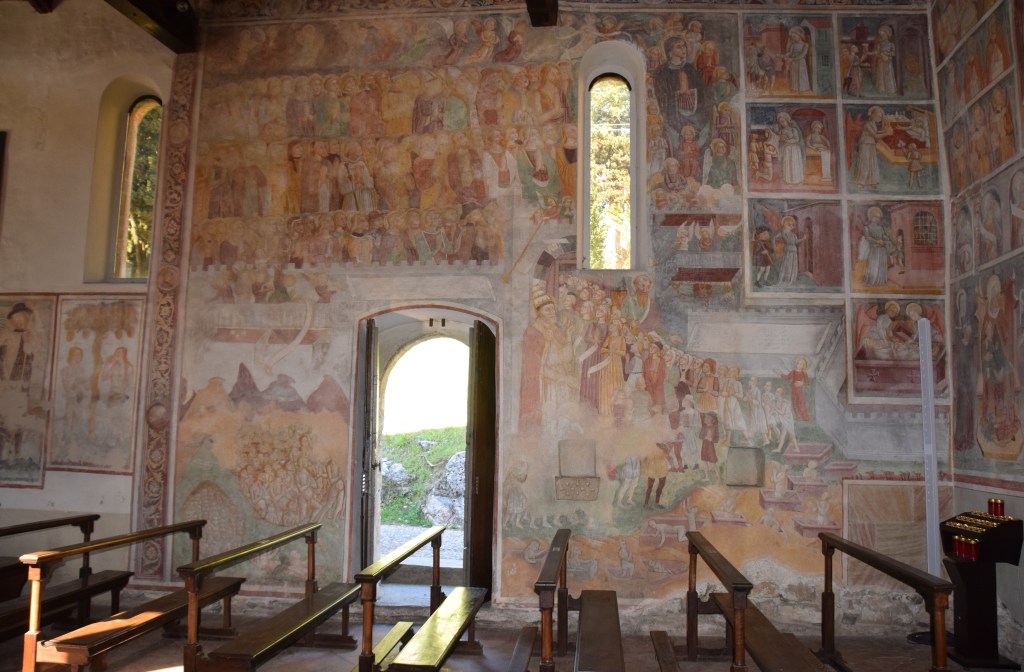
This is a full view of the north / left wall. It shows the souls in Limbo – the place where the dead go to atone for their sins. According to Catholic belief, in Limbo the soul suffers from the loss of the sight of God until their sins are assuaged and they rise to heaven and God’s presence. Also depicted is the Great Virgin who with Saint Peter and Saint Paul greets the ‘good’ who rise from the dead to attain heaven and God’s light. The panels to the far right on the wall show angels involved in works of mercy.

This is a detail from the south / right wall showing the vices or seven deadly sins – pride, envy, gluttony, greed, lust, sloth, and wrath – chained and bound naked and being judged by Minos. The sins can be read on the scrolls that cover their genital area.
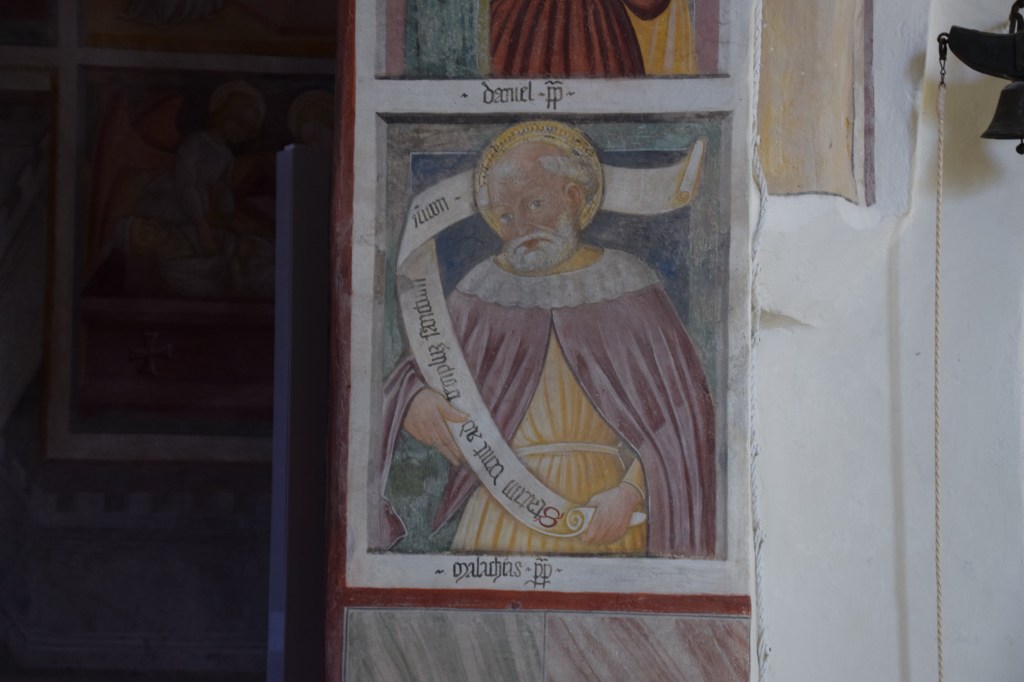
The sub-Triumphal Arch is decorated with doctors of the church. This is Malachias – one of the twelve Minor Prophets. There is some doubt that this is the prophet’s actual name. The name Malachi actually means ‘my messenger’ or ‘missionary’. Regardless, the book he wrote is revered and he was a prophet sometime during the Persian Period 539 BCE – 332 BCE.

A full view of the chancel wall of the frescoed presbytery. The crucifixion scene here is identified by art experts as likely being the work of a local master since it differs stylistically from the other frescoes and common depictions of the event. Here are seen a crucified Christ with Saint Giorgio to Jesus’ right standing next to the Virgin Mary and a kneeling Mary Magdalene. On Jesus’ left are Saints Peter and Paul. Behind the scene is painted a city hypothesized to be Jerusalem.

The sub-Triumphal Arch is decorated with doctors of the church. This is Solomon who was the son of David and a monarch of Israel and reigned from 970-931 BCE. Solomon was considered to be very wise and powerful and he is the subject of many legends.
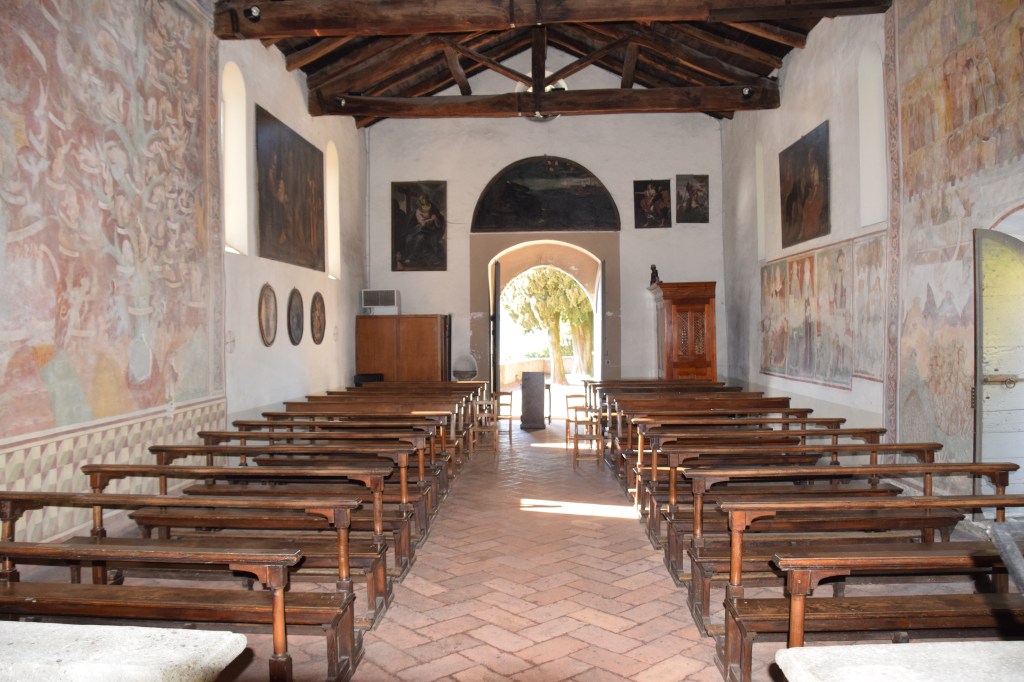
A view of the church from the altar looking back and out the entry doors to the courtyard. The trees in the small courtyard are pollarded. This method of pruning is very common around the lake and in town centers throughout Lombardy. It keeps trees smaller than they would normally grow so they fit within their environment.
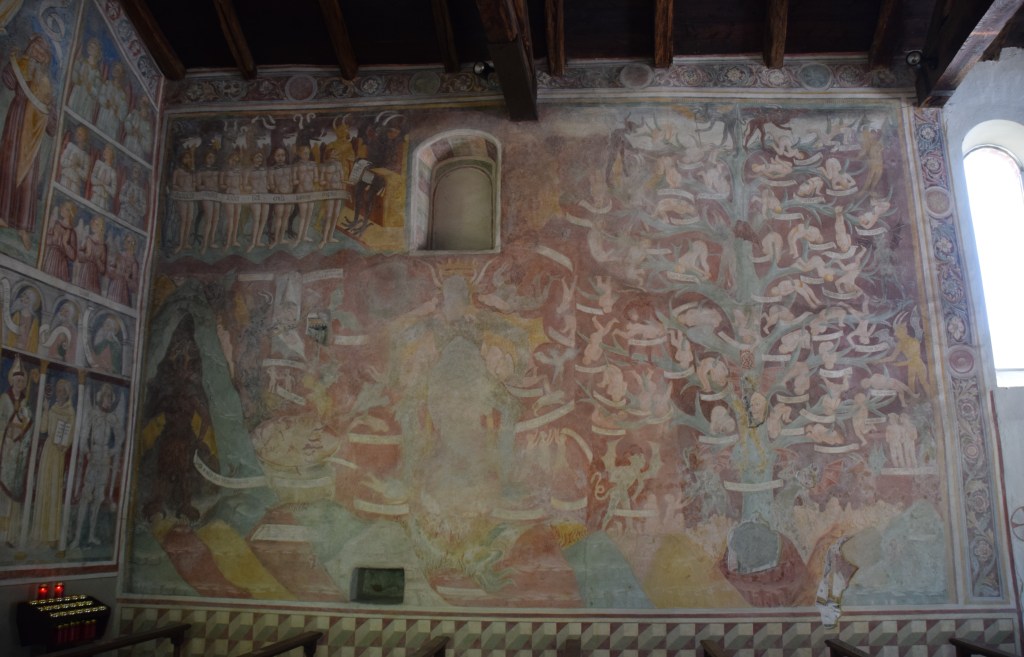
This is a full view of the south / right wall showing the King of Hell in the center – large and threatening. To his right is Minos judging the seven deadly sins and to the left is a large dead tree on whose thorns are impaled the damned from all walks of life – equal in their nakedness and suffering.
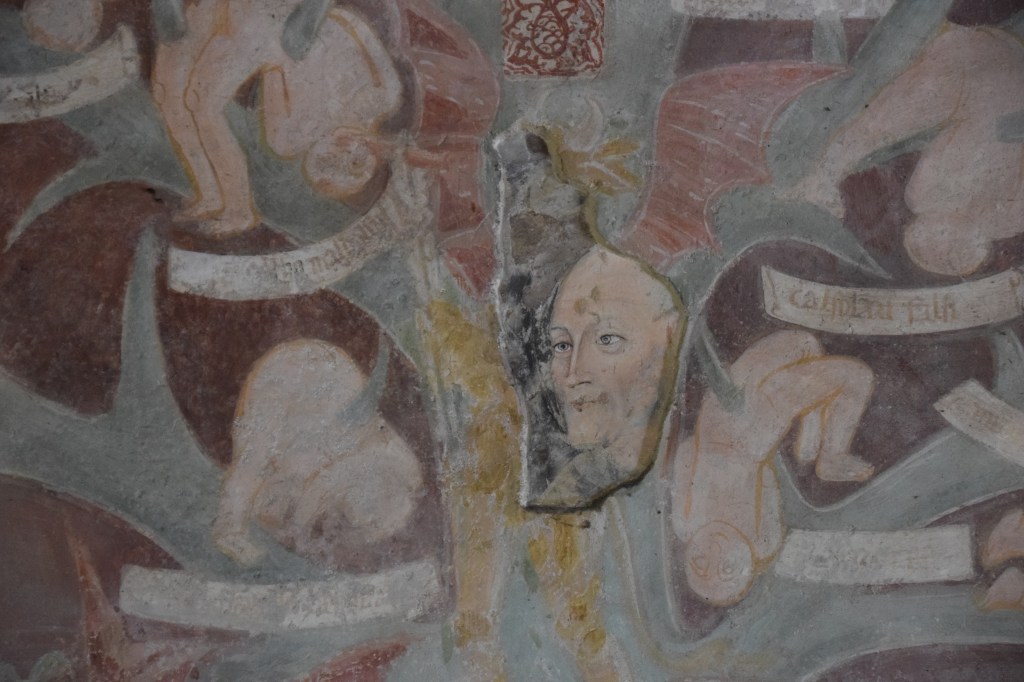
The 15th-century frescoes covering the walls of the church are actually newer frescoes painted over the original 13th-century frescoes. Here is a remnant of that Romanesque art! This is the face of a man – unidentifiable as a sacred personage or an otherwise ‘ordinary’ person.

This detail of the south / right wall shows the damned impaled on the thorns rising from the branches of a dead, fruitless tree. Those condemned at the end of time by the sins of the earthly lives are identified by their scroll showing that the differences of wealth, education, and status are meaningless in Hell where are all equal in their damnation and suffering.
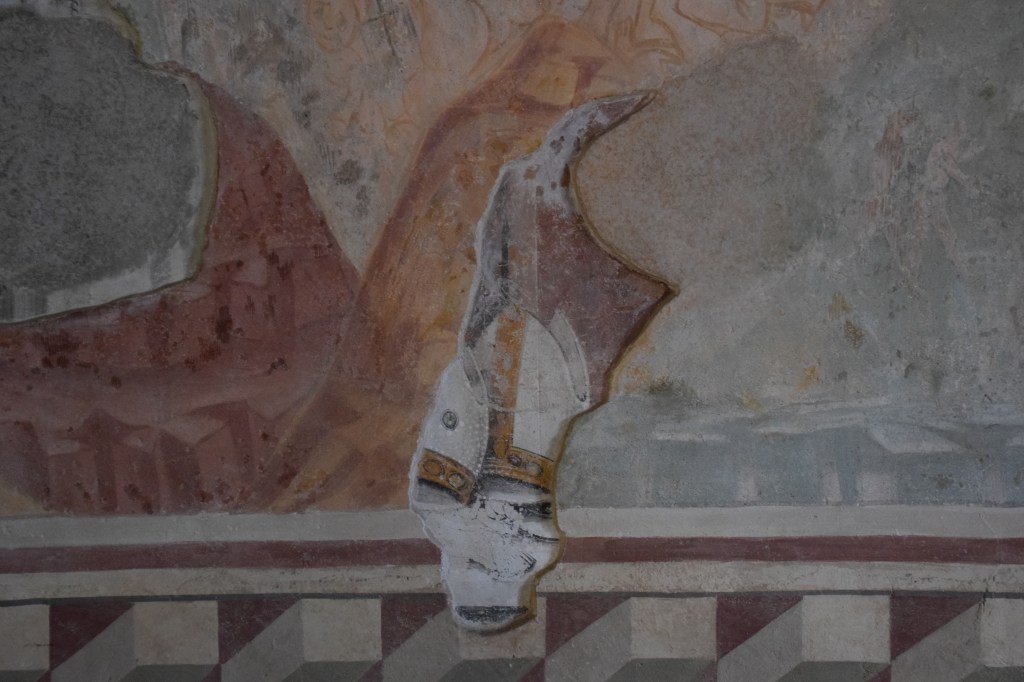
The 15th-century frescoes covering the walls of the church are actually newer frescoes painted over the original 13th-century frescoes. Here is a remnant of that Romanesque art! These are a group of Bishop’s mitres – the formal headdress of a bishop.
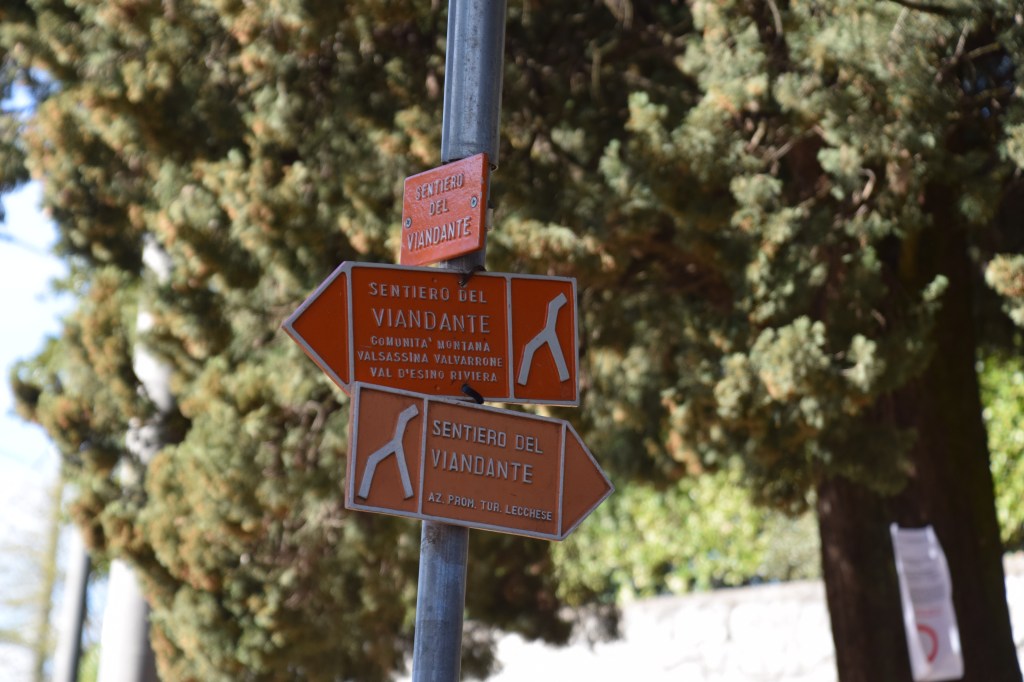
The signs for the Sentiero Viandante in front of the Chiesa San Giorgio di Crebbio.
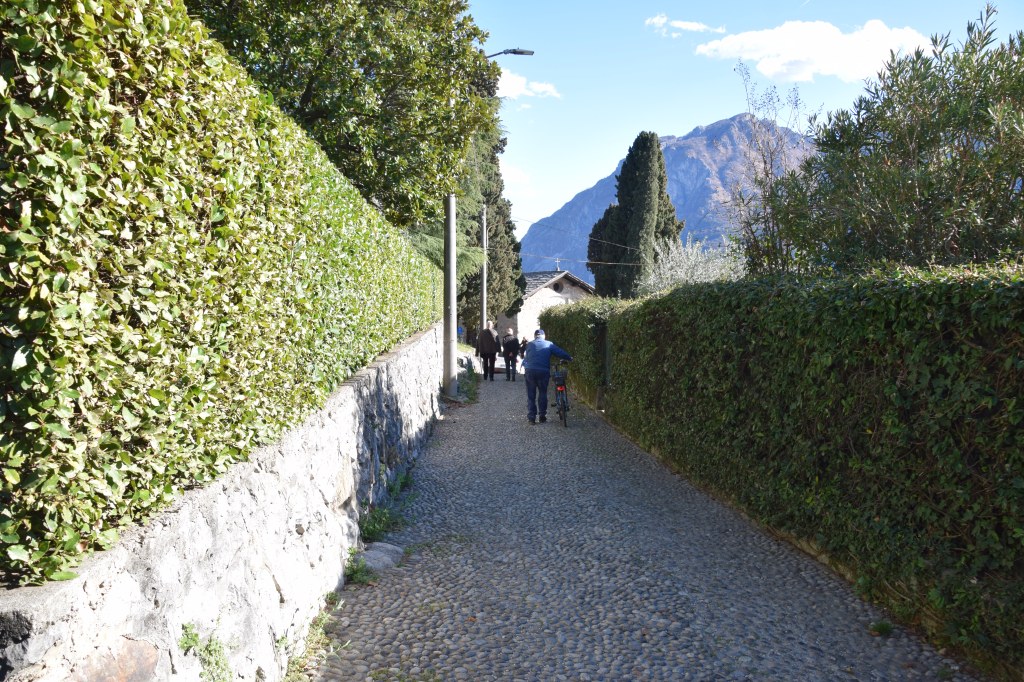
The Sentiero Viandante on which lies the Chiesa di San Giorgio. One can see adherents walking toward the church from the center of Mandello del Lario to attend the 4:00 pm Saturday mass. This historic Path of the Wanderer is 52 kilometers long and can be walked from the province of Lecco in Abbadia Lariana just outside the city of Lecco and goes through the eastern lakeside towns of Mandello del Lario, Olcio, and Lierna, then into the mountains to Esino Lario and down to Perledo and back to the lakeside in Varenna, Bellano, Dervio, Dorio, Piona, and Colico ending in the Valtellina in Piantedo in the province of Sondrio.
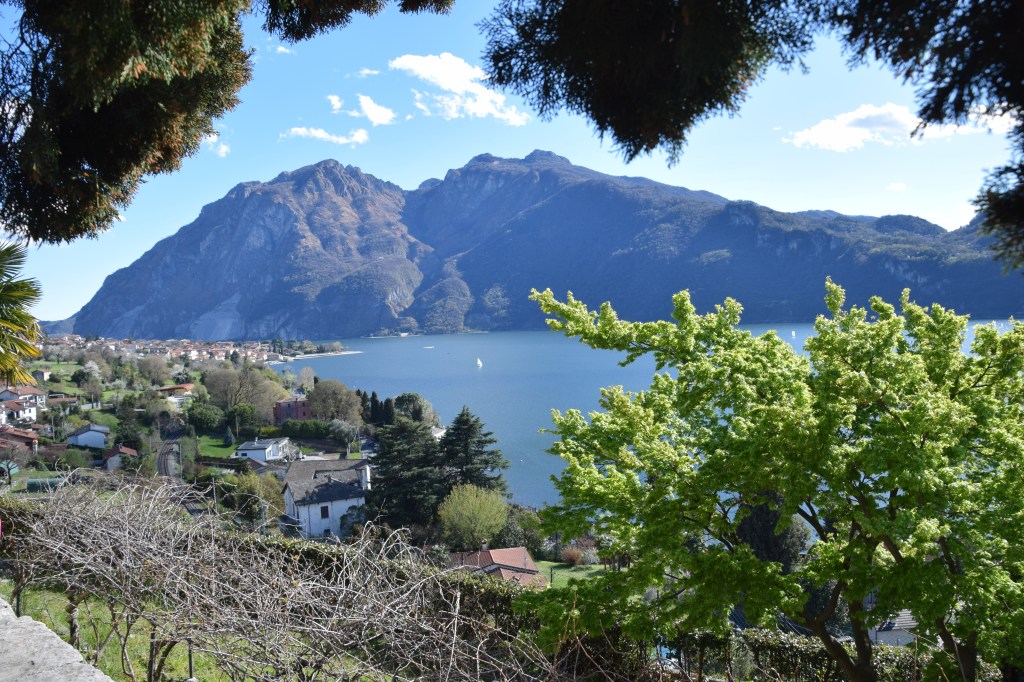
Lake Como as seen from the courtyard of the church. Churches and cemeteries always have the best views!
I hope you enjoy these few photos and feel motivated to visit.
In closing, the Pro Loco of Mandello del Lario offers free tours of the church with reservations from April through October:
ProLoco Mandello
Address: Via Manzoni, 57, Mandello del Lario, Italy
E-Mail: mandello@prolocolario.it
Telephone: 0341 732912
 Wall Madonna's of the Valtellina