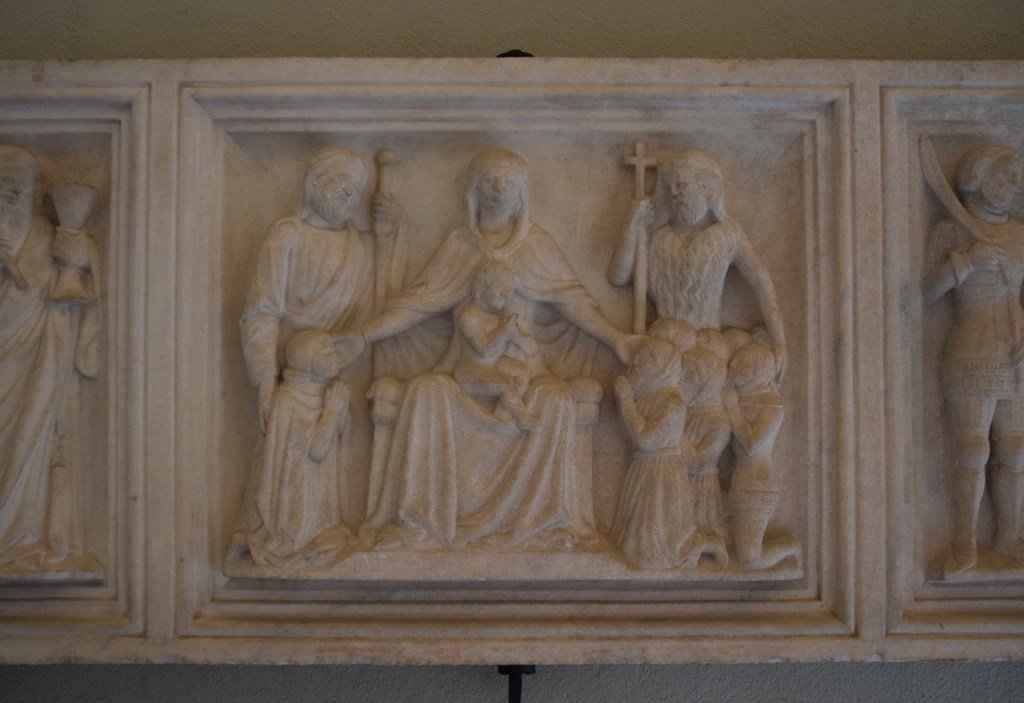
MILAN on a rainy Sunday – 2! As promised here are the few Madonne della Misericordia found in the Musei del Castello Sforzesco. To these three offerings, I add two additional Madonna’s – one – a truly grand ancient sculpture, and the other an odd Filippo Lippi that I find a curiosity. Enjoy these artworks!
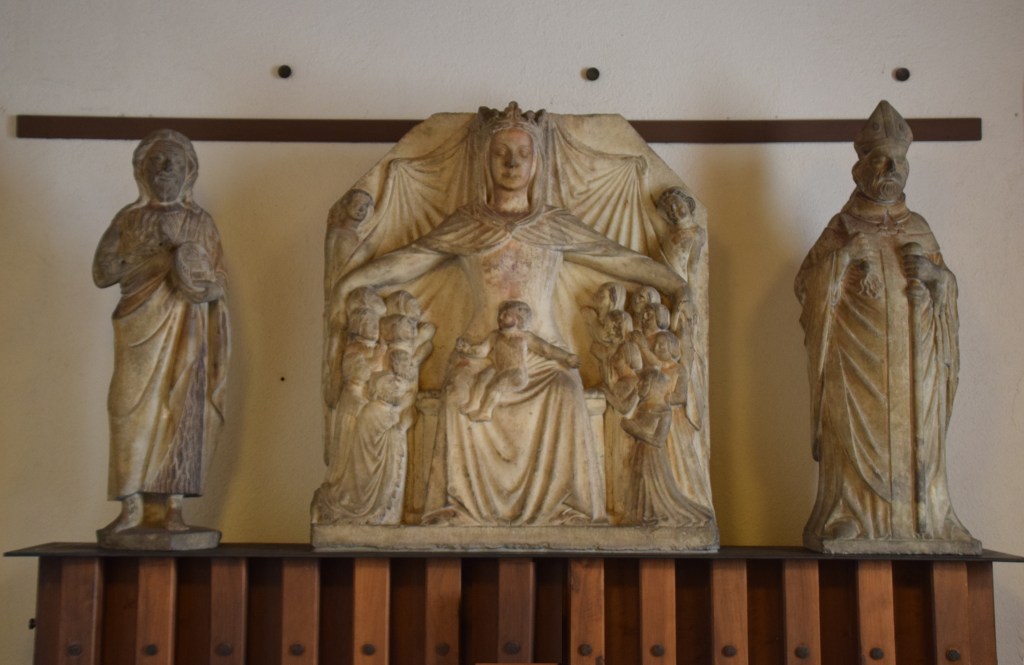
MILAN – Musei del Castello Sforzesco – Madonna della Misericordia – this wonderful multi-piece 14th-century sculpture is from the Castello di Monza. The anonymous artist is Lombardian and this sculpture is located outside the entrance to the rooms dedicated to the decorative arts. The three pieces include San Giovanni Battiste to the left – the Madonna and Child in the center – and San Ambrogio, the Bishop and patron Saint of Milan to the right. Under the mantle of the Virgin are male devotees to the left and female devotees to the right. The donors are in front – the singular figures with hands folded in prayer. They were likely husband and wife.
Built by Galeazzo I Visconti (1277-1328) who was Lord of Milan, the remains of the early 14th-century Castello di Monza were demolished in 1809. This Madonna della Misericordia likely was located above the main gate into the walled fortress.
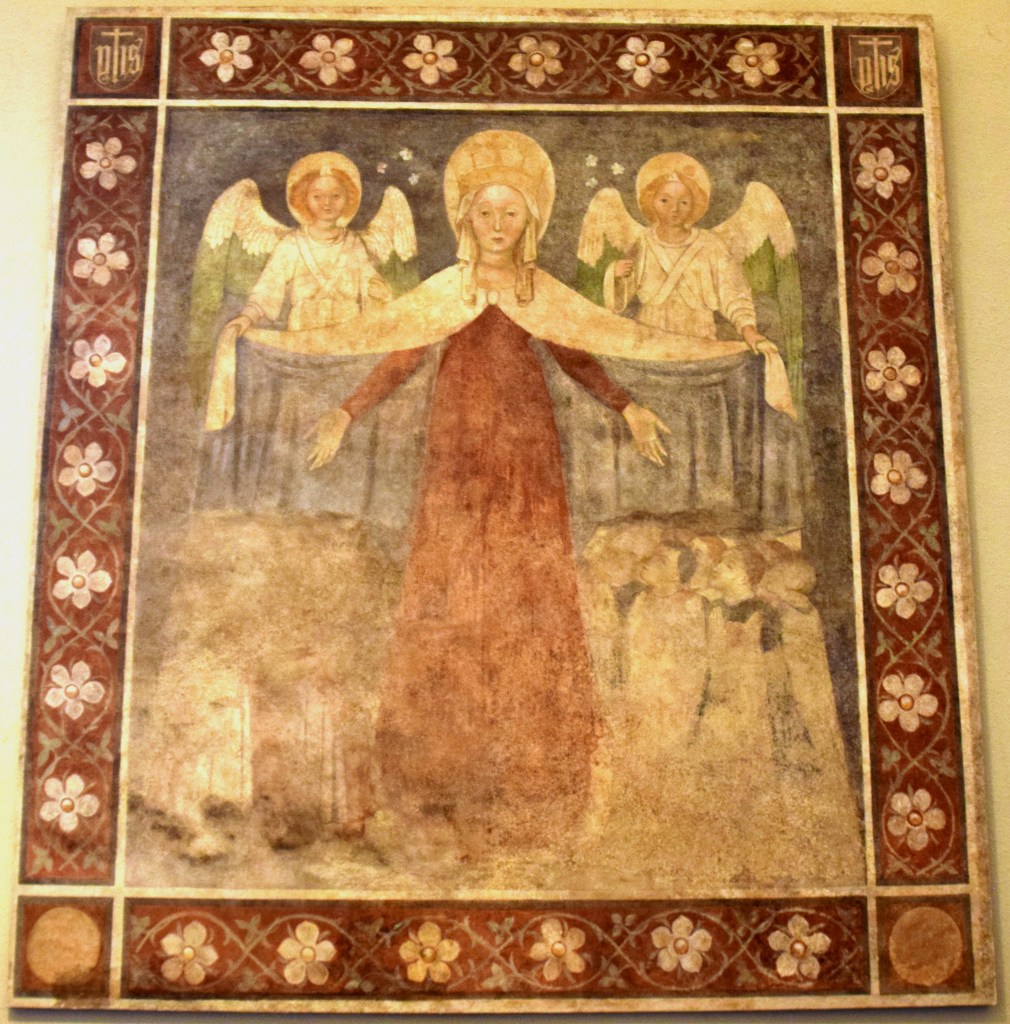
MILAN – Musei del Castello Sforzesco – Madonna della Misericordia – The large fresco greets visitors to the museum. It was carefully removed from the wall where it was originally painted in 1470 and installed next to the ticket counter in the Castello. Please forgive the yellow tinge – I have never quite captured the lovely pastels of this image against the white of the wall. I need professional lighting for that! This fresco was removed from its outdoor location in the Ducal Courtyard of the Castello Sforzesco in order to preserve it.
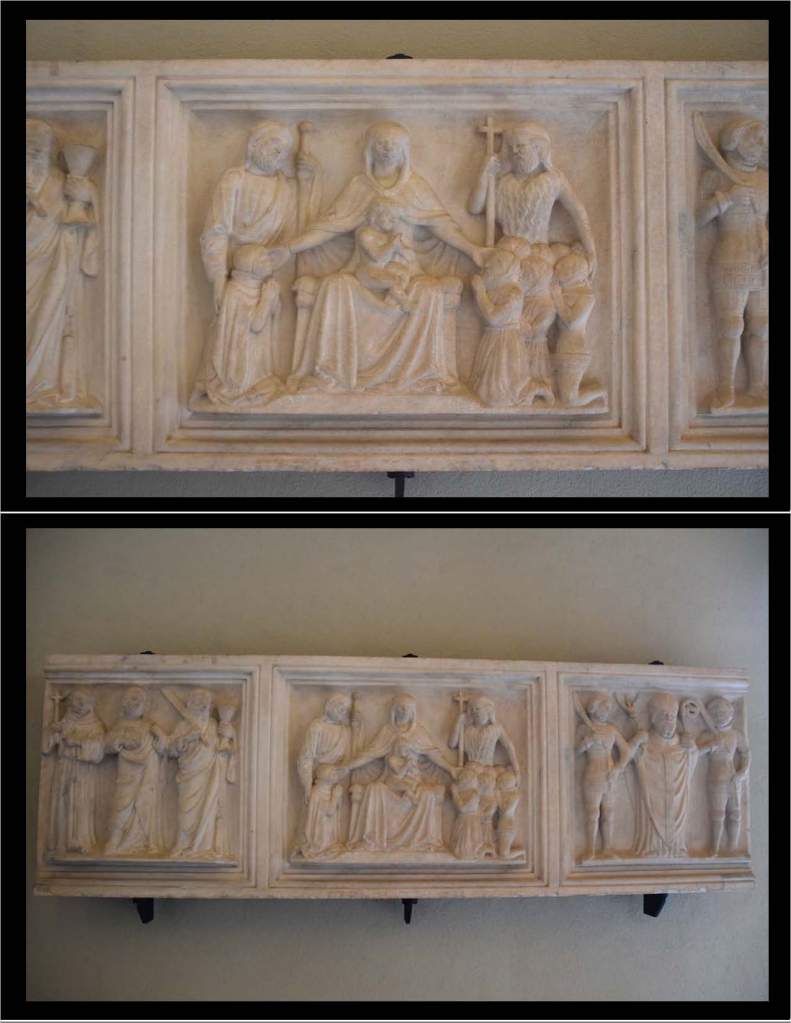
MILAN – Musei del Castello Sforzesco – Madonna della Misericordia, Arte Campionese, 1360 – The three panel Madonna della Misericordia is interesting. In the panel to the left of the sheltering mantle of the Madonna are three saints. I am fairly certain these saints – from left to right – are Francis of Assisi, Peter, and Paul. The Madonna and Child are flanked by Saint Joseph on the left and Saint John the Baptist on the right. The panel to the right of the Madonna shows Saint Ambrose – 4th-century Bishop and patron saint of Milan – flanked by the 2nd-century martyred brothers and twins – Gervasio and Protasio – the patron saints of haymakers who are popular in the Valtellina. Saint Ambrose consecrated the basilica (now called after him) by bringing the relics of these two saints to Milan. The bodies of these saints lie in a crypt in the really grand Basilica di Sant’Ambrogio. The anonymous artist of this wonderful work is from the famed Maestri Campionese – Campione Masters. The guilds of the Maestri Campionese were located in Campione d’Italia – a small Italian enclave located on Lake Lugano in Switzerland but part of the province of Como. The sculptors and builders of the guilds were active from the 12th to the 14th-century in Lombardy, Veneto, Emilia-Romagna, and Trentino. The beautiful lions that welcome worshippers to the Duomo of Bergamo were carved by one of these masters – Giovanni da Campione.
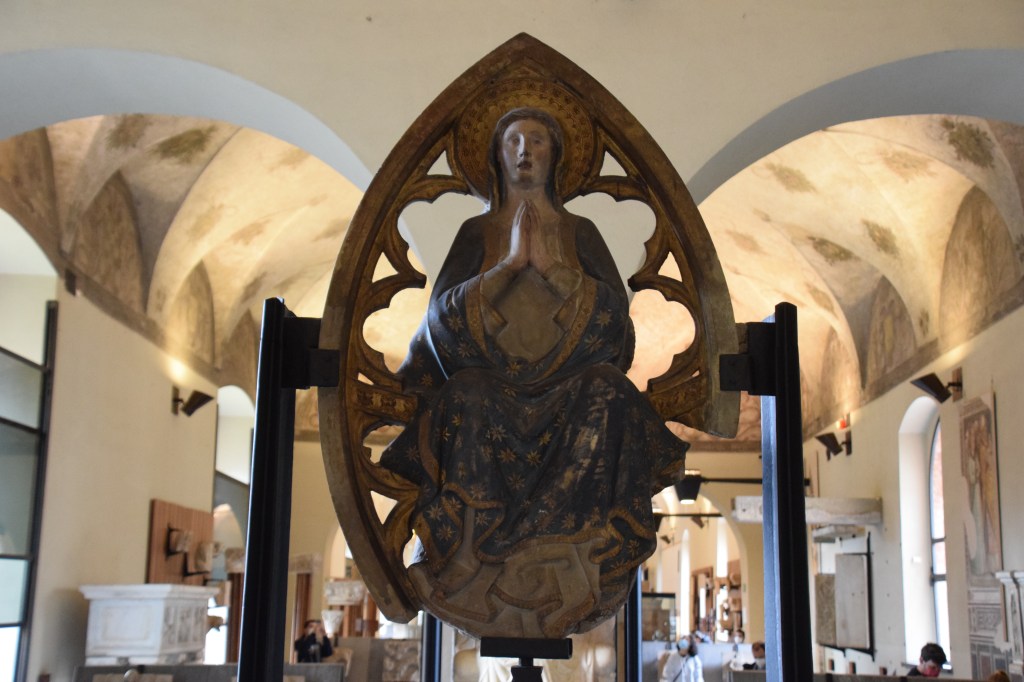
MILAN – Musei del Castello Sforzesco – Vergine Assunta, 1350, sculpted by the anonymous artist known as the Maestro Toscana – the Tuscan Master. The other side of the mandorla holds the Rendentore Benedicente – Jesus giving a blessing.
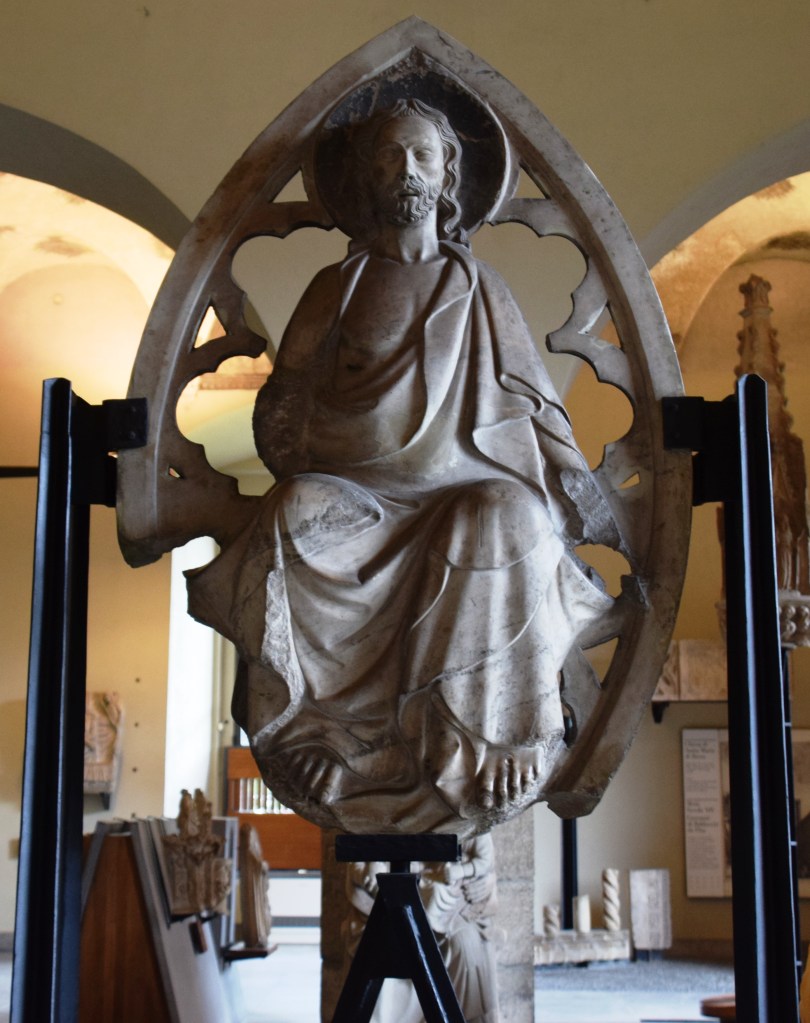
The double-sided work was given to the museum in 1861 and has no originating location listed. This was clearly a piece for a church or an ancient city gate. The sculpture is a most impressive sight and catches one’s eyes with its size and the wonderful gold embellished blue gown of the Great Virgin whose person is identified as sacred by the starred halo that surrounds her head. Only Mary is ever depicted with a starred halo.
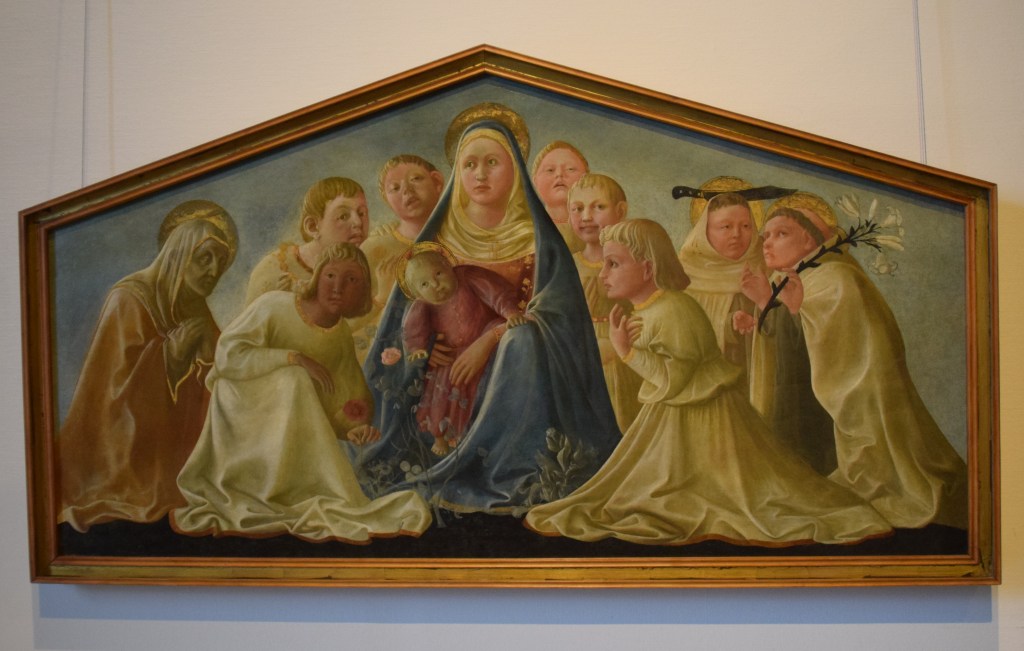
MILAN – Musei del Castello Sforzesco – Madonna Trivulzio, 1429: painted by the incomparable Fra Filippo Lippi. I love this painting because all the figures but one – and I include the Madonna of Humility – look like children. No matter how much I read about this work which claims that only the two saints to the right are depicted as children, I continue to disagree. And – I believe that Fra Lippi painted himself into this work. He has done this previously and the photo I used for comparison is from the L’Incoronazione della Vergine (the Incoronazione Maringhi) painted in 1439 and owned by the Uffizi in Florence. I have offered this well-known self-portrait next to the chubby-faced cherub to the left of Mary that I think is the artist. What do you think?
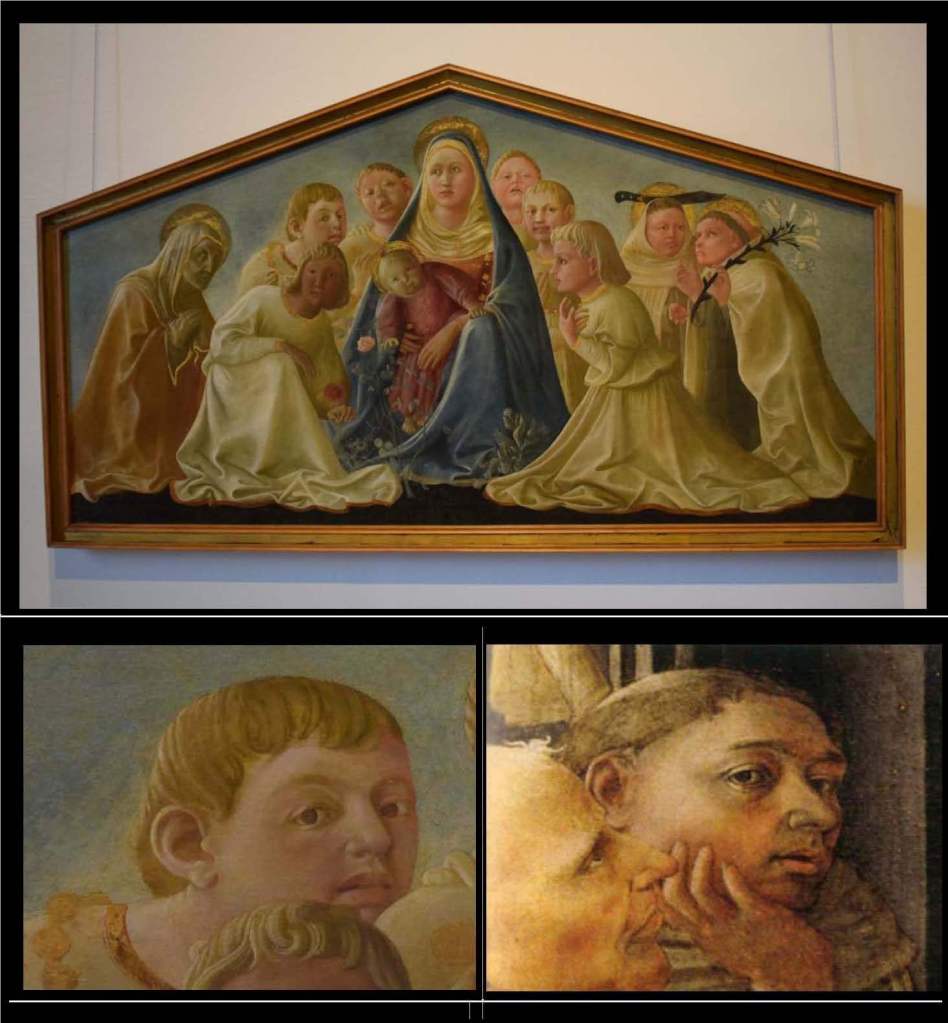
This work is speculated to have been commissioned by the 15th-century Confraternita di Sant’Alberto of Florence – a voluntary organization of lay people that was dedicated to the care of young men aged 13-24. The child-sized figures include three Carmelite saints – Saint Angela of Bohemia (died 1243) to the far left, Saint Angelo di Licata (1185-1220) with the knife in his head and Sant’Alberto degli Abati (1240-1307) holding the lily. Lippi was a Carmelite monk. Saint Alberto is the protecting saint of the Carmelite order and patron saint of Trapani in Sicily. Saint Angelo di Licata was a Jewish convert to Christianity and a martyr. He is known as the Angel of Jerusalem and Angel of Sicily. Saint Angelo is the protector of workers and the patron saint of Licata – a town in Sicily. Saint Angela of Bohemia was a hermit. I cannot locate any information on her other than that.
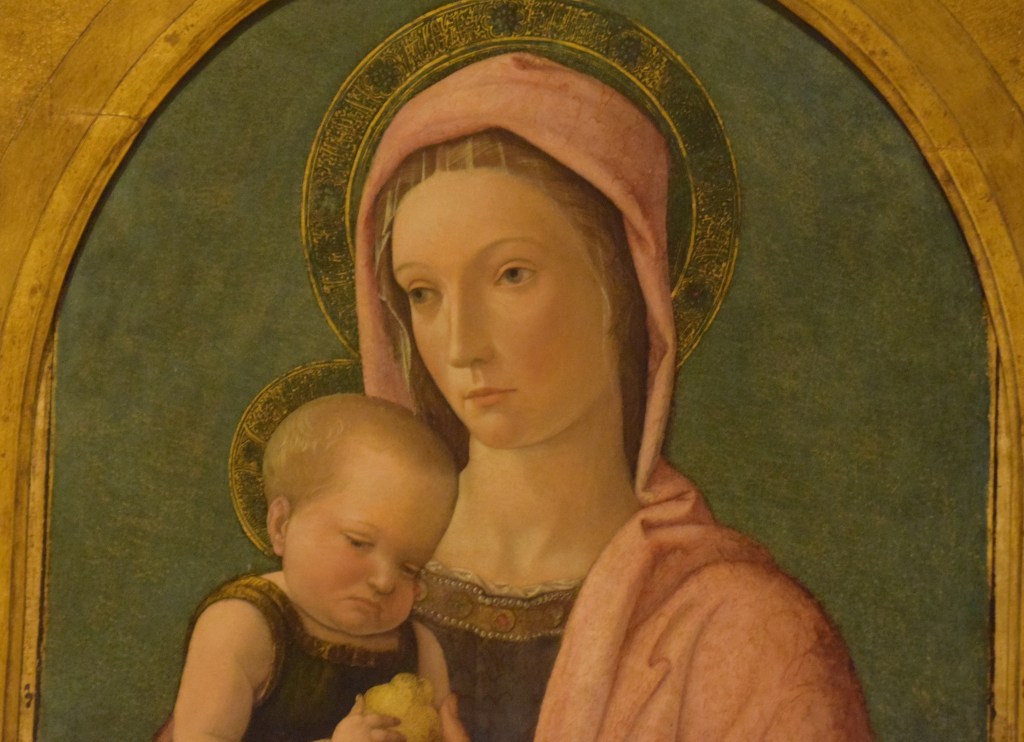
I hope these beautiful works of art have pleased you. I finish this brief post with a Madonna and Child painted by Maestro Giovanni Bellini (1430-1516). Bellini was from a Venetian family of painters and is listed as one of the top ten Italian Renaissance painters. The Bellini family included Jacopo Bellini (1400-1470) often identified as his father, his older brother Gentile Bellini (1429-1507), and a brother-in-law Andrea Mantagna (1431-1506). Italy being the patriarchy it was and still is, there is no information about the sister of Giovanni – Nicolosia Bellini – who had to exist in order for him to have a brother-in-law! We know her name but nothing else. The fame of Giovanni Bellini is legend and is evidenced by a Venetian cocktail named after him! The Bellini is a mix of Prosecco and peach nectar. Like the Bellini this painting is ‘peachy’!
 Wall Madonna's of the Valtellina