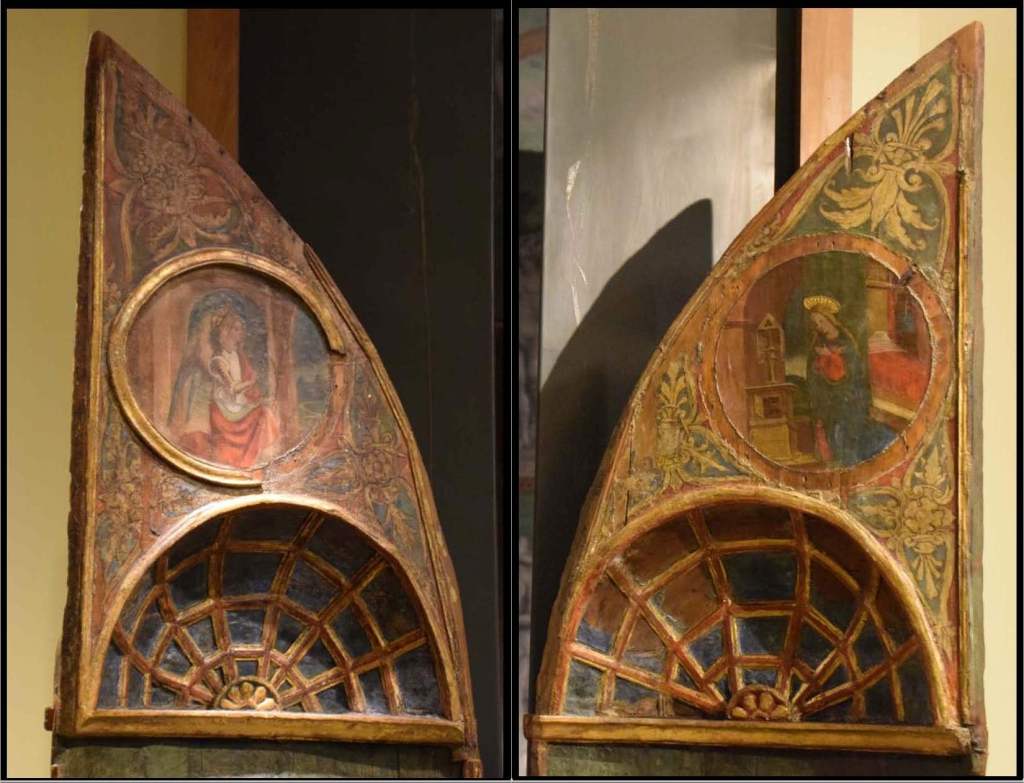
MILAN on a rainy Sunday! I have not spent much slow and contemplative time in the Musei del Castello Sforzesco so I decided that a rainy Sunday was a good day to ‘waste’ inside with the incredible collection of art that I can access for a mere €5 because I am ‘anziana’!! My viewing goals were sculpture, Annunciations, and Madonna della Misericordia’s. I am not a big fan of sculpture but the collection of Lombardian work is astonishing and it deserves the – somewhat reluctant – time that I spent. I will offer a number of posts about my visit each dedicated to one type of art from my viewing goals. Here is the first offering – my photos of all the Annunciations that I found in the museum – and one extra from the not-to-be missed Chiesa di San Maurizio – a church I visit on all my journeys in Milan! Enjoy these photos – not Wall Madonna’s but Madonna art worth a careful look!
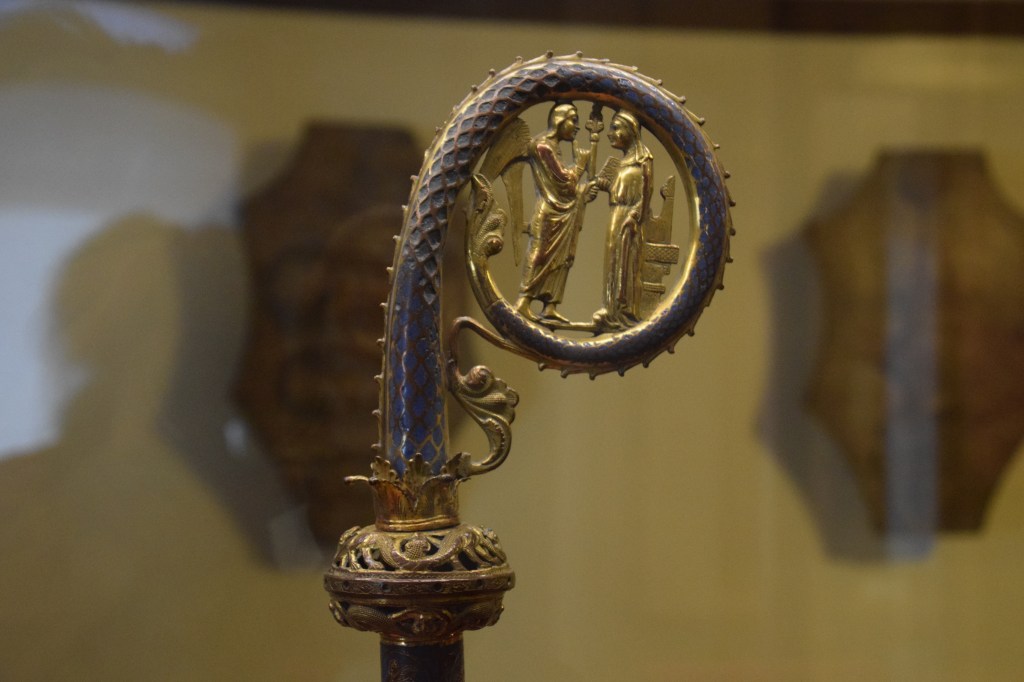
MILAN – Musei del Castello Sforzesco – Annunciation – Riccio di Pastorale, 13th-century from the Chiesa di Santo Stefano in Milan. The ‘riccio di pastorale’ – pastorale hedgehog – is a curved decoration found on a bastone or stick and used by the bishop in pontificals – masses presided over by bishops. The term ‘hedgehog’ means ‘spiral’ idiomatically. The construction is reminiscent of a shepherd’s staff used for thousands of years and seen in the depictions of Egyptian pharaohs and – in its current elaboration as seen here – is recursive to Ottonian art of the 9th-century in Western Europe. The curved end of the staff allowed the shepherd to guide to animals and – when the cane head is ‘empty’ – allowed the shepherd to capture the animal by the neck for a more aggressive direction. Saint Ambrose – the 4th-century Bishop and patron saint of Milan spoke of the ‘Pastoralis Ericius’ – the Riccio di Pastorale. For this eloquent orator and writer the bishop’s staff must be pointed at the bottom in order to spur the lazy, straight in the middle to lead the weak, and curved at the top to gather the lost.
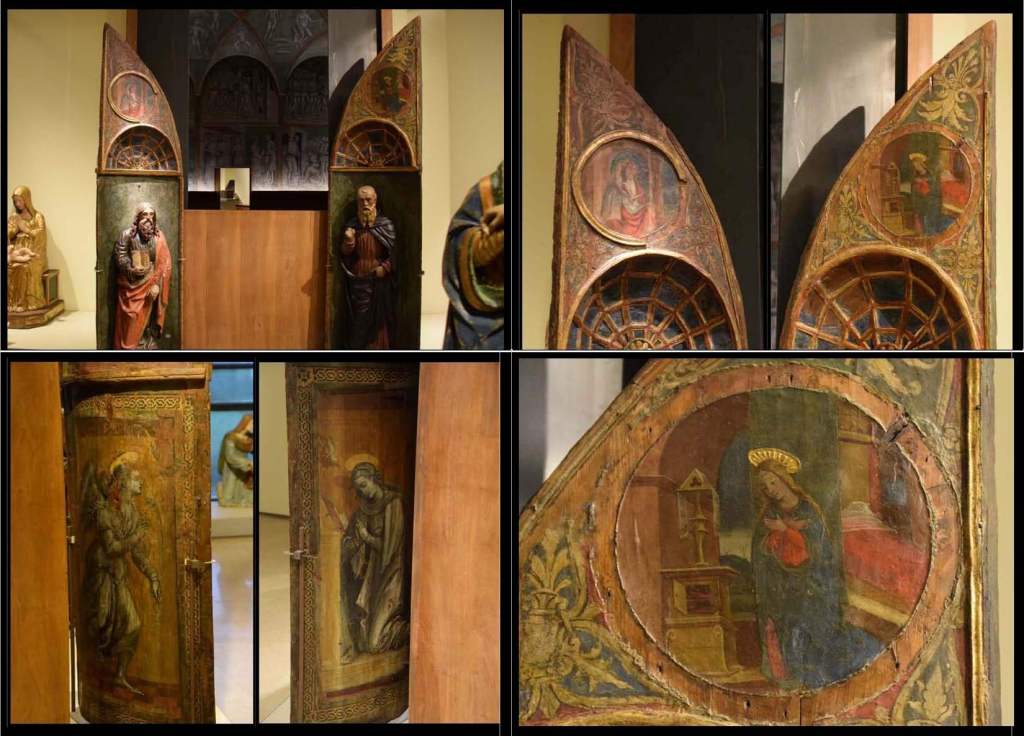
MILAN – Musei del Castello Sforzesco – Two Annunciations, 15th-century – Volets (the wings of a triptych) with Annunciations and Statues of Saints: These panels originally enclosed an altar painting. The sculptures are of two saints – likely Saint Paul on the left and Saint Peter on the right. Above the carved saints is a beautiful frescoed annunciation by Malacrida. The outside of the panels features another frescoed annunciation by an unknown author.
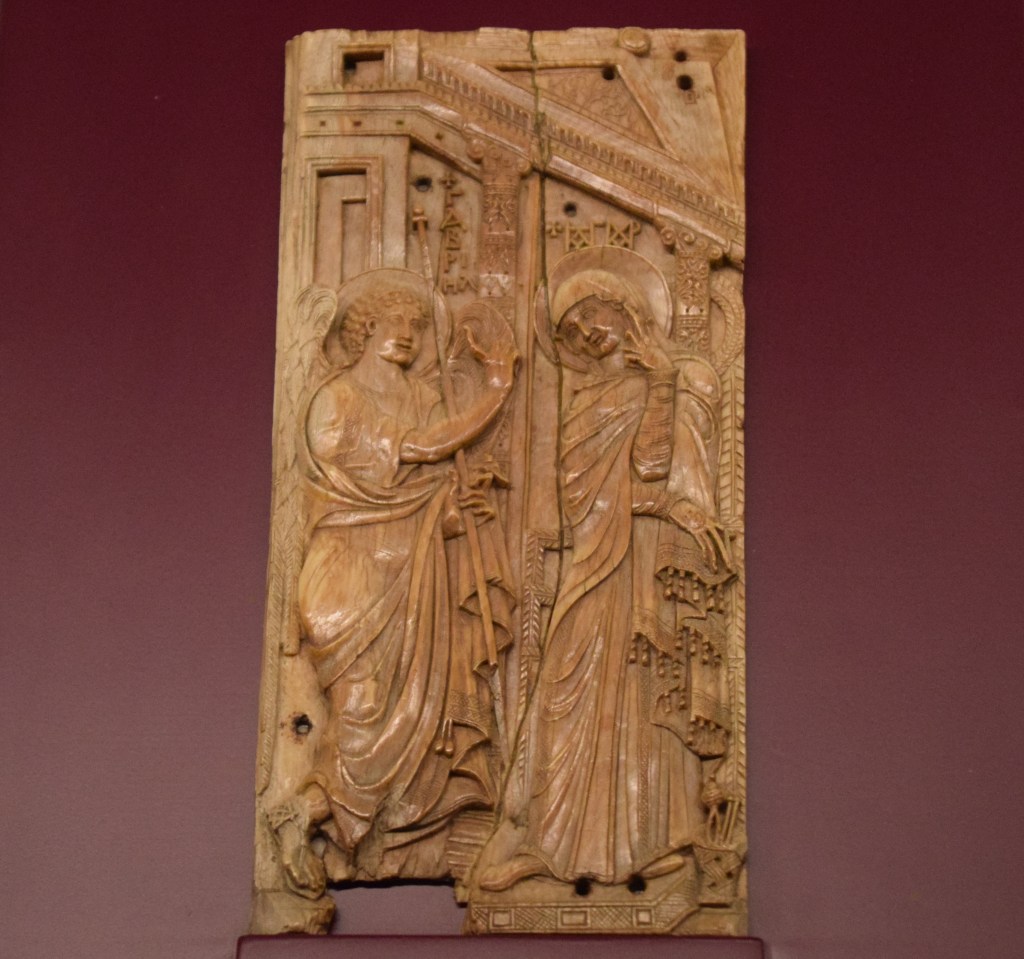
MILAN – Musei del Castello Sforzesco – Annunciation: San Mena, Alexandria, Egypt, 7th-century – carved in ivory. This lovely intaglio is from Abu Mena – a former village and Christian pilgrimage site built where Saint Menas of Alexandria – a Coptic Christian soldier in the Roman army known as the Wonder-Worker – was martyred in the late 3rd-century or early 4th-century. There is written history for the original monastery from the 5th-century.
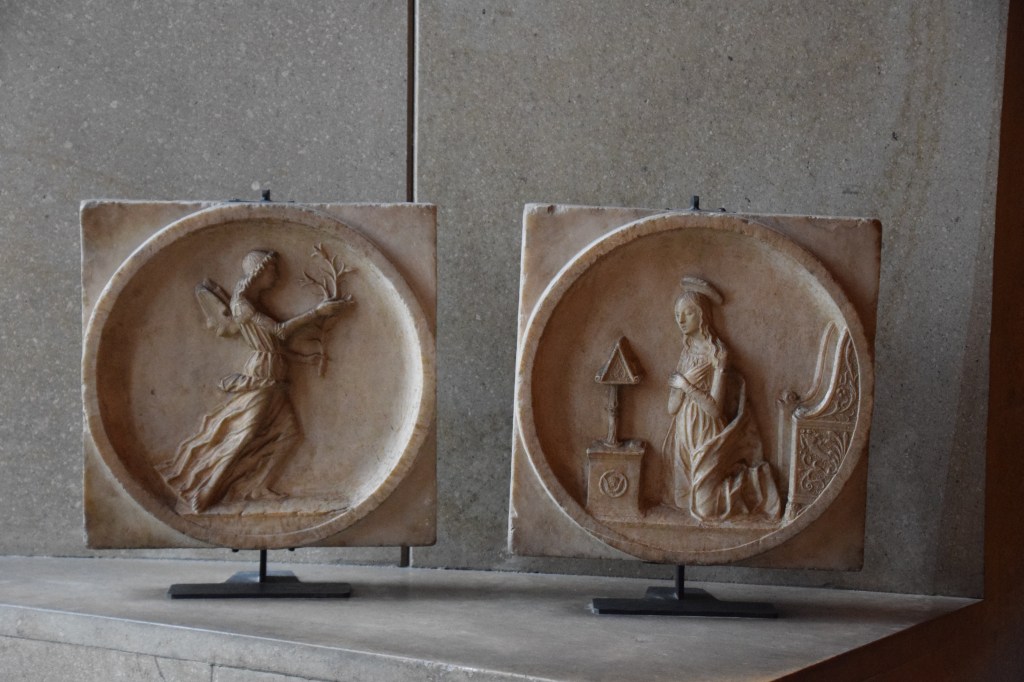
MILAN – Musei del Castello Sforzesco – Annunciation – A 15th-century marble sculpted Annunciation that was part of a larger work that remains unidentified. The work is from the Scuola Giovanni Antonio Amadeo. Giovanni Antonio Amadeo (Pavia 1447 – 1522) was sculptor architect, and engineer.
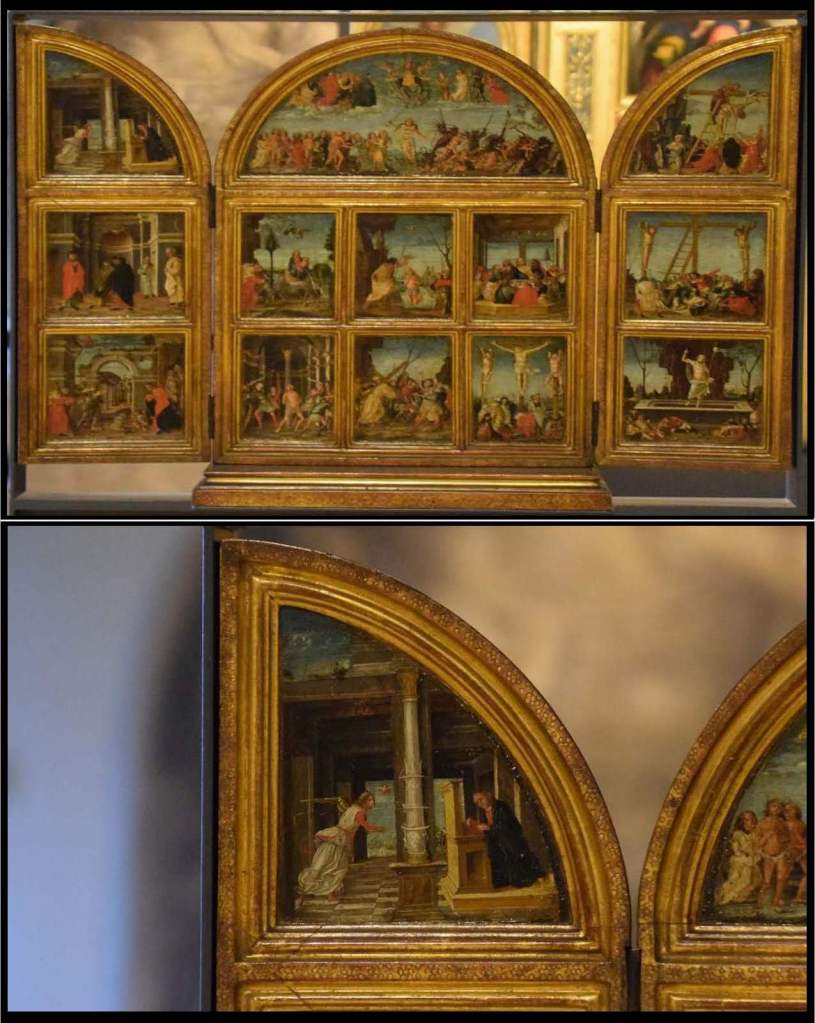
MILAN – Musei del Castello Sforzesco – Annunciation – Triptych, 15th-century – Events from the life of Jesus. This is a very involved and elaborate artwork that depicts thirteen events from the life of Jesus. The anchoring events are the commencement of his life on earth in the Annunciation at the upper left and the end of that life on earth at his crucifixion at the upper right. In the top center is his Ascension into Heaven after his Resurrection. This is a relatively small work and was likely commissioned as a private devotional.
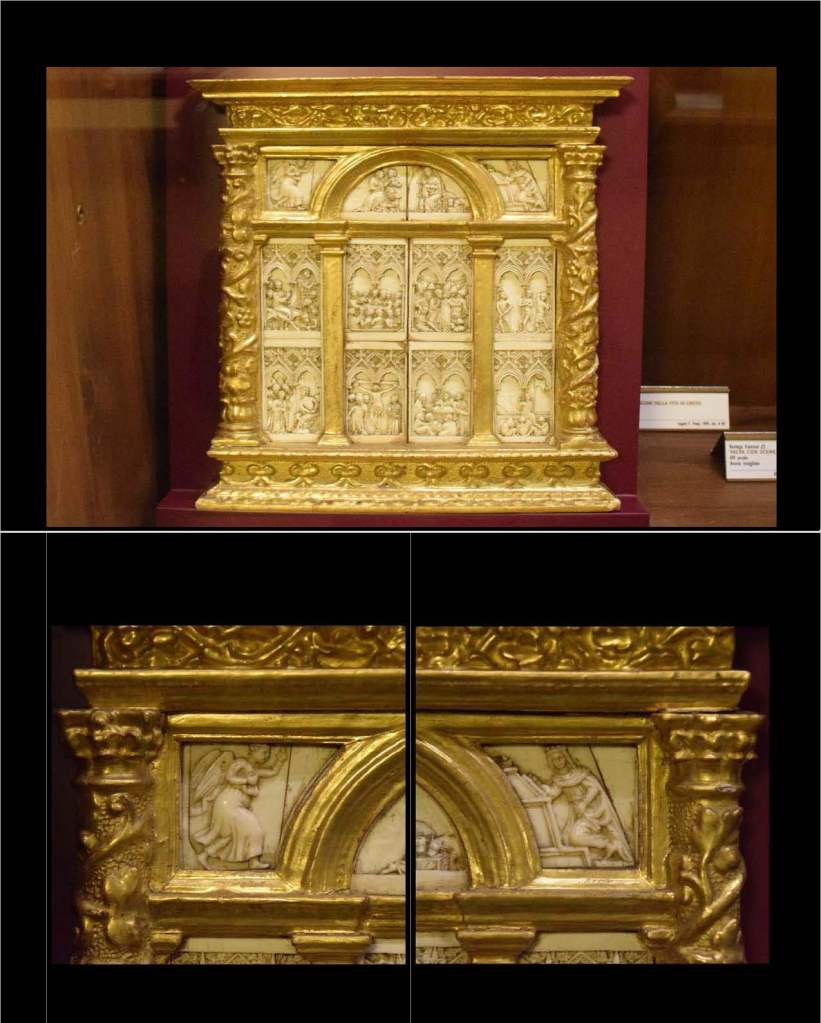
MILAN – Musei del Castello Sforzesco – Annunciation – Cornice, 14th-century – This is a beautiful cornice/frame for a painting made of wood covered embellished with gold leaf decorated with small ‘intagli’ in ivory. The panels depict ten carved scenes from the life of Christ. At the top left and right is the Annunciation with a center panel containing the nativity scene. The panels/doors swing open to reveal what was once likely a painting commissioned as a personal devotion.

This is the full scene – Annunciation with Nativity. As can be seen, the images of Gabriel and Mary are larger which heralds the event as the initiator of the incarnation of the Christina deity.
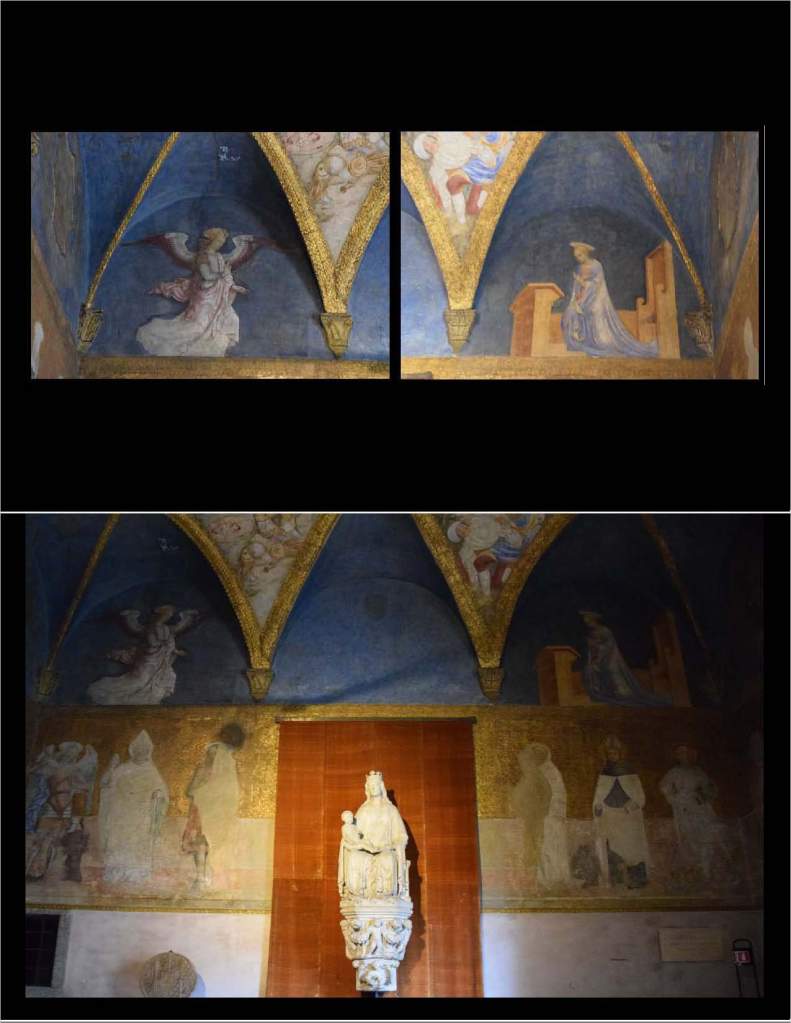
MILAN – Musei del Castello Sforzesco – Annunciation – Ducal Room, 14th-century – This beautifully embellished room commissioned by Galeazzo Maria Sforza (1444 -1476) has fully frescoed walls and ceiling. This wonderful Annunciation floats above a 15th-century marble sculpture of the enthroned Virgin and Child carved by an unknown Lombardian author. The sculpture is not original to the room but is from the villa of the Tittoni family of Desio – a small commune near Monza just north of Milan. The room is breathtaking in it cacophony of colors and imagery. No photograph can do justice to the totality of the experience of standing within it surrounded by the many saints that grace the walls and the blue ceiling above swarming with angels heralding the resurrection and ascension of Jesus to the company of God the Father in ‘Heaven’.
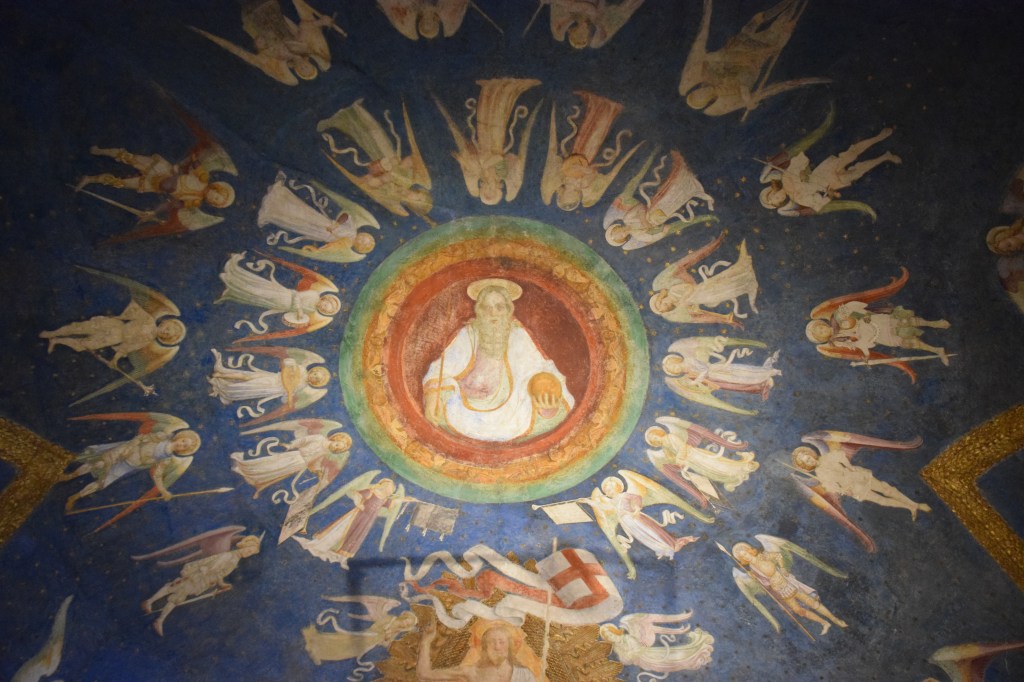
This room alone is worth a visit to the museum. For your curiosity and information: This Sforza Duke – Galeazzo Maria, whose life ended as he lived it, was notorious for his cruelty in the indulgence of his appetites. A bisexual, he castrated, burned, and starved to death lovers and rivals for the objects of his desires, and raped both men and women with impunity. His wantonness offended even his confessor who refused to pray for him and motivated three members of the Milanese governing court to assassinate him with their own hands as he knelt to pray at mass on the Feast of Saint Stephen in the church of the same name.
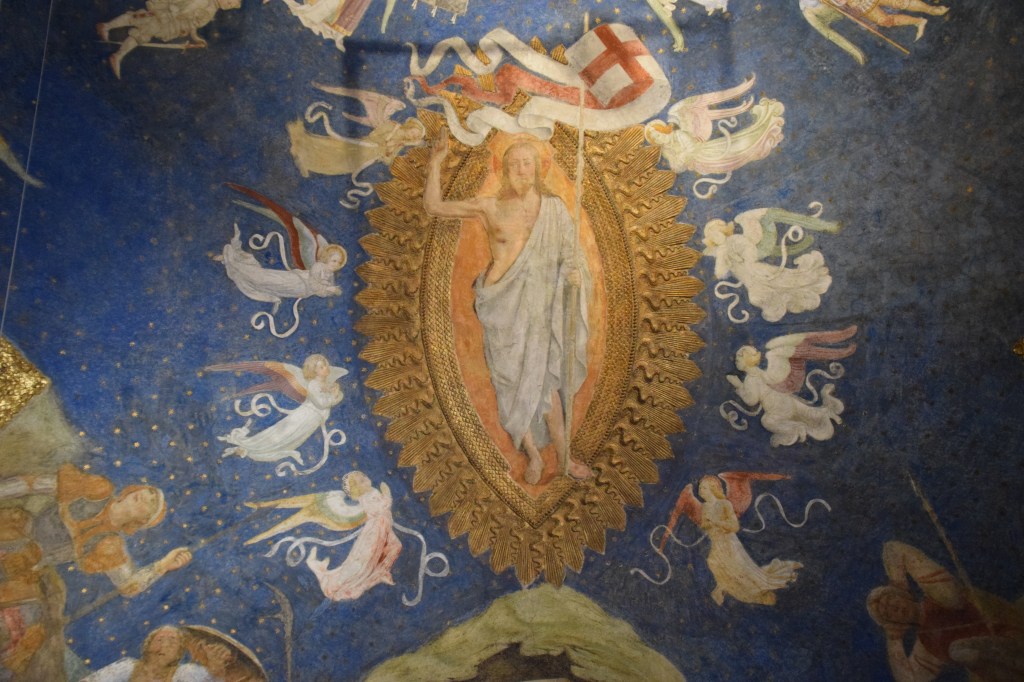
To end on a happy note – the Villa Tittoni is open to the public and offers cultural events, gardens, and a gallery of painting and sculpture. Here is the link: https://villatittoni.it/
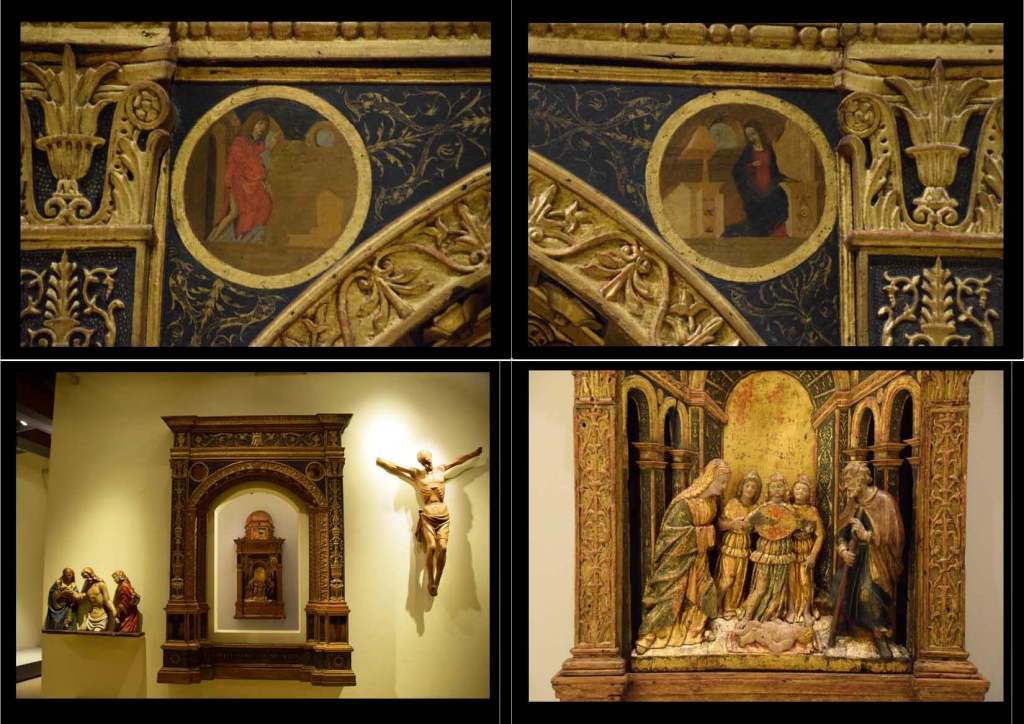
MILAN – Musei del Castello Sforzesco – Annunciation – Cornice, 15th-century – There is scant information about the origins of this frame for a votive painting of the Virgin Mary. The painting and this cornice are from the Tempio Civico della Beata Vergine Incoronata in Lodi. The votive was long considered to be the oldest of its type but modern analysis of the style situate it in the Lombardian Renaissance. Here is framed a wooden sculpture of the Holy Family. Perhaps the votive remains in Lodi. The artwork seen in the photo to the left shows a carved wood Pieta dated 1520, and to the right is a carved wood Christ Crucified dating to the very early 16th-century. The original art depicted Jesus with a real hair wig which was replaced with new as it deteriorated.
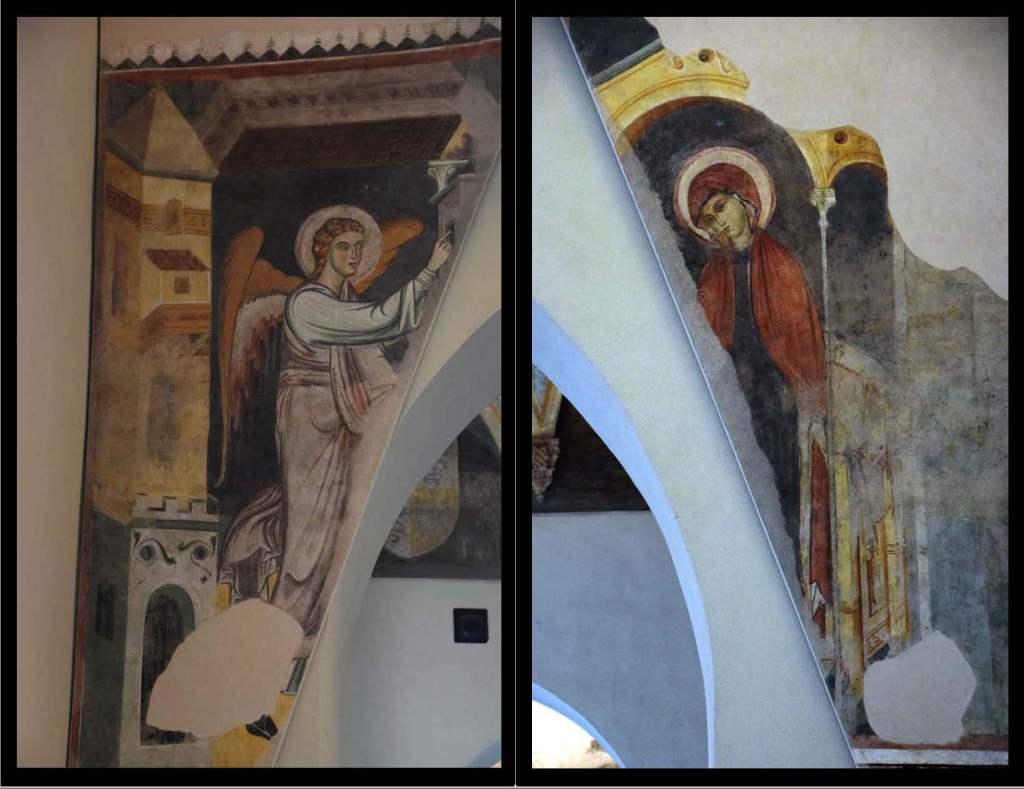
MILAN – Musei del Castello Sforzesco – Annunciation – Cripta di San Giovanni In Conca, 13th-century – These are the remnants of a very large frescoed Annunciation which come from the original 5th-century Basilica di San Giovanni Evangelista only the crypt of which still exists as an archaeological site in the middle of Piazza Missori in Milan. The Basilica was destroyed in 1162 by Frederick Barbarossa and rebuilt in the 13th-century. This Annunciation is from that restoration.
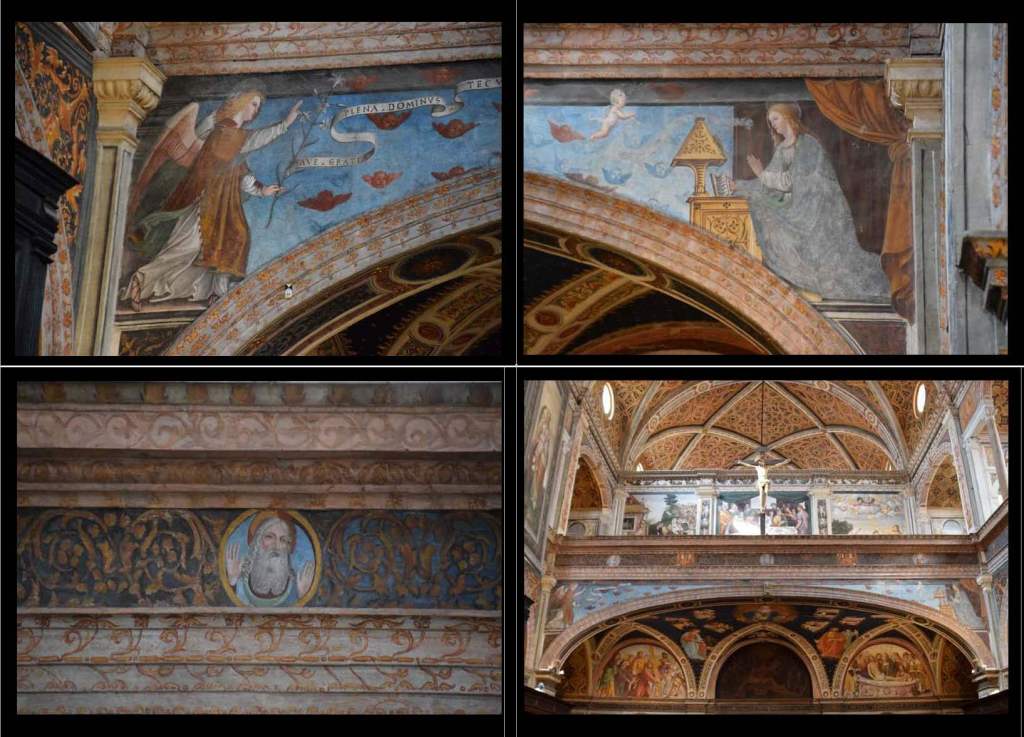
MILAN – Chiesa di San Maurizio al Monastero Maggiore – Annunciation, late 15th to early 16th-century – Painted by the incomparable Bernardino Luini (1480-1532) I had to include the one Annunciation that was not from the museum but which is a worthy addition to this visual narrative. San Maurizio is considered the treasure chest of Milan for its completely intact interior where the walls and ceilings and many chapels of the church host the artwork of Milan’s greatest artists of the 15th and 16th-centuries. Bernardino Luini was the major contributor painting many of the lunettes and chapels of the interior and both sides of the partition wall that separated the faithful from the cloistered nuns who occupied the monastery. Seen here is Luini’s Annunciation that faced the cloistered nuns as they worshipped from behind the altar where the priest offered mass on the other side of the partition wall. Above the Annunciation proper were frescoed in tondo Saint Peter, God the Father, and Saint Paul – the saints separated from their deity by a praying angel. Here I offer a detail view of the Archangel Gabriele and Mary, the fresco of God the Father located direct center above the sacred scene, and a full view of the top half of the Hall of the Nuns partition wall.
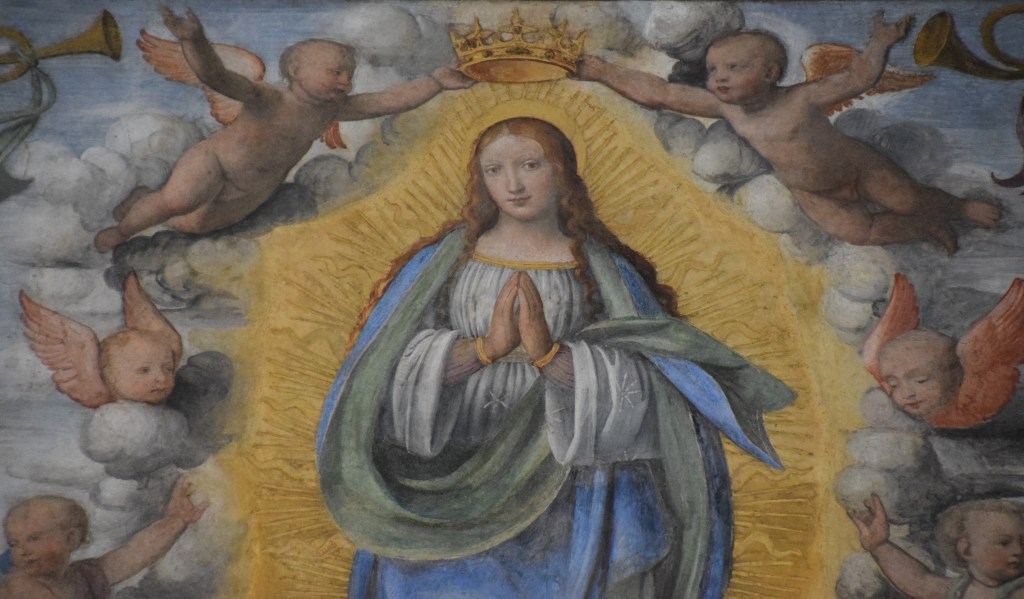
I complete this brief narrative with a detail of the Madonna Assunta from the Hall of the Faithful in San Maurizio painted by Bernardino Luini in the late 15th-century. This is a Wall Madonna is the less strict sense – it is painted on an interior wall of a building.
 Wall Madonna's of the Valtellina