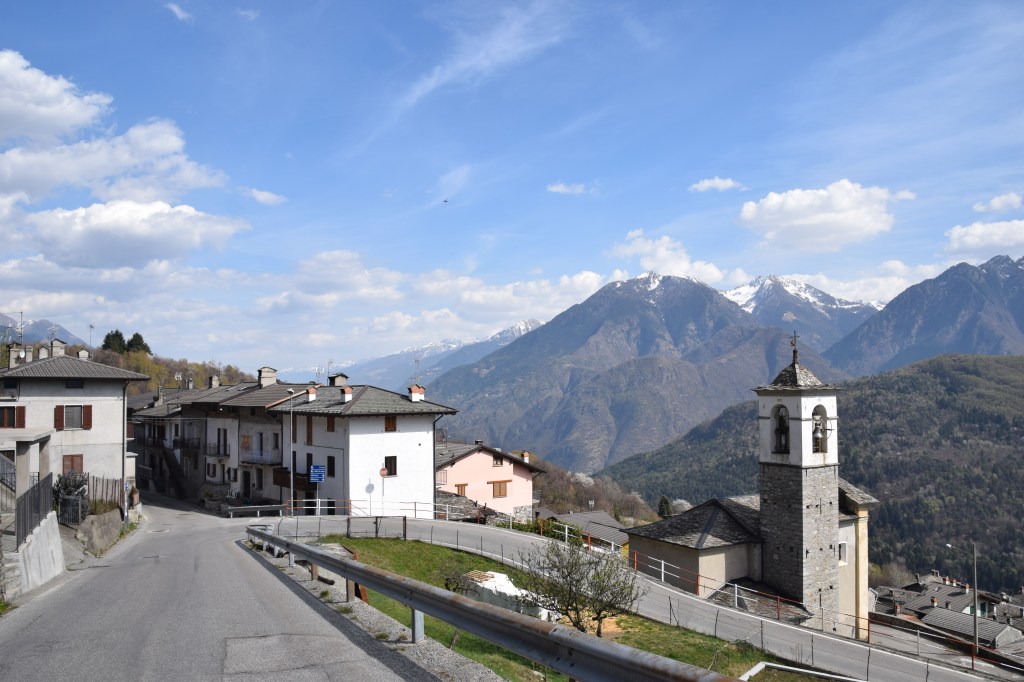
BEDOGLIO – There is always something more to learn! Bedoglio is a tiny mountain frazione with about 8 houses. At 815 meters the little borgo is just north of Cadelpicco and southeast of Caspano on SP10 in the direction of Val Masino.
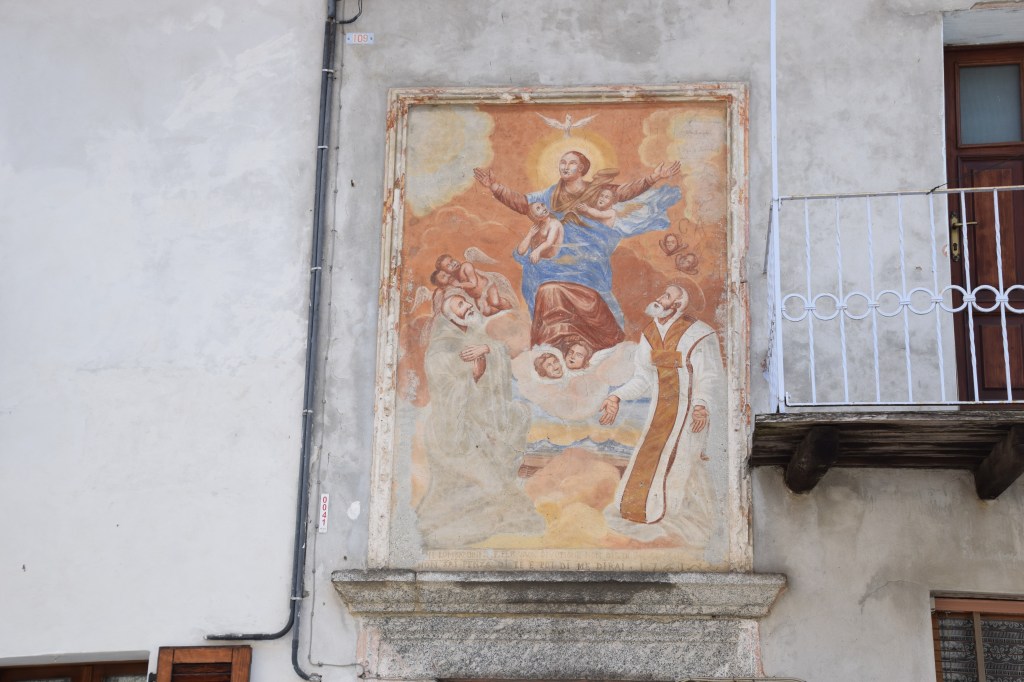
I have photographed the one Wall Madonna in town many times because this is where I walked every day when I stayed in Dazio. But I never noticed the faded and elaborate inscription and date on the bottom of the fresco. Today I noticed it and after a fruitless effort at translating it because I knew it was some ‘saying’ or old idiom, I sent it to my polyglot, genius friend.

This is the inscription on the bottom of the fresco:
M. LOMBARDINI F.F. PER SUA DIVOTIONE…
NON DIR DI ME GIACCHE [DI ME]
NON SAI PENZA DI TE E POI DI ME DIRAI. 1741
My friend – who is a polyglot and a genius – explains this dedication thus:
“I read:
M. LOMBARDINI F.F. PER SUA DIVOTIONE…
Yes, F.F. is fare fece or fece fare (no difference), “had [this] made.”
“M Lombardini had this made because of his devotion…”
And by the way a “devotion” in this type of instance means not that he was devout, but that he had a special affection for and dedication to the particular holy figure in the image.
The first line continues…
NON DIR DI ME GIACCHE [DI ME]
NON SAI…
I am restoring the [DI ME} because this is a well-known proverb-style saying that Italians write on gravestones and elsewhere…
… PENZA DI TE E POI DI ME DIRAI. 1741
“Don’t talk about me as long as you don’t know me. Think about yourself, and then you can talk about me.”
The middle part of the proverb varies. The giacchè sometimes appears as se (“if”) or finchè (“while, until”), but the rest is a well=worn formula.
Why non dir)e) for “talk about” instead of non parlar(e)? Because parlare di somebody means “speak about” in a non-judgmental way. Dire (“tell”) di somebody has the connotation of gossiping, telling stories.
Why dirai at the end? It’s an idiomatic use of the future tense. It means “do blabbly-blah… and THEN you’ll do blabbity-blah.” We don’t use the future this way in English, but it’s de rigueur in Italian. The sense of the proverb is, “Talk about yourself and you will be talking about me,” i.e., we’re all alike. Oh, and, by the way… I’m dead. So…
It seems like an out-of-place sentiment (a little *nasty) to write under a dedication to a saint!”
*The word used was a profanity so I offer a relevant synonym
 Wall Madonna's of the Valtellina