
Lovely Livo is a small mountain town 675 meters above Lake Como with about 160 year-round residents. I love it here because it is home to my favorite Wall Madonna church – the 13th-century San Giacomo Vecchia – the interior walls of which are covered with over thirty frescoes dedicated to the Great Virgin.
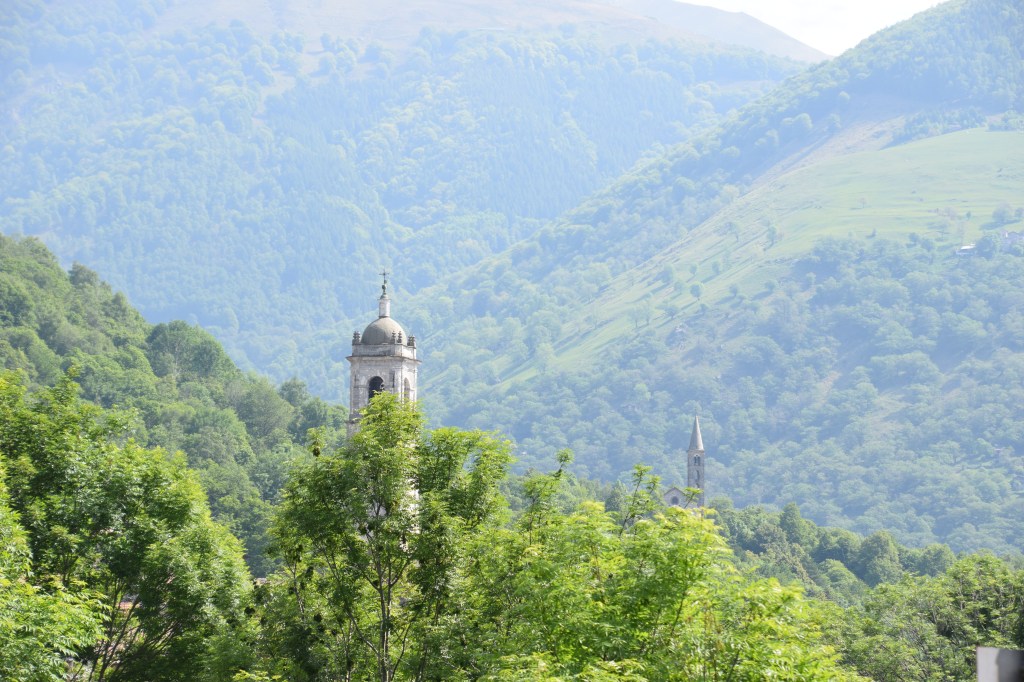
Although Livo does not have the grand view of the lake that nearby Peglio and Dosso del Liro do, it has beautiful chestnut forests, ancient stone houses, and their very own species of goat – the Capri di Livo. There is a wonderful small local restaurant – Crotto Dangri – 2 miles past San Giacomo Vecchia. It lies at the very end of the drivable part of SP4 – Strada Provinciale 4 – the mulatierra suitable only for feet and mules after that. The charm of the forest and waters of the Torrente Darengo promise a delightful dining experience. I have always wanted to go. And so I did. After lunch, I spent some time looking for Wall Madonna’s I might have missed. And I found a 15th-century fresco – still bright but marred and damaged by the addition of a modern staircase that certainly replaced the ladder one had to climb to reach the second-story door to a home. And I discovered more roads to walk in search of my beloved Wall Madonna’s. What follows are the Wall Madonna’s found in Livo and a synopsis of my trip to the lake on June 3, 2021.
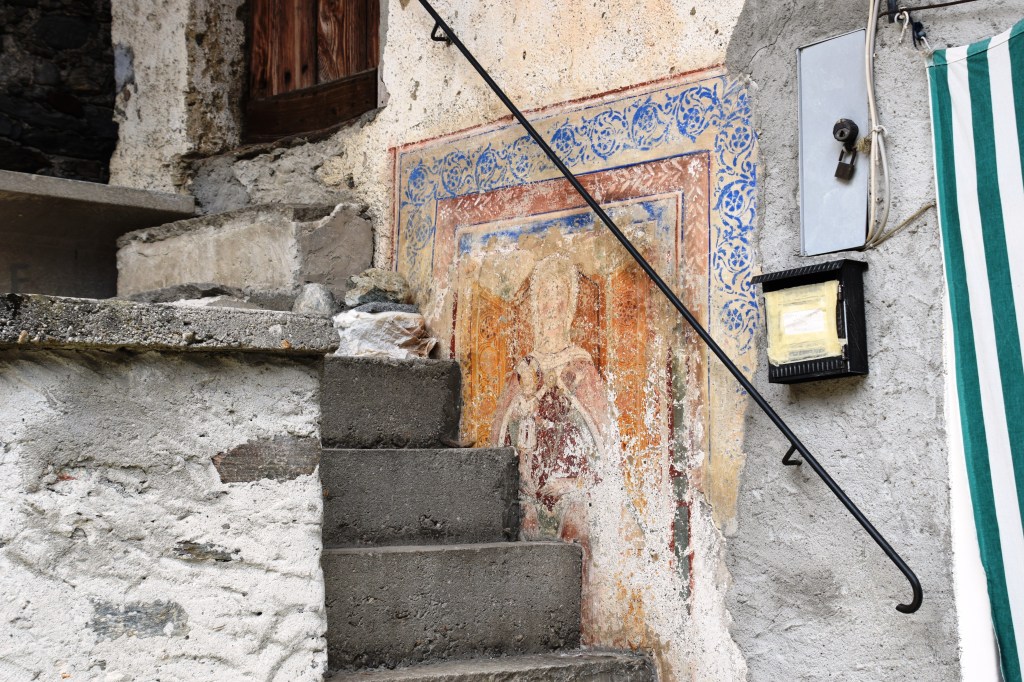
This Wall Madonna is a definite 15th-century fresco reminiscent of those I found in Colorina and Sacco and Rogolo. Such a tragedy that the modern stairs were more important than the Madonna. But one must make note that the fresco still remains – they did not paint over it! I suppose that is a small consolation. I have walked in Livo for almost ten years and never saw this Madonna. Finding this Wall Madonna made my day worth any failure!

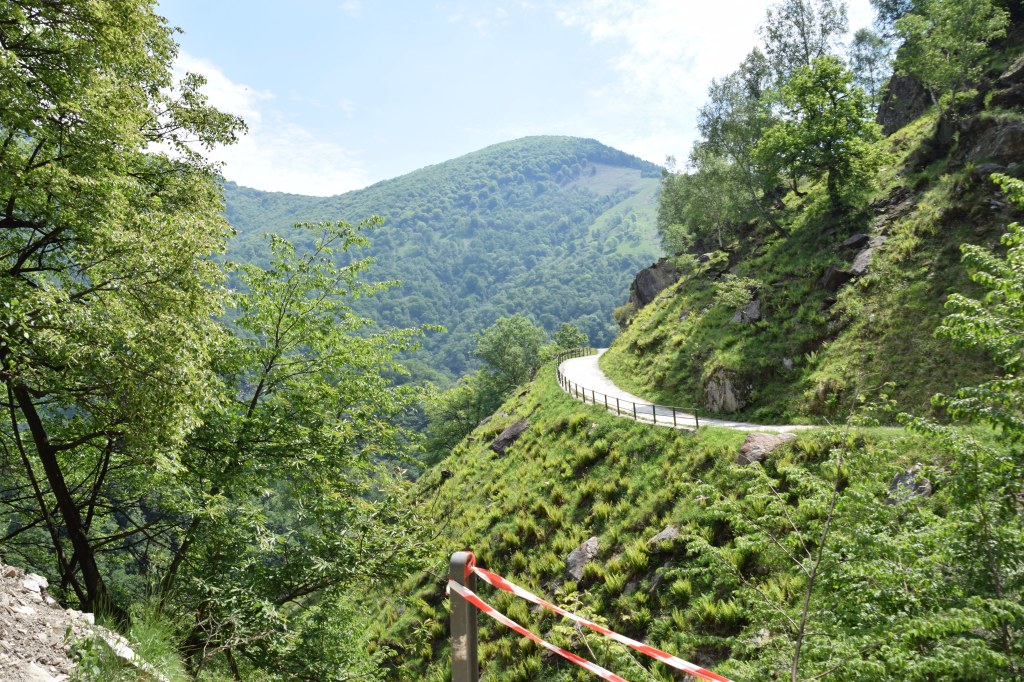
This is SP4 – the road used to be a mulatierra and still is after the Crotto Dangri. The last two miles to the Crotto require that one pay a fee to drive one’s car out here. The road is maintained by the municipality. It is narrow and lacks guardrails for most the way.
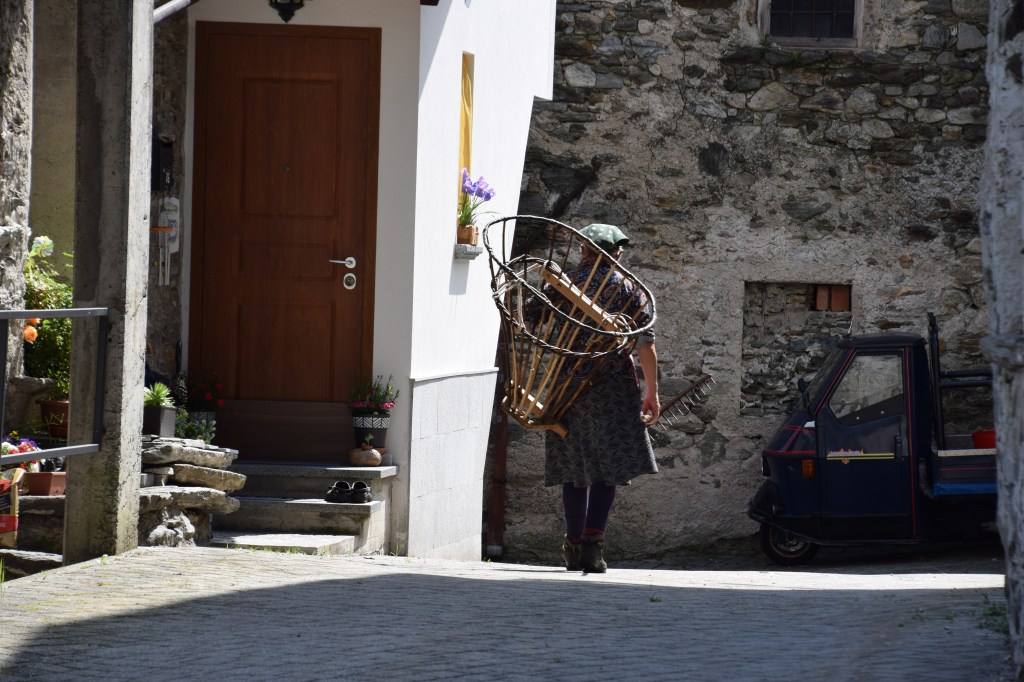
I looked for years for the name of these baskets and finally found it in the literature for one of the rooms in the museum of Palazzo Besta! So I have my cousins Ruggero Rizzi Roberta Dinelli to thank for my newfound knowledge because the palace was on the path of the fabulous Teglio walk they planned for me. This is a Gurlù – in dialect – and Gerla – in modern Italian. This particular basket with its open weave is for hay – a Campace – Gerla per il fieno – basket for hay!
Please note: I could not verify the Lombard word ‘Gurlu’ in any online source. But I did I find ‘Gerla’ and ‘Campace’ in Florio’s 16th-century Italian-English dictionary: John Florio, A Worlde of Wordes, (1598).
The PDF copy of this dictionary is available free for download online at:
https://archive.org/details/worldeofwordesor00flor
Page 55-56 in Florio and page 78-79 in the PDF copy
Campacchio – a kinde of great basket to *carrie *carie **bale or fodder in upon mens shoulders, used in Italy.
*Words are organized in three columns per page. The definition is in the rightmost of the three columns and is the final word on page (55). The definition continues at the top of the first column on page 56.
**Hay bale is likely meant considering the current word used – campace.
Page 146 of Florio and page 160 of the PDF copy
*Gerliero – a kind of porter or burthen carrier that carrieth in baskets
*The ‘iero’ ending indicates this is a person who engages in a particular type of activity – in this case – carrying hay or fodder in a basket.
Gerlo – a kind of basket they use in Italie to carie on mens backs like a ***dosser
***The current definition of ‘dosser’ is someone who lacks money and a home or a lazy person. The meaning here seems to be a thing that must be transported or perhaps the animal that transports the ‘idle’ thing. You decide.
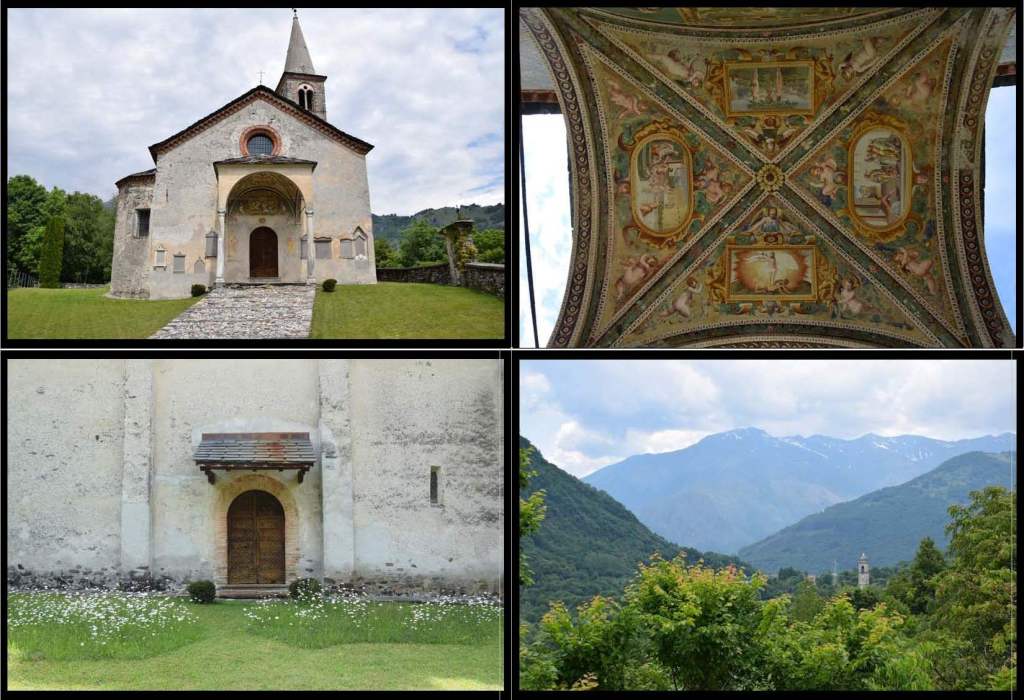
The Chiesa di San Giacomo Vecchia is first mentioned in the town records in 1297. The montage explained clockwise from top left: This is the view of the front of the church; The apse frescoes of the prònao – above the entry door. The paintings are unattributed and tell the story of Genesis; The view of the town and the 18th-century Chiesa di San Giacomo Nuova from the church courtyard; The side entry door of the Chiesa di San Giacomo Vecchia in a field of daisies.
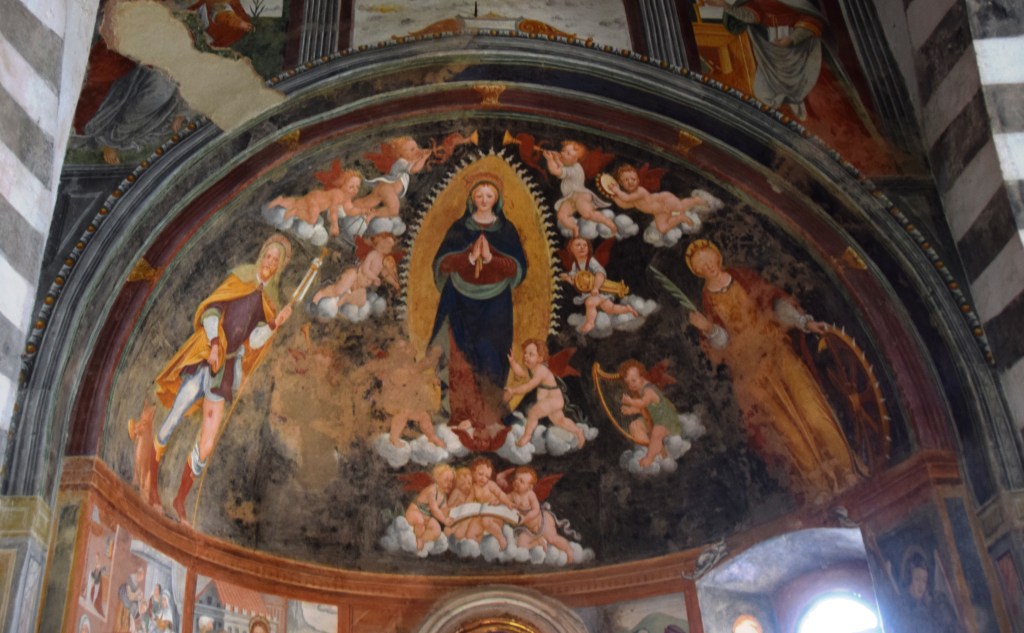
This is my favorite fresco in the old church. The Annunciazione and Vergine in Gloria fra I Santi Rocco e Caterina D’Alessandria was painted in 1549 by Bartolomeo da Ponte Tresa (1495-1557). Ponte Tresa is a town in the Ticino province of Switzerland and is where the painter is believed to have been born. The dates of his birth and death are not known for certain. The clearly talented artist was unknown other than locally until his frescoes in the Chiesa di Sant’Antonio Abate in Viconago in the province of Varese were restored and his talent garnered the attention of historians and art aficionados. His works are found in a number of churches in northern Italy and the lake region. His contribution to San Giacomo Vecchia was discovered when the frescoes of the church were restored in 2018 and the restoration artist – Rossella Bernasconi – painstakingly identified the donors and authors of the frescoes from inscriptions.
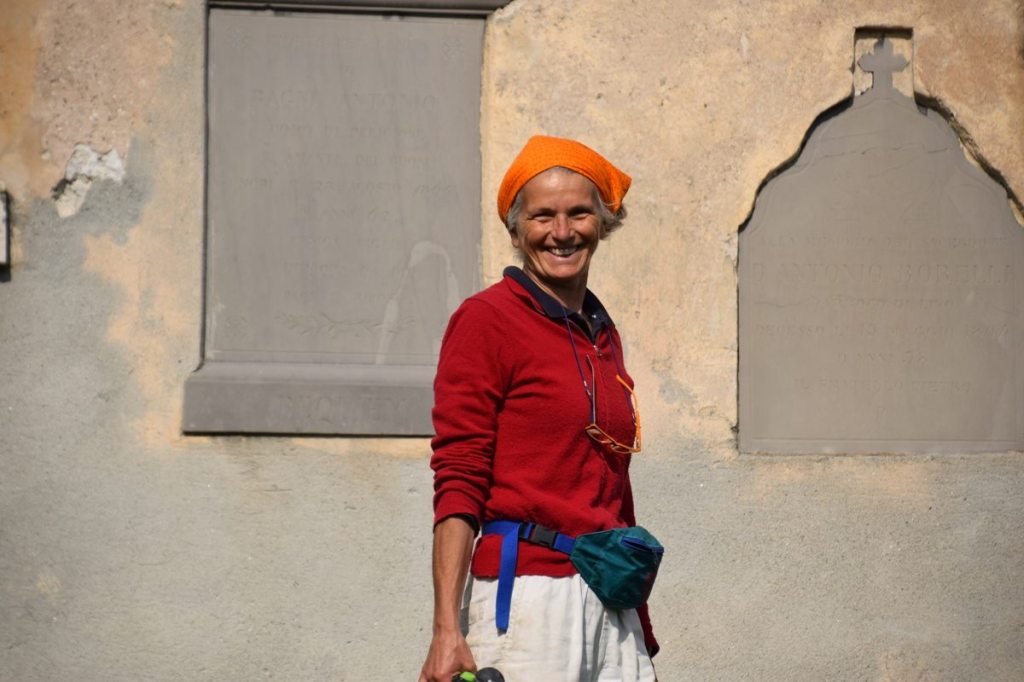
This is the restoration artist Rossella Bernasconi at work in the Chiesa di San Giacomo Vecchia . The photo was taken September 6, 2017 while the year long process of cleaning and restoring the frescoes was in progress. The work was complete in 2018 and the church reopened in a celebration on July 25, 2018. Here is a link to an article: https://www.corrieredicomo.it/san-giacomo-vecchia-a-livo-capolavoro-ritrovato/

An interior view of the Chiesa di San Giacomo Vecchia taken from the entry doors looking toward the altar. The photo was taken using a wide-angle lens. Photo taken February 25, 2019

An interior view of the Chiesa di San Giacomo Vecchia taken from the altar looking toward the entry doors. The photo was taken using a wide-angle lens. Photo taken February 25, 2019
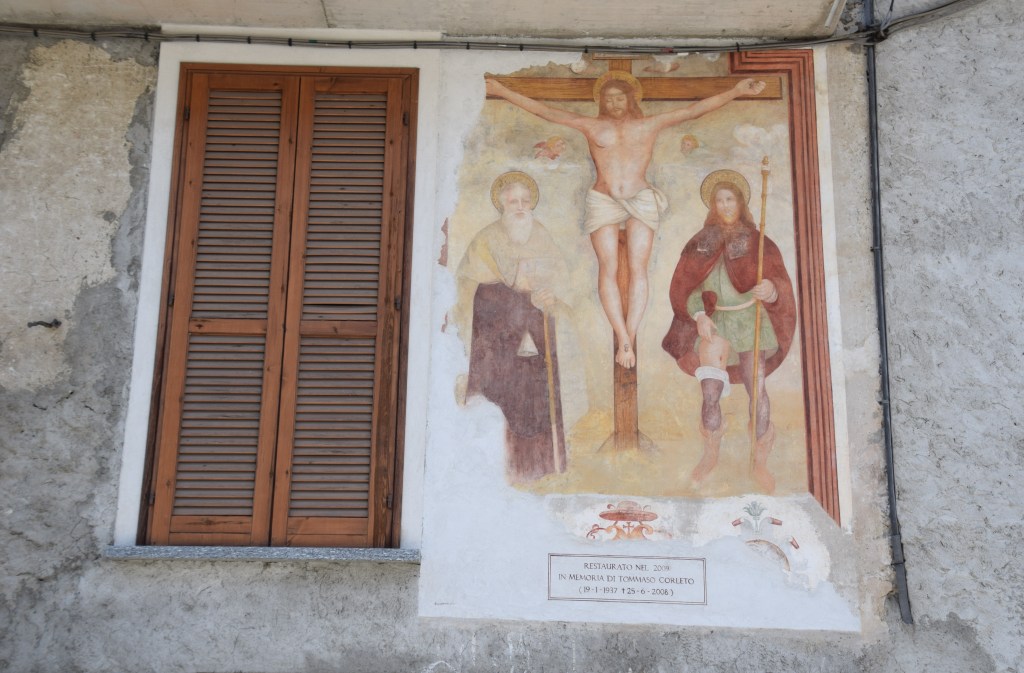
This is a 16th-century fresco recently restored. The fresco features a crucifixion with St Anthony the Abbot on the left and St Rocco on the right. The inscription reads RESTAURATO NEL 2009 – IN MEMORIA DI TOMMASO CORLETO (19 – 1 – 1937 + 25 – 6 – 2008). In English – Restored in 2009 in memory of Tommaso Corleto (10 Jan 1937 to 25 June 2008). The artwork is located on the main street through Livo.
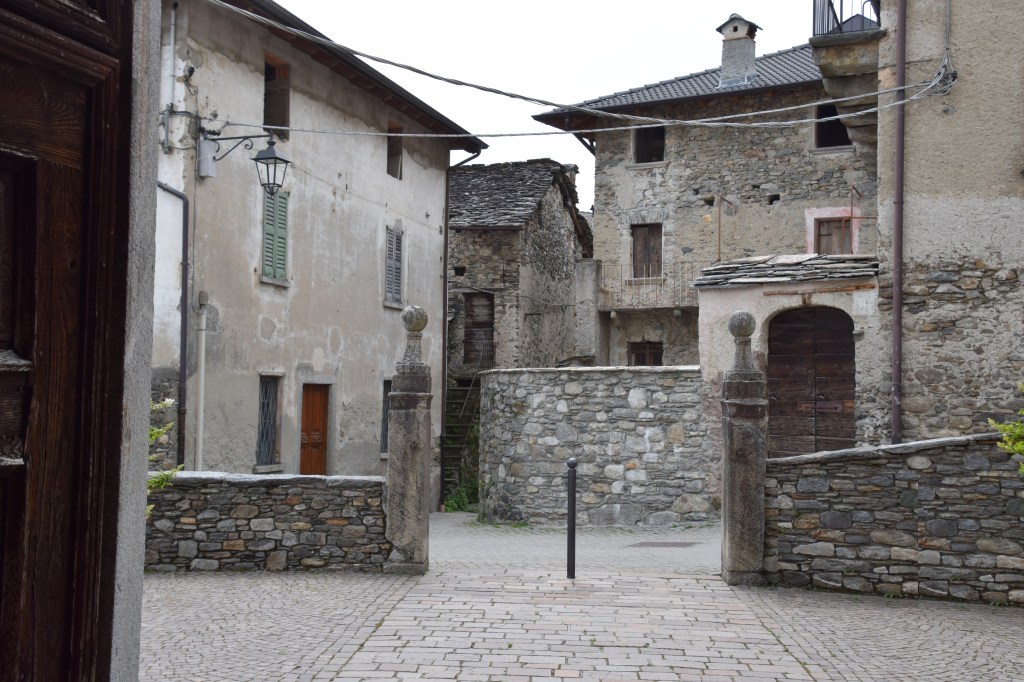
This is the center of town – the courtyard of the 18th-century Chiesa di San Giacomo Nuova as seen from the entry doors.
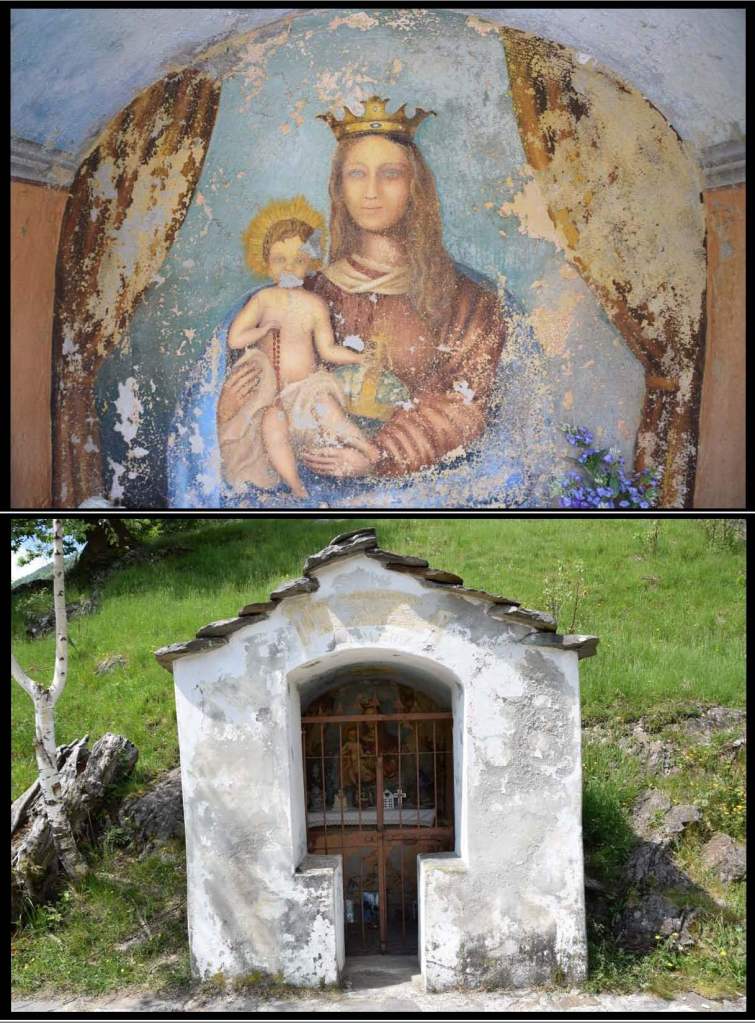
Outside Livo on SP4 – Strada Provinciale 4 – is this beautiful Madonna Shrine located on the road to Crotto Dangi in the Valle di Darengo.
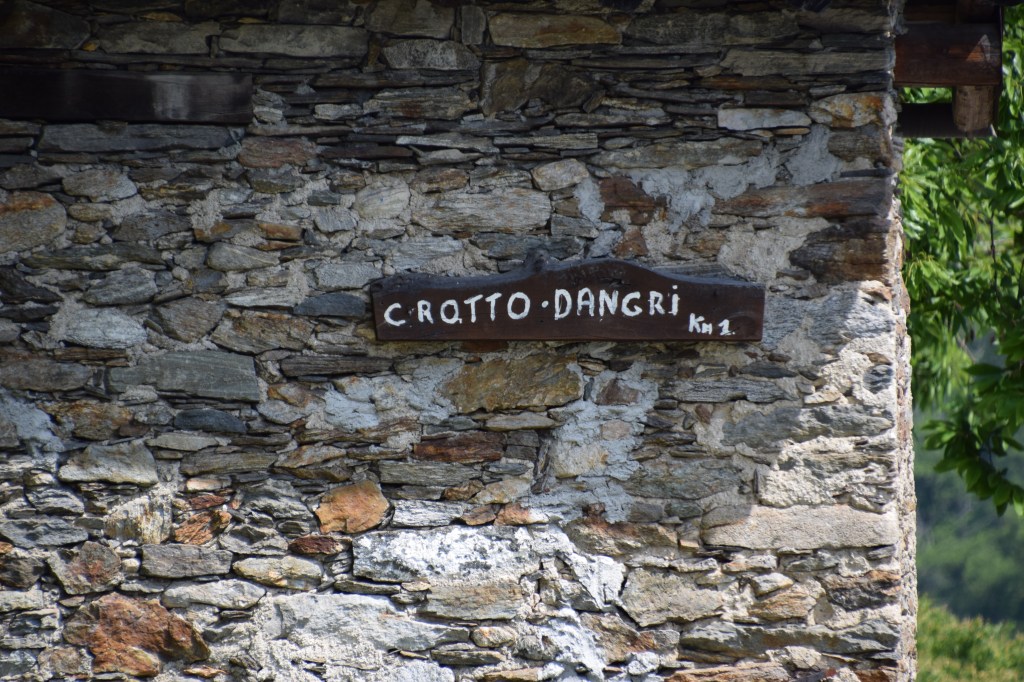
There are signs for the Crotto Dangri along the road to encourage one to keep going – something one might not want to do on a mountain road with no guardrails for much of the way!
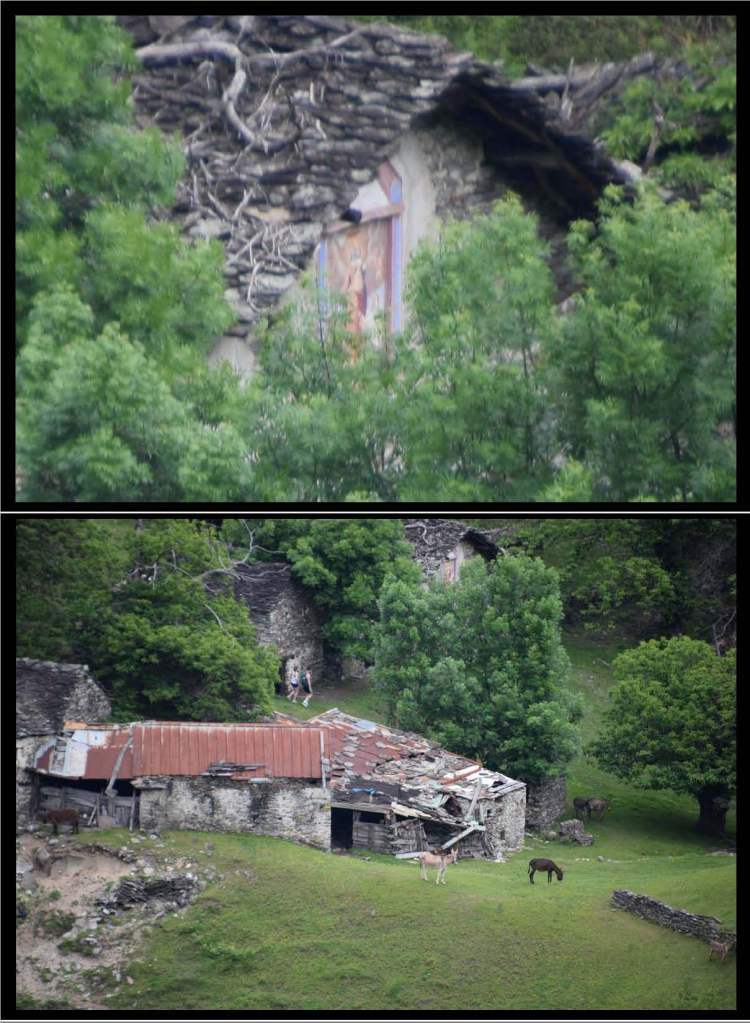
Outside Livo on SP4 – the road to Crotto Dangri – I took some photos of a homestead far below the road in the Valle di Darengo – and when I reviewed them I saw that one of the buildings has a Wall Madonna! Now I must find a way into the valley to photograph it! If you look closely you can see a Madonna and Child between two saints.
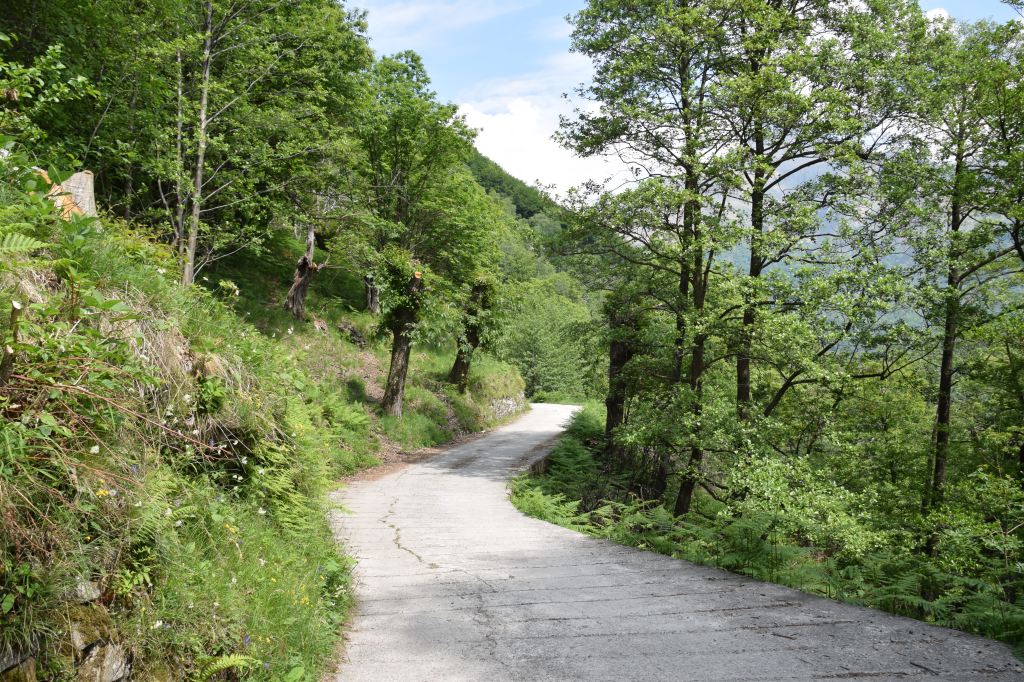
Outisde Livo on SP4 – the road to Crotto Dangri – a wonderful walk with fabulous views the entire two miles of the Valle di Darengo!
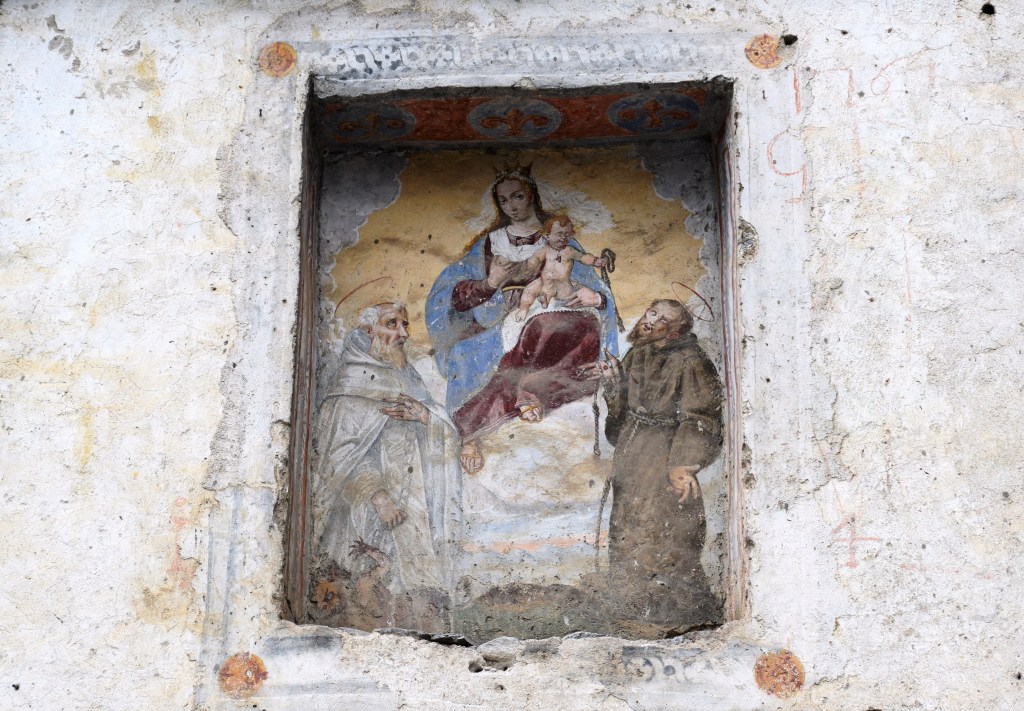
This Wall Madonna is located on the main street through town above an entry door – The fresco is complex and very interesting. Enthroned in the clouds, the Madonna and Child are between two saints – St Bernard of Clairvaux in the habit of the Cistercians and St Francis of Assisi with his stigmata. Jesus is handing St Francis a ‘cintura’ – a belt. On the left is St Bernard and Mary is sharing her breast milk with him. This represents a vision that St Bernard had as attested to in the 12th-century biography of him called the Vita Prima Sancti Bernardi – The First Life of St Bernard. If you look closely, you can see that St Bernard holds a devil on a chain. The demon is representative of the many exorcisms he is said to have performed – also mentioned in his biography. This fresco likely dates to the 17th century. The English translation of the First Life of St Bernard is available for download at this link: https://www.google.com/url?sa=t&rct=j&q=&esrc=s&source=web&cd=&ved=2ahUKEwj1geCb-ofxAhVEDOwKHbh8Dz8QFjAAegQIAhAD&url=https%3A%2F%2Flitpress.org%2FProducts%2FGetSample%2FBCF076P&usg=AOvVaw1_azI6ZqsXbvlc9trl2jt3
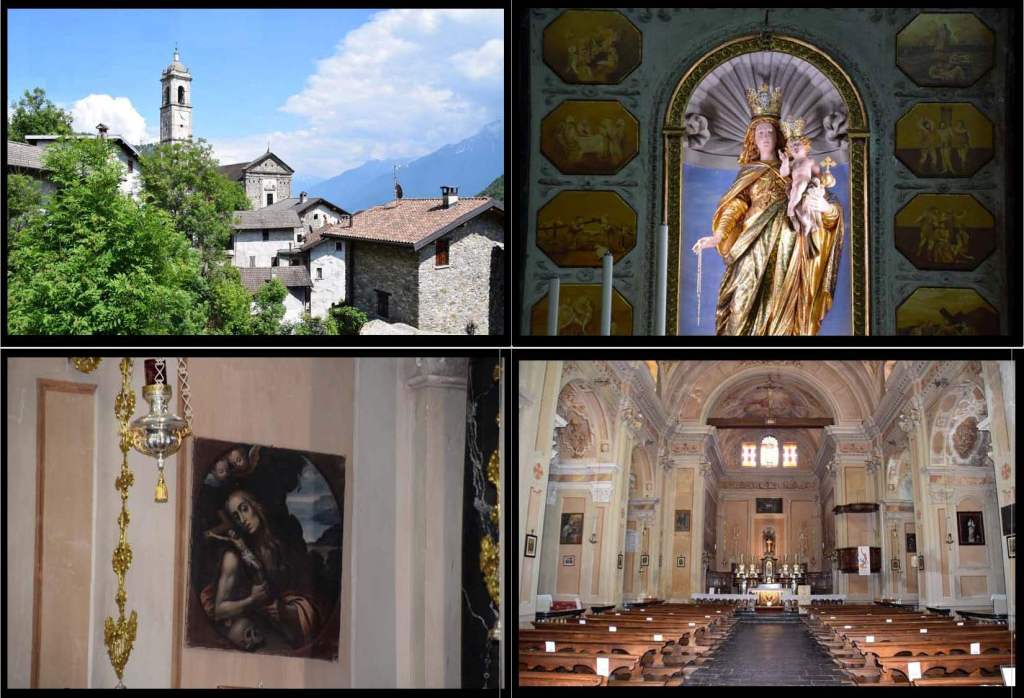
This is a montage of the new parish church – the 18th-century Chiesa di San Giacomo Nuova. The montage explained clockwise from the top left: The Chiesa di San Giacomo Nuova built in 1734. Inside is artwork reflective of the end of the Renaissance and the beginning of the Baroque period for art. Although not to my taste, I appreciate the opulence and overwhelming cacophony of design and decoration. Top right: This is a Madonna del Rosaria; Bottom right – This is a view of the front altar showing the beautiful, carved wood pews (with all their COVID restrictions seating instructions); Bottom left – This is a really interesting semi-modern painting of the Magdalene holding a crucifix. It was the only painting in the church that I liked!
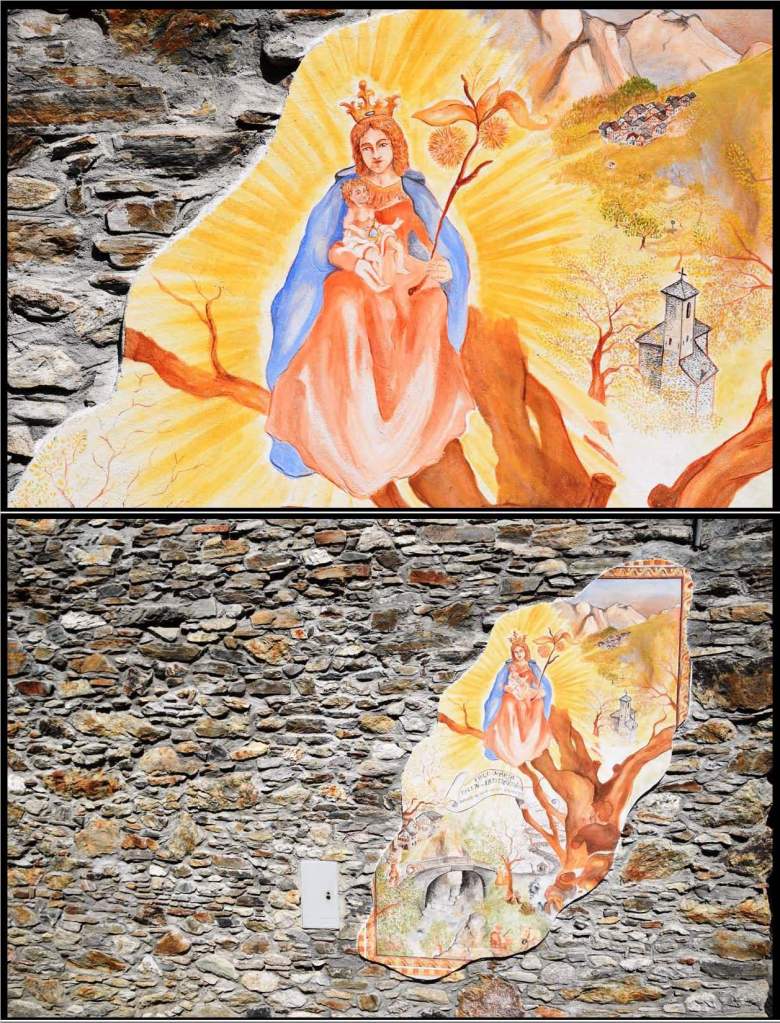
This was once a very large and grand Wall Madonna painted in 1717 and what has survived has been refashioned. I love the Madonna and Child enthroned in a chestnut tree holding a branch with chestnuts inside their spiky shells. Chestnuts are abundant here and they were an important food source in Livo. Chestnuts were known as the bread of the poor and their use as a primary starch and protein (and source of vitamin C) predates the introduction of corn (16th-century) and the potato (17th-century) to Italy.
Hence, the chestnut tree was crucial to mountain life in Livo and all of Lombardia. The fruit was dried and milled and used as flour to make breads, puddings, and sweets. The tannins of the bark and wood were used in tanneries – where animal hides are made into usable leathers. The wood of the tree was used to build – floors and furniture and beams – all made with chestnut were common here. Chestnut blossoms nourished bees and bees offered back their honey and their labors at pollination. And, finally, the tannin and the leaves were used medicinally as an antiseptic and to treat skin irritations.
Currently, the Italian government officially protects certain geographical areas where they grow and designates official varieties of the nut in those areas. The area closest to Livo is Piedmonte and the variety is Castagna Cuneo IGP. Italy produces more chestnuts than any other country in Europe. Here is a link to an informative article: http://www.fao.org/3/x5348e/x5348e03.htm
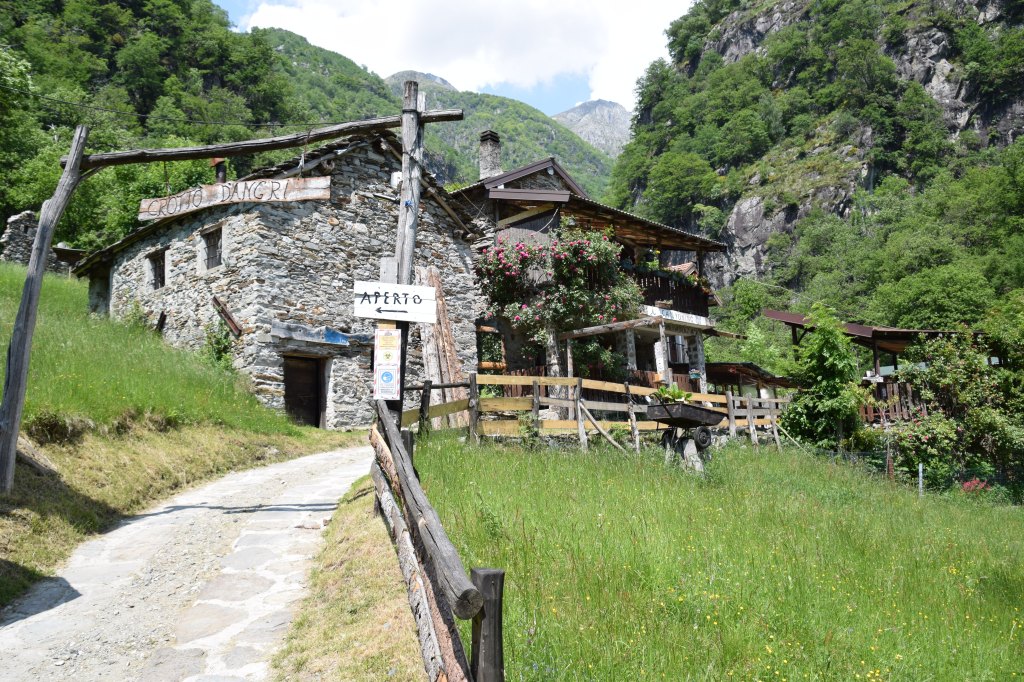
This is the Crotto Dangri – just two miles outside town on the Torrente Dangri in the Valle di Dangri on the end of the driveable portion of the Mulatierra known as SP4 – Strada Provinciale 4. The establishment rents a couple of rooms and serves local foods – mostly pizzoccheri and polenta made with maize and grano sarceno – buckwheat – which is the main flour used for the pasta of pizzoccheri. I do not think there is electricity out here. I wonder how they manage!
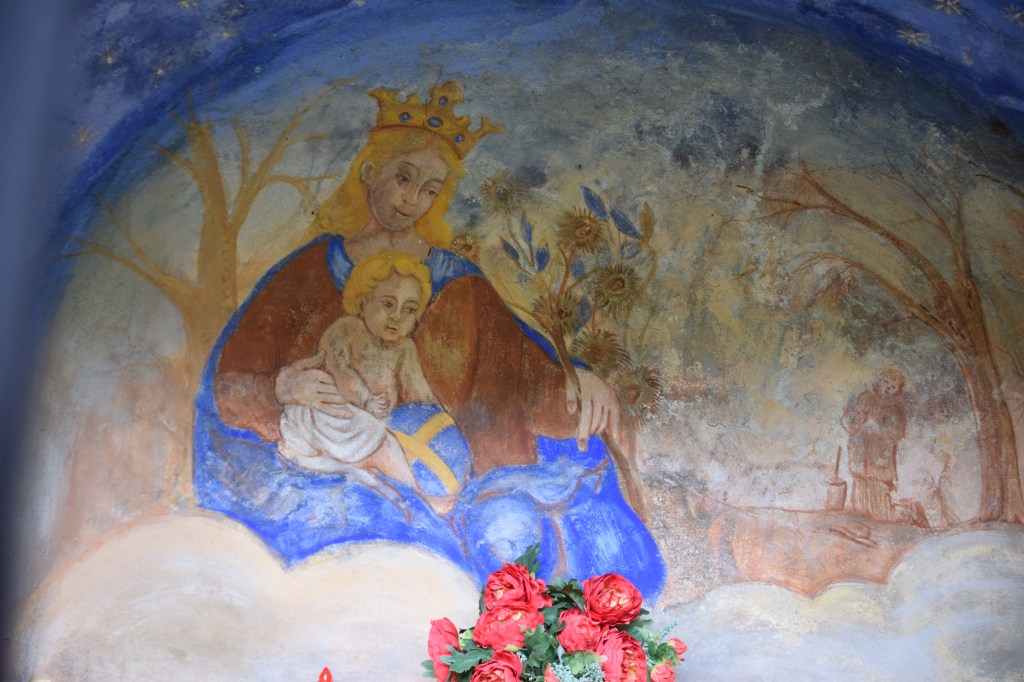
This is a Wall Madonna shrine on the road to Crotto Dangri. Here you see another Madonna holding a branch with chestnuts – more painted testimony to the importance of the chestnut to mountain life.
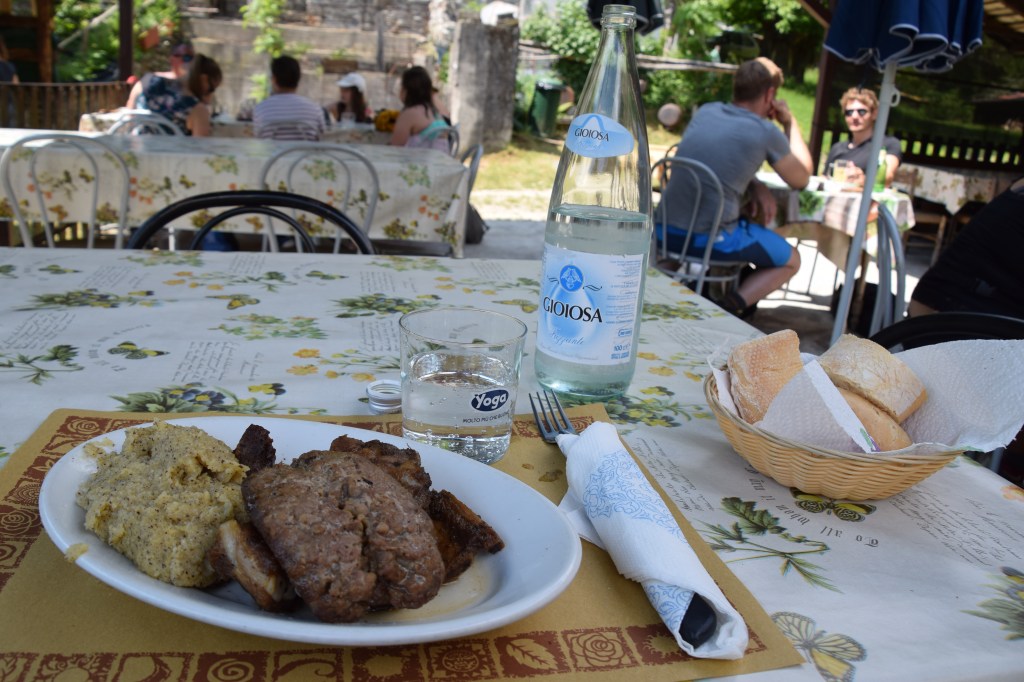
Eating at the Crotto Dangri! My lunch – polenta made with maize and buckwheat flour, sausages and ribs. I like ‘normal’ polenta – no butter added and only cornmeal used to make the ‘pudding’. Buckwheat flour is not my preference. I like cookies made with oatmeal and buckwheat but that is it. However, I do love polenta having eaten it every day growing up while my nonna was alive and so I really enjoyed my lunch and the ambiance of the Crotto!
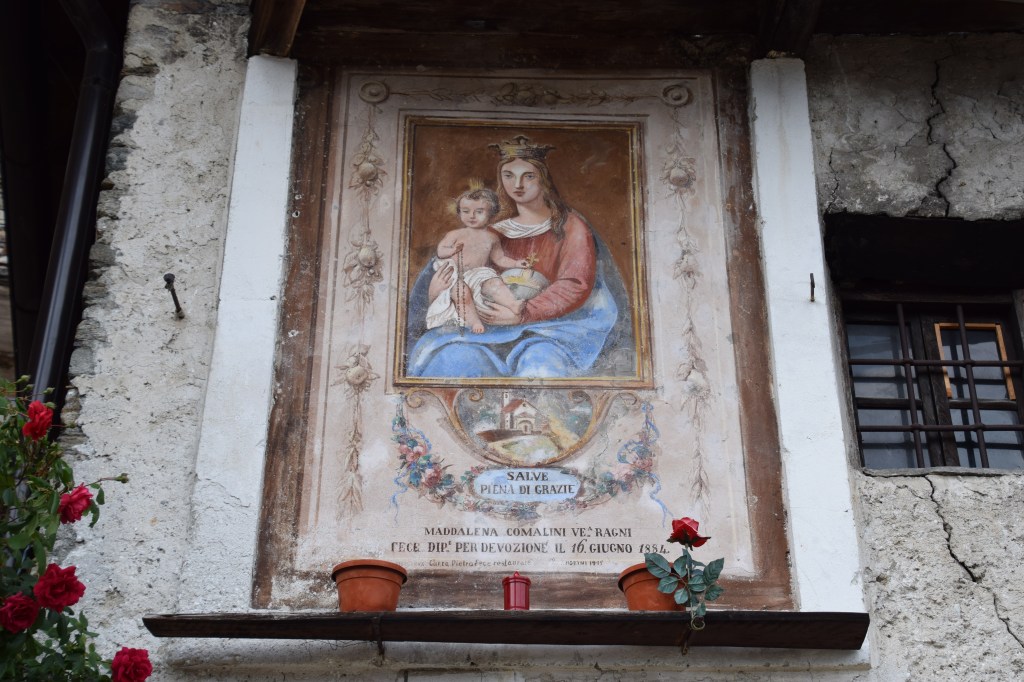
This Wall Madonna was painted in 16 June 1884 and was restored in 1995 by Pietro Careo. The donor was Maddalena Comalini Vera Ragni. I am not sure of the abbreviation though (Ve surperscript A). The inscription – SALVE PIENA DI GRAZIE – would translate as Hail (Mary) full of grace! Jesus holds a rosary making this a version of the Madonna del Rosario.
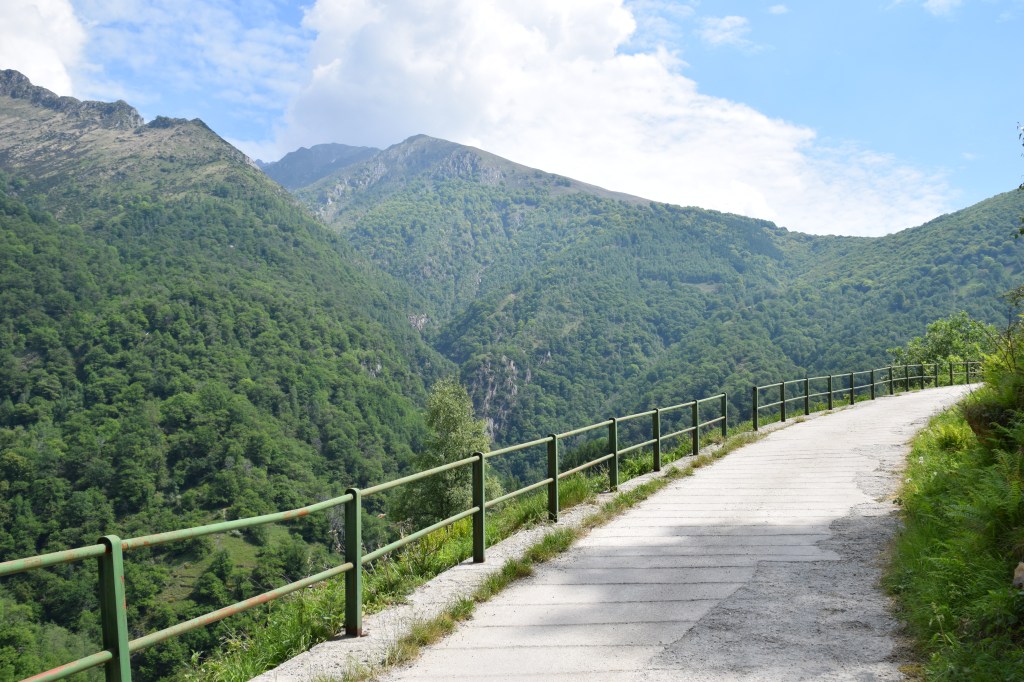
This is SP4 – I am walking back to town from the Crotto Dangri. This is a beautiful view.
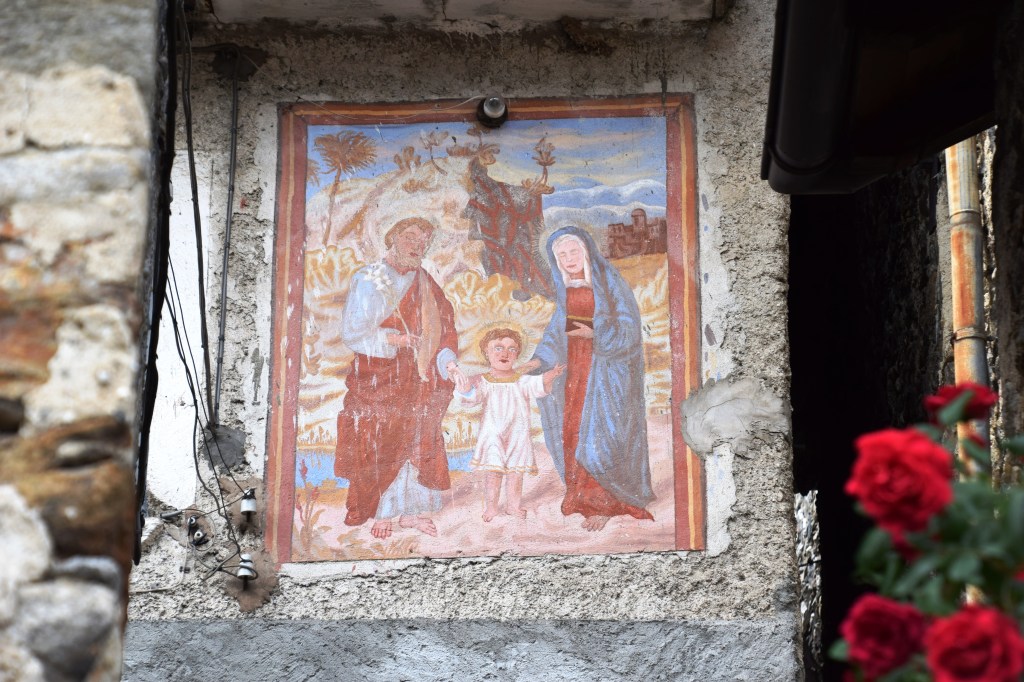
This Wall Madonna is a (poorly) restored Sacra Famiglia that depicts the Holy Family in Egypt. The fresco is located behind the north side houses on the main streets through town. The next photo shows a glimpse of the fresco that sits on a narrow alley behind the previously posted Wall Madonna.

A view of two Wall Madonna’s that show how close together the old home were built. The hoes are clustered around the main street through the center of town.
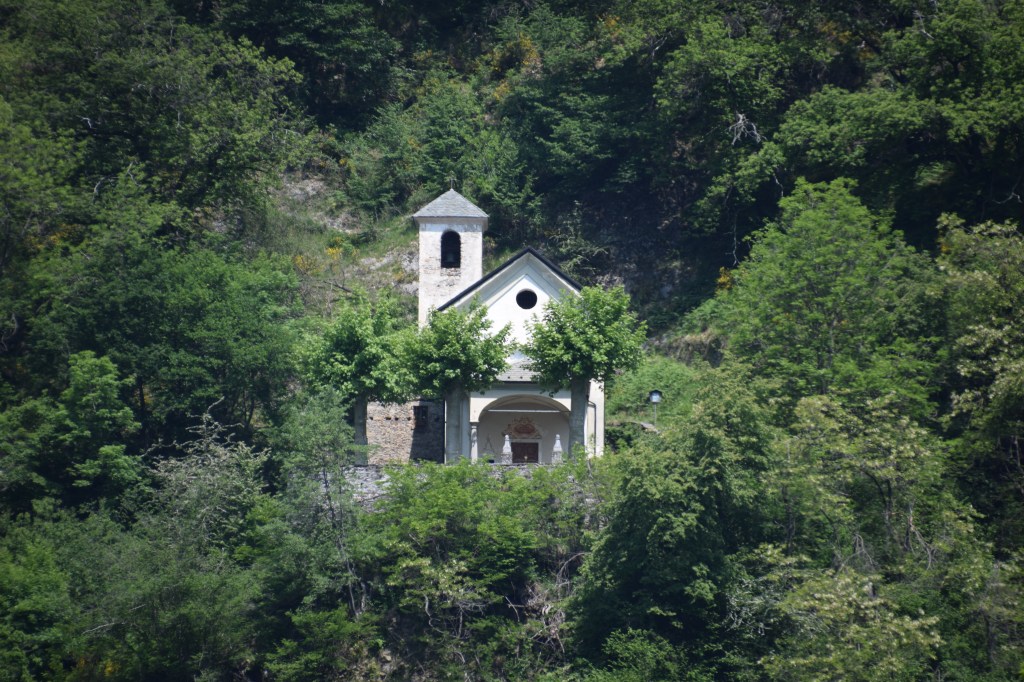
This is the Shrine of Madonna di Mezza Crèsta (Church of Sant’Anna). The small church is located just outside the Crotto Dangri on the mulatierra that leads to the hamlet of Baggio and then high into the mountains. This shrine houses what is known as a miraculous Madonna fresco – a painting to which is attributed miracles. The religious make pilgrimages here.
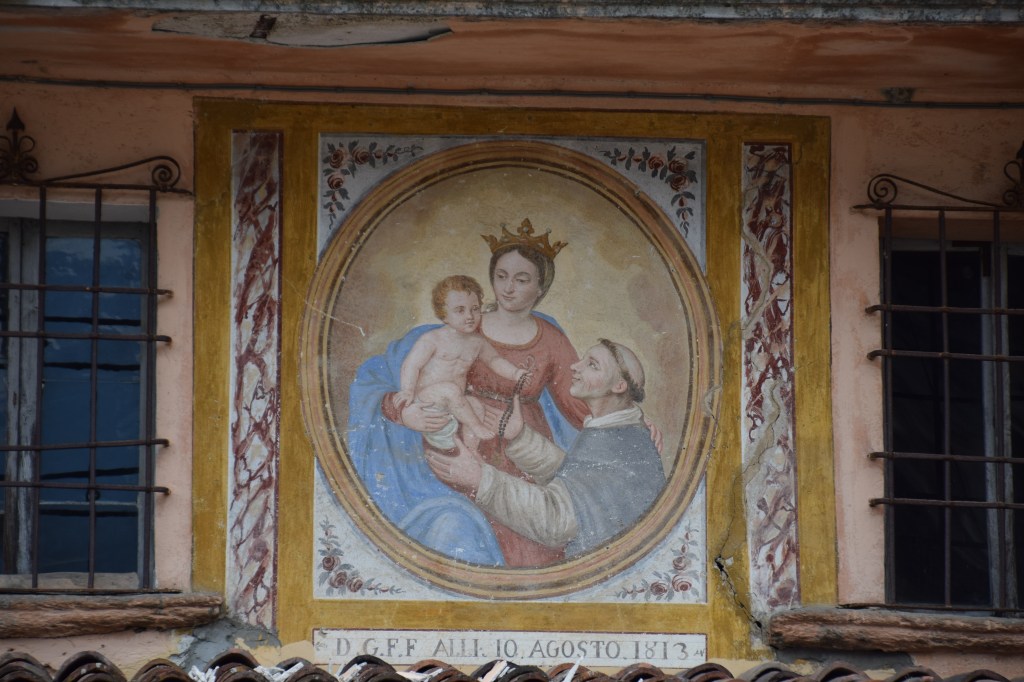
LIVO – Wall Madonna from 1813 – this is a Madonna del Rosario. Jesus hands the rosary to St Bernard of Claivaux. I am pretty sure that is who the saint is because of the Cistercian habit although it may be the traditional saint associated with this ‘miracle’ – St Dominic who also wore a white habit but with a black cloak. The cloak could be faded. The saint is not identified so I am not certain.
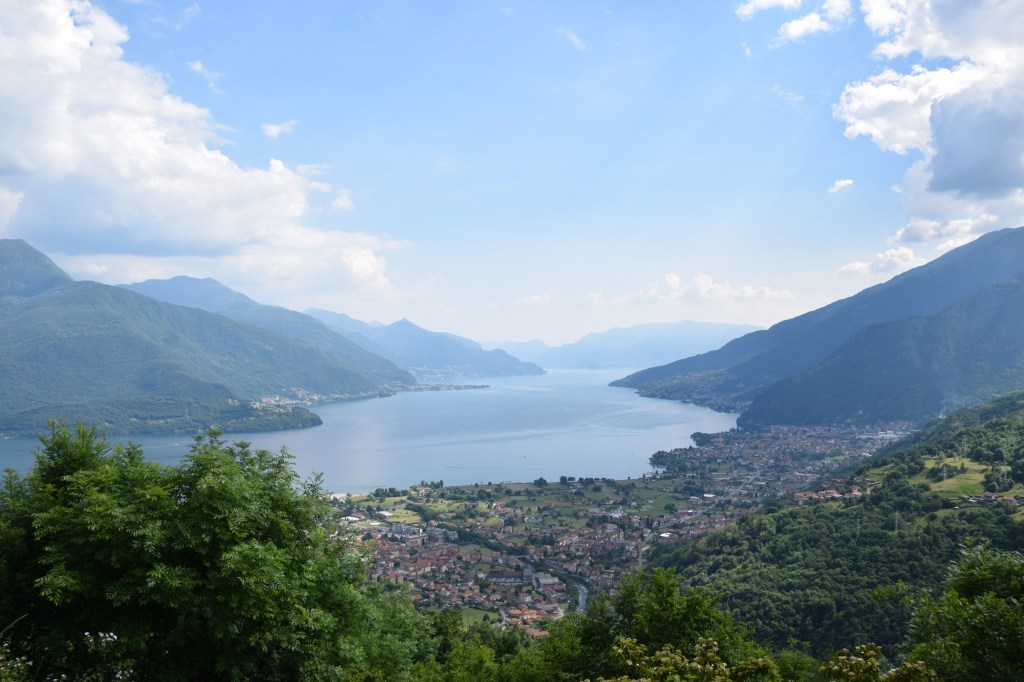
I always stop in Peglio at the Chiesa dei Santi Eusebio e Vittore for my yearly photo of Lake Como from the belvedere. It is such a stupendous view! One must drive through Peglio to reach Livo in the valley behind it. The interior of the Chiesa di Santi Eusebio e Vittore is completely frescoed by Giovanni Batistta della Rovere (1561-1627) known as Il Fiammenghino. to access the church and view the artwork one must make arrangements with a Lake Como tour guide. I have always used Alessandra Mutti. Here is the link: http://imagolario.com/
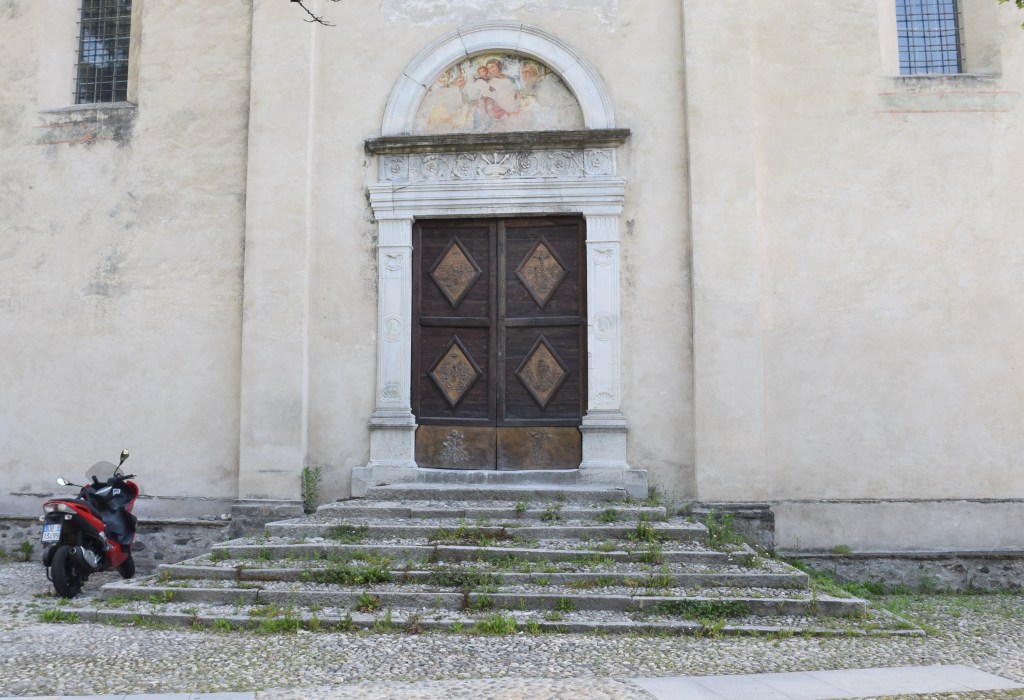
I always try to visit a few of my favorite churches on Lake Como which are veritable art museums and filled with frescoes. These are the entry doors of the Chiesa di Santa Maria delle Grazie – consecrated in 1496. The church was closed when I stopped there in the morning on my way to Livo.

The Chiesa di Santa Maria delle Grazie – consecrated in 1496 – was open on my way home from Livo – at least the doors were open so I walked in. Men were sandblasting the plaster off the outside of the right side of the church. The inside is being restored as one can see from the scaffolding.
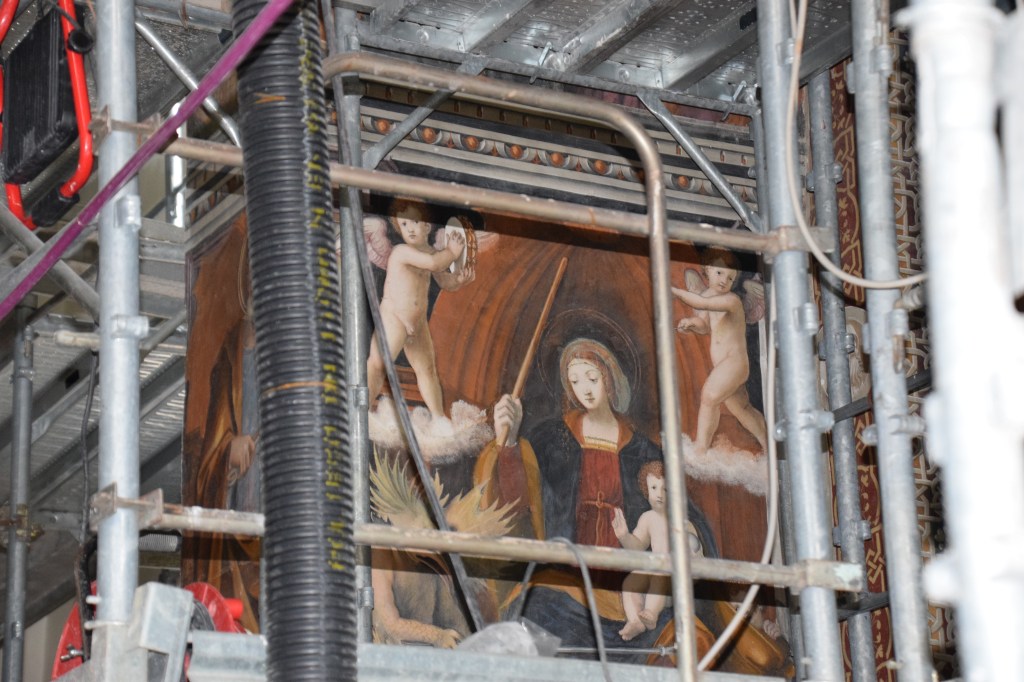
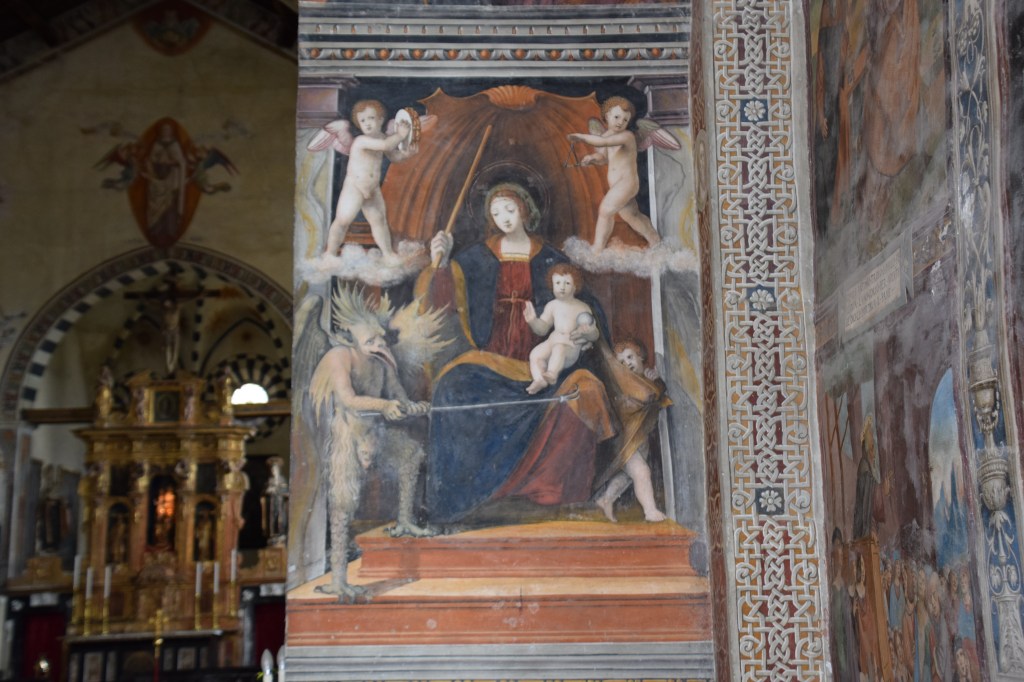
This is one of my favorite frescoes – the Madonna del Cifulet. The Madonna drives out the demon (cifulit) who represents all the evil found in the world. Although obscured by scaffolding her beauty is unmistakable. Here is a view of the fresco before the scaffolding. The photo was taken October 3, 2017. The fresco has no dedication.
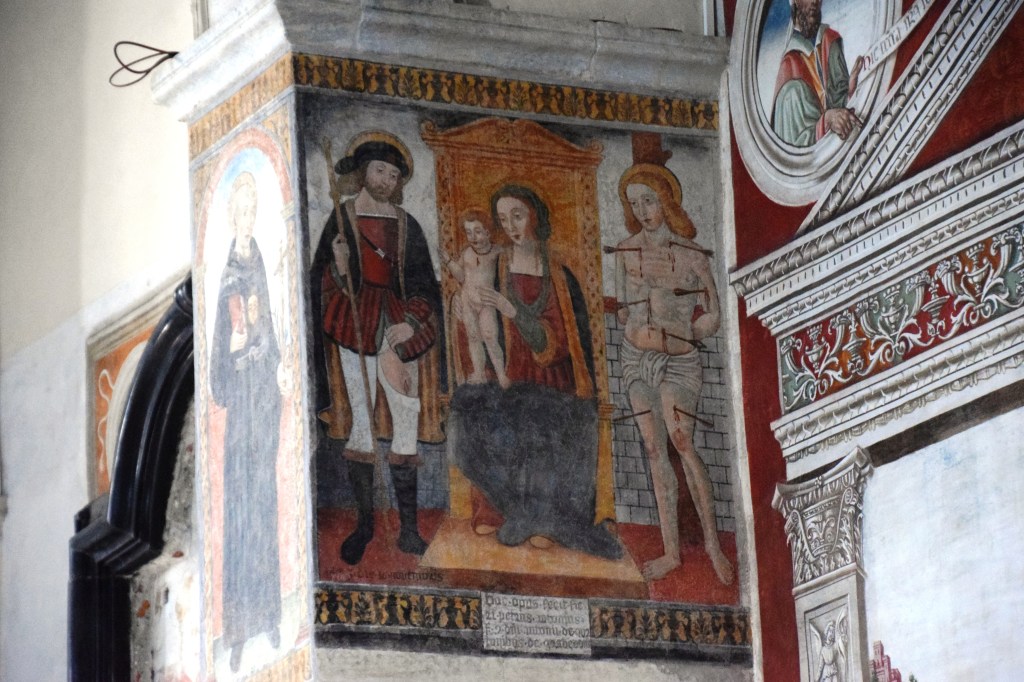
I love this plague Madonna! The fresco features the Madonna and Child between the plague saints – Rocco on the left and Sebastian on the right. These are the saints invoked against the plague the last pandemic of which occurred during the years 1629-1631.
The Latin inscription is difficult to read but attributes the painting to a Peter Anthony. All I can read is HOC OPUS FECIT FI(*)… PETRUS ANTONIUS +- Peter Anthony made this work.
A dear friend who is a polyglot translated the inscription – he is an expert – and did some research on the donor. Here are his REALLY interesting research ,translation and comments! Below:
(T)here are some misspellings (typical of late Latin) and inscrutable elements where the smudges of time have perhaps clouded the issue.
Basically it (*the inscription) says:
hoc opus fecit fieri petrus antonius < f r > d[omi]ni antonii dequrtonibus de grabedona
“Pietro Antonio had this work made < ? > of Lord Antonio Curti of Gravedona.”
1. Pietro Antonio Curti was archpriest of the church of San Vincenzo in Gravedona in the second decade of the 16th century.
2. Notice the misspellings: dequrtonibus should be de cortonibus; and grabedona, should be gravedona.
3. The Pietro in the first line is obviously the Pietro in the second line––an archpriest from a noble family (the Curti) would have had the means to commission the art… And the fact that he titled himself “Lord” is an indication of what he thought of himself.
4….So the abbreviation f r is the link between the two clauses, but I have to admit, assuming the separation of the letters indicates two dramatically abbreviated words, the phrase is obscure to me. I’ll think about it; perhaps it will come to me.
(From a history of Giovanni “Matto” da Como).
“In September of 1517, upon the death of his father Antonio, [Giovanni] returned to the area of Como, gathered his father’s faithful followers and put together a genuine, proper fleet with which, for nearly three years, he plied Lake Como, devastating the towns on both shores. At the threshold of the collegiate church of San Vincenzo he killed the archpriest of Gravedona, Pietro Antonio Curti, who he suspected of having had a hand in his father’s death. He attacked him on the street while he was heading to church to celebrate Mass, and slew him. Afterward, with his father’s supporters, he ransacked the priest’s house and had it demolished. He declared himself a partisan of the Sforza cause. He plied the Valtellina plundering and consigned to the flames the possessions of those who favored the French side. Gian Giacomo de Medici also joined his gang.”
The original Italian:
“Alla morte del padre Antonio (Matto da Brinzio) ritorna nel comasco, raccoglie i fedeli del padre ed arma una vera e propria flotta con la quale scorre per quasi tre anni il lago di Como devastando i paesi dell’una e dell’altra riva. Uccide, sulla soglia della collegiata di San Vincenzo, l’arciprete di Gravedona Pietro Antonio Curti, da lui sospettato di avere avuto mano nella morte del genitore. Lo assale per strada, mentre si sta recando in chiesa per celebrare la messa, e lo ammazza; indi, ne saccheggia la casa con i fautori del padre e la fa demolire. Si dichiara partigiano della causa sforzesca. Scorre in Valtellina depredando e dando alle fiamme i beni di coloro che favoriscono la parte francese. Alla sua banda si unisce anche Gian Giacomo dei Medici. “
*I added the words ‘the inscription’
Here is the link to the excerpt:
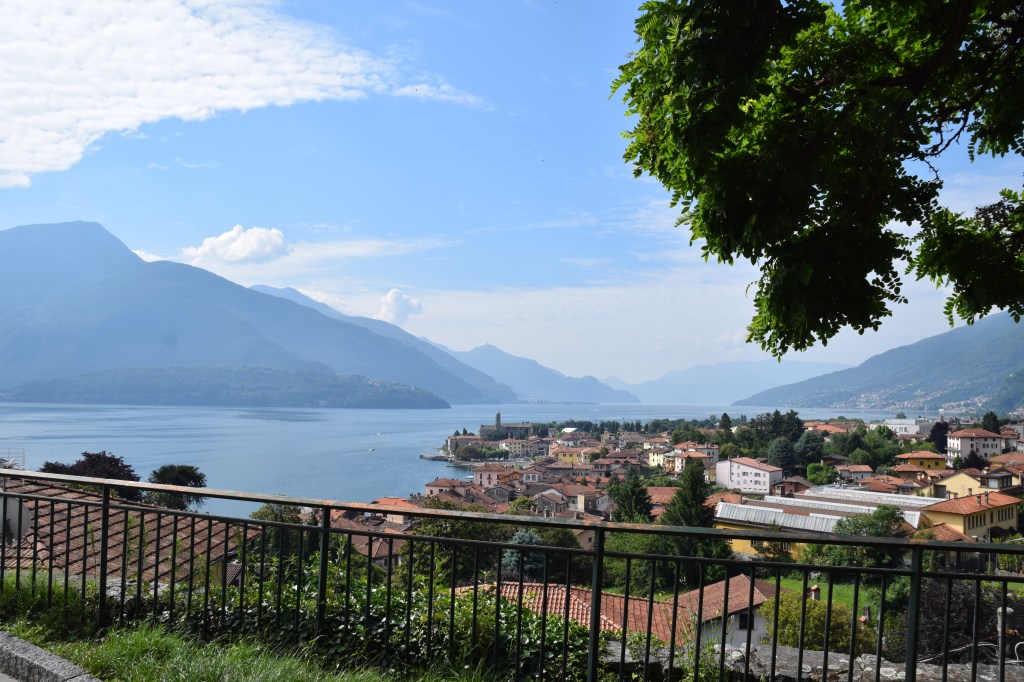
This is the view of the Gravedona and Lake Como from the courtyard. The bell tower in the distance belongs to the utterly gorgeous Chiesa di Santa Maria del Tiglio. The current edifice was built in the 12th-century on the remains of a 5th-century frescoed baptistery which itself was built on top of a Roman pagan temple. The building is made of Lake Como marble – black from Olcio and white from Musso. The facade hosts carved stone reliefs – pagan in symbology – and one can see centaurs, snakes, and Gordian knots. Also found on the facade are two carved mounds that are locally known as the ‘breasts of Queen Teodolida’. Teodolinda was the 6th-century Lombard queen who Christianized the province and converted her people to Catholicism. Her breasts symbolize the fertility of her life’s works.
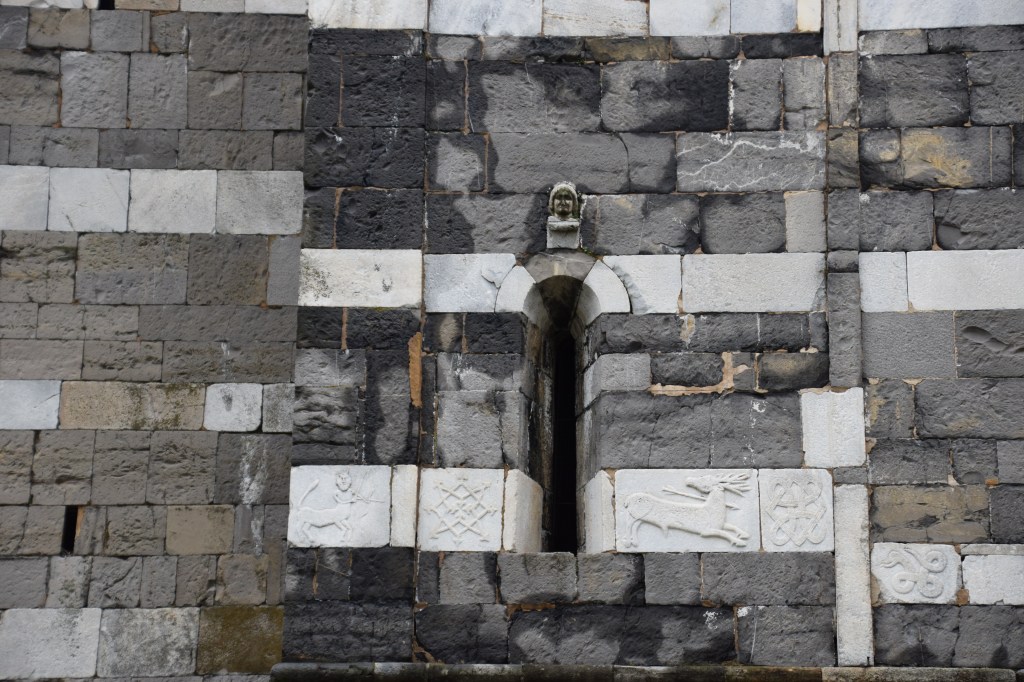
Here is a view of the facade of the church – Chiesa di Maria del Tiglio – that shows some of the pagan symbology.
I hope you have found this one day journey to Livo interesting!
 Wall Madonna's of the Valtellina