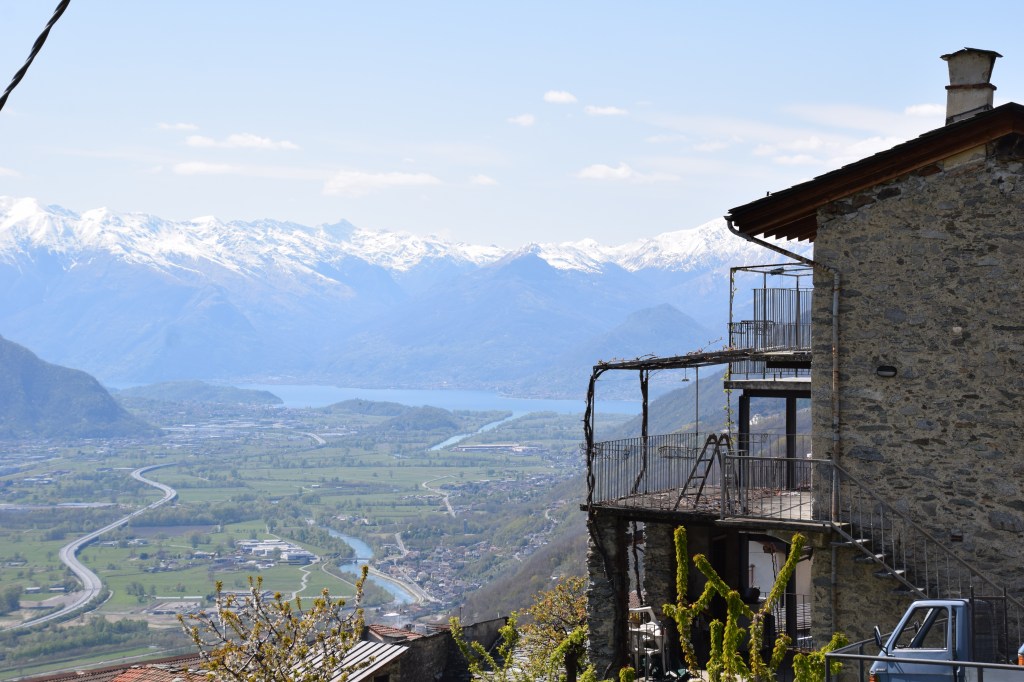
Mello is 700 meters above sea level on the Rhaetian side of the Valtellina. These two characteristics provide cool weather, lots of wind, plenty of sunshine, and stunning vistas! Mello – everywhere – has ravishing views of the Valtellina and Lake Como – lots of charm – and not much else!

MELLO – I adore this Wall Madonna! This still colorful Lady of Mount Carmel features a crucifixion and with Mary and St Dominic. It is a true crime that the entire building is cracking. soon this fresco may be lost!
This ancient village of about 900 people is all tight streets, tiny old casa’s glued together for lack of space, and quite a few surprisingly large, antique three-story crumbling stone buildings that were made up of ‘one-room’ homes. If one doubts that so many families could live in so small a space one need only look closely – the buildings still carry house numbers next to each thick wooden entry door. To reach one’s upper level abode required climbing a wooden ladder – no hand-rails – to an open wooden terrace. There were no internal staircases! When these old homes are marketed this fact is clearly stated in the literature – to get to your rooms you must go outside and climb!
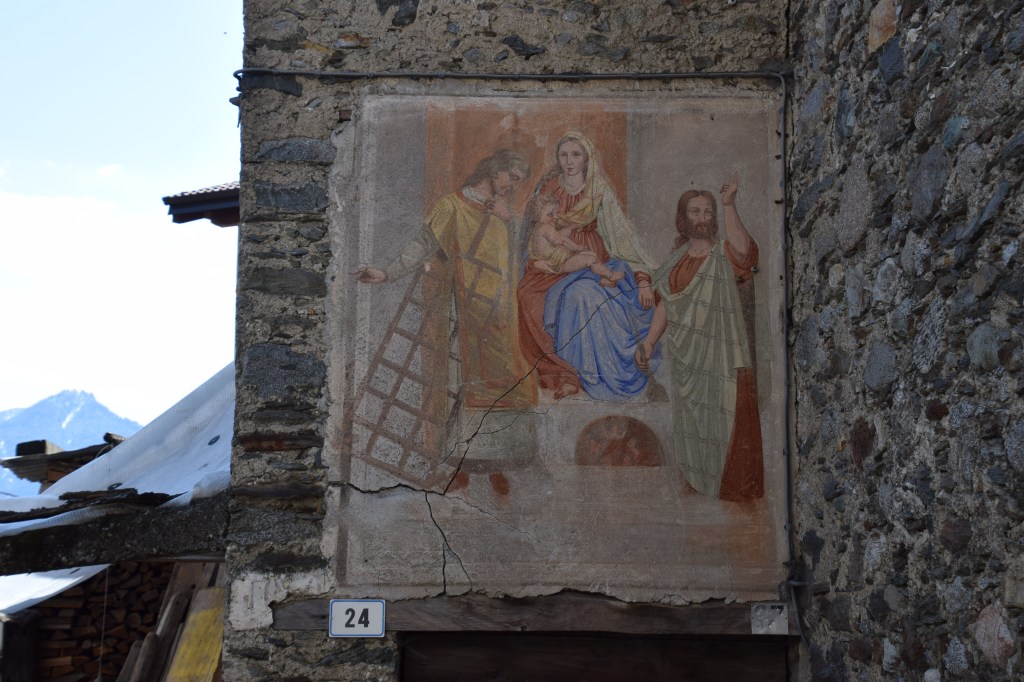
MELLO – A well-preserved Wall Madonna. A Madonna del Latte with San Lorenzo on the left holding the grill on which he was ‘roasted’ and I think the other is Saint Julian the Hospitaller. He is holding what looks to be an oar so that is my best guess. This saint is revered in Malta.
And to get to Mello you must climb – driving five miles of twisting roads to reach the village and all its views – and Wall Madonna’s! I like Mello. I like its ambiance, the industry of its farmers who keep cattle, goats, and sheep here – and grow hay on the mountain top, and I enjoy scouring its’ via’s for Wall Madonna’s. I hope you enjoy these few photos of my best Wall Madonna finds and some fabulous doors and views. Come to Mello for the views!

There is a coat-of-arms carved in the stone surround above the door. It is a circle with a dragon. The stemma of the Lake Como mountain town of Livo is a dragon. And the Terni family of Italy has a dragon as a stemma. As it happens, an Italian surname map shows the greatest concentration of the family Terni in the area of Lombardy where Mello is located. Perhaps this was a Terni family villa. I will have to do more research. I found two doors with a dragon coat-of-arms. This stemma is pretty eroded but the other is not. It is posted below. This is the website address of the Italian surnames map: https://www.mappadeicognomi.it/en/


This Wall Madonna is quite eroded, very dark and dirty, on a small side-street, underneath a wooden terrace, and had a red truck parked in front of it. It is a miracle that I saw it! But close inspection shows a very finely painted fresco. The artist was talented! This is a Madonna of the Rosary and the saints are Peter and Paul.

Here is the full view! I still cannot believe I saw this! The Wall Madonna is on the left side of the building facade.
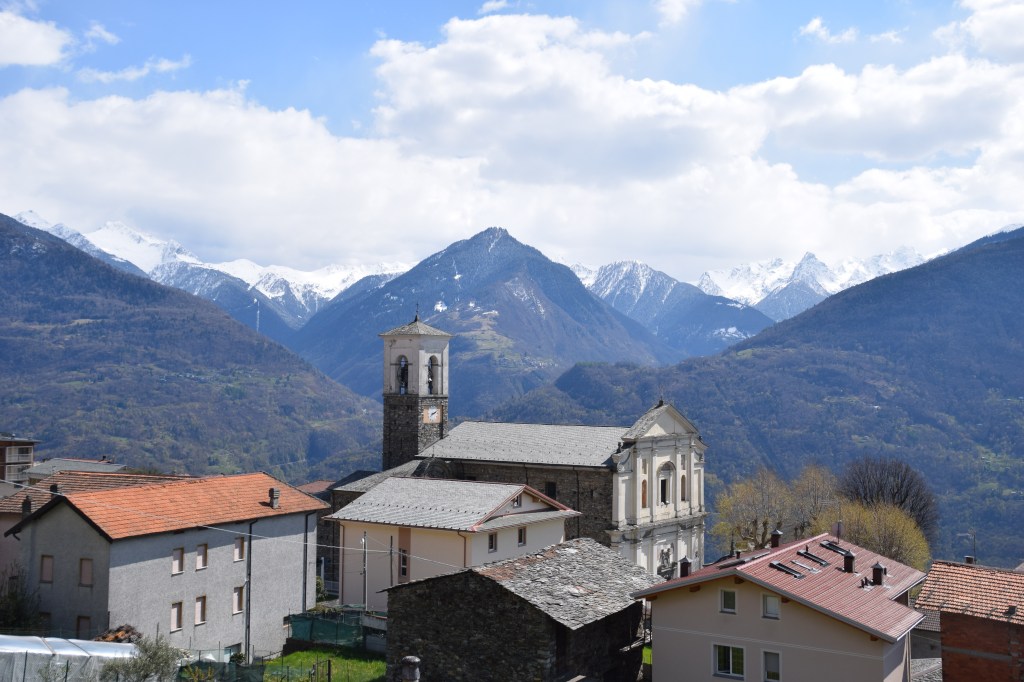
The center of town is always the parish church. This is 15th-century Chiesa di San Fedele – a martyr whose beheading is displayed in a late Renaissance front altar painting! Gruesome to the max! Fidelis of Como was a soldier who died in 304 AD. He was executed for his faith in Como – on Lake Como!
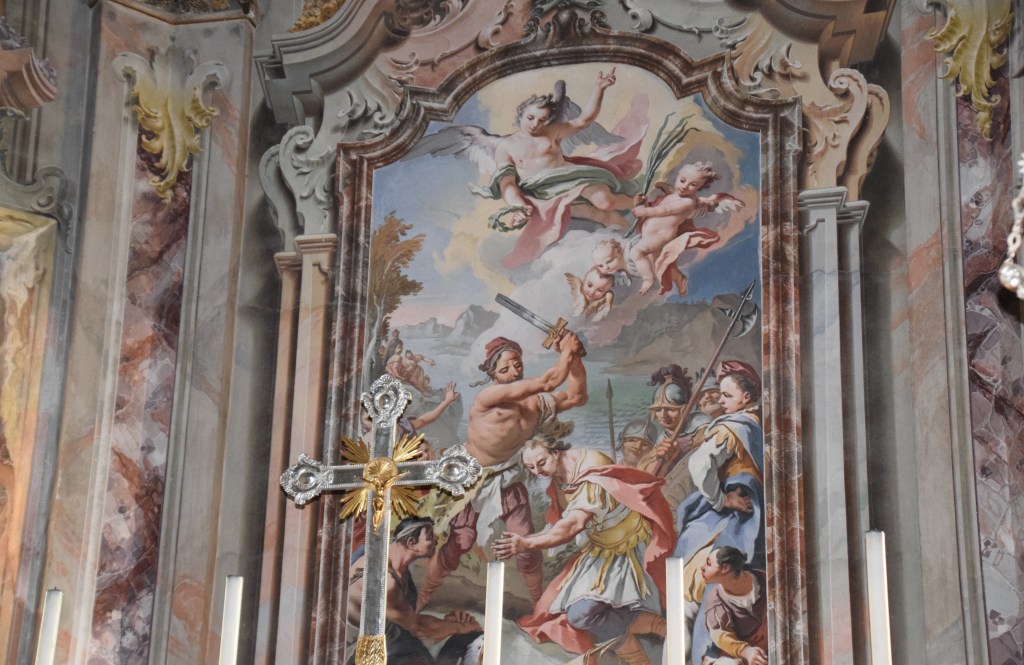
This is the front altar painting that depicts the martyrdom of San Fidelis. The painting likely dates to the late 17th or early 18th century. That is just a guess.
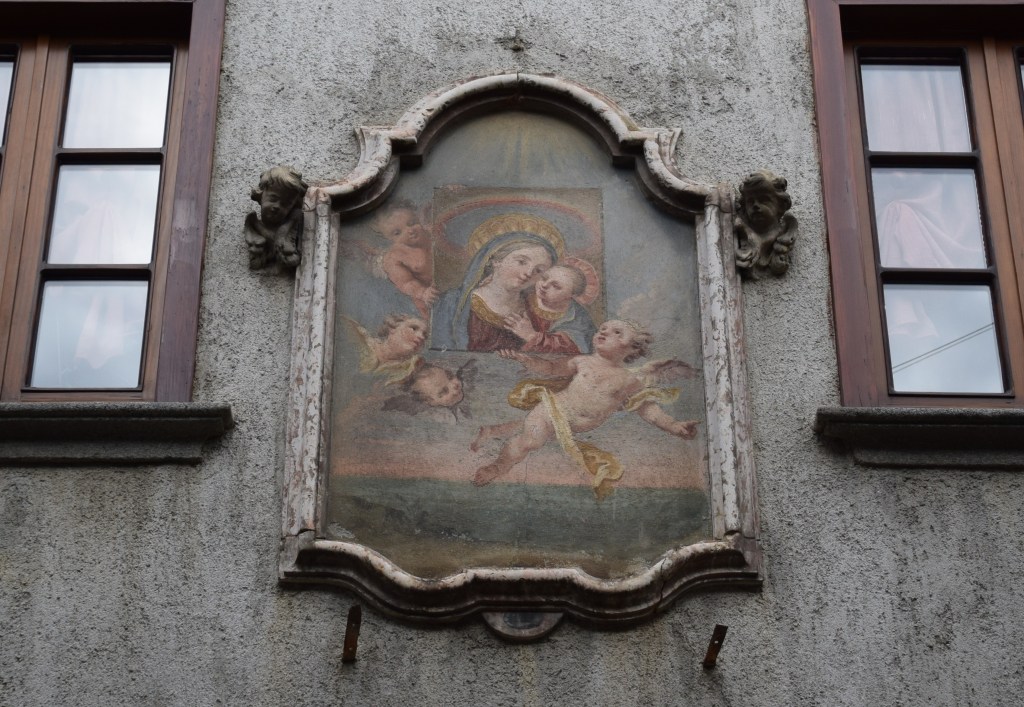
This is a well-maintained Wall Madonna. I like this picture in a picture! It is very 18th-century in imagery which is likely when the Cherub surround was painted. I think the Madonna and child could be older and the addition was a way to preserve and restore what was left of the original fresco. However, I did locate a Madonna shrine in nearby Traona which was dated and – although eroded – has the same ‘picture-in-a-picture’ design. It is posted below.
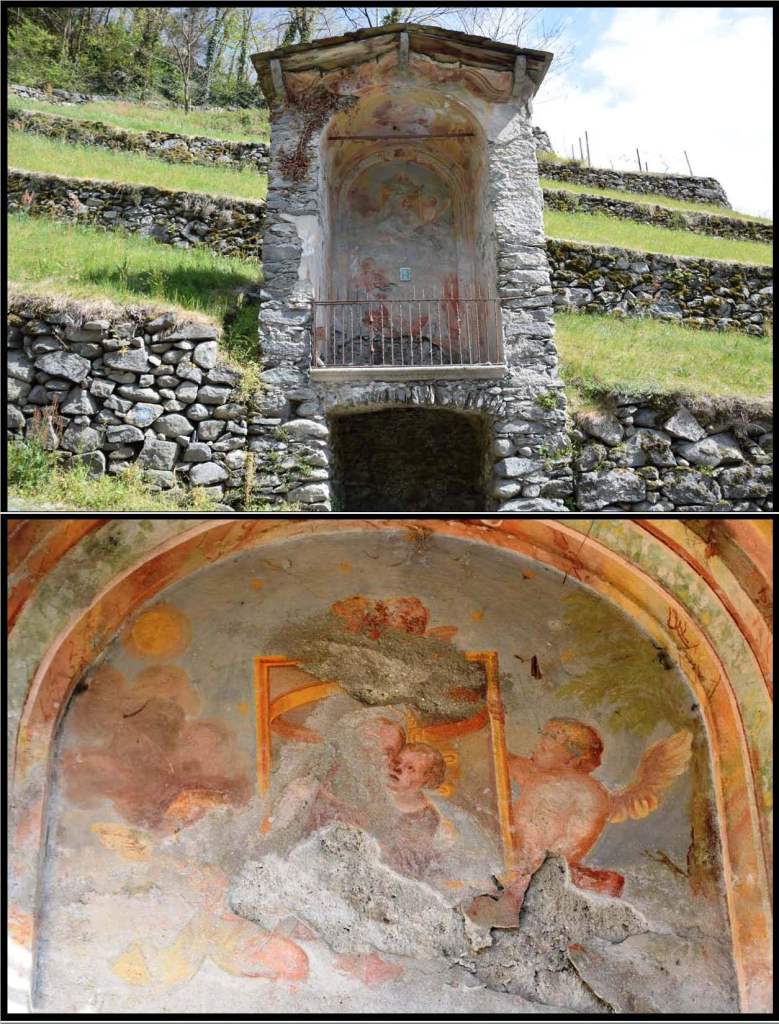
This Madonna shrine is on via Pianezzo in Traona – the town to the east of Mello. The shrine sits on the entrance to the old mulattiera leading to the localita’s outside and above Traona. Although this fresco is not dated the other Madonna shrine is dated 1776. This shrine very likely dates to the same time period.
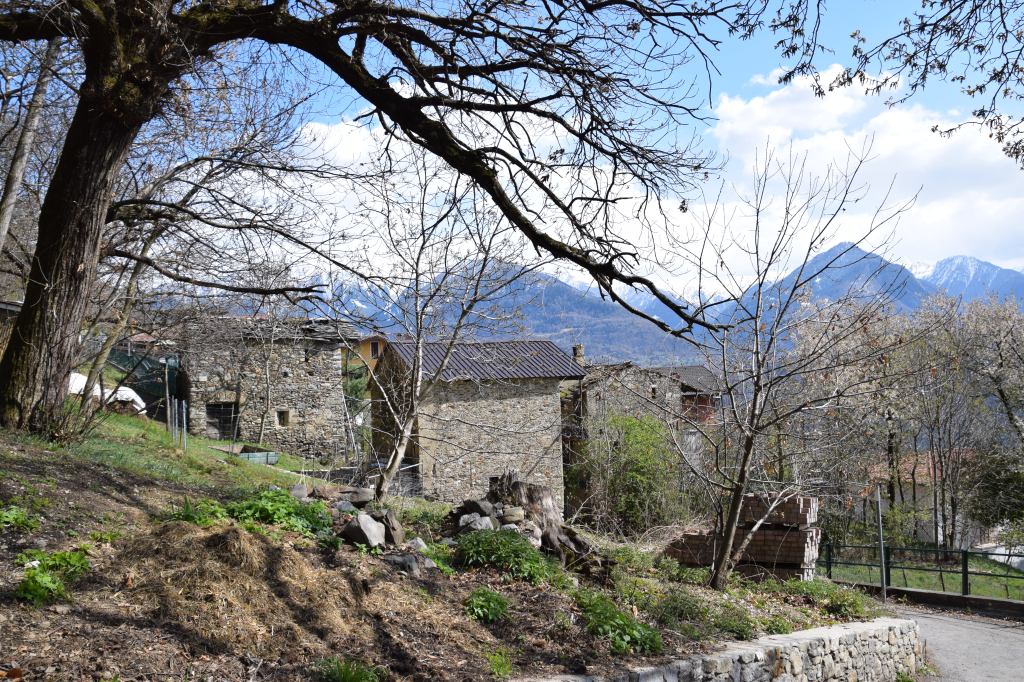
This is the via degli Alpini – the road out of Mello that goes into the summer mountain pastures and homes. This is the far west of the town and the end of via Piazzo. There is farmland all around here.

Most of this Wall Madonna remains intact but its location under a wooden terrace and the direction of the sun made a good photo impossible. This is a very high-quality fresco as one can clearly see. This artist had a nice talent and sense of perspective and balance. The full view is below.

Above is the full fresco. The photo is marred by the sun but one can still see its lovely qualities and bright colors.
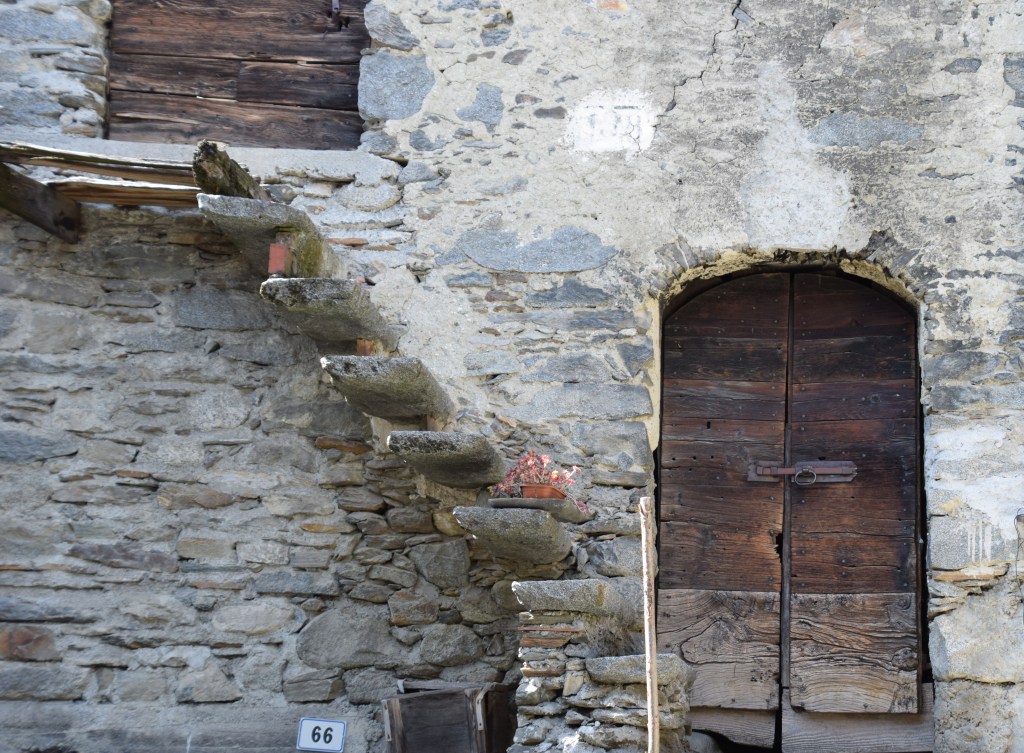
A home with an external staircase to the upper rooms! Few homes had internal staircases.

This is a gorgeous fresco depicting the Madonna of the Rosary with St Lawrence on the left (with the grill on which he was martyred) and St Januarius on the right. Some fool defaced this fresco but she is still wonderful. The Madonna was painted in 1797. This was an impossible Wall Madonna to photograph. This is painted on the second story of a home on a narrow street. The other side of the street is walled, and the wall has a fence running along the top of it. The fence surrounds a planted garden with a locked gate. The top of the wall was narrow but I could have stood on it if I had a way to climb it.
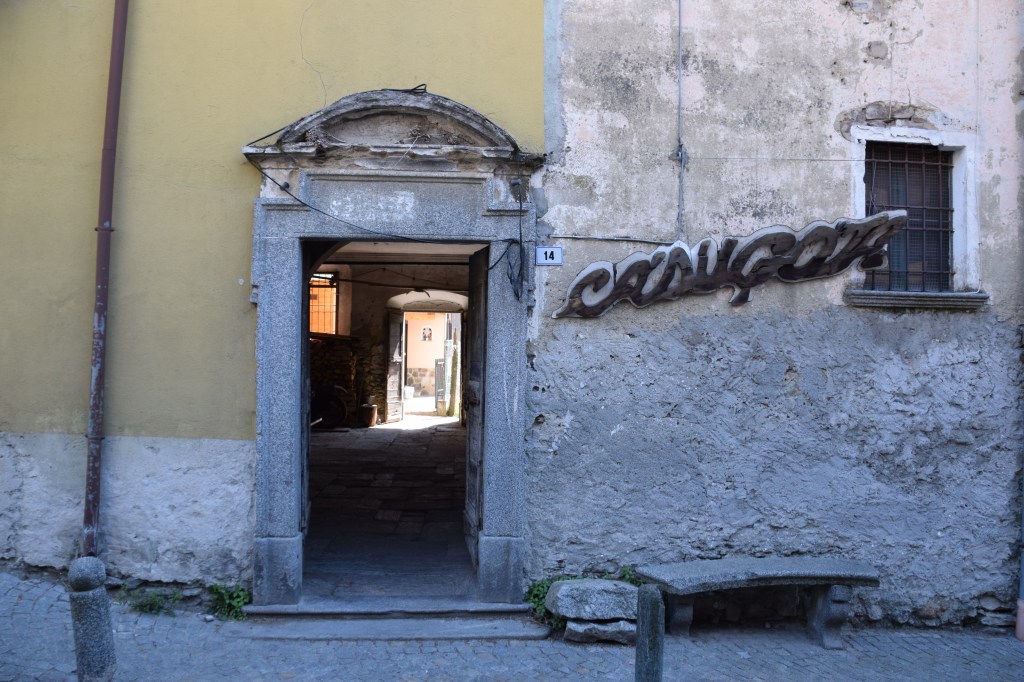
This might be the entry door to a small local business. The word Ca’ is Lombard dialect and it means ‘casa’ – house. This says the house of Sugoti. I really cannot read the carving so that is a guess.

This Wall Madonna was painted in 1873 and restored in 2017. It is lovely. The text reads: PER SUA DEVOZIONE – POLINI PIETRO-ARTUCCHI……RESTURATO DI FULVIA SIMONATO – LUGLIO 2017. The roughly translated meaning is thus: Created for the devotion of Pietro Artucchi Polini. Restored by Fulvia Simonato in July 2017.
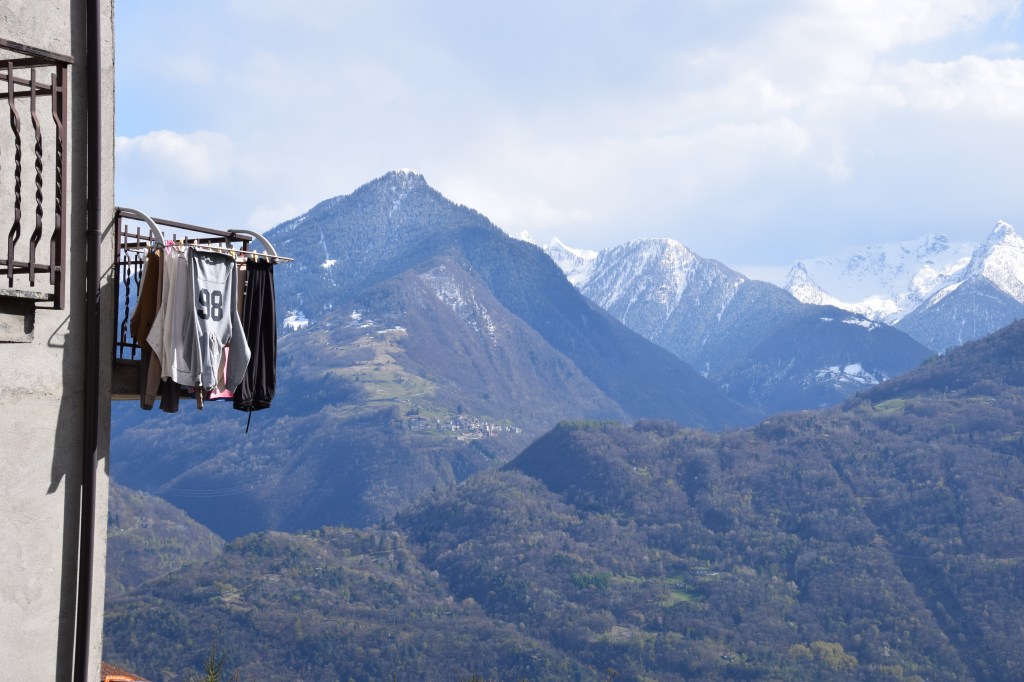
Laundry with a view! That is Bema in the distance on the mountain. Bema is just off the road the leads out of Morbegno to the Passo San Marco. This pass links the Valtellina with the Val Brembana and the Bergamo Alps.
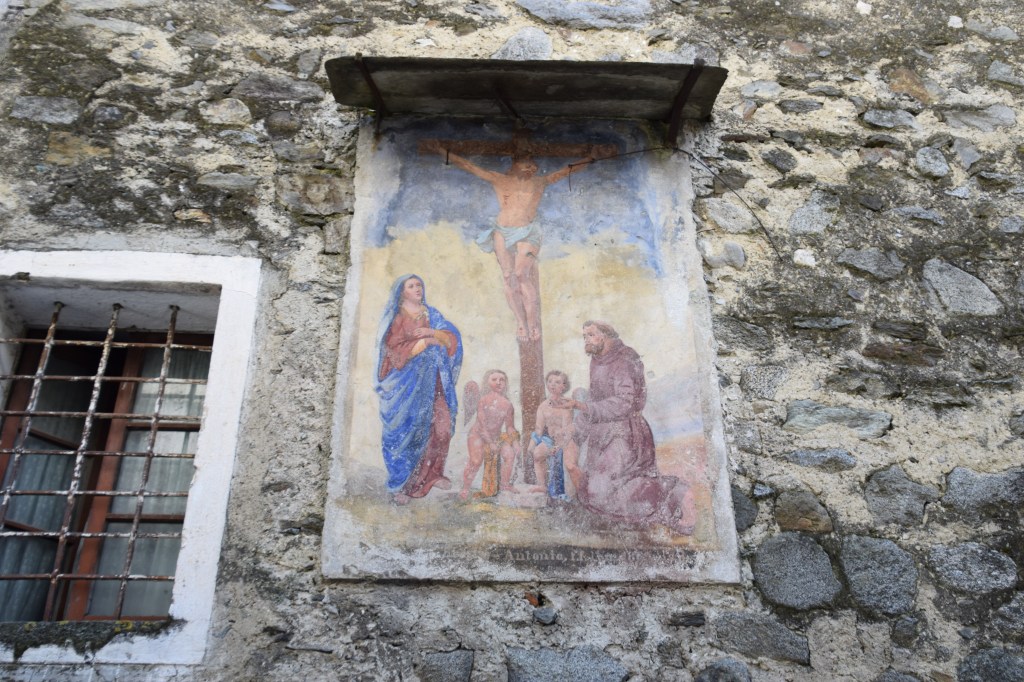
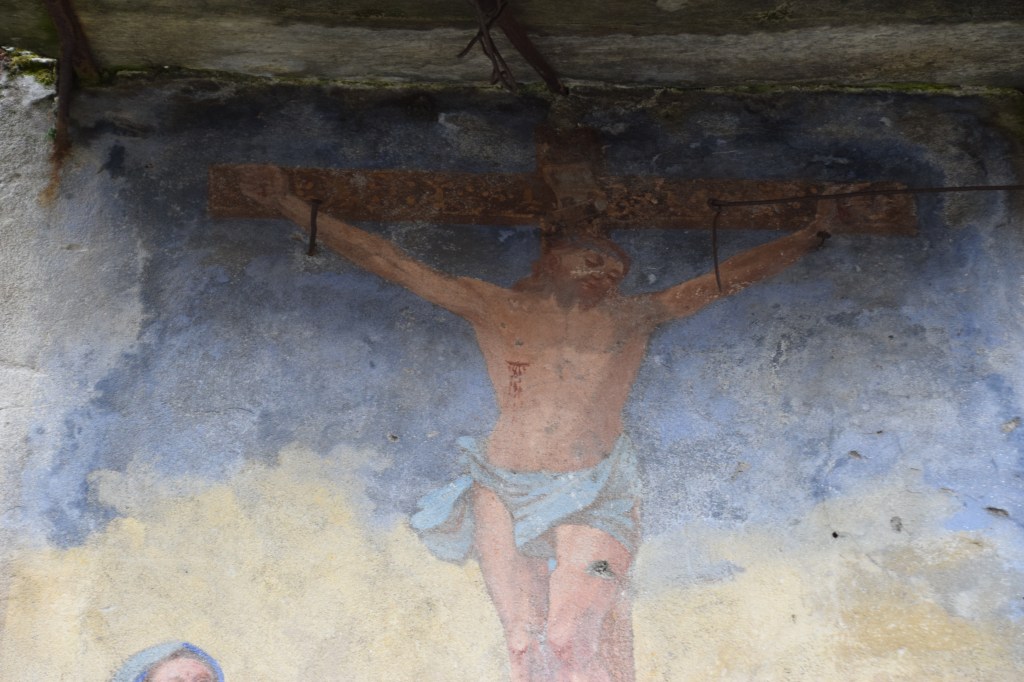
MELLO – Wall Madonna – a very colorful crucifixion. The cover protects the fresco but impedes viewing and photographing. The imagery depicts the Virgin Mary, two angels and St Anthony of Padua (The city is called Padova in Italy). It is common to write the name of the saints below their images in the fresco. There is some legible text remaining that says Antonio. The angels look like they are holding chains. Two close-up photos of the fresco follow.

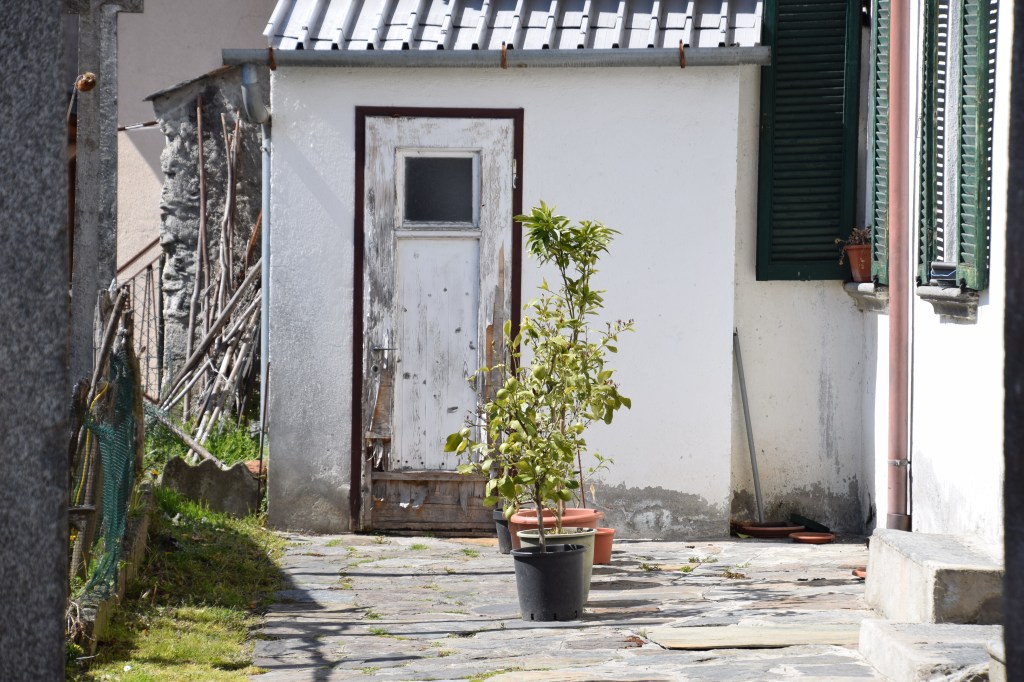
This is one of the interior doors of a large, walled villa on via Roma. There is a small vineyard to the left in the courtyard.

This Wall Madonna was painted in 1905. The crucifixion depicts Mary – in the blue robe, a likely Mary – the mother of St James, and St Joseph. I cannot be sure though but – given the veiled and unveiled images – it seems clear there are two women and one man. That means the likely imagery is of the three saints – two Mary’s and Joseph. The legible text reads: BARAIOLO PIETRO – F.F.L. 1905. Roughly translated this abbreviated text should read: FECE FARE PER [LA] SUA DEVOZIONE – Pietro Baraiolo had this made for his devotion in 1905.
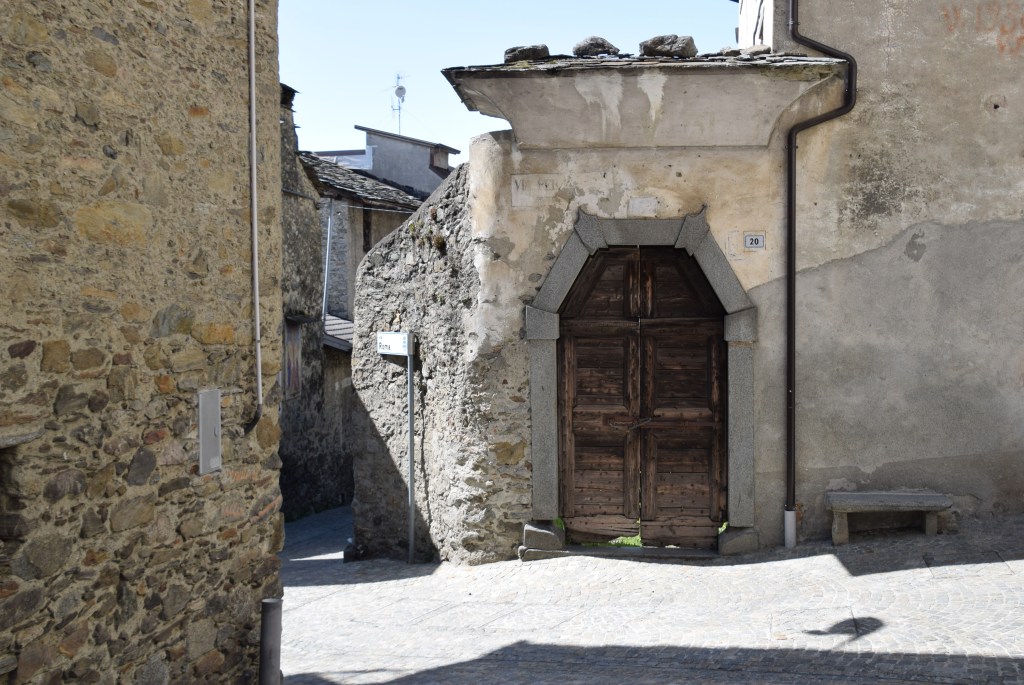
This is the entry door to one of several large, walled villas in the town. Clearly, the town was very prosperous at one time. The villas are still occupied but look like they have been broekn up into apartments since it is clear more than one family occupies them.

Although quite eroded, I loved this Wall Madonna for the image of Mary standing on the globe and crushing the head of a serpent (Satan) with her bare feet. Because the Saint on the right is holding a trumpet and there seem to be remnants of wings behind him, I think it might be the Archangel Gabriel – although I cannot be sure. Based on the clothing and colors, the other saint might be Saint Martin of Tours. San Martino is a popular saint in this area.
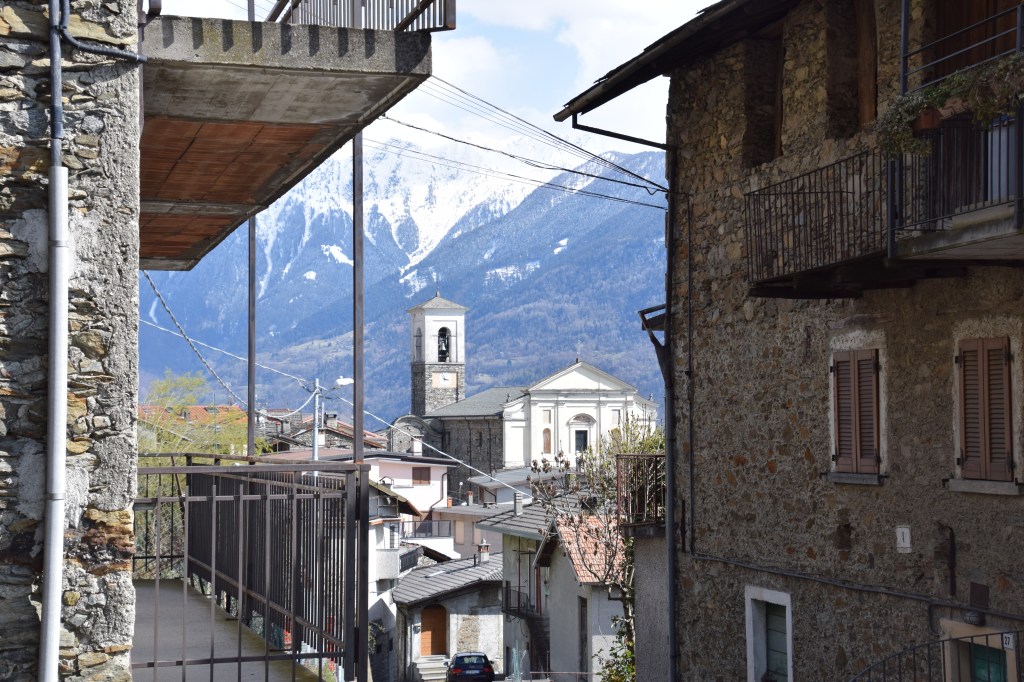
This is a great view illustrating the compactness of the streets and homes. The towns grows outward from and around the parish church. I was trying to get a full view of the front of the church from somewhere in the village but it did not prove possible.

This Wall Madonna was restored in 2006 and is clearly labeled. I think the original fresco might date to the 18th-century. The restored text reads: Above – AVE MARIA; Below: SANT’ABBONDIO + SANT’ANTONIO (di Padova); Below the images: Benedici questa casa – Ridipinto anno 2006. This is the rough translation: Bless this house – (This fresco was) Repainted (in the) year 2006.
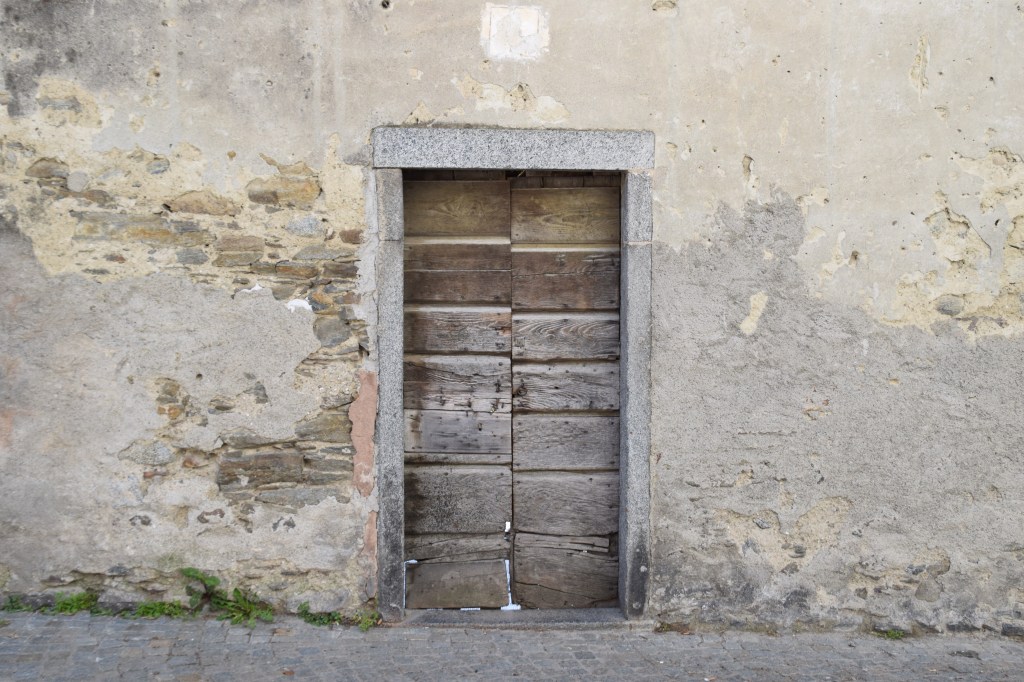
This is an old entry too to a courtyard of a walled home. Surrounding one’s home with a stone wall was the norm.
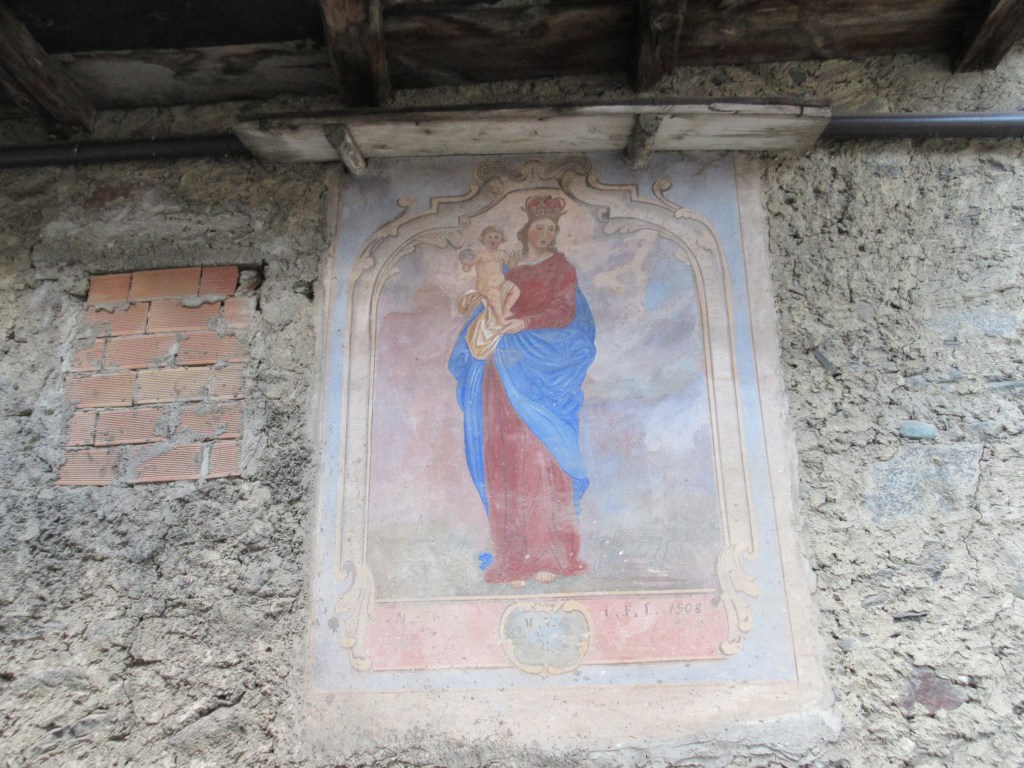
This Wall Madonna has been cleaned and restored. These frescoes were once brightly colored. I would love to go back in time and walk through the town when all these frescoes were pristine! This is a 1908 fresco and Jesus is depicted as Salvator Mundi – Savior of the world. The remaining legible text shows: F.F.L. 1908. This text was the common abbreviation for: FECE FARE PER [LA] SUA DEVOZIONE (….had this made for his devotion)

This is the entry door to the courtyard of a large villa.
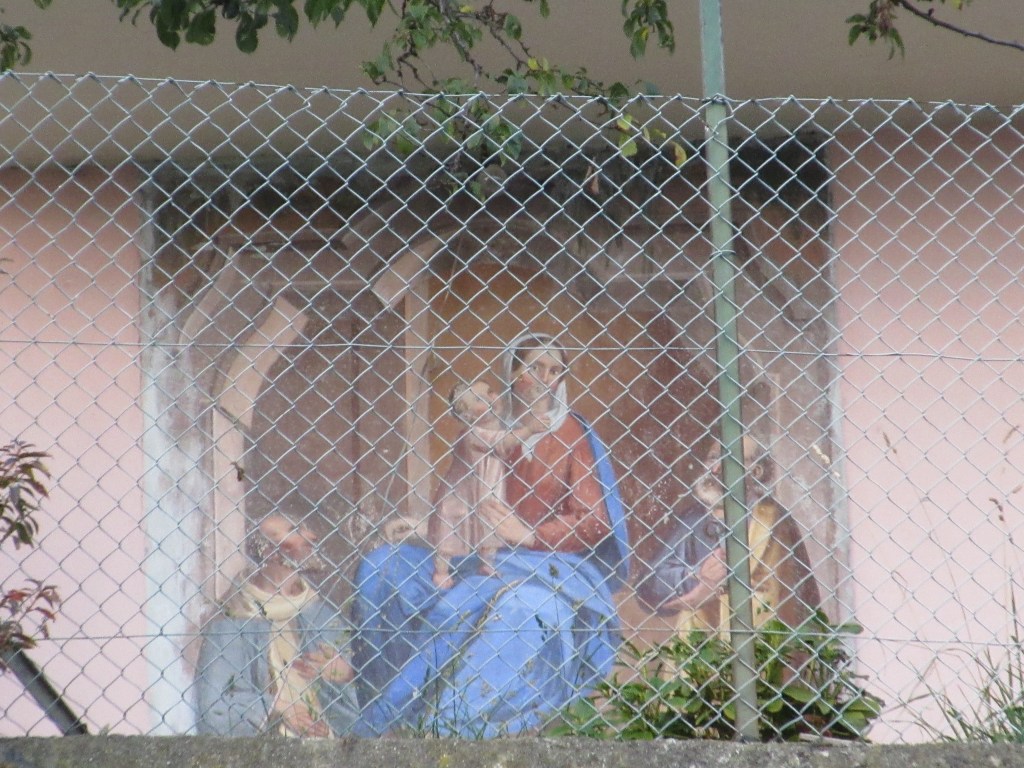
This Wall Madonna was not accessible to my camera being on the facade of a fenced home the yard of which I could not enter. The imagery clearly shows the Great Virgin sitting on a throne holding the infant Jesus. The saint to the right is Peter which is indicated by the keys (to the church) that he holds in his hand. This implies that the saint to the left is Paul who generally is shown holding the book of laws to the church.
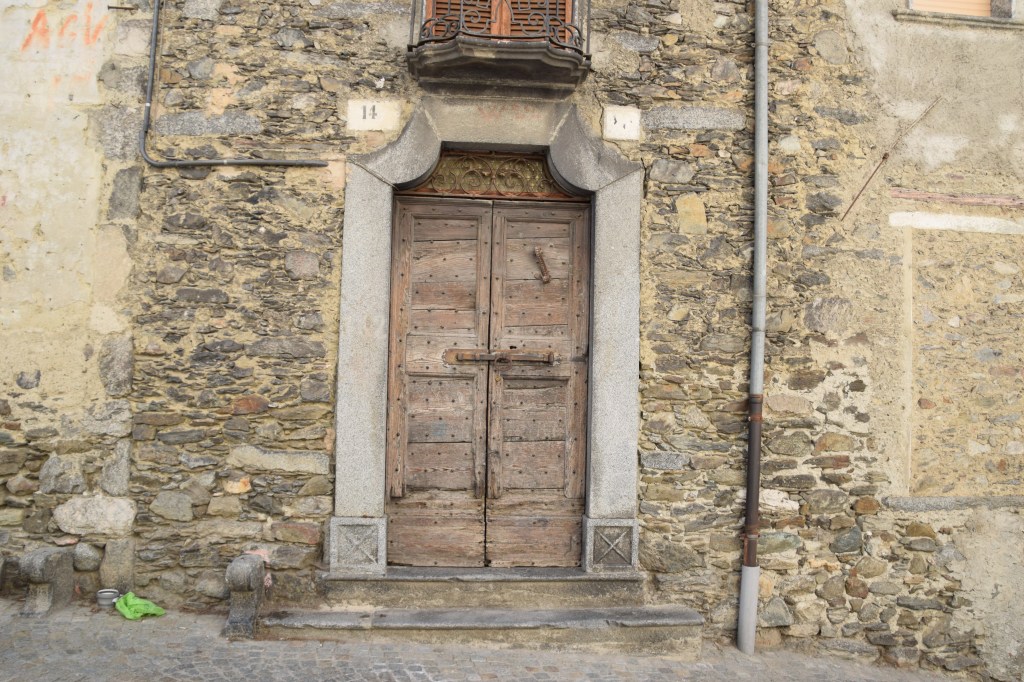
This entry door is on via Vanoni and the unoccupied old villa is right in the center of town next to the church. This home was impressive and is still impressive even though decayed and empty of inhabitants.

This Wall Madonna has little left of it. But those who own it still had what was left restored. One must admire the respect paid to these images! The remaining imagery shows a Coronation of the Virgin. If you look you can see the crown being held over Mary’s head. There are two figures beneath the crown. Mary is to the left I believe.

A truly beautiful door that served entry to a once very grand estate! It’s beauty makes the message written onto its stone surround confounding. It says: DIVIETO DI SOSTA – DO NOT STOP. This means, in general, do not park in front of this door. Hence, the door is still in use! But one might hope that the lovely stone and wooden door – a work of art created by its quality and design – would not be marred by such a trite message that could easily have been offered by a sign next to the door.

This is a Madonna shrine located on the road (via Piazzo) that eventually leads out of the town and into the Alps – if one goes up – or to Traona if one walks laterally across the mountain. Traona is a medieval town that was once walled and had a gate through which one had to pass to reach the alpine roads and villages. There was a customs house at the gates to Traona and on paid a duty to enter. Most of the wall is gone but the gate is still there. I have posted a photo of the Traona gate below.
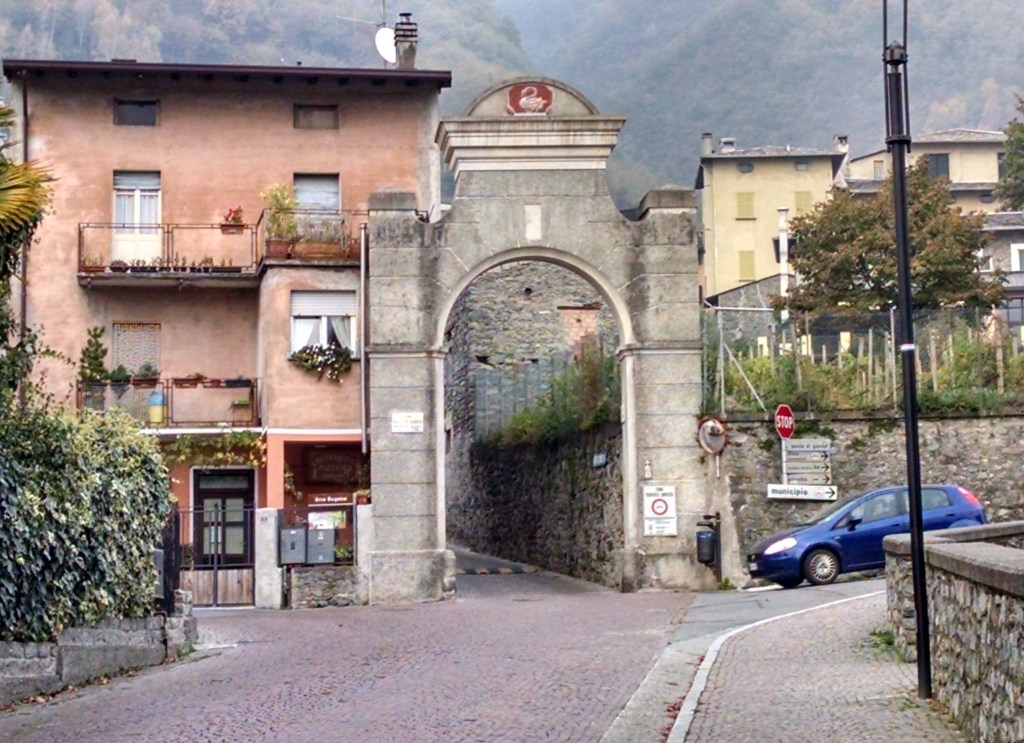
This is the entry gate to the previously walled city of Traona. Traona was a hub for commerce and trade in the Valtellina and it was here in the adjoining customs house – seen to the left – that duty on the goods being brought through the Valtellina was collected. There is a coat-of-arms above the entrance. A swan is featured. This is the symbol; of the Parravicini family – former dukes of Milan.
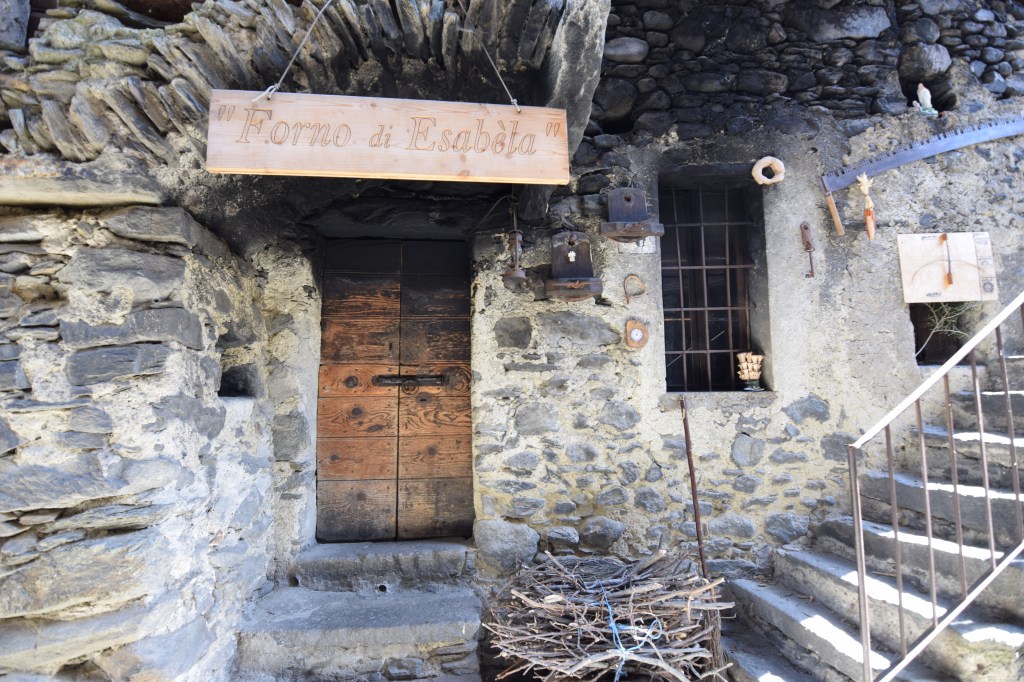
This is a baking business – the Oven of Esabeta. The business is located on a very short and hidden side street and to reach the ‘oven’ one walks down some stairs. I have to wonder if Esabeta bakes bread for those who bring her their dough! Most Italian towns had communal ovens and communal dairies where people would bring their breads and milk to be processed. This was more efficient than having the needed equipment in one’s home. Most homes were only one room!
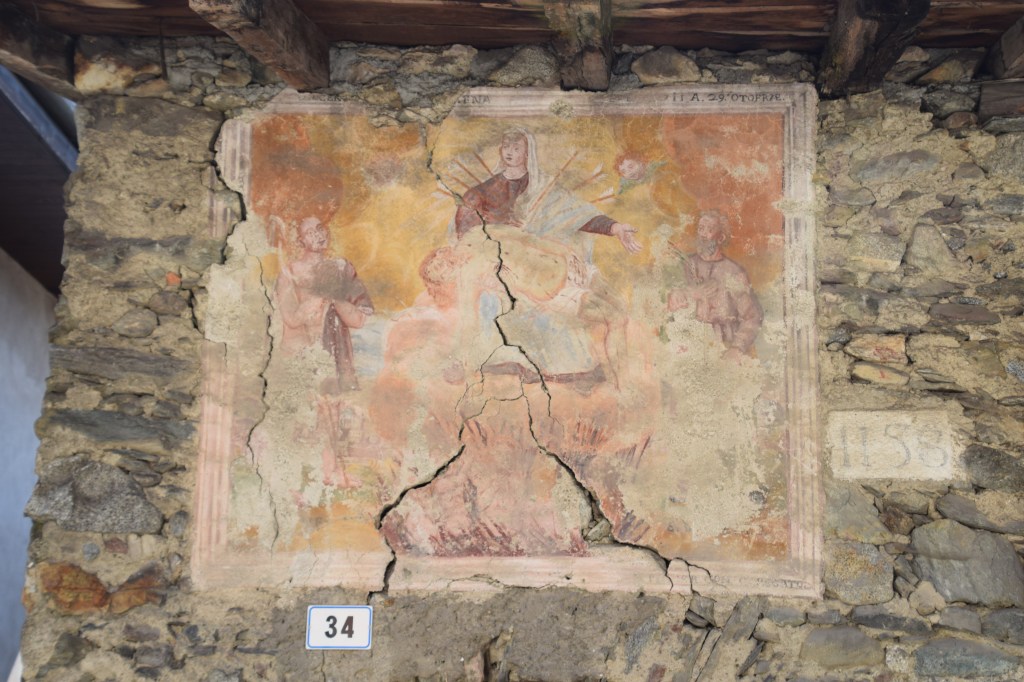
This is a very creative Wall Madonna. It is a Pieta and also features the imagery associated with the depiction of Mary as the Mater Dolorosa – Our Lady of Sorrows. Mary holds the recently crucified Jesus – the common Pieta – yet she, also, is pierced by the seven arrows of the seven sorrows from the prophecy of Simeon (Found in the Gospel of Luke, Chapter 2, verses 25-35). The fresco is dated October 29, 1711. I cannot be sure but I believe the saint on the left is San Fedele and the saint on the right is has a name that begins with ‘V’ -perhaps San Vincenzo. The writing is almost completely gone so I am guessing. Saint Fidelis is the patron saint of the town so one would expect to find present in the Wall Madonna’s painted here. As to the other saint – I have no idea other than my guess based on the initial.

A wonderful view from the back of the town!
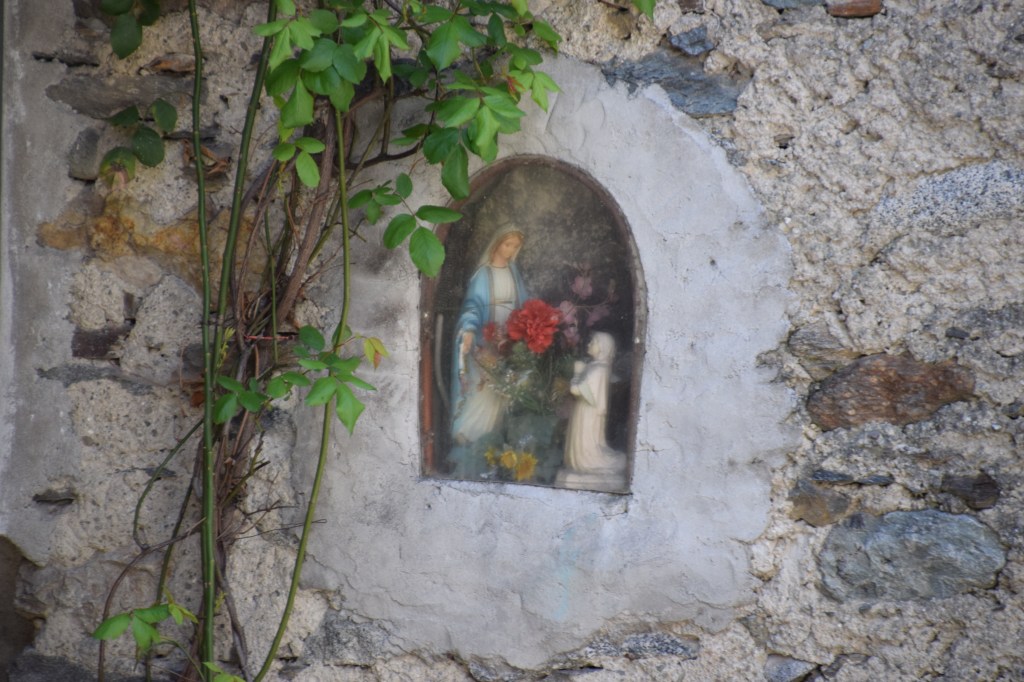
I always find many modern Wall Madonna’s. There are very few present day frescoes but most homes have some kind of Madonna shrine. I really liked this one! I found about twenty of these small shrines in Mello.
 Wall Madonna's of the Valtellina