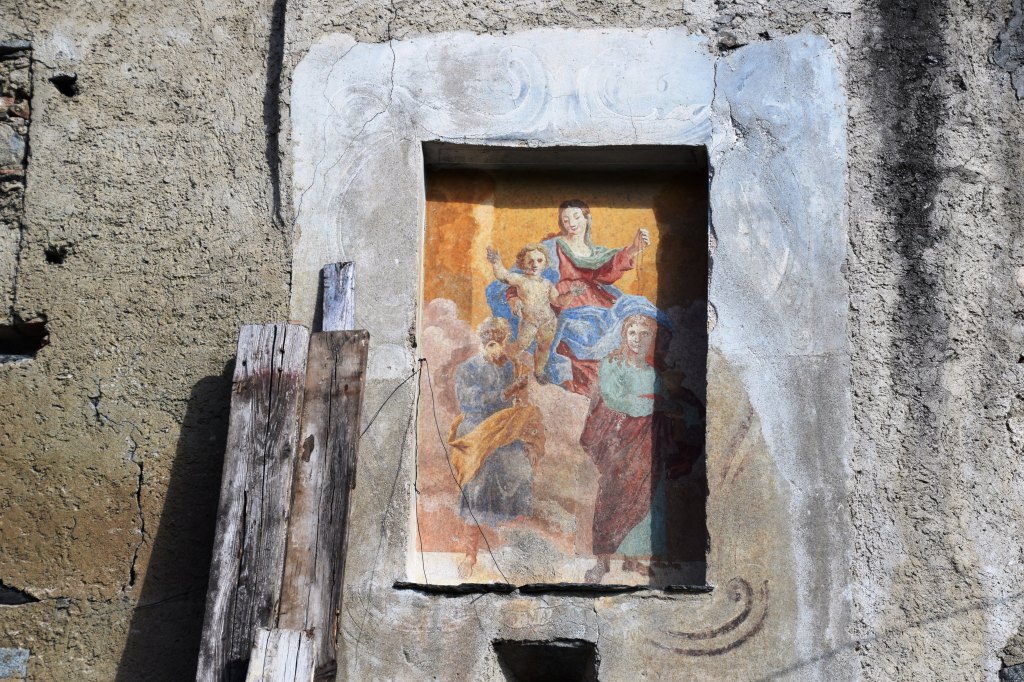
March 16, 2021: I have been photographing Wall Madonna’s for almost ten years. Initially, they were simply a curiosity to me. As my interest grew, my focus changed. Recently, because of finding multiple frescoes in Colorina, Sacco, Gatti, and Triangia that were clearly painted by the same artists, I have now begun to look at the imagery with new eyes. Because of that, I discovered that two frescoes in Mantello – where I walk every day – were not only painted by the same artist but that artist is the same one who painted the frescoes I found in two other towns 20 miles away and in the mountains just outside Sondrio.
Two weeks ago while searching for the Wall Madonna’s attributed to the 17th-century artist from Bergamo – Francesco Ambrosione – I discovered a fresco in Triangia in the Chiesa di San Bernardo that looked exactly like a fresco I discovered in Gatti. Gatti is a tiny frazione of Castione Andevenno. I have learned from my many excursions, that Wall Madonna’s are very often not visible from the main streets in villages and towns. They are located on what was once the front of homes – the entrance that led to the kitchen – the heart of every Italian house. But what we see as the front of old homes – those facades facing the modern, wide, paved roads – are often what were once the backs of those homes. To find frescoes I must enter the narrow alleys between old homes that now generally function as tiny backyards. Hence, when I arrived in Gatti, I searched for Wall Madonna’s between a double-row of mostly ruined, old stone houses separated by a narrow, stone street that was likely the original ‘via Gatti’ – when foot traffic was the norm. It was the treasure I found there that led me down a path of discovery and new insight. After revisiting my photographs of Gatti and Triangia, and assessing the local Mantello frescoes with a more directed insight, it became obvious that the same artist painted all five Wall Madonna’s – the two frescoes in the church, the fresco in Gatti, and the two frescoes in Mantello. I am still bathing in the delight of my new found ‘vision’.
Now that Lombardy is in the Red Zone again and completely shut down, this devotional ‘street’ art of the villages, towns, and cities is the only picture gallery and art museum that one can access. I am appreciating this amazing opportunity – so ordinary to Italians but so extraordinary to me – more and more every day. So, to both celebrate and testify I offer some photos of the five frescoes by the unknown wanderer who left his legacy on the walls of the homes of the hopeful – who invoked the goodwill and protection of their deity through the intercession of the Madonna who is the constant face of their love and thankfulness. I hope you can see the similarities between these works which are all that remains to identify the long dead artist who plied his trade and sold his talent to the faithful whose charity has left us with his art. All the frescoes are from the late 17th or early 18th-centuries. Three have legible dates. If you are interested – and I hope you are – here are the montages I made with an informative narration. Excuse me if I repeat myself in describing the frescoes. It is fascinating that even the most talented artists repeated faces and colors and body positions in their artworks. Noticing this took me ten years! I guess I am a slow learner! Enjoy your own excursion through this small pinacoteca!
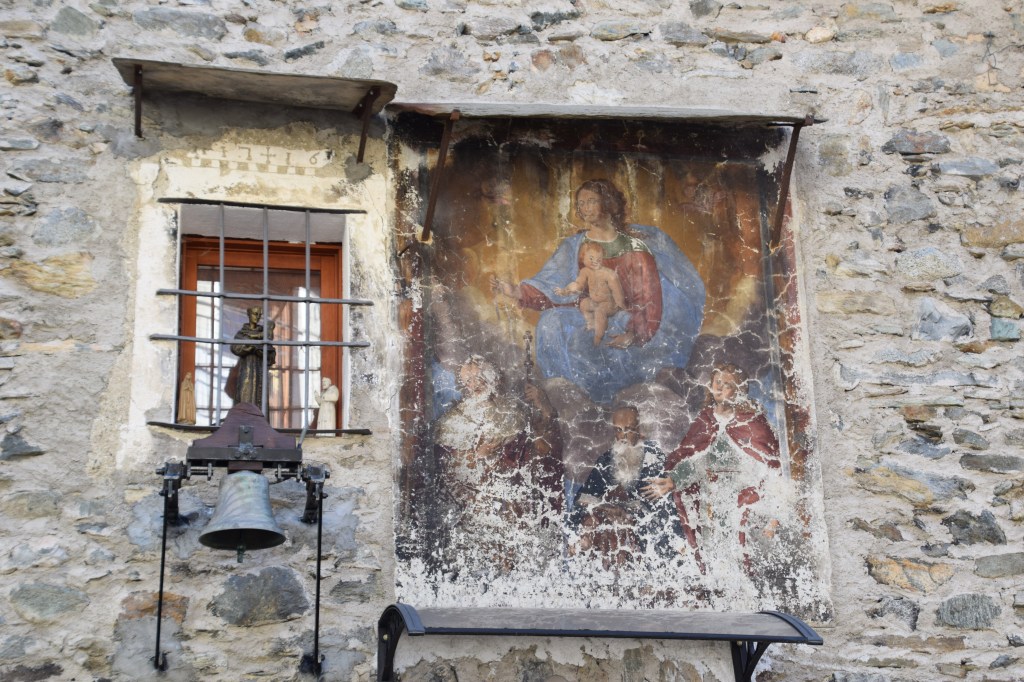
This is the first fresco I found on February 17, 2021. This fresco is located on via Gatti – one side of which has renovated homes and the other side a double row of ancient stone houses through the center of which runs what was likely the original via Gatti. Because this was the old road built wide enough for only carts and people , the fresco was painted on what was the front of the home. It would be easily missed unless one was motivated to walk between these old houses.
I was in Gatti searching for a fresco attributed to Francesco Ambrosione who was born in Branzi in the province of Bergamo and painted in the Valtellina and Valsassina in the late 16th-and early to mid 17th-century. Photographs of the four documented frescoes – some signed – are displayed here on the Lombardia Beni Culturali website: http://www.lombardiabeniculturali.it/opere-arte/autori/19921/
Here is a montage of the photos that I took of his work. The top left fresco was restored and then obscured by a terrace roof when the home was renovated. I was standing halfway up the flight of stairs that leads to the old front door and the new terrace.

The 2015 article by Dalmazio Ambrosini found on pages 245-249, in Quaderini Brembani 13, offers this information about Ambrosione in its title and text: I pittori Francesco e Giuseppe Ambrosione di Branzi, “magistri vagantes” tra Sei e Settecento verso Valtellina e Valsassina This translates as: “Francesco and his grandson Giuseppe Ambrosione were known as magistri vagantes ( = Latin), “wandering/traveling masters.” They made their art in the late 16th and early 17th centuries in (the) Valtellina and Valsassina.”
I had found three of the frescoes – two in Caiolo Alto, and one in Fusine and was looking for the fourth among the many frazioni of Castione Andevenno. I found it on February 22 in Guasto and decided to celebrate by exploring more of the frazioni for Wall Madonna’s.
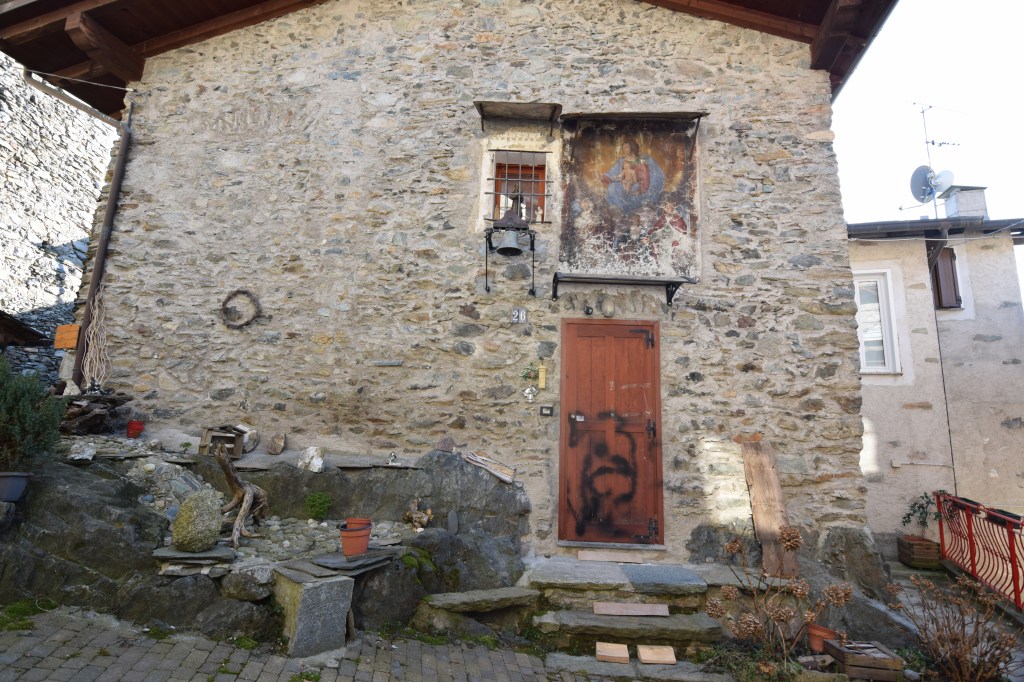
Taken with a wide-angle lens this is a full view of the home – sadly vandalized. The window next to the fresco seems ‘newer’ and shows old plaster that is inscribed with the date 1716. This dates the home and fresco to at latest – 1716. However, the home and fresco may be older than the date of whatever work once decorated the wall where there is now a window. I stopped in Gatti again on February 22 to walk from there to the tiny fazioni of Bonetti and Cadoli. I then retrieved my car and headed up the mountain for Barboni. I had to drive through Triangia to get there and decided to explore the historic center of town and see if the church was open.
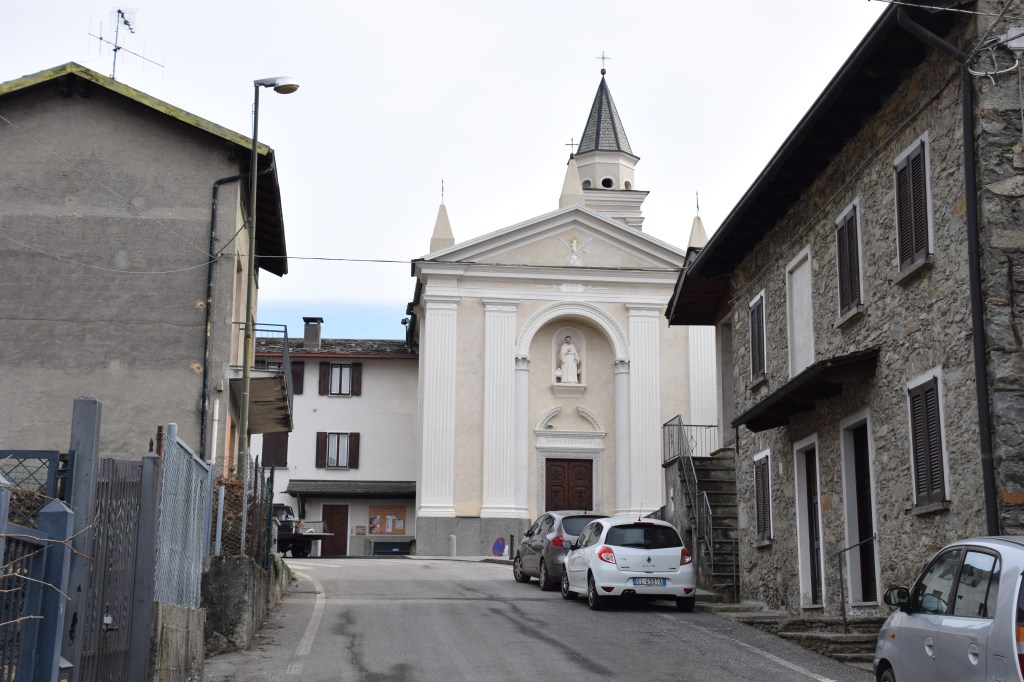
The church was open and upon entering I found two Madonna frescoes facing each other on the side walls.
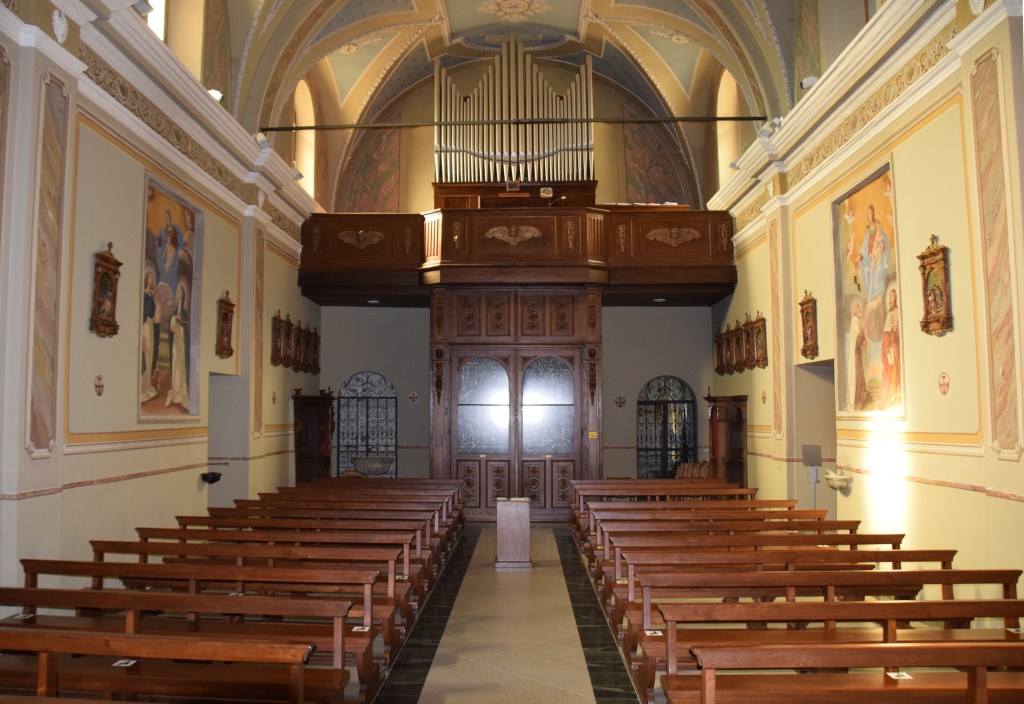
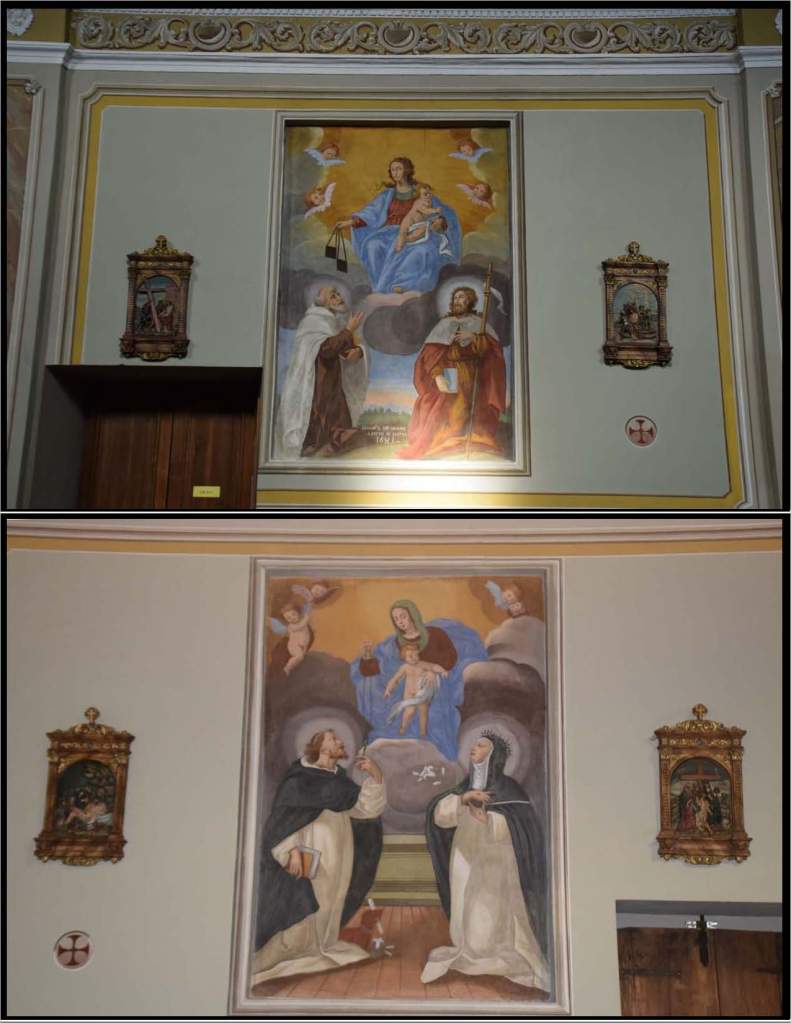
The photo was taken from the front of the church looking back toward the entry doors. One can see the two frescoes facing each other. These are not paintings attached to the walls. They are frescoes and both depict the Madonna del Carmelo.

When I saw this fresco I was immediately struck by the exactness of the image of Mary found in the fresco in Gatti. To confirm my find I contacted the Lombardia Beni Culturali to inform them of what I found and ask for confirmation and the name of the artist who painted the frescoes in the Triangia church – San Bernardo. I was put in touch with a former director and expert on the history of the Valtellina who – although not confirming the authorship – attested to the similarities. She, also, suggested an examination of the facing fresco and told me the painter of the two church frescoes was unknown. I created a montage comparison and shared it with her. I have not heard back as of yet.
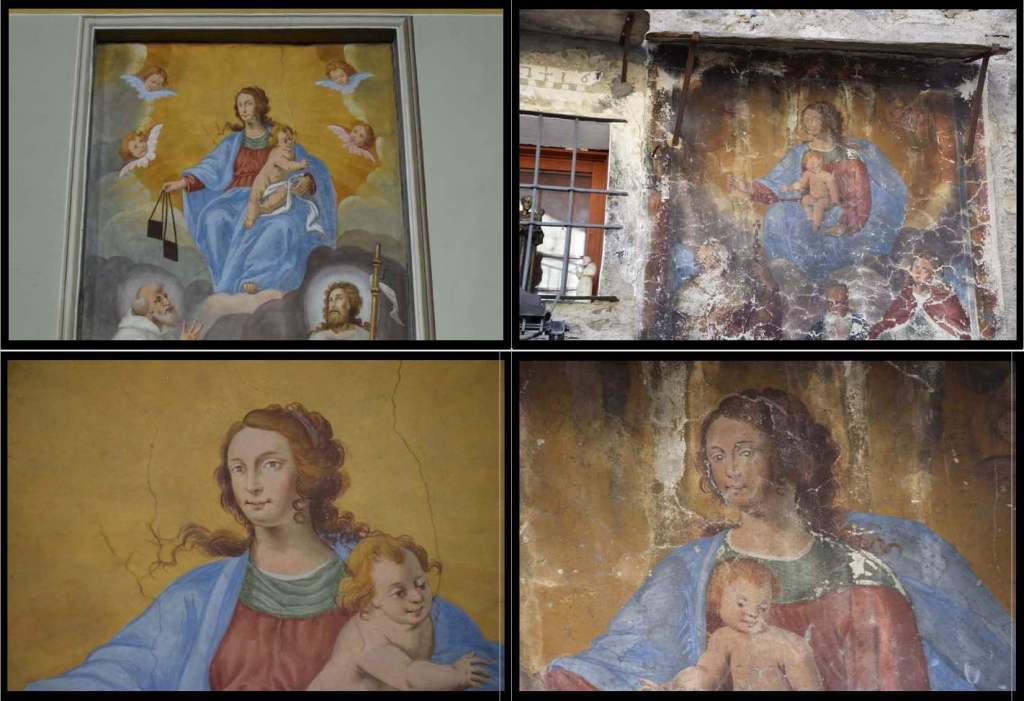
Here is a montage offering a comparison of the two frescoes.

This is the fresco found on the right wall as one faces the altar. A close examination indicates similarities to the facing fresco.
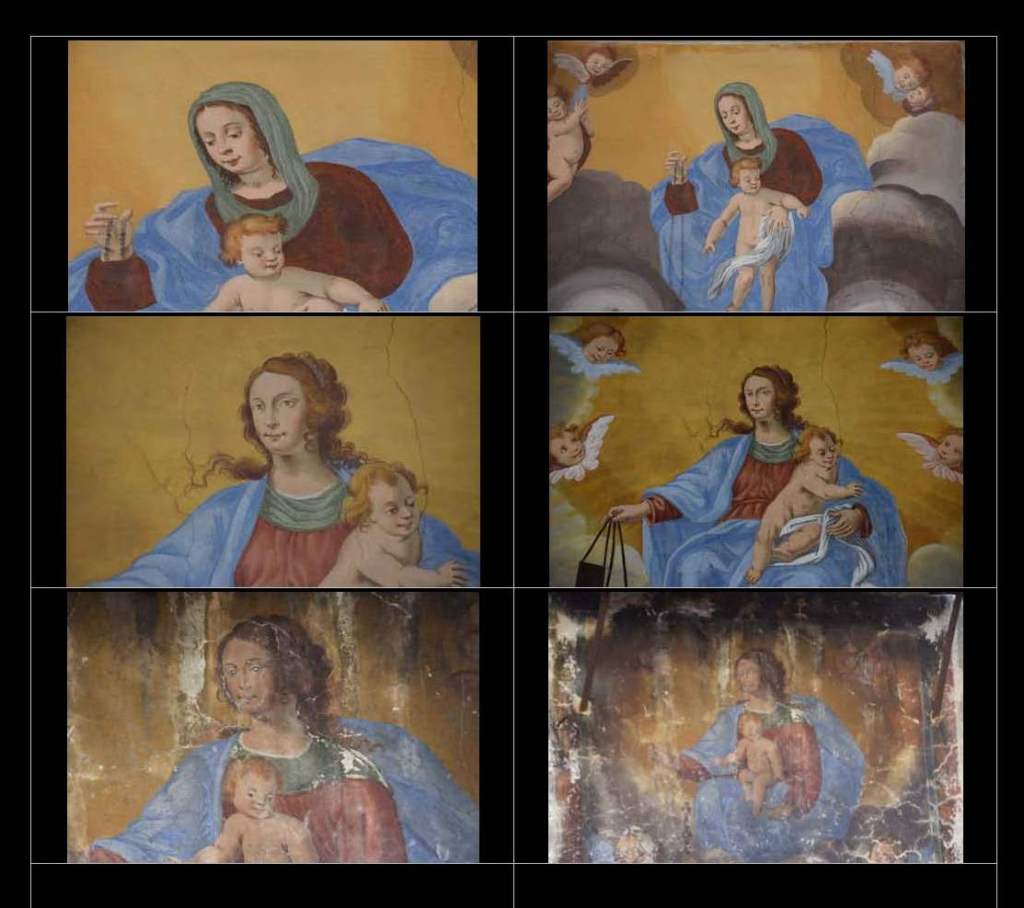
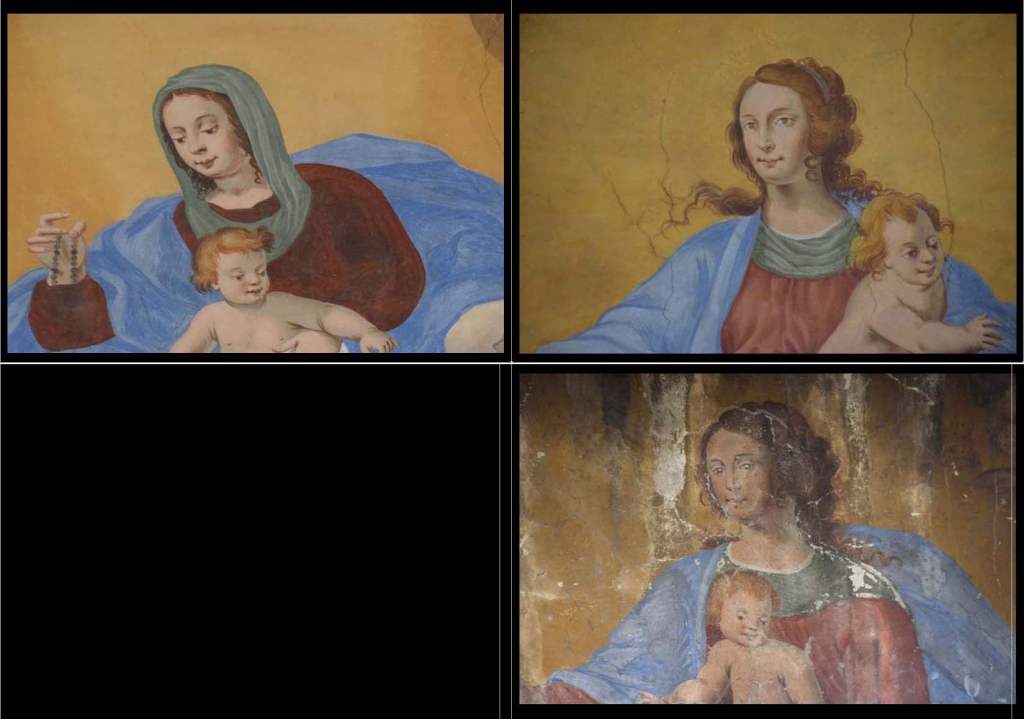
Here are two montages offering a comparison of the three frescoes. There are clear similarities in imagery, color, clothing, and the shapes of the bodies and features of the faces.
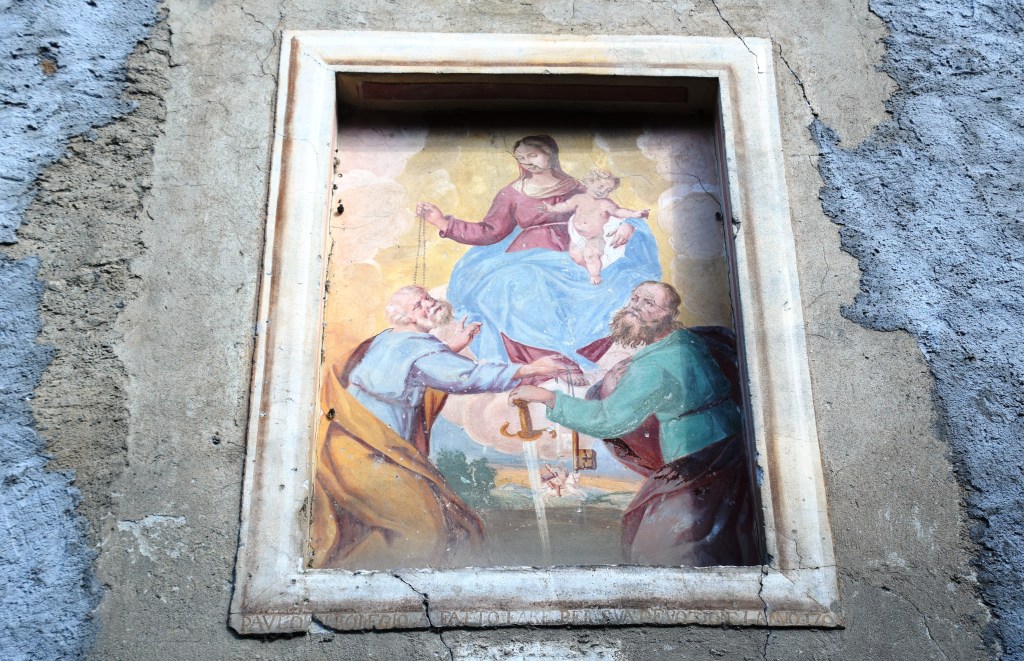
On March 15 while taking a walk from Dubino to Cino – as is my habit – I stopped to admire the beautiful Wall Madonna’s along the way and was suddenly struck by the colors and imagery of this fresco. I have walked by and photographed this Wall Madonna many times. Because it faces the Rhaetian side of the Valtellina, the view is often marred by the shadow cast by the sun. The fresco sits on the narrow, one-lane local road that leads from Mantello to Cino. The road passes through what were three old frazioni, the names of which are indicated by the names of the sections of the road – via Cantone, via Pusterla (sitting directly next to the Torrente Valle del Mulini), via Torchi, the wider SP5 to Cino. Each frazione has a small group of ancient homes clustered together. The exception is Cantone which may have been a località since an old road – recently extended to Cino – is host to homes scattered along it for two miles and there are no clusters of houses as there are on via Pusterla and via Torchi. Via Pusterla has a small church – the Oratorio della Madonna della Grazie. A località is a geographical area associated with a larger town that is inhabited but lacks a populated center having instead occupied homes scattered throughout a territory.
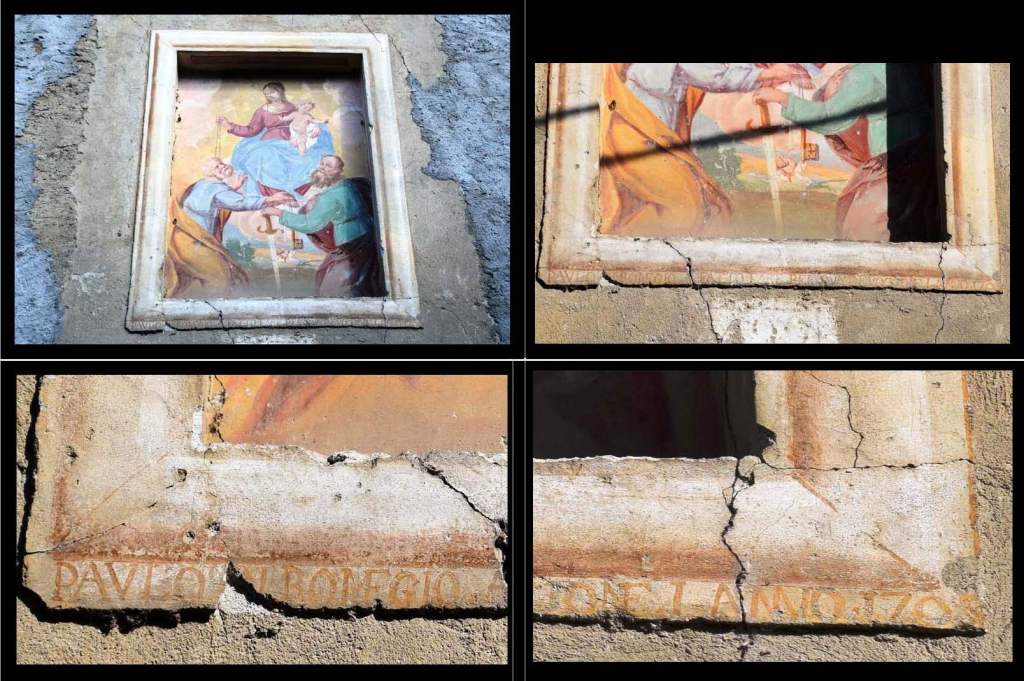
The fresco has a legible date (1708) and dedication (PAULO ** BOMEGIO A FATTO FARE PER SUA DEVOZIONE L’ANNO 1708). This likely survived because it was carved into the stone frame. In between Saints Peter and Paul is St George – the Dragon Slayer. Via Torchi is the old road to Cino – on the mountain. The parish church there is the Chiesa di San Giorgio.
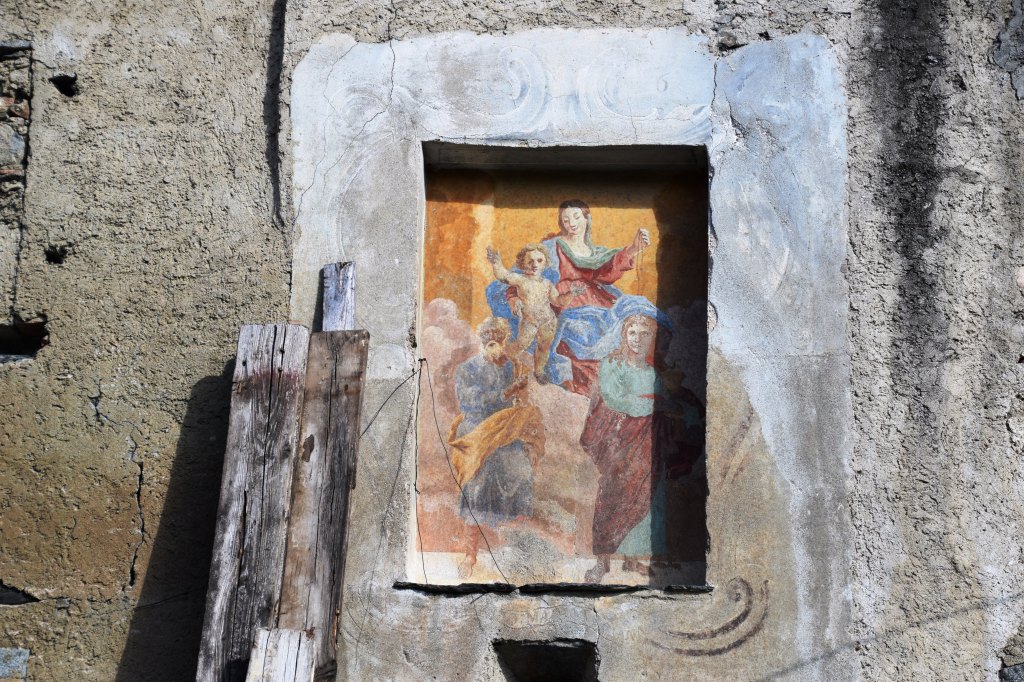
This second Wall Madonna is located a few houses up the road from the previous fresco. It was originally decorated by a painted frame and there is little of that embellishment remaining. There are a few hints of what was once a dedication but essentially everything is lost to the erosion caused by years of exposure. It was only three days ago that I become cognizant of the resemblance of these frescoes to each other and then their similarities to the three frescoes in Triangia and Gatti. It was a ‘Eureka!’ moment for me and one that made only too clear the difficulties faced by art historians to catalogue and identify these astonishing works of art. Mantello is 34 kilometers – about 23 miles – from Triangia and Gatti.
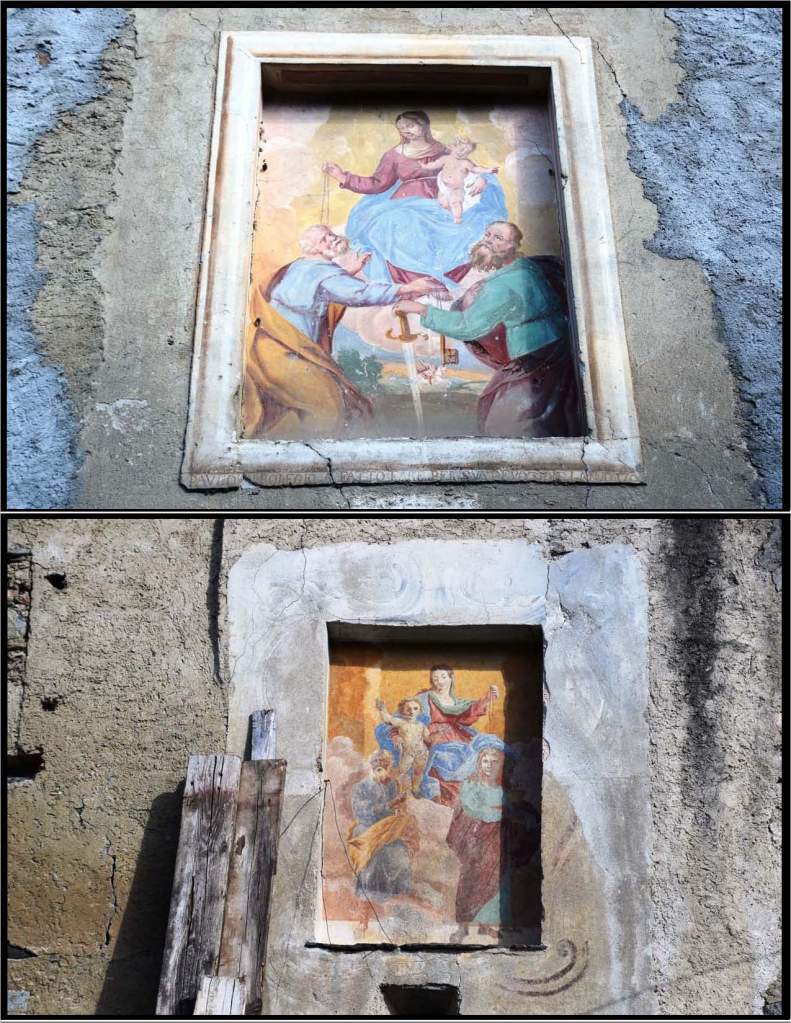
Via Torchi is a road not preferred and only traveled by those who live along it. Gatti is not host to any tourism and Triangia is visited for its lake which lies outside the small village. Finding the connection between these five frescoes was – for me – a very happy accident. Finding Wall Madonna’s often hidden on what used to be the street faces of homes and are now private, interior alleys is a triumph over the laws of probability In fact, even those experts who record, analyze, and catalogue the history and art of the Valtellina often do not have knowledge of all the frescoes to be found in a single small town. For example, I found three 15th-century Wall Madonna’s in Colorina – two up the local road to the summer pastures and perhaps two kilometers from the village center and one in town. However, only one was known – the one located in the town on via Bocchetti – the district of the town from which the road to the mountains is found. The one farthest from town turned out to be the oldest with a fairly legible date that appears to be 1410. The fresco in town is dated to 1497.

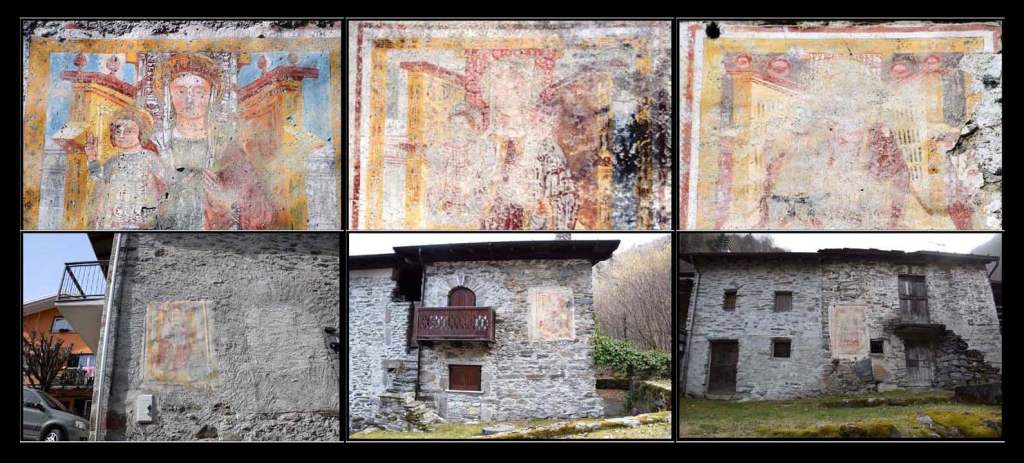
These are the three 15th-century Wall Madonna’s located in Colorina. The fresco on the left is dated to 1497. This Wall Madonna is featured on page 20 of the 2010 article Segni sacri sulle case: Pittura murale devozionale tra comunicazione e memoria written by Giovanna Virgilio and published by the Comunità Montana Valtellina di Sondrio. Although it is in Italian, one can appreciate the photos of the Valtellina frescoes and Google Translate those parts of the article in which one might have an interest.
The fresco in the center is located about 1 kilometer outside the town on a renovated farmhouse that is along the road that leads into the summer pastures in the mountains. The fresco on the right is dated to 1410 (the date and part of the dedication remains). This Wall Madonna is located on the facade of what was a tiny cluster of stone houses and now seems to be privately owned by someone who renovated part of the cluster of homes. This house lies just before the municipal road sign that limits traffic into the mountains to those who are authorized. To drive these local roads one must pay a fare either at the City Hall (Municipio) or a local bar. It was finding these three clearly similar Wall Madonna’s that truly altered how I ‘saw’ this art, how i thought about this art, and how I recorded this art when I found it.
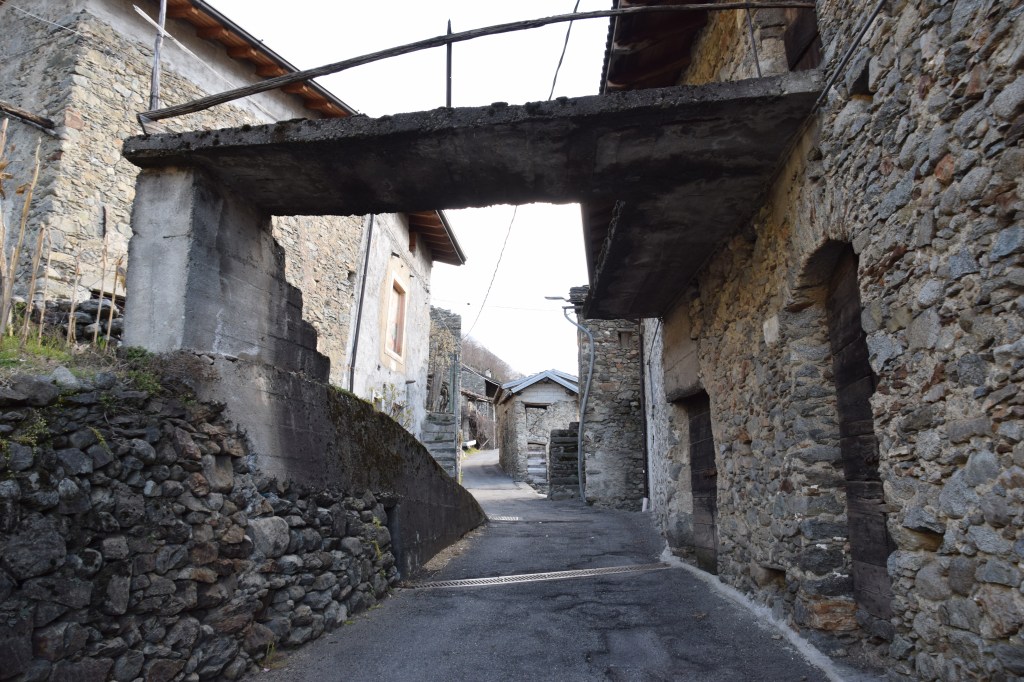
This is via Torchi looking up the hill towards Cino. The first Mantello fresco – the one with the legible date – can be seen on the left. The second fresco is located past it on the facade of what is now a barn – just before the last visible home on the left in this photo. Although clearly visible from the street, because this is not the main road to Cino the likelihood of finding these frescoes will be a function of choosing this walk or drive. And since Cino is a common destination for tourists seeking a day in the summer mountain pastures – the road to which is found in Cino – it is even less likely one would find these frescoes unless one lived here. Few would choose to drive three miles on a two-way, one-lane road when a nicely paved, two-lane road to town is available. And noticing a similarity to frescoes fond over 20 miles away in tiny mountain frazioni is even less likely – and is – I believe – a truly happy accident – and a miracle of persistence!
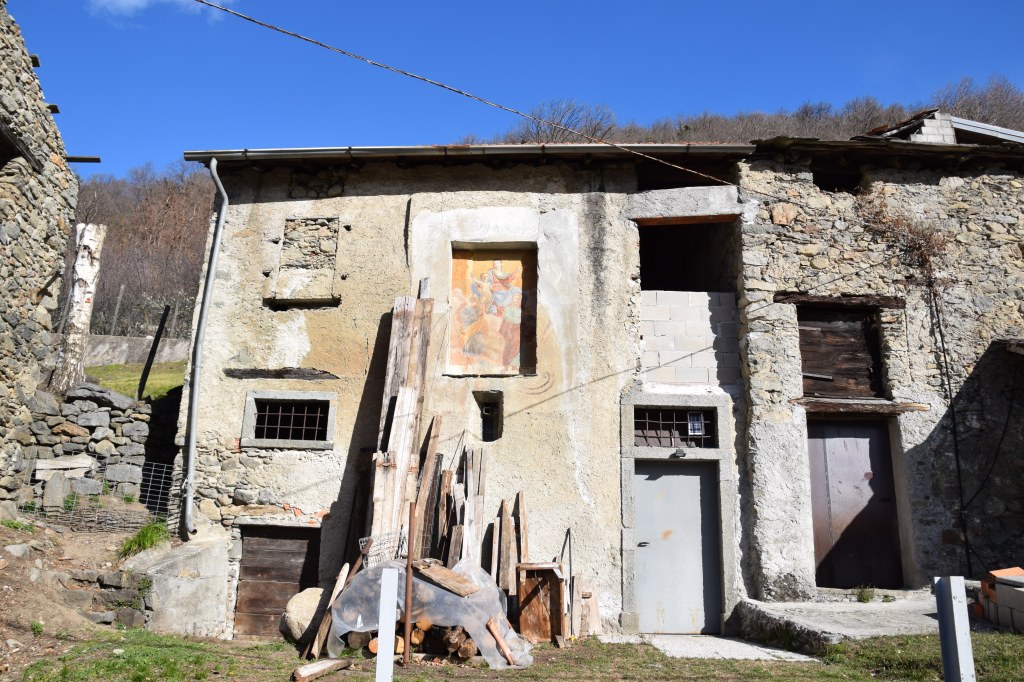
This is a full view of what were once multiple small homes and what is now used as a barn.
Without further ado, here are the montages offering comparisons of the five frescoes – two from Triangia, one from Gatti, and two from Mantello. I believe they are all painted by the same artist. What do you think?
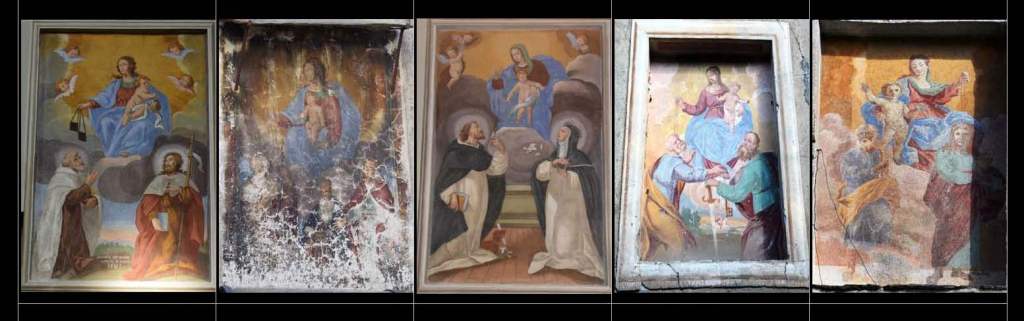
These are the five Wall Madonna’s compared full-view next to each other. From left to right, these are the towns in which they are located: TRIANGIA: Chiesa di San Bernardo; GATTI: via Gatti; TRIANGIA: Chiesa di San Bernardo; MANTELLO: via Torchi; MANTELLO: via Torchi.
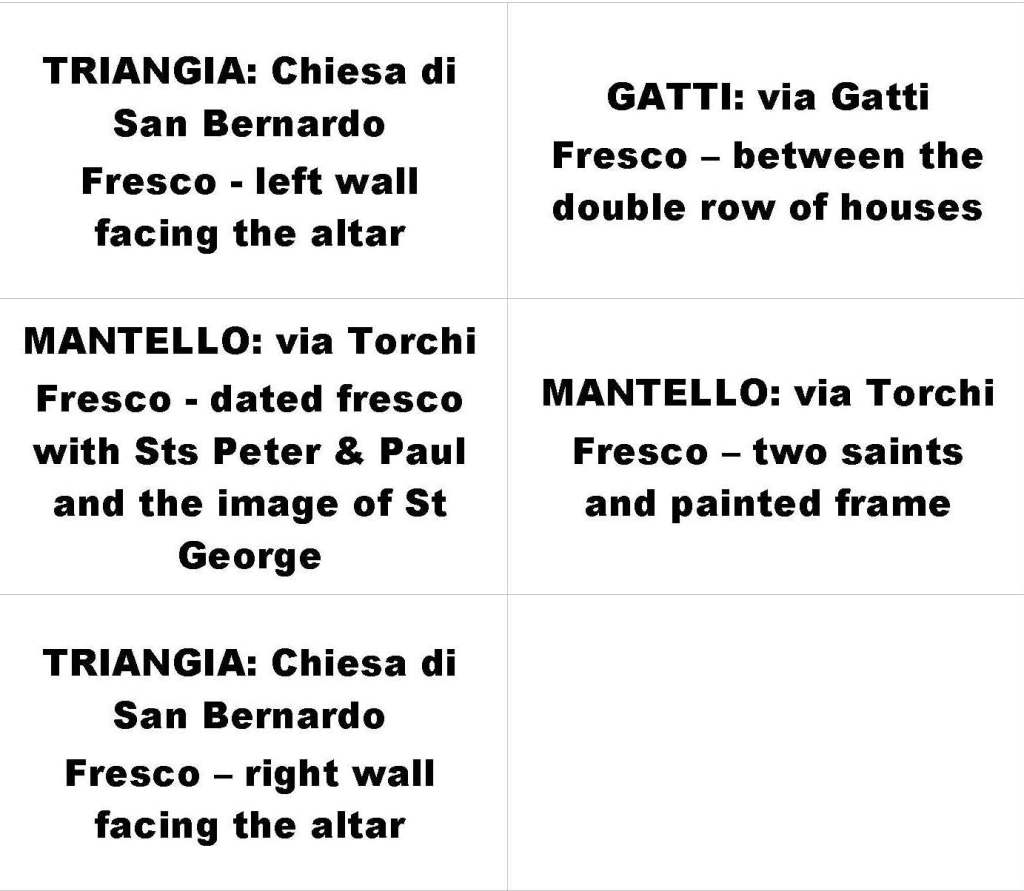
The following montage indicates the layout of the fresco images in all the montages.
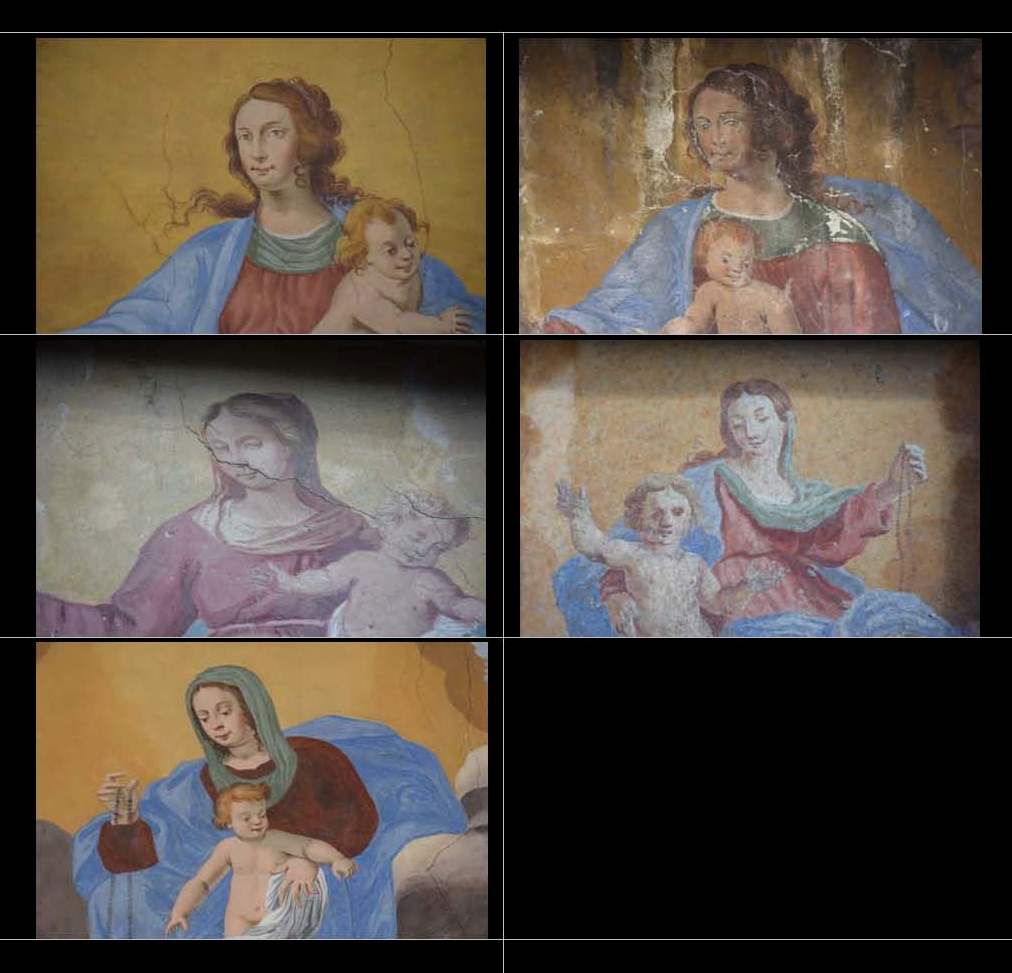
Both frescoes in Triangia depict the Madonna del Carmelo. This image of Mary called the Madonna del Carmelo – shows her holding the scapular – a part of the religious habit worn by the monks who call themselves Carmelites. This special garb is associated with a group of 12th-century hermits who went to Carmel (one of the states associated with the crusades) in order to devote themselves to prayer and serving the poor. They established their order there and chose Mary as their patron. Mary is called the Queen of Carmel who offers special support for those who wear the scapular. There are two types of scapular. One type is associated with the Benedictines from the 7th-century. This is a long piece of cloth worn over the shoulder. This scapular is the devotional type that is worn by the ordained or laypersons to signify their devotion to the Christian lifestyle. Scapular like this are smaller and worn like a necklace. They can have embroidered or embossed prayers or verses on them.
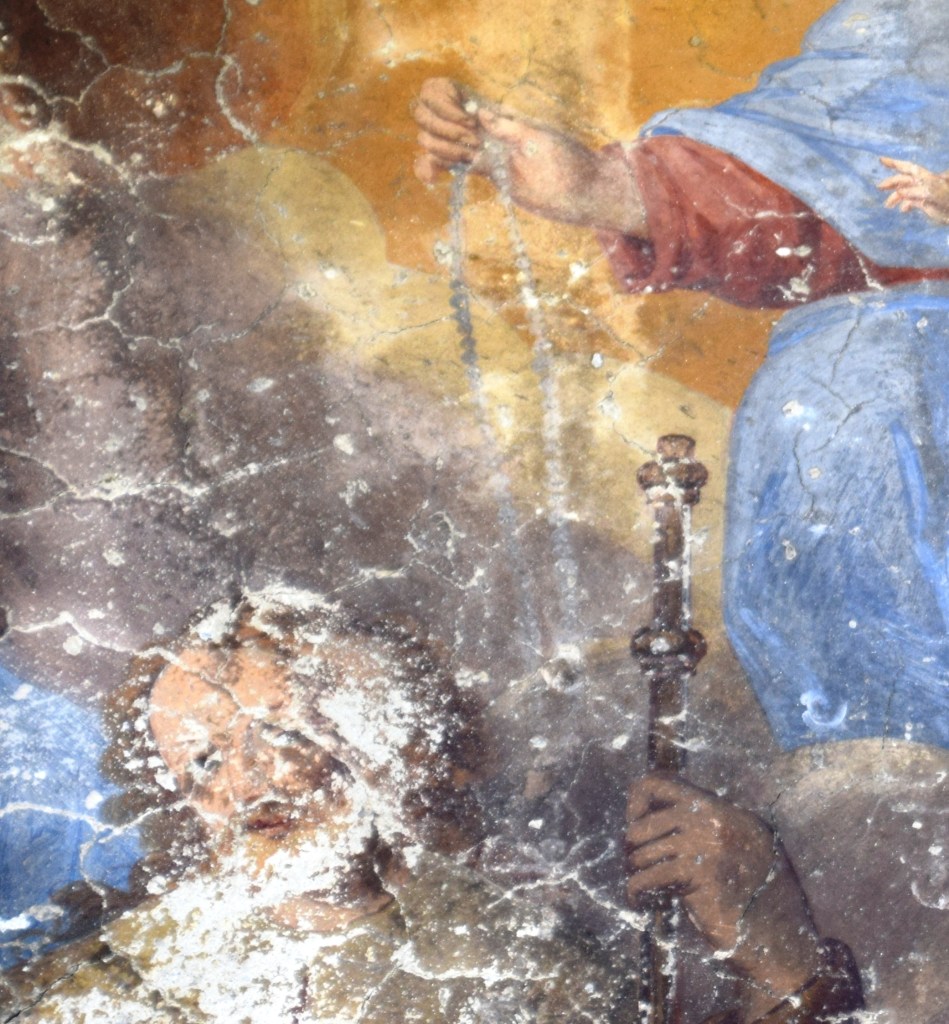
Because the fresco from Gatti is eroded, one has to assume the imagery is copied and Mary holds the scapular. There is a hint of a square image at the end of a two ‘strings’ near St Peter’s face but unless one could get close to the fresco on a ladder this cannot be confirmed. One can only say for certain that the Virgin is either holding a rosary or a scapular. For those who wish to speculate, I offer this cropped image. It is obvious that Mary is not holding a rosary – the large beads that separate the ‘decades’ or ten beads on which which says a prayer – are clearly missing in the two strands. Although what Mary holds are two strands of beads and one might want to argue this then represents a rosary, one must note that in the Triangia fresco on the right wall, the scapular in Mary’s hand is hung from a strand of beads. Rosary beads are distinctive. This is not a rosary.
In both of the frescoes in Mantello, Mary is holding a rosary. The imagery of the Madonna del Rosario is clear. This depiction of the Virgin dates to 1208 when San Domenico (1170-1221) claimed to have had vision of Mary in Proulxville, France whereupon he immediately founded a convent.

The tilt Mary’s head and her downcast gaze is similar. The imagery of the two top frescoes – Triangia and Gatti is striking as is the imagery of the other three frescoes – Triangia and the two from Mantello. But a closer examination of the mouth makes the relationship obvious.
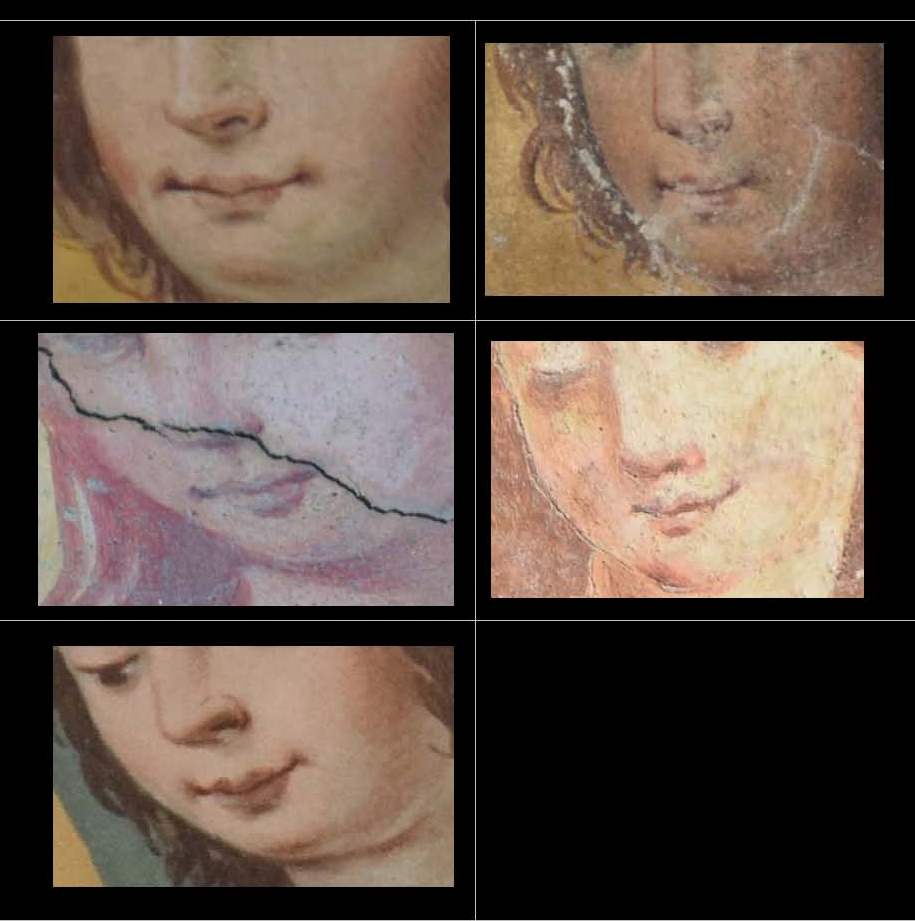
The comparison of the Mary’s mouth shows a striking resemblance between the five frescoes. The shape of the face, nose and mouth of the Mantello fresco and lower San Bernardo fresco look identical. with slightly more tilt the other Mantello fresco is identical also. I think this comparison is the most telling – the artist for all five is the same.
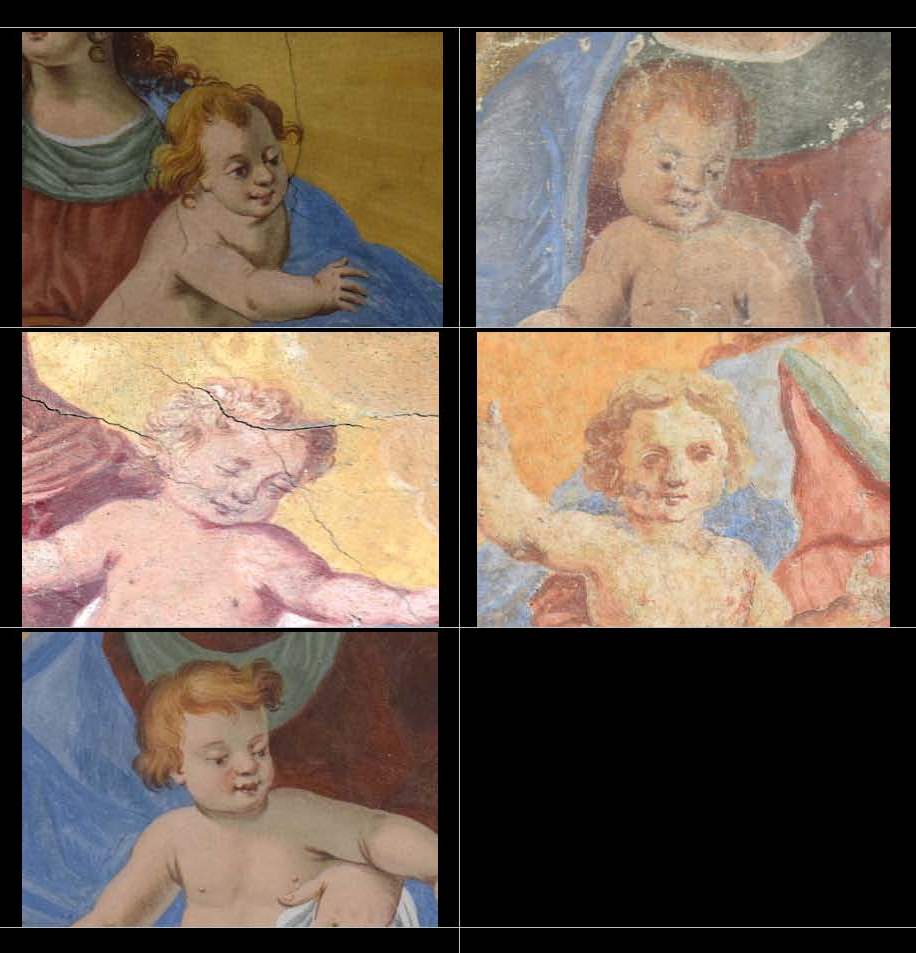
The comparison of Jesus show commonalities in the shape of the infant’s arms, the color of his hair, his hairline, and his gaze.

The mouths of all these images of Jesus are similar and they are drawn similar to the mouths of all the Mary’s. The shape of the chin and plumpness of the cheeks is the same.
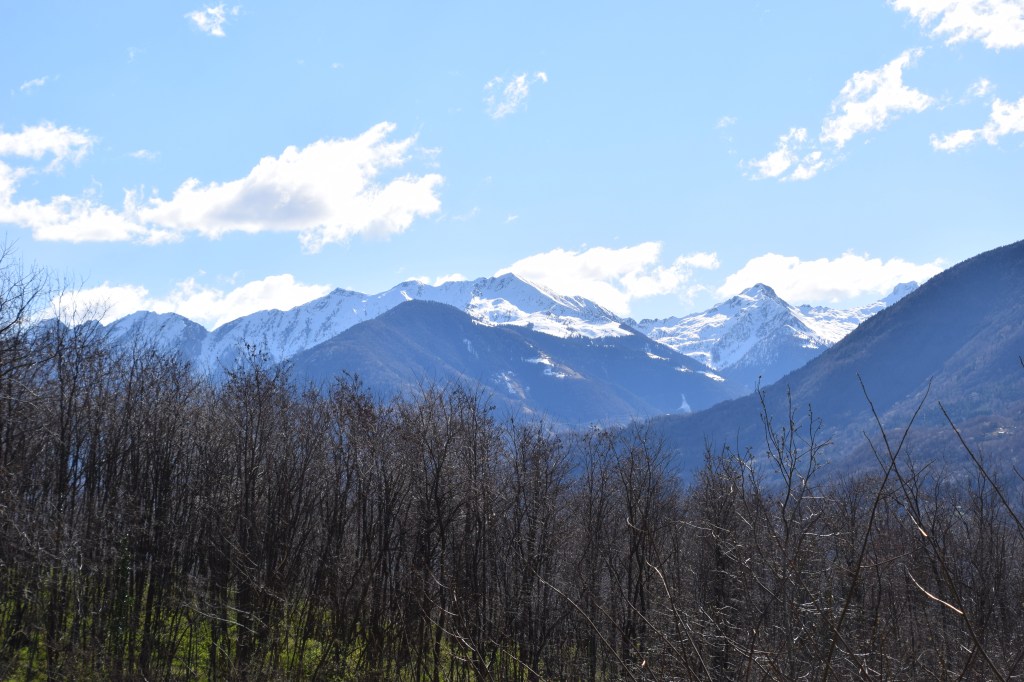
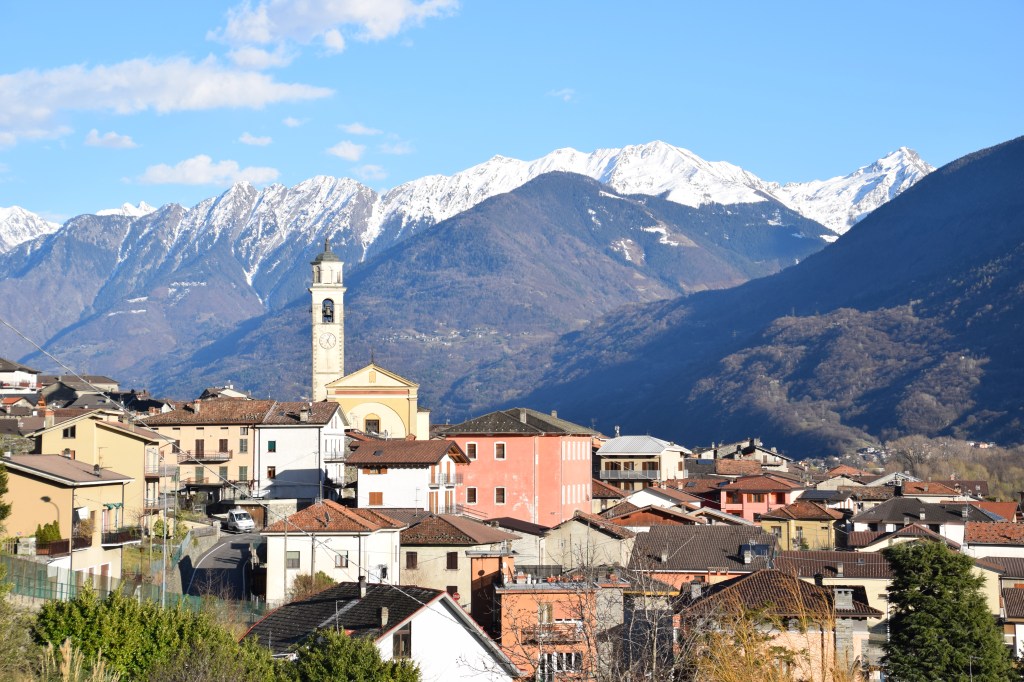
I hope you find my theory compelling and – if not – then I hope you enjoyed the discussion of these fabulous Wall Madonna’s. My search continues and in this time of the COVID-19 pandemic I am that much more grateful for the devotion of the people that left us all with an open-air museum and Pinacoteca. Because that devotion lives on in the tradition of gracing one’s home with the images of Mary and Jesus, one only need step outside in this beautiful valley to enjoy the talents of Italian artists – both living and long dead. Please come stalk Wall Madonna’s when the curtain of this virus lifts. And please enjoy these parting views of the Alps that embrace the Valtellina and crowd one’s view no matter what way one aims a gaze!
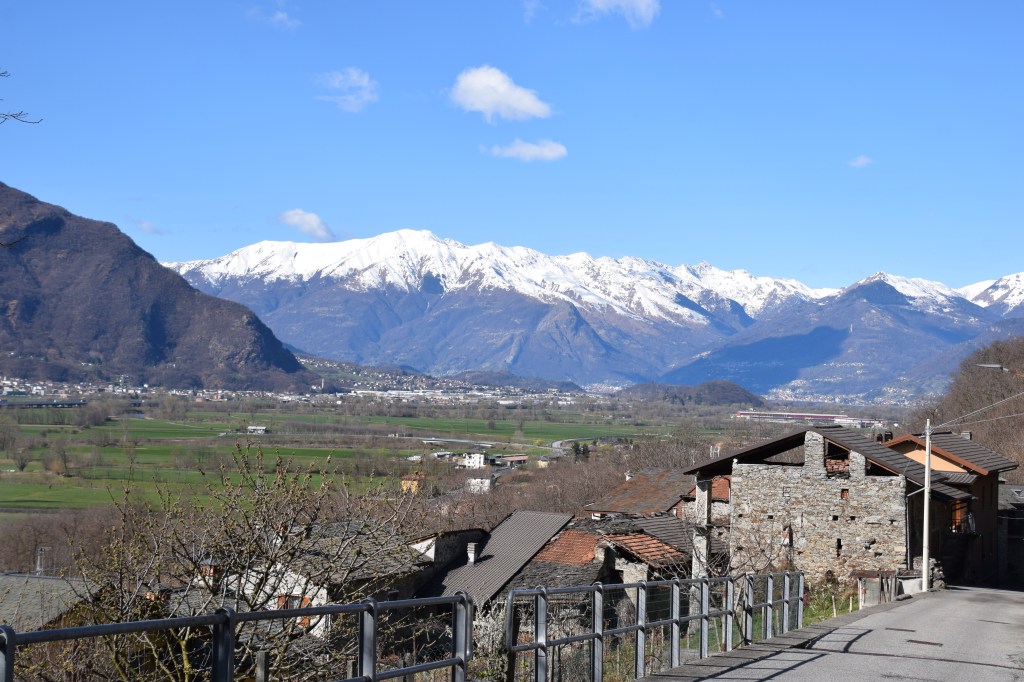
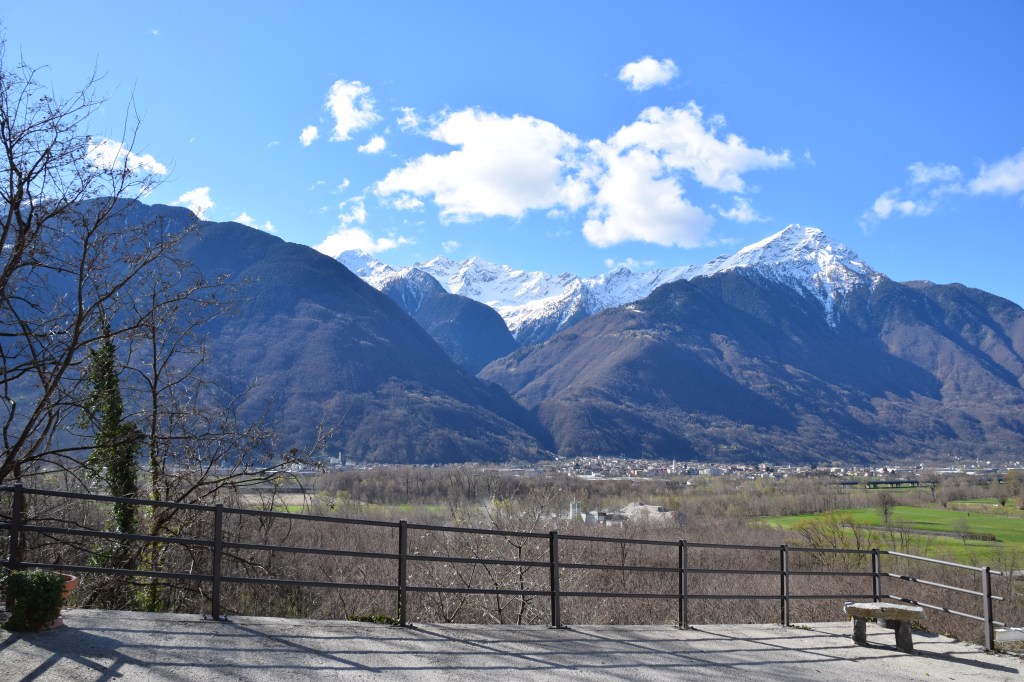
 Wall Madonna's of the Valtellina