I am avoiding work which I save for the weekend so I can stalk Wall Madonna’s during the week. Friday was a Wall Madonna boom! Here is a quick post from part of my 6-hour walk in the Frazioni of Traona. To walk the old local roads in this agricultural area where olives and vines are grown and where I hoped to find Wall Madonna’s – I parked in the courtyard of the Ex-Convento di San Francesco. This is a 17th-century church that served for a brief two years as a free school for poor children through the efforts of Father Luigi Guanella (1842-1915) – a priest much revered in the Lake Como provinces and the Valtellina.
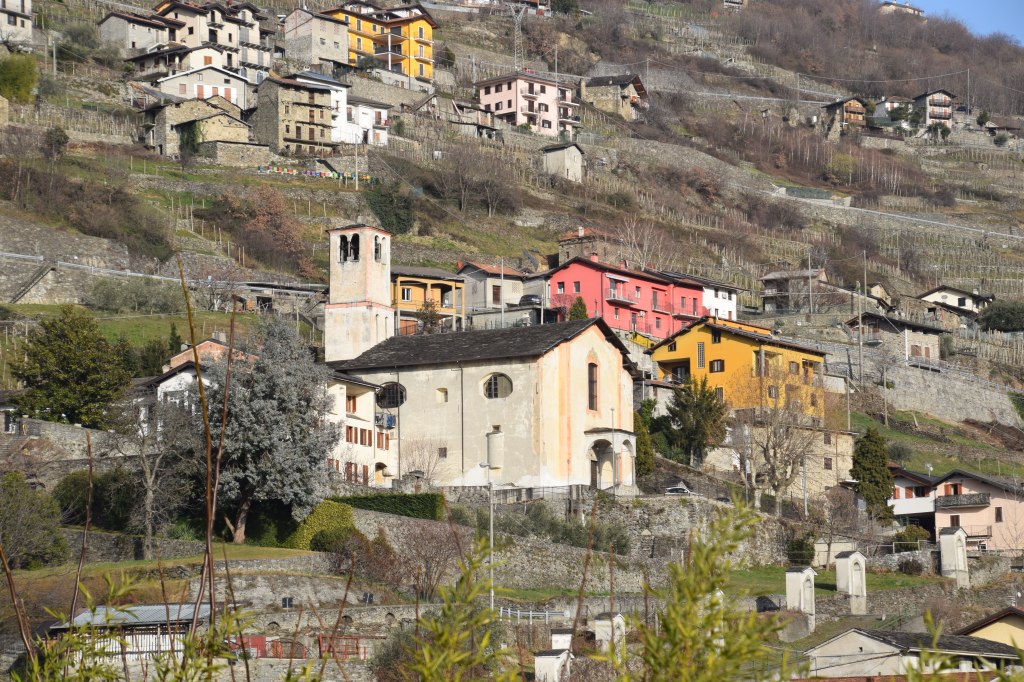
The Chiesa di San Francesco, 17th-century – ex-convent or monastery bought by Father Luig Guanella to use as a free school for poor children. It only lasted two years but is well remembered here as is Don Guanella. This is the view from the tiny frazione of Coffedo – where a woman remembered my taking photos from two years ago!
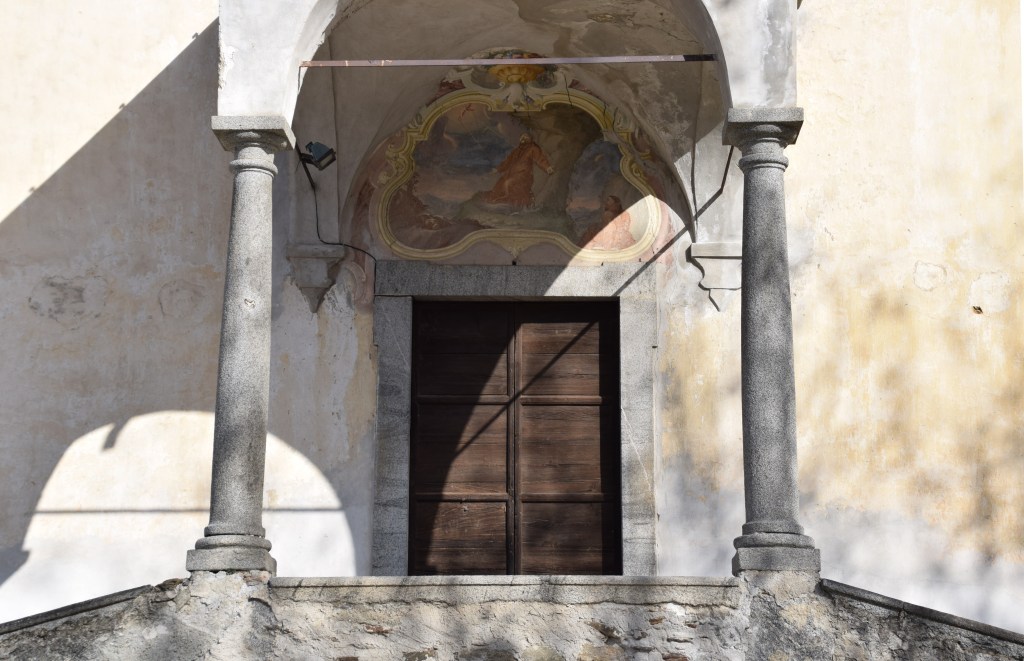
These are the entry doors with a fresco of St Francis of Assisi receiving his stigmata from the Holy Spirit in the form of a dove. The fresco shows St Francis being given the stigmata by a Seraphim on a crucifix. To the right a another Franciscan monk – likely Brother Leo who was one of two monks who accompanied St Francis to Mount Alverna to pray. To the right is an open sacred text lying on top of a skull with a crucifix off to the side. There are writings by the Minister General of the Franciscan Order, Brother Elias, who on October 3, 1226 – the day St Francis died – recorded the incident in a letter to his community. Th event occurred two years before St Francis’ death.
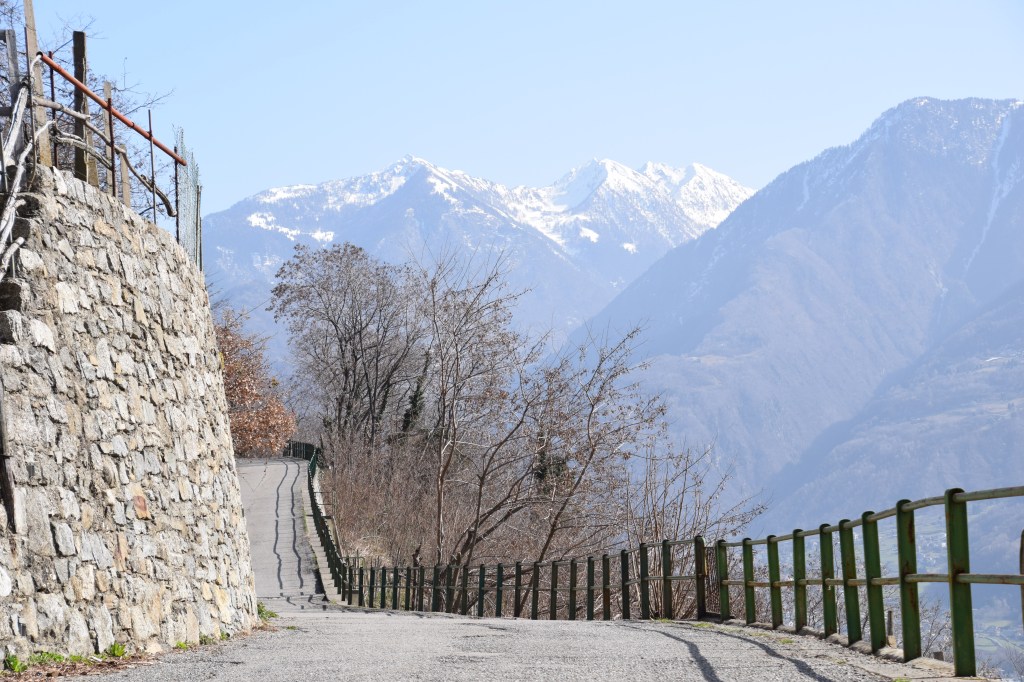
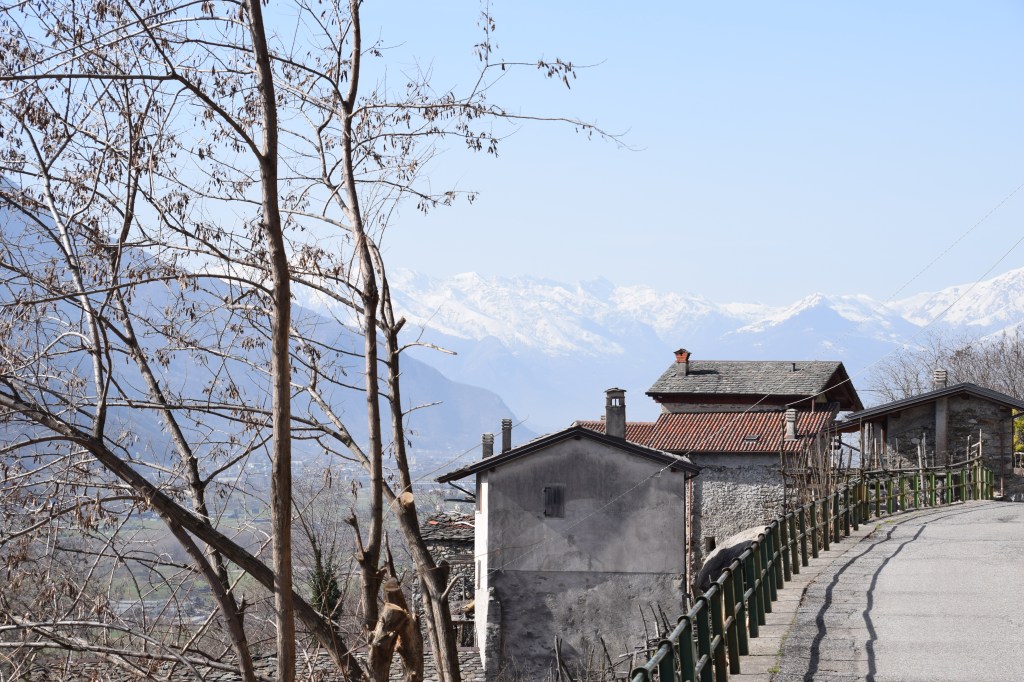
Walking via Manecia to Corlazio. The view of the Valtellina is always fantastic.
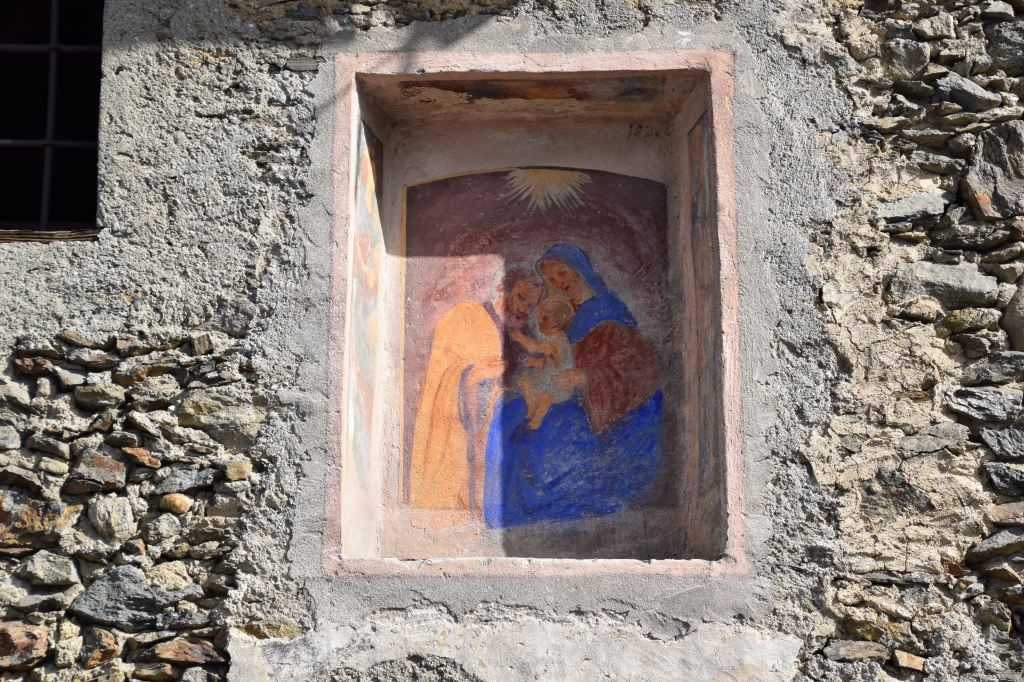
I found many Wall Madonna’s on my walk. This is a colorful Sacra Famiglia.

This area is dedicated to agriculture. The Rhaetian side of the Valtellina is warm and sunny having southern exposure. Grapes and olives grow here and all the tiny farms have their own small vineyards and olive groves. That is a vineyard on the left.
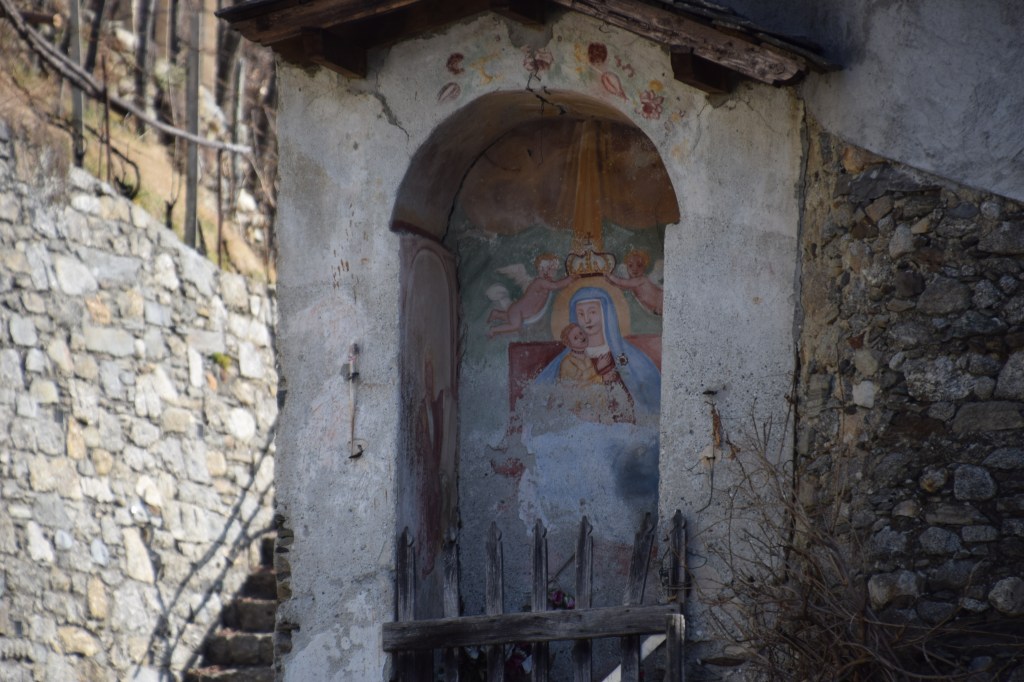
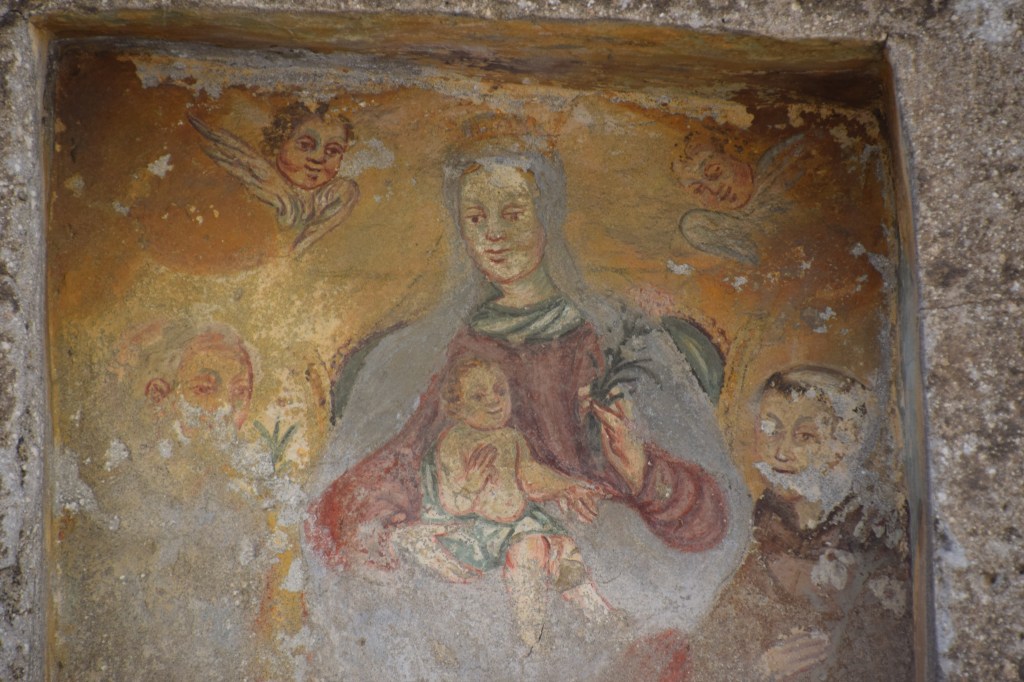
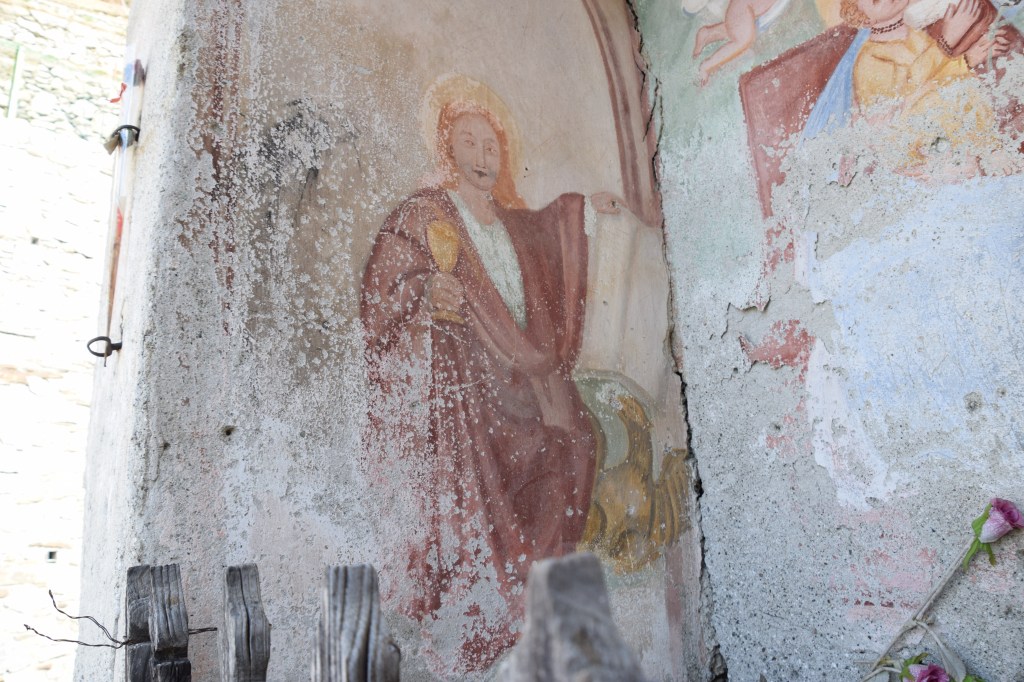
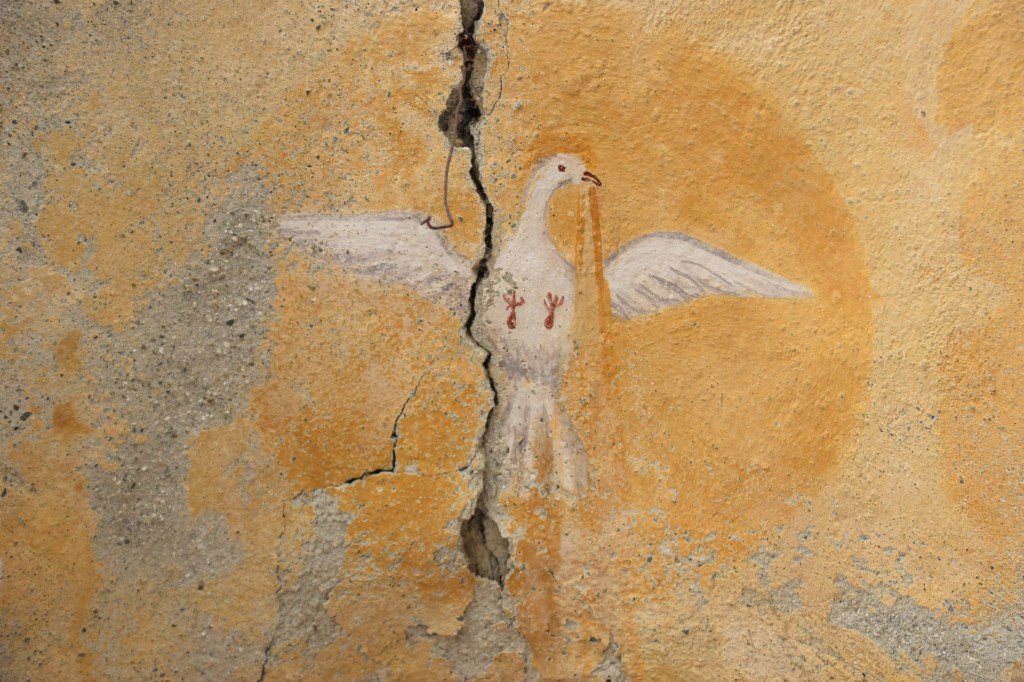
This is a privately owned Wall Madonna. It is constructed like the small shrines to the Madonna that populate all the forest path and provincial roads in the Valtellina. This fresce depicts an enthroned Madonna and Child., The Virgin is being crowned by two cherubs who – flying through the air – hold the crown over Mary’s head. To Mary’s right is the Evangelist John holding a chalice in his right hand and his gospels in his left. The Eagle – his symbol – is at his feet. The saint to Mary’s left is too eroded to identify but one can see a brown haired man with a beard. This is likely either St Mark the Evangelist or St Luke. Above Mary’s head flies the Holy Spirit in the form of a dove.
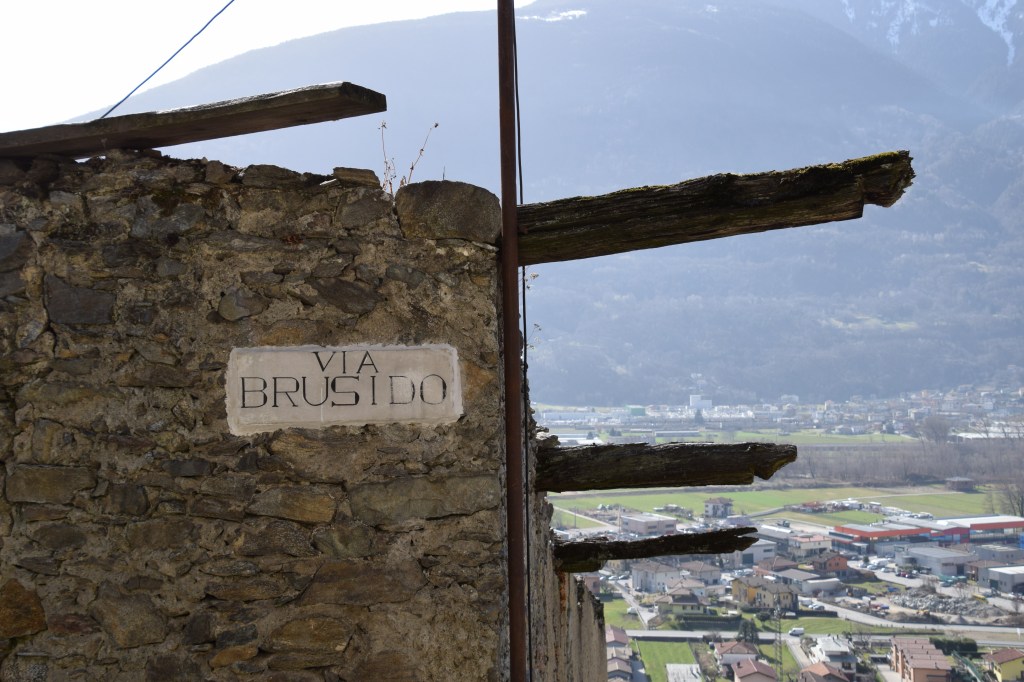
Many of the tiny frazione which consisted of just a few houses were consolidated into united comune. Along via Manesia finds quite a few. Here is one – Brusido. This tiny frazione was a very short mule path to the right. There were about four houses clinging to the mountainside.
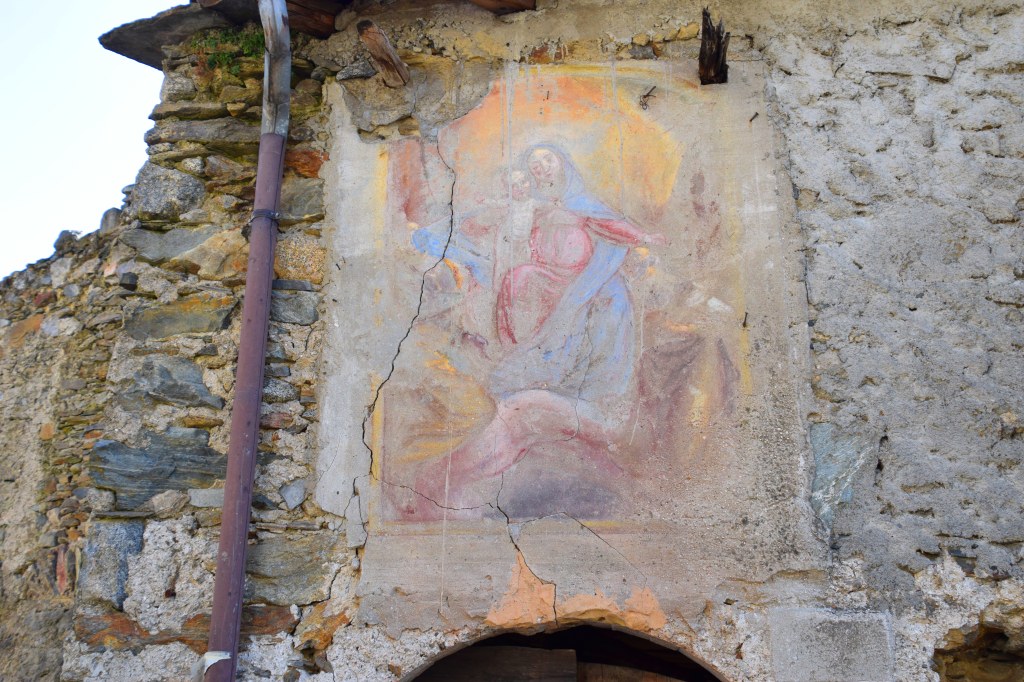
Still walking to Corlazio ones finds a very beautiful and once very colorful Wall Madonna posed in a style reminiscent of the Madonna della Miseriacordia. I colorized this photo a bit because the sun washed out the remaining colors of this once grand Madonna and Child both with their arms outstretched in a gesture reminiscent of the Madonna della Misericordia – Our Lady of Mercy – who offers the protection of the mantle. The protection of the mantle – was a gift of mercy and succor that medieval noblewomen could offer to the persecuted and those in need. This noble maternal protection could not be sundered or otherwise violated once offered.
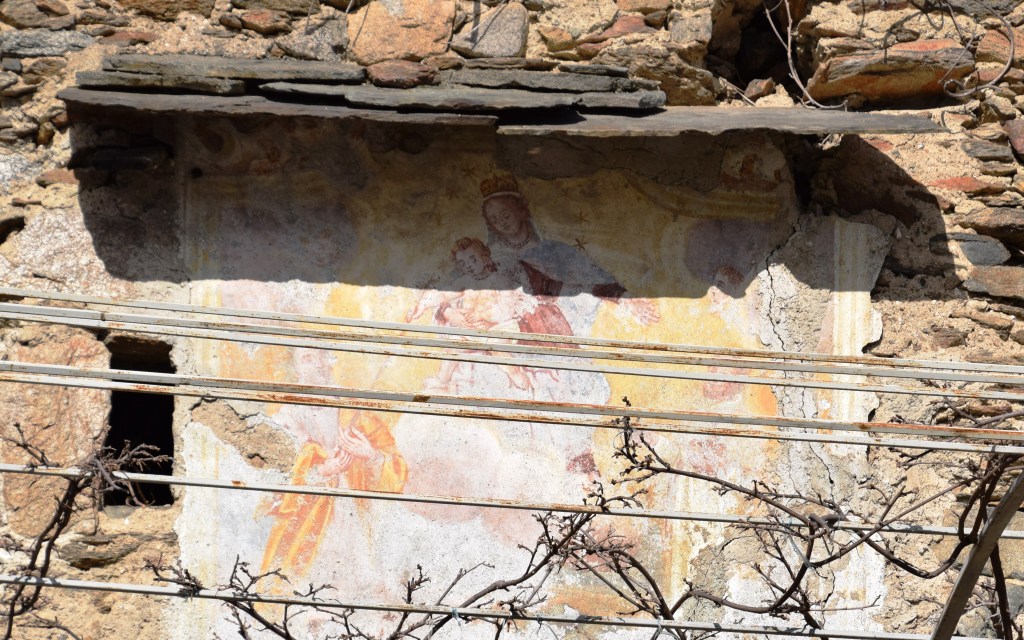
This Wall Madonna is right in the center of Corlazio. The Madonna and Child are depicted between two saints – one of whom is St Joseph – to Mary’s right. The other saint on Mary’s left is eroded and I cannot identify him. The fresco is largely blocked from view by a grapevine arbor that shelters the parking space of a private home. It is totally obscured from view in the spring and summer.
Before one reaches the center of Corlazio one must pass the beautiful frescoed 15th-centruy church the Chiesa di Santa Caterina di Corlazzo.
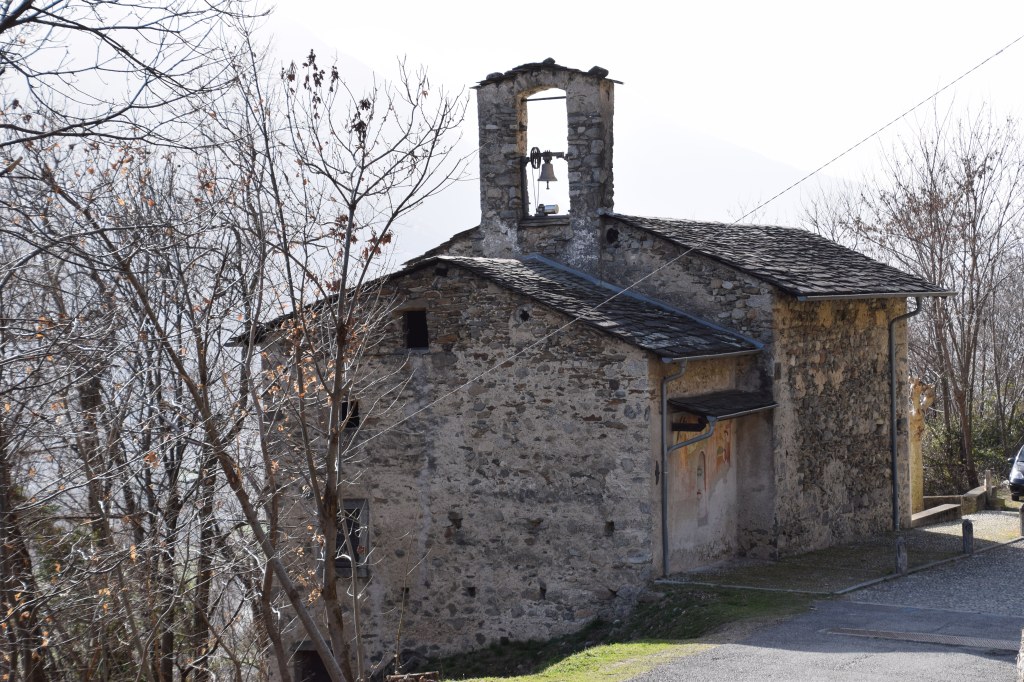
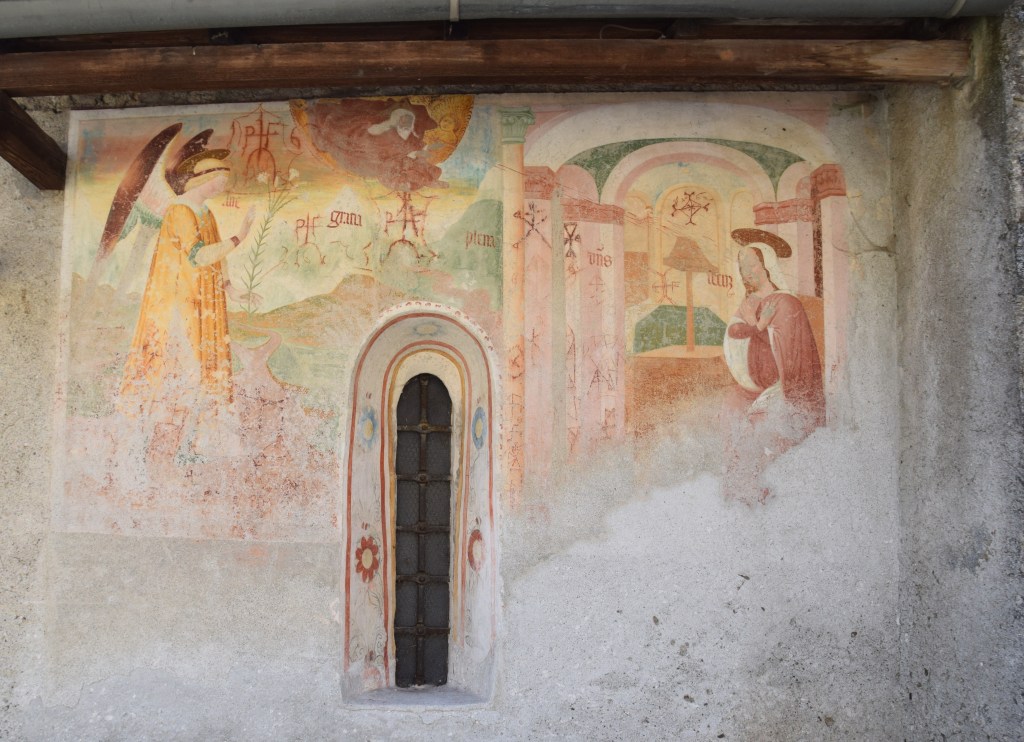
I love this small, ancient church. It has an astonishing Annunciation fresco one the outside wall and a lovely altar apse fresco inside. The Annunciation is marred by ancient graffiti.
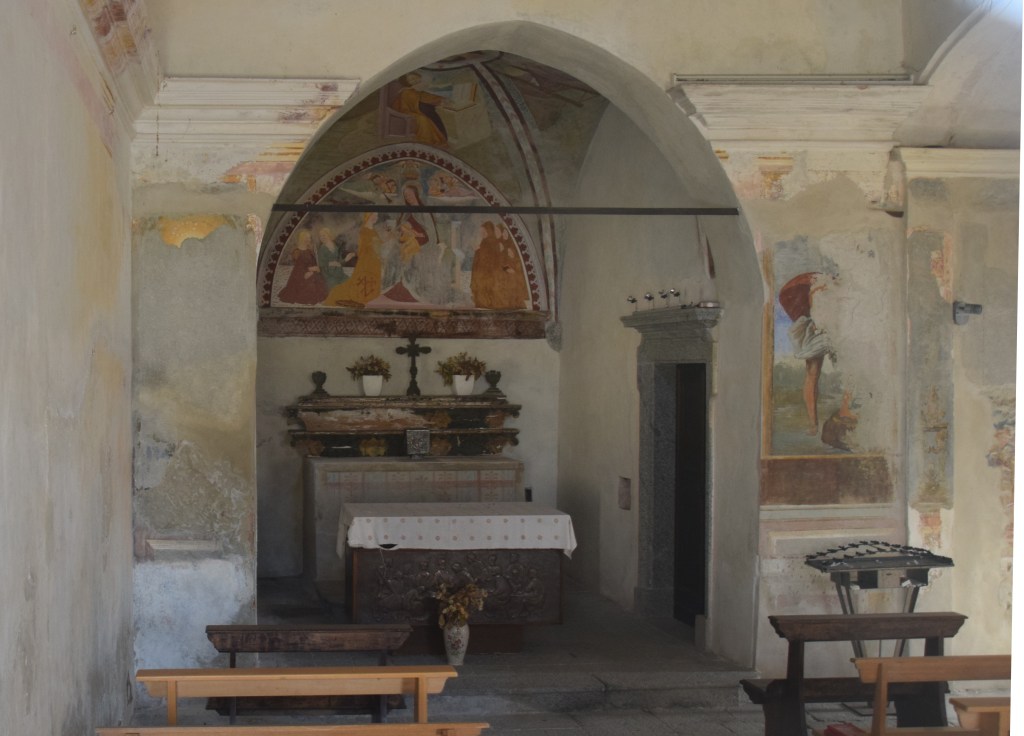
The altar apse fresco is fabulous. Because the church is closed, I had to take photos through a locked glass window. They are unfortunately not pristine. But one can clearly see the imagery.
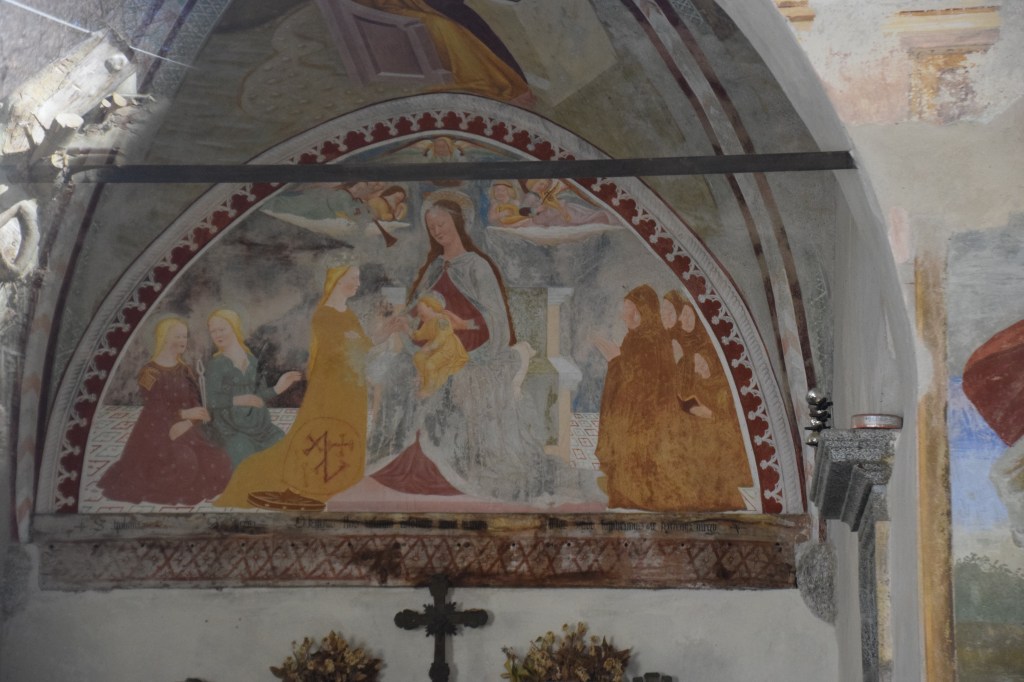
Here one sees the Madonna and Child, This is a Mystic Marriage of Saint Catherine. These Mystic Marriages can feature either Catherine of Siena or Catherine of Alexandria. The Breaking Wheel or Execution Wheel seen at St Catherine’s feet identifies her as the 3rd-century Catherine from Alexandria (287-305) – the young teen murdered for her faith and her intellect at 18 years old. To Mary;s left are Carthusian monks and two the right a two female saints. Heralding Messenger Angels fly to Mary’s right and left and above her head a Cherub holds a crown . In the apse dome is depicted a pope – identifiable by the papal tiara he wears. He is seated with an open sacred text on a table. This would likely be the pope who ruled at the time the fresco was painted. One the facing walls were frescoed two saints. The one on the right is clearly Saint Rocco. This would imply that the completely eroded saint on the left would be St Sebastian. That is my best guess for what these frescoes originally represented given the time period and the fact that I have never seen St Rocco without St Sebastian. These churches used imagery that invoked protection against the plague during this time period. Hence, it is very common to have both St Sebastian and St Rocco flanking the Madonna and Child.
This final photo comes from Valletta – the tiny frazione where the 17th-centruy Church of Santa Apollonia is located. Saint Appollonia was the child who was tortured by having her teeth pulled out. The small borgo has the well-maintained church and the ruined buildings that once housed the clerics and locals who farmed the hillside.. This doorway – with its colorful blue door – is on the second floor of a building someone began restoration on in 1982. The Christogram – IHS (Greek for ‘Jesus’ – IHΣΟΥΣ) has been placed inside what looks like a harp.

 Wall Madonna's of the Valtellina